
You've done calf raises for months. Your quads have grown, maybe your arms too, and your calves look exactly as they did when you started. Search for answers and you'll meet two camps: one says calves are pure genetics, and the other says to do a hundred raises a day.
Neither answer helps much. The first tells you not to bother, and the second turns an exercise you already find dull into a daily chore. It's easy to quietly drop calf work altogether.
The research tells a more useful story. Calves are hard to grow for specific reasons you can work around: what your genes hand you, how your calves already work all day, and how most people train them. This article goes through each one, then the trials on stretch, knee angle, volume, load and frequency, and finishes with a progression you can run at home with a step and a dumbbell. For the exercises themselves and two ready-made workouts, see our guide to calf exercises at home.
Are Calves 100% Genetics?
No. Genes have a large say in calf size, but not the only one. In 215 pairs of older female twins, Mikkola and colleagues (2009) estimated that 75 percent of the differences in lower-leg muscle area were genetic. In 418 members of large families on Tobago, Prior and colleagues (2007) put the heritability of calf muscle area at just 23 percent after adjusting for age, sex and height. The figure depends on the group studied, and neither study found calves that were close to 100 percent inherited.
Heritability describes differences between people, not a ceiling on your own calves. Your build decides where you start and how your calves are shaped, such as how high on the shin the muscle ends and the Achilles tendon begins. Training decides how much muscle you add from there. In the trials below, calves grew when people trained them hard with the knee straight, from untrained young women to lifters with years of training behind them.
Are Calves the Hardest Muscle to Grow?
They feel like it, but in the trials they grew about 6 to 15 percent in 6 to 12 weeks when people trained them hard through the stretch with the knee straight. Three things make calves seem more stubborn than they are.
Your calves work all day, but the tendon does the stretching
Calves carry you through every step, so it seems they should already be well trained. The way they work during walking is the catch. Fukunaga and colleagues (2001) filmed the calf with ultrasound while 6 men walked at 3 km/h. The muscle fibres of the gastrocnemius stayed at nearly the same length through each step, about 5 cm, while the Achilles tendon stretched about 7 mm and sprang back to push off. The tendon acts as the spring and the muscle holds steady. That makes walking efficient, and it helps explain why thousands of daily steps don't add calf muscle: the fibres work at a low effort and barely change length.
Half the calf is a slow-twitch endurance muscle
The soleus, the flat muscle under the gastrocnemius, makes up about 52 percent of the volume of the main calf muscles, according to an MRI study of 13 men by Albracht and colleagues (2008). In an autopsy study of 32 people, Edgerton and colleagues (1975) found the soleus was about 70 percent slow-twitch fibres, against about 50 percent in the gastrocnemius and 32 percent in the vastus lateralis of the thigh. Slow-twitch fibres resist fatigue, which suits a muscle that holds you upright all day. It also means easy sets of 20 or 30 bodyweight raises can feel like work without getting close to the effort that builds muscle.
Most calf raises skip the part of the rep that builds muscle
The typical calf raise is done quickly on a flat floor, bouncing out of the bottom. The bounce hands the work to the Achilles tendon, just as walking does, and the flat floor stops your heel before the calf reaches a full stretch. The trials below suggest that the stretch is exactly where calf growth happens.
Knowing what to do is the easy part.
FitCraft, our mobile fitness app, pairs you with an AI coach who builds you a personalized plan around your goals, schedule, and fitness level. Every FitCraft program is designed by Domenic Angelino, MPH (Brown University) and NSCA-CSCS, with research published in the Journal of Strength and Conditioning Research and Medicine & Science in Sports & Exercise.
Take the Free Assessment Free • 2 minutes • No credit cardHow to Grow Calves: What the Training Trials Show
Five lines of research tell you how to train calves for size: where in the rep you work, the angle of your knee, how many sets you do, how heavy you go and how often you train.
Spend your reps in the stretch
Calves grow best when you load them at long muscle lengths, with your heel low and the calf stretched. In a 2023 trial by Kassiano and colleagues, 42 young women who trained only the bottom half of the calf raise grew the inner gastrocnemius more than women who used the full range or the top half, and our reviews of stretch-mediated hypertrophy and lengthened partials walk through the numbers. A 2025 trial by Larsen and colleagues then tested the idea in 23 resistance-trained people. Bottom-half partials, and full reps followed by partials past failure, both grew the inner calf, with a small and uncertain edge of about 0.4 mm for the bottom-half leg.
Keep your knee straight
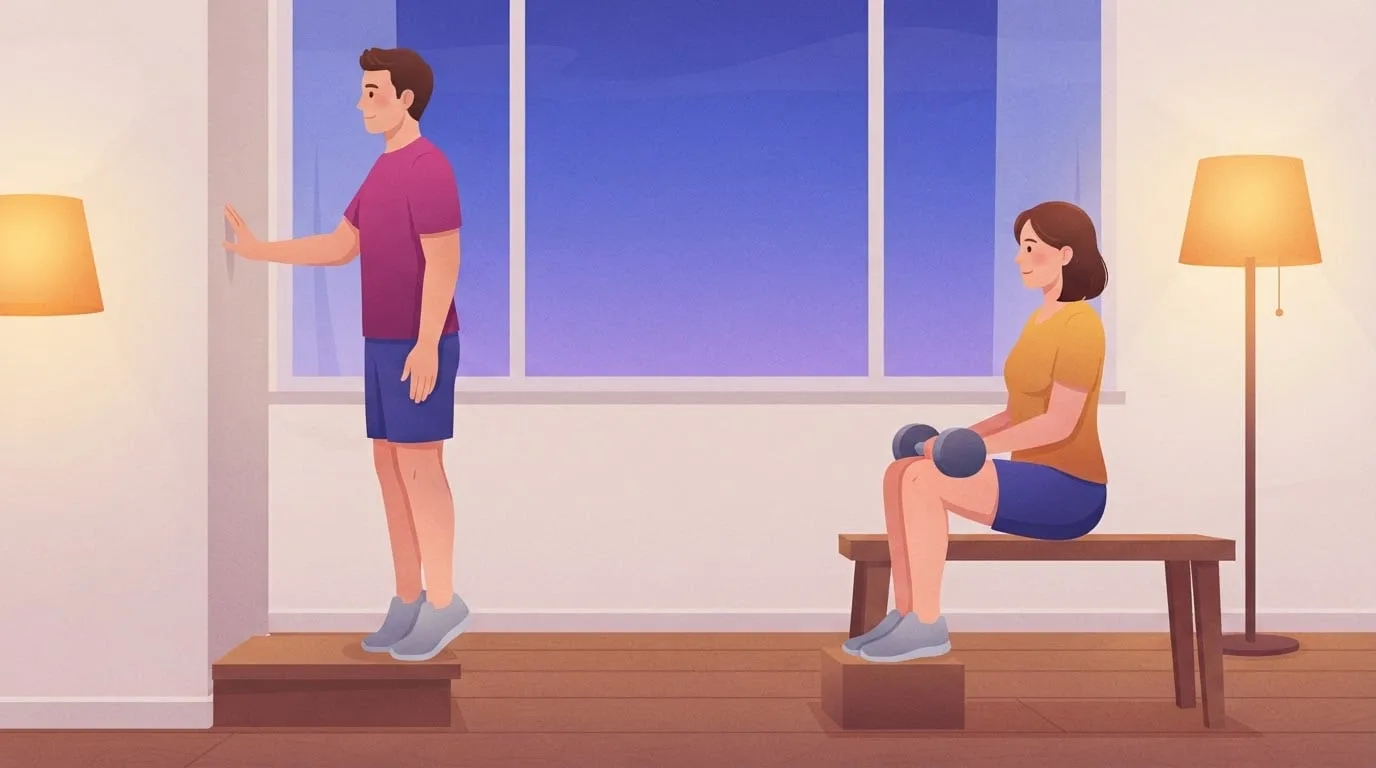
Knee angle is the same idea in another form. The gastrocnemius crosses the knee, so it's longest when your knee is straight. In Kinoshita and colleagues' 2023 trial, standing calf raises grew both heads of the gastrocnemius by 9 to 12 percent over 12 weeks, while seated raises, with the muscle slack, grew them by less than 2 percent. The authors credited training the muscle at a longer length. The soleus, which doesn't cross the knee, grew about as much with seated raises as with standing ones. Our guide to calf exercises at home shows where each raise fits in a workout.
Do more sets than you think
Volume matters for calves too. Kassiano and colleagues (2024) split 61 untrained young women into groups doing 6, 9 or 12 sets of calf raises a week, over three sessions a week for six weeks. Every group grew. Twelve weekly sets added 12.0 percent to calf muscle thickness, against 6.9 percent for six sets, and nine sets didn't differ clearly from either. That matches the wider research in our review of how many sets per muscle group per week: up to a point, more hard sets build more muscle.
Is it better to go heavy or light on calf raises?
Both work, within limits. The calf trials grew muscle with heavy sets of 10 reps at 70 percent of a one-rep max (Kinoshita) and with lighter sets of 15 to 20 reps taken to failure (Kassiano). What matters more is how close each set gets to failure. A 2024 series of meta-regressions by Robinson and colleagues found that muscle growth increased as sets were stopped closer to failure.
Very light loads are the exception. In a 12-week trial in 30 men, Lasevicius and colleagues (2018) found that training at 20 percent of a one-rep max grew the thigh and arm muscles about half as much as training at 40 to 80 percent, even with the total work matched. A practical rule follows: once you can do more than about 30 two-leg raises, make the exercise harder by moving to one leg or holding a dumbbell, rather than adding more reps.
How often should you train your calves?
Two or three times a week works well, and the total number of hard sets matters more than the number of sessions. In a meta-analysis of 25 studies, Schoenfeld, Grgic and Krieger (2019) found no meaningful difference in growth between training a muscle more or less often when the weekly sets were equal. The calf trials above trained two or three times a week. Splitting 12 weekly sets into three sessions of 4 keeps each one short and the last sets hard.
How to target the inner calf
Point your toes slightly out. In Nunes and colleagues' 2020 trial, 22 young men trained each leg with a different foot position for 9 weeks. Toes pointed out grew the inner (medial) gastrocnemius 8.4 percent against 3.8 percent with toes pointed in, and toes pointed in grew the outer (lateral) head 9.1 percent against 5.5 percent. Toes pointed forward landed in between for both heads. The differences are a few percent, so use foot angle to even out a lagging side once the stretch, the sets and the effort are in place.
How to Progress Calf Training at Home
At home, your body weight and a dumbbell or two do the job of a calf machine. That's enough, because there are more ways to make a calf raise harder than adding weight. Climb this ladder one rung at a time, and move up when you reach the top of your rep range on every set:
- Two legs on the floor, 15 to 25 reps, to learn the movement.
- Two legs on a step, with your heels dropping below the edge into the stretch.
- One leg on a step, which roughly doubles the load on each calf.
- One leg on a step holding a dumbbell, then a heavier one, aiming for 8 to 15 reps.
- Slower reps, with a three-second lowering and a two-second pause in the stretch, once your heaviest dumbbell gets easy.
- Bottom-half partials after failure: when you can't do another full rep, keep going with reps in the stretched bottom half until those stop too.
- More sets, building from about 6 to 12 a week across two or three sessions.
Let your Achilles tendon keep up. Tendons adapt to training too, and a meta-analysis by Bohm, Mersmann and Arampatzis (2015) found that tendon stiffness rose more with heavier loading, with programs of 12 weeks or longer trending toward bigger changes. Add load or a new rung gradually, and treat pain at the back of your heel or ankle as a reason to drop back a rung.
If you'd rather not plan every rung yourself, a dumbbell workout app can lay out the progression for you. FitCraft builds programs from dumbbell and bodyweight exercises, your AI coach demonstrates each one on an interactive 3D model, and the workouts adjust as you progress. Streaks and collectible cards give you a reason to come back for the short sessions your calves need two or three times a week.
How Fast Can Calves Grow?
Not in a week or two. The shortest of these trials ran for six weeks, and by then the 12-set group's calf muscles were about 12 percent thicker, while 8 to 12 weeks of hard training produced gains of roughly 6 to 15 percent. That's real muscle, but early changes are small enough that you'll probably notice stairs and hills feeling easier before you see a difference in the mirror.
Skinny legs can be a different question from small calves. If you're thin all over, gaining muscle anywhere is easier when you eat enough to support it, and our guide on how many calories to build muscle covers how much extra food that takes. The calf training stays the same.
Will 100 Calf Raises a Day Do Anything?
Yes, but mostly for endurance, not size. A hundred easy two-leg raises spread through the day keep every set far from failure, and the Robinson meta-regressions found that growth shrinks as sets end further from failure. Your calves will get better at doing easy raises. To grow them, swap the hundred easy reps for three or four hard sets of single-leg raises on a step, two or three times a week. That takes less time and gives the muscle a real reason to grow.
What This Means for You
Your calves aren't the one muscle that ignores training. They've simply been trained the way they work all day: quick, bouncy and easy. Change three things, a deep stretch on every rep, sets that end close to failure and enough of those sets each week, and they respond like the rest of you.
Picture the next three months. Two or three short sessions a week on the bottom stair, a dumbbell that keeps getting heavier, and single-leg sets that used to stall at 10 reps now reaching 15. Stairs and hills feel easier first. Keep the sessions going and the mirror catches up.
Frequently Asked Questions
How many sets and reps should I do for calf raises?
Work up to about 10 to 12 hard sets of calf raises a week, split across two or three sessions, with 8 to 20 reps per set taken close to failure. In a 2024 trial, 12 weekly sets grew the calves more than 6 sets did. Use the lower end of the rep range when you hold a dumbbell and the higher end for bodyweight raises.
How do you perform half calf raises?
Stand on a step with your heels hanging off, lower your heels into the deepest stretch you can control, then rise only about halfway, until your heels are roughly level with the step, and lower again. These bottom-half reps are called lengthened partials, and they grew the calves at least as well as full reps in two trials. You can also finish a set of full reps with a few of them.
How to build calf muscle as a woman?
The same way as anyone: standing calf raises through a deep stretch, taken close to failure, building to about 10 to 12 hard sets a week. The two trials that showed the value of the stretch and of more sets both trained young women, whose calf muscles grew by up to about 15 percent in six to eight weeks.
How to get bigger calves for skinny legs?
Train your calves with standing raises on a step, close to failure, two or three times a week, and progress to single-leg and dumbbell raises. If you're thin all over, eating enough to gain a little weight, with plenty of protein, supports muscle growth everywhere, calves included.
Can you get bigger calves in a month?
You can start to, but the change will be small. In the trials, calf muscle thickness rose about 7 to 12 percent after six weeks of hard training, and most people notice stairs and hills feeling easier before they see a difference. Give it two to three months of steady sessions.