Calves are the muscles home workouts forget. Squats and lunges barely load them, so they get a few quick sets of calf raises on a flat floor at the end of a session, if they get anything at all. Months later they look the same, and it's easy to decide you were simply born with small calves.
That conclusion stings, because it feels like effort that went nowhere. You did the reps. Your calves still don't fill out your jeans, and the exercise starts to feel pointless enough to skip.
The problem is usually the design of the exercise, not your genetics. The typical calf raise skips the deep stretch at the bottom, bounces out of it on the spring of the Achilles tendon, and ends long before the muscle is tired. This guide fixes all three. You get 10 calf exercises at home, what each one trains, and two workouts that need only a stair, a wall and a pair of dumbbells. For the research on why calves seem stubborn and how to keep them growing for months, read our article on how to get bigger calves.
The 10 Best Calf Exercises at Home
Your calf has two main muscles. The gastrocnemius, the diamond-shaped muscle you can see, crosses both the knee and the ankle, so it works hardest with your knee straight. The soleus lies underneath it and crosses only the ankle. Exercises 1 to 4 are straight-knee calf raises, 5 and 6 bend the knee, and 7 to 10 cover holds, the front of the shin and the bounce in your calves.
| # | Exercise | Equipment | What it trains | Sets x reps |
|---|---|---|---|---|
| 1 | Standing calf raise | Floor, wall | Both calf muscles, the learning version | 2-3 x 15-25 |
| 2 | Calf raise on a step | Stair or sturdy step | Both calf muscles through the deep stretch | 3 x 12-20 |
| 3 | Single-leg calf raise | Step, wall | One calf at a time with your full body weight | 3 x 8-15 per leg |
| 4 | Dumbbell calf raise | One or two dumbbells, step | Both calf muscles with added load | 3 x 8-15 |
| 5 | Bent-knee calf raise | Wall | Extra soleus work | 2-3 x 15-20 |
| 6 | Seated calf raise | Chair, book, dumbbell or backpack | The soleus, with the gastrocnemius slack | 2-3 x 15-20 |
| 7 | Isometric calf hold | Step, optional dumbbell | Strength and tendon load without movement | 2-3 x 20-45 sec |
| 8 | Tibialis raise | Wall | The front of the shin | 2 x 15-25 |
| 9 | Calf hops | Floor | Calf endurance and rhythm | 2-3 x 20-40 hops |
| 10 | Pogo hops | Floor | Springy, reactive calves | 3 x 10-15 hops |
1. Standing calf raise
Stand tall with your feet hip-width apart and your fingertips on a wall. Rise onto the balls of your feet as high as you can, hold the top for a second, and lower over about three seconds until your heels touch the floor. Keep your body straight and your weight over the big-toe side of each foot. This is where everyone should learn the movement, and our calf raise page covers the setup and the common mistakes. Its limit is the floor. Your heels stop at floor level, so the rep never reaches the stretch, and once 25 reps feel easy it's time for the step.
2. Calf raise on a step
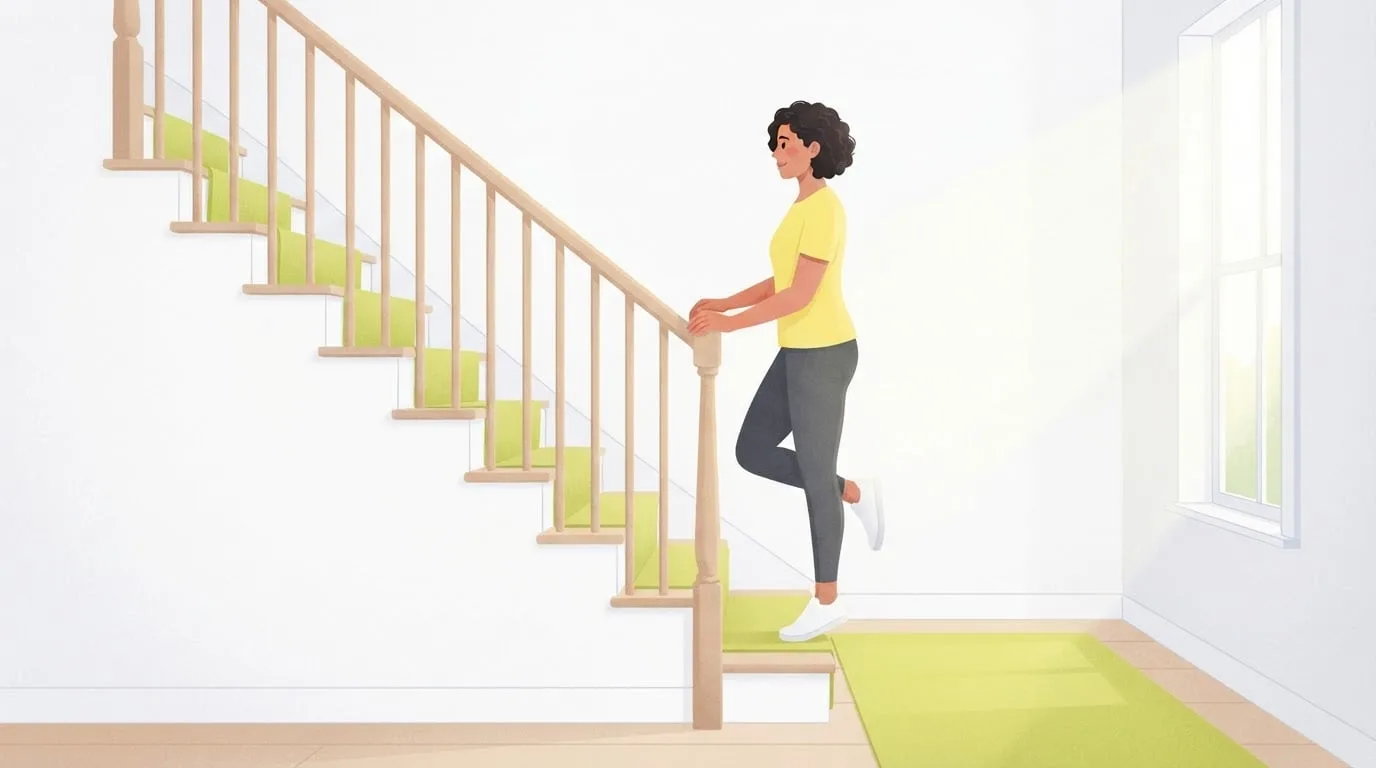
Stand with the balls of both feet on the edge of a stair and your heels hanging off, one hand on the rail. Lower your heels below the step until your calves feel a strong stretch, hold for a second, then rise as high as you can. Build your calf training around this version. In a 2023 trial by Kassiano and colleagues, training only the stretched bottom half of the calf raise grew the inner calf more than the full range or the top half did, and our leg day workout walks through that study. A sturdy step, a thick book or a low stair all work. A wobbly box doesn't.
3. Single-leg calf raise
Stand on one foot on the step with the other foot hooked behind your ankle, and use the wall or rail for balance only. Lower into the stretch and rise as high as you can. Your whole body weight now sits on one calf, roughly double the load of a two-leg raise, with no equipment at all. It also shows you whether one side is weaker. Start each set with your weaker leg and match its reps on the other side. When 15 clean reps per leg feel easy, pick up a dumbbell.
4. Dumbbell calf raise
For single-leg raises, hold a dumbbell in the hand on the same side as your working leg and put your free hand on the wall. For two-leg raises, hold one in each hand and stand near a wall in case you need it. The dumbbell is how calf raises keep getting harder after your body weight stops being enough. Pick a weight that leaves you one or two clean reps short of failure at 8 to 15 reps, and go heavier once you reach 15 on every set. No dumbbells? A backpack loaded with books does the same job on two-leg raises.
5. Bent-knee calf raise
Face a wall with your hands on it and bend your knees to about 30 to 45 degrees, the top of a shallow squat. Keep that knee angle fixed while you raise and lower your heels, on two legs or one. Bending the knee shortens the gastrocnemius, so the soleus has to do more of the work. The shift is smaller than its reputation, though. Hébert-Losier and colleagues (2012) recorded 48 adults and found that a 45-degree bend changed calf muscle activity by only about 4 to 5 percent. Treat it as extra soleus work on top of straight-knee raises, not a replacement for them.
6. Seated calf raise
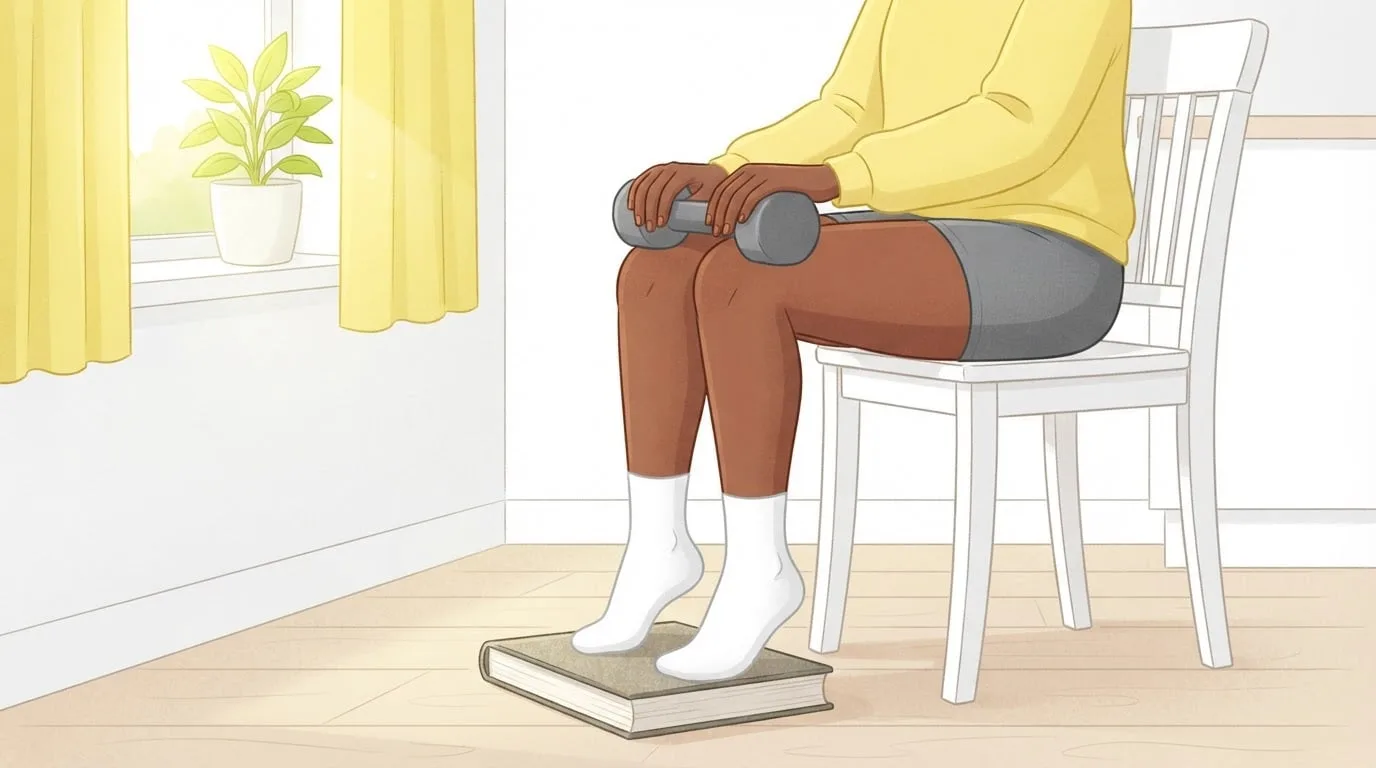
Sit on a chair with the balls of your feet on a thick book or a step and your knees bent to 90 degrees. Rest a dumbbell or a loaded backpack across your thighs just above your knees, then raise and lower your heels through their full range. At this knee angle the gastrocnemius is slack, which makes this the soleus exercise. Don't make it your main one, for reasons the knee-angle trial below makes clear. It earns its place when standing raises bother your feet, when your balance is shaky, or when you want soleus work at the end of a session. A slow, unweighted version called the soleus pushup is studied for blood sugar rather than muscle size.
7. Isometric calf hold
An isometric hold means you hold a position instead of moving through it. Two versions are worth doing. For muscle, stand on a step on both feet and hold your heels just below the edge, in the stretch, for 20 to 30 seconds. For strength and the Achilles tendon, rise halfway on one leg and hold for 30 to 45 seconds, adding a dumbbell once that's easy. A systematic review by Oranchuk and colleagues (2019) found that holds at long muscle lengths built more muscle than holds at short lengths. It also concluded that tendons need hard holds, at 70 percent of maximal effort or more, before they adapt.
8. Tibialis raise
Stand with your back and hips against a wall and your heels about a foot out in front of you. Keep your legs straight and lift your toes and the front of your feet toward your shins as high as they go, then lower them slowly. The tibialis raise trains the tibialis anterior on the front of your shin, the muscle that lifts your toes and lowers your foot gently after each heel strike when you walk or run. It works the opposite side of the ankle from your calves, so pairing the two trains the whole lower leg. Walking your heels further from the wall makes it harder.
9. Calf hops
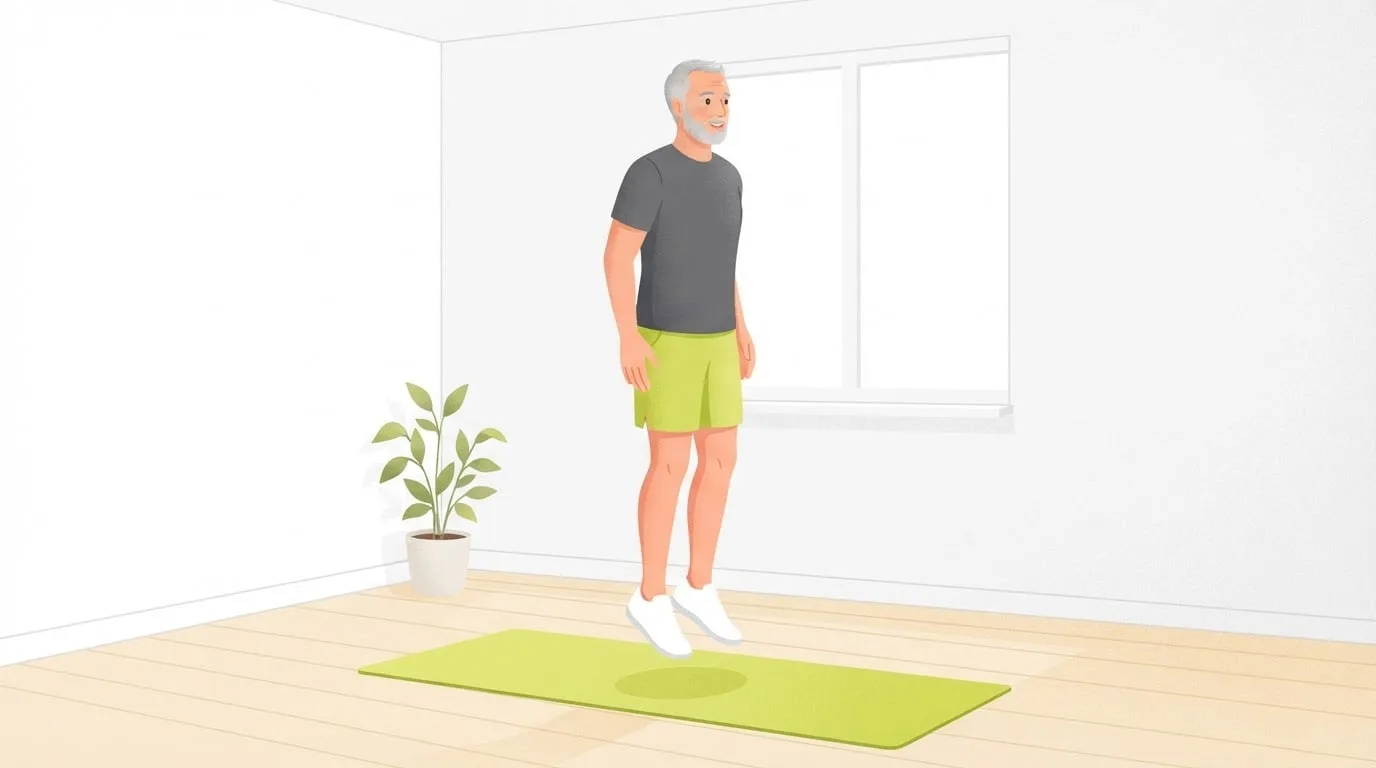
Calf hops are small, quick hops on the balls of both feet, an inch or two off the floor, with soft knees and quiet landings. They build calf endurance and rhythm, get your heart rate up and make a good warm-up before raises. Our calf hops page covers the technique and the pace, plus easier versions if your landings are loud. Do them at the start of a session, while your calves are fresh.
10. Pogo hops
Pogo hops are the springier version. Keep your knees almost straight, bounce off the balls of your feet and spend as little time on the floor as you can, as if the floor were hot. The hops go a few inches high and the sets stay short, about 10 to 15 contacts, so every bounce stays crisp.
Raises and hops do different jobs. In a 12-week study by Kubo and colleagues (2007), 10 people trained one leg with hopping and drop jumps and the other with heavy calf-raise training. The hopping leg jumped higher in all three jump tests and got stiffer at the ankle during jumps. The heavy leg got a stiffer Achilles tendon and improved in only one jump test. If you run or play a sport, do both.
Find out what's really holding you back
FitCraft, our mobile fitness app, pairs you with an AI coach who builds you a personalized plan around your goals, schedule, and fitness level. Every FitCraft program is designed by Domenic Angelino, MPH (Brown University) and NSCA-CSCS, with research published in the Journal of Strength and Conditioning Research and Medicine & Science in Sports & Exercise.
Take the Free Assessment Free • 2 minutes • No credit cardCalf Muscles: Why Knee Angle Matters
The calf muscles are the gastrocnemius and the soleus, and together they're called the triceps surae. They join into the Achilles tendon, which attaches to your heel, and they point your foot and lift your heel off the floor. The gastrocnemius starts above the back of the knee, so straightening your knee stretches it and bending your knee lets it go slack. The soleus starts below the knee, which means it works in every calf raise you'll ever do, standing or seated.
That's why straight-knee raises come first in this guide. Kinoshita and colleagues (2023) had 14 untrained adults train one leg with standing calf raises and the other with seated raises, twice a week for 12 weeks, and measured the muscles with MRI. Standing raises grew the medial gastrocnemius 9.2 percent and the lateral gastrocnemius 12.4 percent. Seated raises grew them by 0.6 and 1.7 percent. The soleus grew about the same in both legs, 2.1 percent standing and 2.9 percent seated.
So a standing raise trains the whole calf, while a seated raise trains mostly the soleus. Bent-knee and seated raises still help, as extra soleus work and as options for sore feet, but they're the side dish.
Calf Workout at Home: Two Routines
Each workout takes 15 to 20 minutes. Pick one and do it two or three times a week on days that aren't back to back, either on its own or at the end of a leg session. Every raise follows the same three rules: lower over about three seconds, pause for one second in the stretch, and rise as high as you can without bouncing. End a set when your heels can no longer rise as high as they did on the first rep.
Workout 1: calf workout at home with no equipment (about 15 minutes)
| Order | Exercise | Sets x reps | Rest |
|---|---|---|---|
| 1 | Calf hops | 2 x 20-30 hops | 30 sec |
| 2 | Calf raise on a step | 3 x 15-25 | 45 sec |
| 3 | Single-leg calf raise on a step | 2 x 8-15 per leg | Alternate legs, 30 sec |
| 4 | Bent-knee calf raise | 2 x 15-20 | 30 sec |
| 5 | Isometric hold in the stretch, both feet on the step | 2 x 20-30 sec | 30 sec |
| 6 | Tibialis raise | 2 x 15-25 | 30 sec |
Calf exercises at home for beginners
If you're new to training, start Workout 1 with standing calf raises on the floor instead of the step for the first week or two. Do 2 sets of each exercise and leave out the single-leg raises and the hops. Move to the step when 25 floor raises feel easy, and add the single-leg raises when 25 raises on the step do.
Workout 2: dumbbell calf workout at home (about 20 minutes)
| Order | Exercise | Sets x reps | Rest |
|---|---|---|---|
| 1 | Pogo hops | 3 x 10-15 hops | 60 sec |
| 2 | Single-leg dumbbell calf raise on a step | 3 x 8-15 per leg | 60 sec |
| 3 | Seated dumbbell calf raise | 3 x 12-20 | 60 sec |
| 4 | Single-leg isometric hold, halfway up, holding a dumbbell | 2 x 30-45 sec per leg | 45 sec |
| 5 | Tibialis raise | 2 x 15-25 | 30 sec |
How to progress both workouts
Use double progression. Choose a rep range, and when you reach the top of it on every set with clean reps, make the exercise harder: floor to step, two legs to one, bodyweight to a dumbbell, then a heavier dumbbell. Change one thing at a time. When your calves recover easily between sessions, add a set to the raises. Our article on how to get bigger calves explains how many weekly sets to work up to and why the stretch matters so much.
If you'd rather have the sets, weights and progressions planned for you, a dumbbell workout app can do that part. FitCraft's strength workouts use dumbbells and bodyweight, and your AI coach demonstrates each exercise on an interactive 3D model you can rotate and zoom. Workouts adjust as you progress, and streaks and calendar tracking help the small exercises, the ones easiest to skip, keep showing up in your week.
What Are the Signs of Weak Calves?
The clearest sign is a low score on the single-leg heel raise test. Standing on one leg, you count how many full heel raises you can do before you can't rise as high as you did at the start. In 566 adults aged 20 to 81, Hébert-Losier and colleagues (2017) found a median of 24 raises for men and 21 for women, done on a gentle 10-degree slope. Our guide on how to strengthen ankles shows how to run the test at home. A score far below those medians, or a gap of more than a few reps between your legs, means your calves are worth training.
Everyday signs point the same way. Your calves are the first thing to tire on hills, stairs or long walks, one heel won't rise as high as the other, or one calf looks or feels smaller.
Pain isn't one of these signs. Throbbing pain, swelling, or red or darkened skin in one calf can mean a deep vein thrombosis, a blood clot in the leg, according to the NHS. That needs urgent medical help, and emergency help if you're also short of breath or have chest pain.
The Bottom Line
Calf exercises at home work when the reps go deep. Build your training on standing calf raises on a step, progress them to one leg and then to a dumbbell, and add bent-knee raises, holds, tibialis raises and hops for the jobs raises don't cover. Two or three short sessions a week, with a slow lowering and a pause in the stretch, is enough to see your calves change.
Your calves aren't broken. They just need reps in the range that builds them, done often enough to add up.
Frequently Asked Questions
What is the number one calf exercise?
The single-leg calf raise on a step is the best single calf exercise you can do at home. It keeps your knee straight so both calf muscles work, it takes your heel below the step into the stretch where calves grew most in trials, and it loads one calf with your full body weight. Hold a dumbbell once 15 reps on each leg feel easy.
What is a good calf workout at home?
A good calf workout at home takes about 15 minutes: 2 sets of calf hops, 3 sets of calf raises on a step, 2 sets of single-leg raises on each leg, 2 sets of bent-knee raises, a 20 to 30 second hold in the stretch and 2 sets of tibialis raises. Do it two or three times a week and lower every rep slowly.
Can I do calf raises every day?
Yes, easy calf raises every day are fine for most people, because your calves already work through every walk. For growth, the number of hard sets you do in a week matters more than how many days you spread them across, so two or three hard sessions a week is enough. Take a day off if your calves are still sore or your Achilles tendon hurts.
How do I stretch my calves?
Stand facing a wall with one foot back, heel down and knee straight, and lean forward until you feel a stretch high in the calf, then hold for about 30 seconds. Bend the back knee a little to move the stretch lower, into the soleus. A review of 5 trials found that calf stretching adds only about 2 to 3 degrees of ankle range, so it complements strength work rather than replacing it.
What is the root cause of tight calves?
Most tight calves come from load they aren't used to, such as a jump in running, hills, hopping or a new calf workout, which leaves them sore and stiff for a few days. Build that load up gradually, and regular calf raises help your calves handle more of it. Throbbing pain, swelling or red or darkened skin in one calf is different and needs urgent medical help, because it can be a blood clot.
How to tone up calves at home?
Toning your calves means building a bit more muscle and, for more definition, carrying a little less body fat. Calf raises on a step, single-leg raises and dumbbell raises build the muscle. You can't burn fat from your calves alone, so the definition comes from your overall eating and activity.