Granola has one of the best reputations in the cereal aisle. It's made from oats, it's full of nuts and seeds, and the bags are covered in mountains and wheat fields. It's also one of the most calorie-dense foods you can pour into a bowl, which is why it keeps turning up on lists of foods that seem healthy but aren't. If you've ever switched to granola to eat better and watched nothing change, you're not imagining it.
So is granola good for you? Mostly yes, with one big condition: the amount. The same ingredients that make it nutritious, oats, nuts, seeds, a little oil and something sweet, are what pack close to 500 calories into every 100 grams. This page covers what a serving of granola gives you, why it's so dense, how much sugar it carries and how much is too much at breakfast, what the few granola trials found, and how to pick the healthiest granola from a label.
Granola Nutrition Facts: What a Serving Gives You
Granola recipes vary a lot, so it helps to look at two reference entries from USDA FoodData Central: a typical granola of the kind sold in stores, and a homemade-style granola that's heavier on nuts and oil.
| Nutrient | Typical granola, ½ cup (55 g) | Typical granola, 1 cup (110 g) | Homemade-style granola, 1 cup (122 g) |
|---|---|---|---|
| Calories | 231 | 462 | 597 |
| Carbohydrate | 37 g | 74 g | 66 g |
| Fiber | 4.1 g | 8.1 g | 10.9 g |
| Total sugars | 12.2 g | 24.4 g | 24.2 g |
| Protein | 5.4 g | 10.8 g | 16.7 g |
| Fat | 7.2 g | 14.3 g | 29.7 g |
| Saturated fat | 0.7 g | 1.5 g | 4.8 g |
| Sodium | 89 mg | 177 mg | 32 mg |
| Iron | 1.7 mg | 3.4 mg | 4.8 mg |
Values from USDA FoodData Central entries 2708461 (cereal, granola) and 171646 (granola, homemade), scaled to the weights shown and rounded.
Three things stand out. The fiber is real: half a cup of typical granola has about 4 grams, roughly 15 percent of the 28-gram daily value. The protein is modest: even the nut-heavy recipe has about 17 grams per cup, and the typical one about 11. And the sugar is about 24 grams per cup in both. Plain oats carry almost no sugar, so nearly all of it comes from the sweetener in the coating and from dried fruit.
Granola is a carbohydrate food first. In the typical version about two thirds of the calories come from carbohydrate, a little over a quarter from fat and less than a tenth from protein. The homemade-style recipe splits its calories almost evenly between carbohydrate and fat. Either way, it isn't a protein food, whatever the front of the bag says.
Why Is Granola So High in Calories?
Granola starts as rolled oats, a fairly modest food. What turns oats into granola is a coating of oil and sweetener (honey, maple syrup, sugar or brown rice syrup), plus nuts, seeds and often dried fruit, baked until the mix clumps into crunchy clusters. Each of those additions is energy dense, and baking drives off water, so the finished product lands at about 420 to 490 calories per 100 grams.
Weight per cup is the other half of the story. US labeling rules sort ready-to-eat cereals by how much a cup weighs: puffed cereals under 20 grams, most flakes and rings between 20 and 43 grams, and dense cereals of 43 grams or more, the group granola falls into (21 CFR 101.12). A cup of granola weighs 110 to 122 grams. Fill the same bowl you'd fill with flakes and you've served several times the calories.
That matters because of how people eat. In a review of energy density research, Rolls (2009) found that people tend to eat a fairly consistent weight of food at a meal, so when the food is denser, they take in more calories without feeling any fuller. A bowl of granola looks like an ordinary breakfast and delivers what amounts to a full lunch. Oatmeal is the opposite case, because cooked oats are mostly water, which is why oatmeal tends to work better for weight loss than the same oats baked into clusters.
How Much Sugar Is in Granola?
Half a cup of USDA's typical granola has about 12 grams of sugar, and a full cup about 24. Labels vary widely around that, from granolas with a few grams of added sugar per serving to cluster, chocolate and honey-glazed versions with several times as much. That spread is why the label is worth more than anything on the front of the bag.
Granola sweeteners often sound healthier than table sugar. Your body treats them the same way. The Dietary Guidelines list honey, molasses, agave syrup, rice syrup, cane sugar, fruit juice concentrate and anything ending in "-ose" as added sugars, and maple syrup and coconut sugar count too. A granola sweetened with honey and brown rice syrup isn't lower in sugar than one sweetened with sugar; it just reads that way.
On a US Nutrition Facts label, look for the line that says "Includes" a number of grams of added sugars, under Total Sugars. Sugar from unsweetened dried fruit counts in the total but not in the added line. Many dried fruits in granola are sweetened, though, with dried cranberries the most common example, and their sugar does count as added.
How Much Added Sugar Is Too Much at Breakfast?
Granola and boxed cereal share the same problem at breakfast, so here are the limits worth knowing. They all point the same way.
- No more than 10 grams per meal. The 2025-2030 Dietary Guidelines for Americans say no amount of added sugar is recommended as part of a healthy diet, and that one meal should contain no more than 10 grams. For children up to age 10 they recommend none at all.
- About 25 to 36 grams a day. The American Heart Association's scientific statement (Johnson and colleagues, 2009) sets a ceiling of 100 calories of added sugar a day for most women and 150 for most men, roughly 6 and 9 teaspoons.
- Children under 25 grams a day. A later AHA statement on children (Vos and colleagues, 2017) recommends no more than 25 grams a day for ages 2 to 18 and none before age 2. The panel judged the evidence strong that added sugar raises children's cardiovascular risk through extra calories, extra body fat and worse blood lipids.
- 5 grams per serving to be called "healthy." Under the FDA's updated "healthy" claim rules, a grain product needs at least three quarters of an ounce of whole grain per serving and no more than 5 grams of added sugar, 230 mg of sodium and 1 gram of saturated fat.
Now put a bowl of granola against those numbers. Half a cup of typical granola carries about 12 grams of sugar, most of it from sweeteners, which can fill the 10-gram meal limit before you've added anything. A full cup roughly doubles it. A sweetened vanilla yogurt underneath or a drizzle of honey on top pushes the bowl further over. A granola that meets the FDA's 5-gram limit, eaten in a half-cup portion, leaves room in the meal budget, and fresh fruit adds sweetness without any added sugar at all.
What the Research Says About Granola and Cholesterol
Granola itself has barely been studied, but one trial tested it directly. Connolly and colleagues (2016) recruited 32 adults with mildly high cholesterol or impaired glucose control. Each ate 45 grams a day of a whole-grain oat granola for six weeks and 45 grams a day of a cornflake cereal for six weeks, in random order with a four-week break between. Neither the volunteers nor the researchers knew which cereal was which, and 30 people finished.
After the granola phase, average total cholesterol had dropped from about 208 to 188 mg/dL and LDL cholesterol from about 132 to 125 mg/dL. After the cornflake phase, both had risen. The granola also raised the counts of bifidobacteria and lactobacilli in stool samples, two groups of gut bacteria generally seen as beneficial, which the authors described as a prebiotic effect. HDL cholesterol, triglycerides, insulin, appetite hormones and body fat didn't change significantly.
Three caveats keep this in proportion. It was one small trial of 30 people. A cereal company supplied the granola and co-funded the work with a university trust, though the authors state the sponsor had no role in the design or analysis. And the dose of the active fiber was low.
That last point matters most. The cholesterol-lowering fiber in oats is beta-glucan, and the FDA's heart health claim for oats rests on eating 3 grams or more of it a day (21 CFR 101.81). A meta-analysis of 28 trials by Whitehead and colleagues (2014) found that 3 grams or more a day lowered LDL cholesterol by about 0.25 mmol/L, roughly 10 mg/dL. The trial granola held 2.9 grams of beta-glucan per 100 grams, so the 45-gram daily serving supplied about 1.3 grams. Reaching 3 grams from that granola would take about 100 grams, close to a full cup and over 400 calories. Plain oats get you there for far fewer calories, because the oil, nuts and sugar in granola dilute the oats.
Does the Way Granola Is Made Change Blood Sugar?
Yes, and the ingredient list gives it away. Wolever and colleagues (2022) ran four randomized crossover trials in 160 healthy adults, three of them comparing two granolas matched for carbohydrate, protein and fat. The test granola was built mainly from whole oats and wheat. The control swapped part of that for puffed rice, puffed millet, tapioca syrup and maltodextrin, starches that digest almost at once. Eaten with skim milk, the oat-based granola produced about 17 percent less rise in blood sugar over two hours and about 13 percent less insulin, pooled across the 120 people in those three trials.
Two details keep the finding honest. Both granolas still contained sugar (the test one listed sugar, molasses and honey), so this was about the grain structure, not about being low in sugar. And hunger didn't differ, so the gentler blood sugar curve didn't make anyone feel fuller. PepsiCo funded the trials and supplied the cereals. The practical lesson still holds: a granola whose first ingredient is whole rolled oats beats one bulked out with puffed rice, rice syrup or maltodextrin.
Knowing what to do is the easy part.
FitCraft, our mobile fitness app, pairs you with an AI coach who builds you a personalized plan around your goals, schedule, and fitness level. Every FitCraft program is designed by Domenic Angelino, MPH (Brown University) and NSCA-CSCS, with research published in the Journal of Strength and Conditioning Research and Medicine & Science in Sports & Exercise.
Take the Free Assessment Free • 2 minutes • No credit cardIs Granola a Grain? Granola vs Cereal vs Muesli
Yes, granola is a grain food, and usually a whole-grain one, because its base is rolled oats, which keep the bran and germ of the oat kernel. The 2025-2030 Dietary Guidelines recommend 2 to 4 servings of whole grains a day and tell you to prioritize fiber-rich whole grains, so an oat-based granola counts toward that goal.
The differences between granola, muesli and boxed cereal come down to how each is made:
- Granola is oats coated in oil and sweetener, often with nuts, seeds and dried fruit, and baked into clusters. It's dense, crunchy and rarely fortified with added vitamins.
- Muesli is granola's untoasted cousin: the same oats, nuts, seeds and dried fruit, mixed raw and usually without added oil. That typically makes it lower in fat and added sugar, though dried fruit still brings plenty of natural sugar.
- Flaked, puffed and ring cereals are made from a grain dough or whole grains that are flaked, puffed or shaped, then toasted. They're much lighter per cup, many are made from refined grain, and many are fortified with iron and B vitamins.
Is granola better than cereal? Neither wins automatically. An oat-based granola usually brings more whole grain, fiber and healthy fat per bowl, while a plain whole-grain flake brings far fewer calories per cup. The worst choice in either aisle is the sweetest one, and our comparison of 15 common types in is cereal healthy? shows which boxed cereals carry the least sugar.
Is It Better to Eat Granola With Milk or Yogurt?
Yogurt, if it's plain Greek yogurt and the granola is the topping. Granola is low in protein, and the base of the bowl is where you fix that. A 170-gram (6-ounce) serving of plain nonfat Greek yogurt has about 17 grams of protein and about 100 calories, according to USDA data. Top it with a quarter cup of typical granola, about 116 calories, and you have a breakfast of about 220 calories with around 20 grams of protein before the berries.
Milk works too, but it changes the portion math. A cup of 2% milk adds about 8 grams of protein and 120 calories (USDA), and a bowl of granola with milk usually means a full cup of granola or more. That bowl comes to roughly 580 calories with about 19 grams of protein, much of it from the milk.
The best granola for yogurt is a less sweet one, because the yogurt and fruit are doing most of the work. Flavored yogurts bring their own added sugar, so plain yogurt with berries keeps the bowl under the 10-gram meal limit. For more ways to reach 20 grams of protein in the morning, see our high protein breakfast ideas.
How Much Granola Should You Eat a Day?
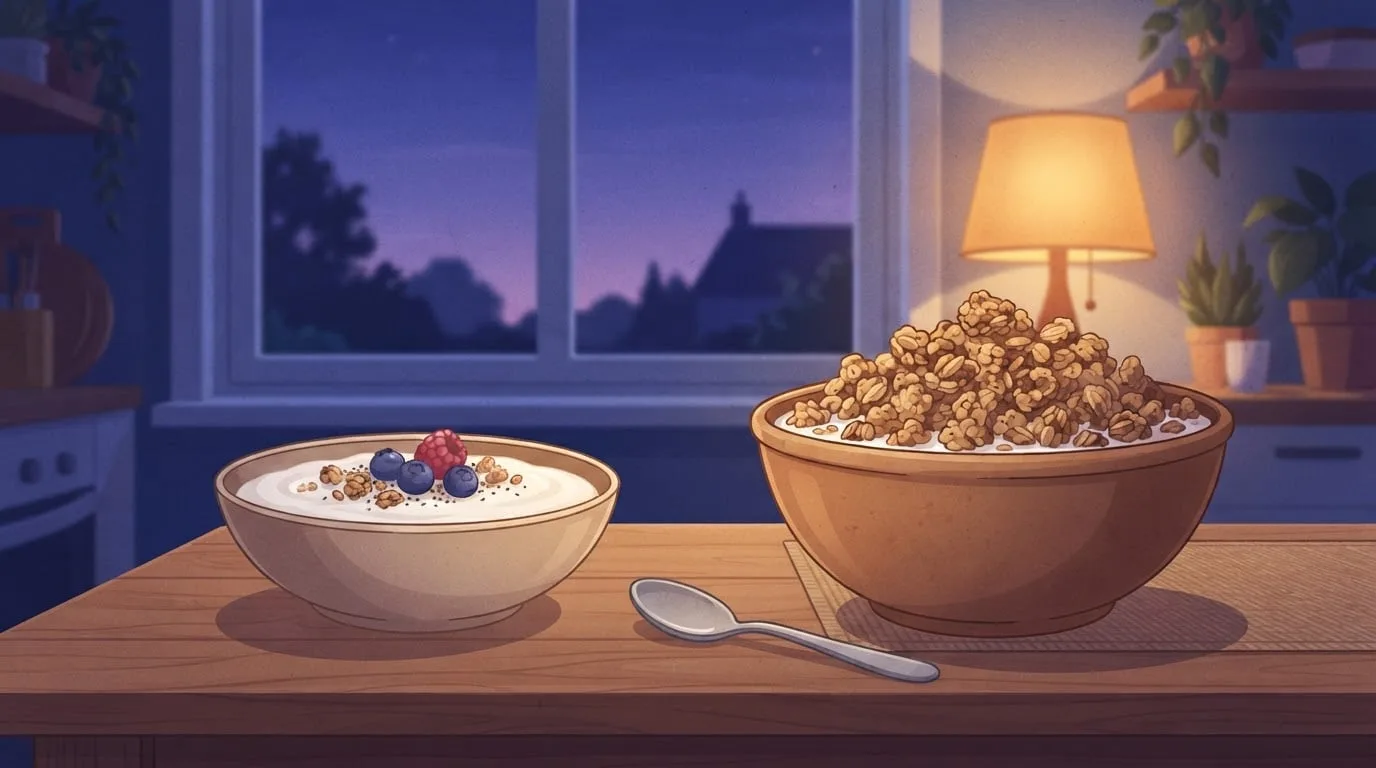
For most people, a quarter to half a cup. A quarter cup is about 115 to 150 calories, which works as a topping. Half a cup is 230 to 300 calories, closer to a full breakfast on its own. FDA rules set the reference serving for dense cereals like granola at 60 grams, about half a cup, but granola bags don't all list the same serving, so compare grams rather than cups.
Granola is easy to over-pour. The clusters stack loosely, and a bowl that looks like one serving often holds two or three. Measuring it with a measuring cup or a kitchen scale for a week recalibrates your eye, and after that you can pour by sight.
Is granola good for weight loss? It can fit, as long as you count it. A quarter-cup topping on yogurt fits easily into a weight-loss plan. A full bowl with milk, at close to 600 calories, is a big meal that many people don't count as one, and granola eaten by the handful from the bag adds up the same way. That's why granola is a regular on lists of foods that seem healthy but aren't: the food is fine, and the portion is the problem.
What Is the Healthiest Granola? How to Read the Label
There's no single healthiest granola, and the healthy granola brands change from store to store, but the healthiest store bought granola is easy to spot once you know where to look. Skip the front of the bag, with its words like natural, ancient grains or protein, and check six things on the back:
- Whole grain first. Rolled oats or another whole grain should be the first ingredient. If puffed rice, rice flour, tapioca syrup or maltodextrin sits near the top, expect a faster rise in blood sugar, as the Wolever trials showed.
- Grams per serving. Note the serving weight in grams before comparing anything else. A 30-gram serving and a 60-gram serving can't be compared until you scale one to the other.
- Added sugar of 5 grams or less per serving. That matches the FDA's ceiling for a grain food labeled healthy and leaves room inside the 10-gram meal limit.
- Fiber of 3 grams or more per serving. In the best high fiber granolas it comes from oats, nuts and seeds rather than from fiber added in the factory.
- Saturated fat of 1 to 2 grams or less. Coconut oil, palm oil, chocolate and coconut flakes push it up.
- A short ingredient list. Minimally processed granola reads like a recipe you could make at home: oats, nuts, seeds, one sweetener, one oil, and maybe spices and dried fruit.
Types of granola and what to watch for
- Classic oat granola: the standard, judged by the six checks above.
- Low-sugar granola: often a good pick, but some reach low sugar with non-nutritive sweeteners, which the Dietary Guidelines also advise limiting.
- Grain-free or "keto" granola: built from nuts, seeds and coconut, so it has fewer carbs but usually even more calories per cup.
- Protein granola: adds soy or whey protein, but still delivers less protein per calorie than a bowl of plain Greek yogurt.
Is Homemade Granola Healthier?
Usually, because you decide how much sweetener and oil go in. Homemade isn't automatically light, though. The homemade-style granola in the USDA table above has about 600 calories a cup, because nuts and oil are dense. Making your own gives you control of the sugar, not a low-calorie food.
Here's a simple low-sugar batch. Mix 3 cups of rolled oats, 1 cup of chopped nuts, half a cup of pumpkin or sunflower seeds, 3 tablespoons of olive or canola oil, 3 tablespoons of maple syrup, cinnamon and a pinch of salt. Spread it on a lined tray and bake at 325°F for 20 to 25 minutes, stirring halfway, then let it cool on the tray so it crisps. Add any dried fruit after baking.
The sugar math is easy to check. Three tablespoons of maple syrup hold about 36 grams of sugar, based on USDA's entry for maple syrup, and the batch makes about nine half-cup servings, so each serving carries about 4 grams of added sugar. Rolled oats are the best oats for granola: quick oats turn powdery, and steel-cut oats stay hard.

Is It Okay to Eat Granola Every Morning?
Yes, for most people, if the portion and the label are right. A quarter to half cup of a whole-grain, low-sugar granola on plain yogurt or with milk is a reasonable daily breakfast. Rotating it with eggs, oatmeal or other breakfasts adds variety, but there's nothing wrong with a granola habit that fits your calories. A few groups should take more care:
- People with diabetes or prediabetes. Half a cup of typical granola has about 37 grams of carbohydrate, about two and a half 15-gram carb servings. Count it, pick an oat-first, low-sugar granola, and pair it with protein.
- People with celiac disease. Oats are naturally gluten free but are often contaminated with wheat during growing and milling, so choose granola labeled gluten-free. A small number of people with celiac disease also react to oats themselves, so check with your doctor.
- People with nut allergies. Most granolas contain tree nuts or peanuts or are made on shared equipment, so read the allergen statement every time.
- People trying to lose weight. Measure it and count it as part of the meal, not as a garnish.
What This Means for You
Granola earns part of its reputation. The oats bring whole grain and fiber, the nuts and seeds bring healthy fats and minerals, and the one trial of granola itself found better cholesterol numbers than cornflakes. What it doesn't do is stay small on its own. Measure a quarter to half cup, choose one with oats first and 5 grams of added sugar or less, and put it on plain Greek yogurt, and you have a breakfast that works for you.
No single breakfast makes or breaks your results, though. What changes them is the pattern you repeat. Stacy, 41, lost 22 lb in four months with a routine she could keep up: "After my second kid, I needed something stupidly simple." A measured scoop of granola and a short workout on the calendar are both simple enough to repeat. If the workouts are the part that keeps slipping, our roundup of the best workout apps for weight loss compares the options. FitCraft is one of them: a 3D AI coach demonstrates each exercise and says your name during the session, and streaks and leaderboards give you a reason to come back the next day.
Frequently Asked Questions
Is granola good for you?
Yes, in small portions. Granola is mostly whole-grain oats with nuts and seeds, so it brings fiber, healthy fats and iron, but a cup carries 460 to 600 calories and about 24 grams of sugar. A quarter to half cup of a low-sugar granola on plain yogurt is the healthiest way to eat it.
Is granola good for weight loss?
It can fit, but it's easy to overeat. Granola has about 420 to 490 calories per 100 grams, so a quarter cup of about 115 to 150 calories works as a topping, while a full bowl with milk comes close to 600. For weight loss, measure it and use it on yogurt rather than as the whole meal.
Is granola a carb or protein?
A carb. In typical granola about two thirds of the calories come from carbohydrate and under a tenth from protein: a cup has about 74 grams of carbs and 11 grams of protein. Protein granolas add a few grams, but plain Greek yogurt is a better way to make the bowl high in protein.
How many calories are in a tablespoon of granola?
About 30 to 37 calories. In USDA data a cup of granola weighs 110 to 122 grams and has 460 to 600 calories, and a cup holds 16 tablespoons. That's why a few spoonfuls on yogurt is a light topping while a poured bowl is a full meal.
How many calories are in granola and yogurt?
About 220 calories for 6 ounces of plain nonfat Greek yogurt with a quarter cup of granola, with around 20 grams of protein. Swapping in a sweetened flavored yogurt and pouring half a cup of granola can push the same bowl toward 400 calories and past the 10-gram added sugar limit for a meal.
Are granola bars healthy?
Most are a sweet snack rather than a health food. USDA's average granola bar has 471 calories and 28.6 grams of sugar per 100 grams, so a 40-gram bar carries about 190 calories and 11 grams of sugar with only about 2 grams of fiber. If you buy them, look for oats or nuts as the first ingredient and 5 grams of added sugar or less.
What is the healthiest granola for yogurt?
A plain, oat-first granola with 5 grams of added sugar or less per serving and some nuts or seeds for crunch. The yogurt brings the protein, so the granola only needs to bring texture and fiber. Keep it to a few tablespoons or a quarter cup, and add berries for sweetness instead of honey.