
Oatmeal has been the "healthy breakfast" of default for decades, and every few years someone announces that actually it's fattening because carbs, or actually it's a superfood, or actually the oat industry is lying to us. The food itself hasn't changed. What changes is what people are putting in the bowl and whether the calorie count still fits into a day that produces weight loss.
The short version is that plain oatmeal is one of the most useful weight-loss foods in a supermarket, for a specific and well-documented reason, and most oatmeal-eaters aren't eating plain oatmeal.
What Makes Oatmeal Actually Filling
The active ingredient is beta-glucan, a viscous soluble fiber concentrated in oats and barley. It behaves in the stomach and small intestine the way it sounds: it thickens the food matrix, slows gastric emptying, and blunts the postprandial glucose response. That produces two things people trying to lose weight actually want. Longer time between "just ate" and "hungry again." Smaller blood-sugar swings, so you're not fighting cravings an hour after breakfast.
Rebello and colleagues (2013) ran the cleanest test of this. 47 healthy adults ate matched-calorie servings of instant oatmeal or a name-brand ready-to-eat cornflake cereal in a randomised crossover trial, and rated hunger, fullness, and desire to eat every 15 to 30 minutes for four hours. Oatmeal significantly lowered hunger, raised fullness and reduced prospective food intake at nearly every timepoint, at the same calorie load. The oatmeal servings also delivered more than double the beta-glucan, which the authors attribute the effect to.
The 2016 review by Rebello, O'Neil and Greenway in Nutrition Reviews pulled together the mechanistic and clinical evidence and concluded that the satiety effect of oats appears reliable and dose-dependent on beta-glucan content and viscosity. It's not magic and it's not a cure. It's a food that reliably holds hunger down per calorie eaten, which is exactly the property a weight-loss breakfast needs.
The Math of a Weight-Loss Bowl
Half a cup of dry rolled oats is 150 calories, 5 grams of protein, 27 grams of carbohydrate and about 4 grams of fiber. Cooked in water that's what the bowl contains. Cooked in a cup of 2 percent milk it becomes roughly 270 calories with 13 grams of protein. That's the base.
Now the toppings, and this is where every social-media oatmeal reel quietly hides the story:
| Topping | Portion | Added calories |
|---|---|---|
| Peanut butter | 2 tbsp | 190 |
| Almond butter | 2 tbsp | 180 |
| Honey | 1 tbsp | 60 |
| Maple syrup | 2 tbsp | 100 |
| Banana | 1 medium | 105 |
| Granola | ¼ cup | 140 |
| Chocolate chips | 2 tbsp | 140 |
| Berries | ½ cup | 40 |
| Chia seeds | 1 tbsp | 60 |
Add peanut butter, honey, a banana and granola to your bowl and you've built a 645-calorie breakfast that reads as "healthy oatmeal" and lands almost identically to a cinnamon roll from a chain bakery. The satiety math is still fine, but a big fraction of the day's calorie budget just disappeared into what you thought was diet food.
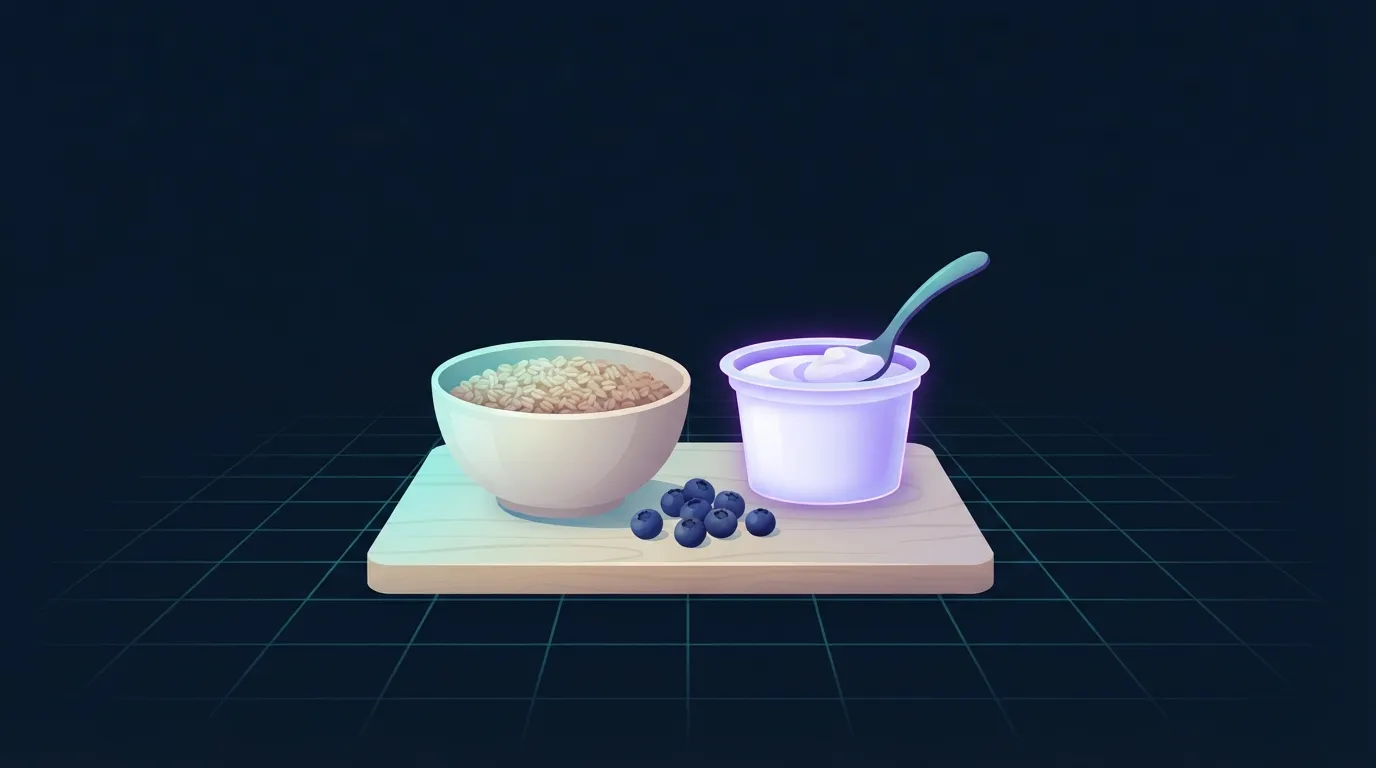
A weight-loss-shaped bowl looks different. Half a cup of dry oats. Cooked in water or unsweetened almond milk. Stirred with either a scoop of protein powder off the heat or six ounces of Greek yogurt on top. One small handful of berries. That's 280 to 350 calories with 25 to 30 grams of protein and 6 to 7 grams of fiber. That's a breakfast that shows up at dinner time still doing its job.
Steel-Cut, Rolled, Instant: Does It Matter?
Somewhat, and mostly at the extremes. Steel-cut oats (the whole groat cut into pieces) and rolled oats (steamed and pressed) are the least-processed forms. They preserve the beta-glucan structure that drives the satiety effect. Quick oats are more finely rolled and cook faster; the beta-glucan still functions, just less viscously. Flavored instant oatmeal packets are quick oats plus 8 to 12 grams of added sugar, which does a couple of unhelpful things: it raises the calorie load, spikes blood sugar faster, and pulls down the satiety benefit the oats were bringing.
Wolever and colleagues (2010) demonstrated the underlying principle. In a 4-week randomised trial they varied the molecular weight of the oat beta-glucan participants consumed and showed the higher-molecular-weight (more viscous) versions produced significantly larger LDL cholesterol reductions. Cholesterol isn't the endpoint here, but it uses the same physical property that drives satiety, and it goes the same way processing does: the more processed the oat, the smaller the effect.
Practical version: buy plain rolled or steel-cut oats. Cook them however works for your morning. Skip the flavored packets.
Find out what's really holding you back
FitCraft, our mobile fitness app, pairs you with an AI coach who builds you a personalized plan around your goals, schedule, and fitness level. Every FitCraft program is designed by Domenic Angelino, MPH (Brown University) and NSCA-CSCS, with research published in the Journal of Strength and Conditioning Research and Medicine & Science in Sports & Exercise.
Take the Free Assessment Free • 2 minutes • No credit cardWhat About the Body Composition Trials?
A couple of small trials have looked at oat consumption and body composition directly. Chang and colleagues (2013) in Plant Foods for Human Nutrition asked 34 adults with mildly elevated cholesterol to eat about 70 grams of oats a day for 12 weeks and measured weight, waist circumference and liver enzymes. Weight, waist circumference and waist-to-hip ratio all fell modestly from baseline. The trial had no isocaloric control group eating a different high-fiber breakfast, so what it tells us is that adding oats to the diet reduces body weight in this population, not that oats do it better than other high-fiber foods.
That's the honest story across the wider literature. High-fiber, moderate-glycemic breakfasts consistently produce better satiety and small weight advantages compared to lower-fiber, higher-glycemic ones. Oats are one of the best-studied members of that category, but they don't do anything a different high-fiber breakfast wouldn't. The reason to eat them is that they're cheap, shelf-stable, take three minutes, and hold hunger down reliably.
Fiber matters more broadly than just at breakfast. Our review of whether fiber helps weight loss walks through the pooled trials and where the biggest per-gram wins actually live.
Common Oatmeal Mistakes That Kill the Weight-Loss Effect
Skipping the protein. Oats alone are around 5 grams of protein for a half-cup dry serving. That's not enough to hold hunger past mid-morning for most adults. Add Greek yogurt, an egg, cottage cheese, or a scoop of whey stirred in after cooking. Aim for at least 20 grams of protein at breakfast; it's the single change with the largest effect on how full you feel by lunch.
Treating "healthy" toppings as calorie-free. Nut butter, honey, maple syrup, granola, chocolate chips, coconut flakes, banana slices. They all count, they add up fast, and they're the difference between a 300-calorie meal and a 700-calorie meal. Weigh or measure them for a week; you'll probably discover you were doubling the calorie load without noticing.
Buying flavored instant packets. Convenience is the whole point, and unflavored quick oats are already fast. Flavored packets add 8 to 12 grams of sugar and, worse, teach your palate to expect sweetness in every subsequent bowl. Buy a canister of plain oats and add a quarter teaspoon of cinnamon and a splash of vanilla; you get the flavor cue without the sugar.
Eating a "second breakfast." This one is subtle. Oatmeal holds hunger surprisingly well, but a lot of people eat it too early (5 or 6am, with the intent of eating a "real" meal at 9am) and end up double-breakfasting. If your first meal is oatmeal, that's the meal. Don't stack a bagel behind it.
Using it as a green light. Oatmeal is not a food that produces weight loss in the presence of a calorie surplus. Nothing does. If you're eating a bowl of oats for breakfast and 400 extra calories the rest of the day because you already "did the healthy thing," the bowl isn't the problem, but it isn't the solution either.

Three Weight-Loss Oatmeal Templates That Actually Work
All three are 300 to 400 calories, 20 to 30 grams of protein and 6 to 8 grams of fiber. Prep is under five minutes.
The high-protein classic. Half a cup dry rolled oats cooked in three-quarters of a cup unsweetened almond milk. Off the heat, stir in a scoop of whey or plant protein powder and a quarter teaspoon of cinnamon. Top with a half-cup of blueberries. Around 320 calories, 27 grams of protein.
The Greek-yogurt bowl. Cook half a cup of oats in water, transfer to a bowl, top with six ounces of nonfat Greek yogurt, a tablespoon of chia seeds and a small handful of raspberries. Around 340 calories, 24 grams of protein.
The savory oats. Half a cup of oats cooked in low-sodium broth with a pinch of salt. Off the heat, stir in a beaten egg (the residual heat cooks it) and top with a soft-boiled second egg, half an avocado sliced thin, and a shake of hot sauce. Around 400 calories, 20 grams of protein and 8 grams of fiber. Not everyone likes it. Those who do never go back.
Where Oatmeal Fits in the Bigger Picture
A single meal isn't going to move the scale on its own. What moves the scale is a repeated small deficit across weeks, and the food that helps you maintain a deficit is the food that keeps you full without asking for a lot of calories in return. Oatmeal fits that description better than most things at a supermarket, which is why it keeps showing up in weight-loss meal plans across every era and every diet ideology.
The other lever is the one nobody wants to hear about, which is the training and habit side. Consistent, structured exercise is what makes a small calorie deficit sustainable in the first place. If the workout side is what keeps slipping, that's what we built our roundup of the best workout apps for weight loss to compare: which apps actually help people stay consistent, which ones flatter you for a week and then lose you.
The Bottom Line
Plain oats, a protein source, a small portion of fruit, cooked in something without sugar in it: yes, that's a weight-loss breakfast, and one of the better ones for the money. A jar of overnight oats topped with nut butter, honey, banana and granola: also 600 calories, no different from a bakery muffin, and quietly the reason nothing is happening on the scale.
The food isn't the story. The bowl is. Build the bowl on the base, respect the toppings, and oatmeal earns its reputation.
Frequently Asked Questions
Is oatmeal good for weight loss?
Yes, when it replaces something more calorie-dense, no when it's a delivery vehicle for four tablespoons of nut butter and honey. Half a cup of dry rolled oats is about 150 calories and roughly 4 grams of fiber, of which about 2 grams is beta-glucan, the viscous soluble fiber that slows gastric emptying and holds hunger down for hours. Rebello and colleagues (2013) fed 47 adults matched-calorie oatmeal against a name-brand cornflake cereal in a crossover trial and found oatmeal produced significantly lower hunger and higher fullness across four hours. The food is a strong per-calorie satiety tool. The bowl only becomes a weight-loss meal if you don't triple the calorie count with toppings.
How much oatmeal should I eat to lose weight?
Start with a half-cup dry portion of rolled or steel-cut oats, which is roughly 150 calories cooked. Add 20 to 30 grams of protein (Greek yogurt, an egg on the side, or a scoop of whey stirred in after cooking) so the meal actually holds you until lunch. Cap added toppings at 100 to 150 calories total: a small handful of berries, a teaspoon of nut butter, a sprinkle of nuts or seeds. That builds a 300 to 450 calorie breakfast with 25 to 35 grams of protein and 6 to 8 grams of fiber, which is where most weight-loss meal templates land.
What kind of oats are best for weight loss?
Steel-cut and rolled oats beat quick oats and flavored instant packets for satiety, and it's not close. The processing that makes oats cook faster also breaks down the beta-glucan structure, which is the exact mechanism behind the fullness effect. Wolever and colleagues (2010) showed that the molecular weight of beta-glucan directly predicted its cholesterol-lowering effect, and the same physical property drives satiety. Flavored instant packets add a further 8 to 12 grams of sugar per serving. Buy a canister of rolled or steel-cut oats and sweeten what you make.
Is overnight oatmeal good for weight loss?
It can be, and often isn't. The oats themselves are fine, but the standard recipe (chia seeds, nut butter, banana, honey, granola on top) routinely lands the jar between 500 and 700 calories, which is dessert with a fiber garnish. If overnight oats fit your morning better than a hot bowl, keep the base (half-cup dry oats, one cup milk of choice, chia seeds if you want them), add protein (Greek yogurt or protein powder), and treat toppings like the same 100 to 150 calorie budget above.
Will eating oatmeal every day help me lose belly fat?
It will help maintain a calorie deficit, which is what loses belly fat. There is no food that spot-reduces abdominal fat. Chang and colleagues (2013) did find that adults with elevated cholesterol who ate about 70 grams of oats a day for 12 weeks showed reductions in body weight, waist circumference and waist-to-hip ratio compared to baseline, but the deficit is doing the work, not the oats specifically. Any high-fiber, moderate-calorie breakfast that replaces a higher-calorie one will produce the same result.
Is oatmeal better than eggs for weight loss?
Both are strong choices for different reasons, and the answer is to eat them together. Eggs win on protein per calorie (about 6 grams of protein for 70 calories per egg). Oatmeal wins on fiber per calorie (about 4 grams of fiber for 150 calories per half-cup dry). Weight-loss meals that hit both satiety levers (protein plus soluble fiber) tend to hold hunger longer than either one alone. Two eggs on the side of a half-cup oatmeal is a 340-calorie breakfast with 18 grams of protein and 4 grams of fiber.