
You finally found a routine you like, and now you want to do it every day. Or you've read that serious lifters train six days a week and you wonder whether your three sessions are enough. Either way, the question is the same. Can you lift weights every day without getting hurt or stalling?
You can, if you plan it. Daily lifting works when you rotate muscle groups, keep most sets a couple of reps short of failure and give each muscle a day or two to recover. It also isn't necessary. Studies that compared near-daily training with three days a week found about the same gains when the total work was equal.
Below you'll find what the daily-lifting studies show, how many days a week to lift, how often to train each muscle group, three weekly plans that make daily lifting work and the signs you're lifting too often.
Can You Lift Weights Every Day?
Yes, you can lift weights every day as long as you don't train the same muscles hard on back-to-back days. The limit is recovery. After a hard session, a muscle keeps rebuilding for a day or two and needs about that long before it's ready to work hard again. That's why people who lift daily split their week by body part.
What the daily-lifting studies found
Several trials have compared lifting on most days of the week with lifting about three days a week:
- Six days vs three, muscle and strength. Saric and colleagues (2019) split 27 experienced lifters into groups training 3 or 6 times a week for 6 weeks, with the same total sets. Strength and muscle thickness rose about the same in both groups.
- Six days vs three, strength. Colquhoun and colleagues (2018) ran a similar 6-week test in 28 trained men. Strength gains were almost identical, such as 16.8 kg and 16.7 kg on the squat.
- Every muscle, five days a week. Zaroni and colleagues (2019) had 18 trained men work every muscle on 5 days a week or each muscle once a week in a split. Strength gains matched, and the five-day group grew more muscle in two of the three muscles measured.
- Beginners. Barcelos and colleagues (2018) had 20 untrained young men train one leg 5 times a week and the other 2 or 3 times a week for 8 weeks. The five-day leg did more total work but gained the same strength and size.
These were short studies of young men, so they say less about a 45-year-old restarting after years off. They do show that training more often adds little once the total amount of work is the same. For the beginners, extra days mostly meant extra work without extra results.
The large reviews agree. An early meta-analysis by Schoenfeld, Ogborn and Krieger (2016) found that training each muscle twice a week grew more muscle than once a week. When weekly volume was matched across 25 studies, though, frequency made no meaningful difference to growth (Schoenfeld, Grgic and Krieger, 2019). Grgic and colleagues (2018) pooled 22 strength studies. Gains rose with frequency overall, but not in the studies that matched weekly volume. A 2026 model of 67 studies and 2,058 people by Pelland and colleagues found that frequency had little or no effect on muscle size, while strength rose with frequency at a shrinking rate. Our training frequency research review covers each of these in detail.
How Many Days a Week Should You Lift Weights?
Two to four days a week is enough for most adults. The US Physical Activity Guidelines ask for muscle-strengthening work for all the major muscle groups on at least 2 days a week. The American College of Sports Medicine's 2026 position stand drew on 137 systematic reviews covering more than 30,000 people. It found that strength improved more with at least 2 sessions a week and muscle growth improved with at least 10 sets per muscle group a week. How often you trained didn't change muscle growth. ACSM's earlier 2009 stand suggested 2 to 3 days a week for beginners, 3 to 4 after about six months of steady training and 4 to 5 for advanced lifters.
| Your situation | Days a week | How to set it up |
|---|---|---|
| New or restarting | 2 to 3 | Full body each time, with a day off between sessions |
| Training steadily for 6 months or more | 3 to 4 | Full body, or an upper and lower split |
| Want to lift most days | 5 to 6 | Push, pull and legs, or upper and lower on alternating days |
| Want to lift every day | 7 | Hard days that rotate between muscle groups, plus light days |
The fewer days you lift, the more each session has to cover. Three full-body sessions train each muscle three times a week, and a six-day push, pull and legs week trains each muscle twice in shorter sessions.
How Often Should You Train Each Muscle Group?
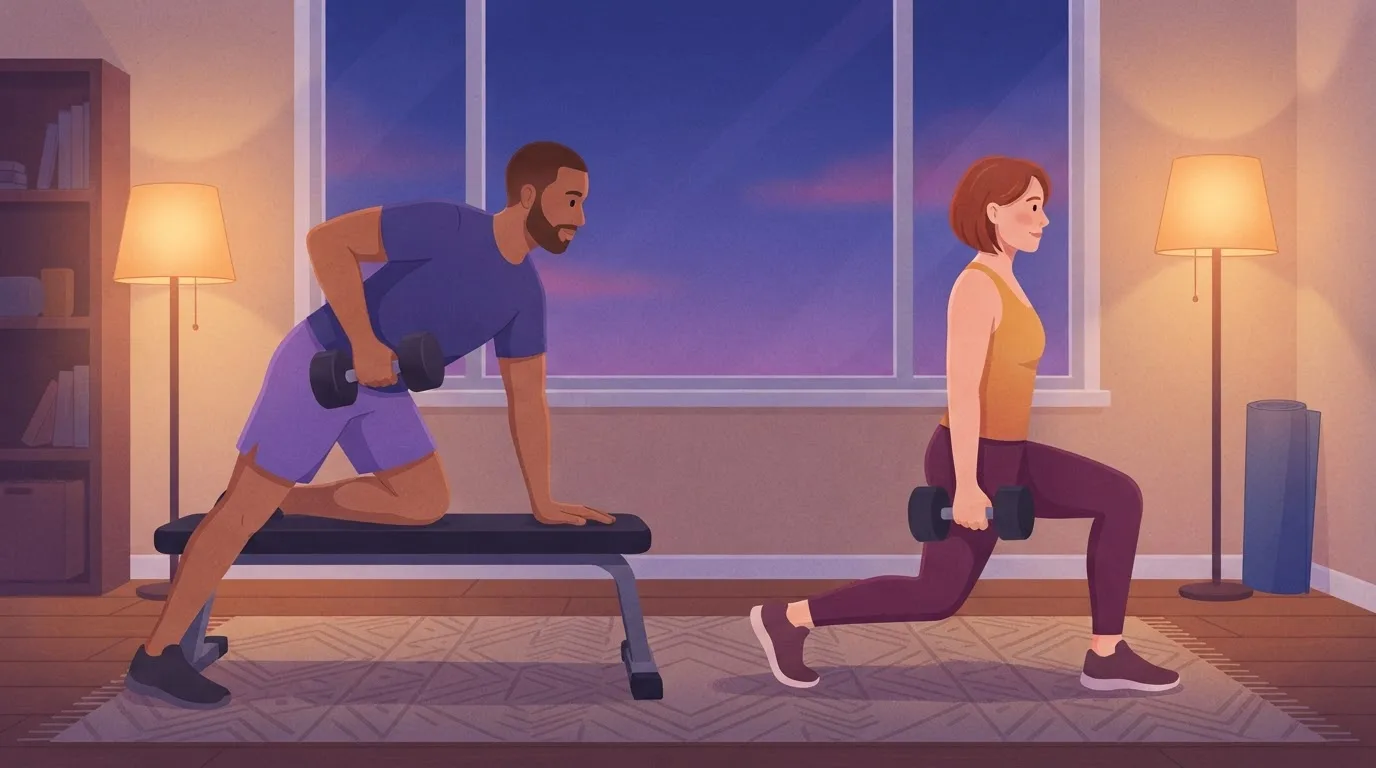
Train each muscle group about twice a week, with at least 48 hours between hard sessions for the same muscle. Twice a week is what the early meta-analysis favored, and it's an easy way to spread 10 or more weekly sets per muscle, the ACSM's threshold for growth, into sessions that don't drag on. If you lift every day, a given muscle works hard on two or three of those days and rests or works lightly on the others.
A rough guide for a home dumbbell week:
- Legs and glutes. Two hard sessions, with moves such as goblet squats, lunges and Romanian deadlifts.
- Chest, shoulders and triceps. Two hard sessions, with push-ups and dumbbell presses.
- Back and biceps. Two hard sessions, with one-arm rows and curls.
- Core. Short sets of planks or dead bugs can go on most days if they stay easy.
Knowing what to do is the easy part.
FitCraft, our mobile fitness app, pairs you with an AI coach who builds you a personalized plan around your goals, schedule, and fitness level. Every FitCraft program is designed by Domenic Angelino, MPH (Brown University) and NSCA-CSCS, with research published in the Journal of Strength and Conditioning Research and Medicine & Science in Sports & Exercise.
Take the Free Assessment Free • 2 minutes • No credit cardHow to Lift Weights Every Day Without Overdoing It
Daily lifting works when hard days rotate between muscle groups and some days stay light. Pick the plan that matches how often you really want to train.
| Day | 4 days | 6 days | Every day |
|---|---|---|---|
| Monday | Upper body | Push | Lower body, hard |
| Tuesday | Lower body | Pull | Upper body, hard |
| Wednesday | Walk or rest | Legs | Light full body |
| Thursday | Upper body | Push | Lower body, hard |
| Friday | Lower body | Pull | Upper body, hard |
| Saturday | Walk or mobility | Legs | Light full body |
| Sunday | Rest | Rest | Light core and mobility |
The six-day column is a push, pull and legs split, and our push pull legs routine lays it out with dumbbells and body weight. If you want the every-day plan, these four rules keep it safe:
- Two hard days per muscle group. Leave at least 48 hours between them.
- Stop most sets 1 to 3 reps short of failure. ACSM's 2026 review found that training to failure didn't consistently improve results, and failure sets take longer to recover from.
- Keep light days light. Use about half your usual weight or effort, do fewer sets and practice your form. You should finish feeling better than when you started.
- Add work slowly. The US guidelines say injury risk rises with the gap between what you usually do and what you suddenly try. Add a day or a few sets at a time and give your body a week or two to adjust.
How Long Do Muscles Need to Recover Between Lifting Sessions?
Most muscles need about 48 hours after a hard session before they're ready to be trained hard again, and longer when every set went to failure. Muscle building after a workout follows a short curve. MacDougall and colleagues (1995) concluded that protein building in an exercised arm more than doubles by 24 hours after heavy training and is almost back to normal by 36 hours. In untrained adults, Phillips and colleagues (1997) found it still 34% above resting levels 48 hours after a workout.
Fatigue clears on a similar schedule. Morán-Navarro and colleagues (2017) had 10 trained men do squats and bench presses three ways with the same weight. When every set went to failure, jump height and bar speed recovered more slowly. When the men stopped each set at half the reps they could manage, they recovered faster between 24 and 48 hours, even with the same total reps. Recovery also depends on your age, your experience and how new the exercise is, as our answer to how long muscles take to recover explains.

Signs You're Lifting Too Often
The clearest sign you're lifting too often is a drop in performance that lasts more than a week or two, together with feeling worn out. One bad session doesn't count. Watch for these:
- Your weights or reps fall for a week or more, even after good sleep.
- Soreness in a muscle hasn't faded by the time its next hard session comes around.
- Your joints or tendons ache during warm-ups, especially elbows, shoulders and knees.
- You sleep badly, feel irritable or dread workouts you used to enjoy.
- You feel tired all day, even on rest days.
Short dips are normal. A joint consensus statement on overtraining by Meeusen and colleagues (2013) describes a short-term drop in performance after hard training, called functional overreaching, that turns into a gain once you recover. When training and rest stay out of balance for longer, performance can stall for weeks. Overtraining syndrome, with fatigue, falling performance and mood changes, is the far end of that scale, and no single blood test or heart rate measure reliably detects it.
How you feel is a good early warning. In a review of 56 studies, Saw, Main and Gastin (2016) found that self-reported measures such as mood, stress and fatigue tracked training load better than common objective measures like resting heart rate and blood markers.
If several signs show up together, cut your sets in half for a week or take 2 to 3 days off lifting and walk instead. Our answer to whether it's bad to work out every day explains how overtraining builds up and what daily movement looks like. See a doctor if the tiredness lasts for weeks.
Is It Okay to Lift 5 Pound Weights Every Day?
Yes, lifting 5-pound weights every day is fine for most people, because a light load puts little strain on your muscles and joints. It can still build some muscle if the sets are hard. In a meta-analysis of 21 studies, Schoenfeld and colleagues (2017) found that loads of 60% of your one-rep max or less built as much muscle as heavier loads when every set went to failure. Heavier loads built more maximal strength.
The catch is that 5 pounds is light for some muscles and heavy for others. Your legs, back and chest will barely notice it, so daily 5-pound squats won't do much for them. Your shoulders and arms work much harder with it, and lateral raises or curls taken close to failure every day can leave them sore and tired. If you use light weights daily, keep most sets easy and save the hard sets for two or three days a week per muscle.
Easy daily practice also suits skill work. Doing a few easy sets of push-ups or squats spread through the day, a method called greasing the groove, is a popular way to practice a movement often without the fatigue of a full workout.
Should You Lift Weights Every Day to Lose Weight?
No, you don't need to lift every day to lose weight. Lifting helps you lose fat, but more lifting doesn't seem to add much. In a review of 58 studies, Wewege and colleagues (2022) found that resistance training cut body fat by 1.46 percentage points and fat mass by about 0.55 kg compared with no exercise. The amount of training wasn't linked to the size of the effect. Those are modest numbers. Fat loss depends mostly on what you eat.
The US guidelines note that strength work helps you hold on to muscle while you lose weight. So 2 to 4 lifting days, a daily walk and a modest change in what you eat are likely to do more than lifting every day while your diet stays the same.
What This Means for You
If you enjoy lifting and want to do it every day, you can. Rotate muscle groups, keep two hard sessions per muscle each week, stop most sets a few reps short of failure and make some days light. If you'd rather lift three or four days a week, you'll get nearly the same results and have more days for walking and rest.
Either way, the plan only works if you keep showing up for months, and that's where most people stall. You start strong in January, life gets busy and the gaps between workouts grow. That's a planning problem, and it's fixable.
Our ranking of the best strength training apps compares the options for training at home and in a gym. In FitCraft, an AI coach demonstrates each dumbbell and bodyweight exercise on an interactive 3D model, with cues on which muscles to focus on, and says your name during the workout. Multi-week programs get harder as you progress, and streaks, XP and leaderboards give you a reason to come back. As one FitCraft user, Katie, put it: "I've tried everything. This is the first time I've stuck with something past two weeks."
Frequently Asked Questions
Do muscles grow on rest days?
Yes, muscles keep rebuilding on rest days. Protein building stays raised for about 24 to 48 hours after a hard session, so much of the repair from Monday's workout happens on Tuesday. A rest day, or a day spent training other muscles, gives that process time to finish.
Is 4 days rest too much for the gym?
No, four days off won't undo your progress. In a 24-week bench press study, men who took a 3-week break after every 6 weeks of training ended with the same muscle and strength gains as men who trained without breaks. Four days is a normal gap after a busy week, an illness or a trip.
Can I lift weights every day if I'm not sore?
Not being sore doesn't mean a muscle has recovered. Soreness fades as your body gets used to a workout, but the muscle still needs time to rebuild, and the fatigue from hard sets can last a day or two. Plan your rest by muscle group and by how hard your last session was.
Can you lift dumbbells every day?
Yes, you can lift dumbbells every day if you rotate muscle groups, such as legs one day and upper body the next. Keep two hard sessions per muscle each week and stop most sets a rep or two short of failure. Light dumbbell days for form practice can fill the gaps.
What is the 3 3 3 rule in weightlifting?
The 3-3-3 rule is an informal beginner plan rather than a research-based method, and versions differ. The most common one means 3 workouts a week, 3 exercises per workout and 3 sets of each exercise. A muscle trained by one of those exercises gets about 9 hard sets a week, close to the 10 weekly sets the ACSM links with more growth.