
You've probably heard both rules said with total confidence. Breakfast is the most important meal of the day, so never skip it. Or breakfast is optional, and skipping it is the easiest form of intermittent fasting there is. If you're not hungry until 11 and you skip it most days, you might be wondering whether you're quietly doing damage.
So is skipping breakfast bad? For most healthy adults, no. Breakfast is one of the few meal-timing questions that has been tested in randomized trials, and those trials tell a calmer story than the headlines. This page covers what the trials measured, why observational studies make breakfast skippers look so much worse off, what skipping does to a morning or evening workout, how it affects the protein you get across the day, and the groups who should keep eating breakfast.
What Happened When Adults Skipped Breakfast in Randomized Trials
The most detailed tests come from the Bath Breakfast Project in England, run by James Betts and colleagues at the University of Bath. Instead of asking people what they usually eat, the researchers randomly assigned them to eat breakfast or to fast every morning for six weeks, then measured nearly everything that could change.
The lean adults trial
In the first trial, Betts and colleagues (2014) assigned 33 lean adults aged 21 to 60 to eat at least 700 calories before 11 a.m. or nothing at all until noon. Resting metabolism stayed within 11 calories a day between the groups, so skipping breakfast didn't slow anyone down. Body weight and body fat ended up the same. Markers of cardiovascular health didn't change in either group, and neither did how well fat tissue took up blood sugar.
Two differences did show up. The breakfast eaters moved more, burning about 442 extra calories a day through physical activity, and they also ate about 539 more calories, so the two roughly cancelled out. And by the sixth week, blood sugar swung more in the afternoon and evening on fasting days than on breakfast days.
The trial in adults with obesity
Chowdhury and colleagues (2016) repeated the design in 23 adults with obesity. Breakfast raised activity only during the morning, by about 188 calories, and the people who fasted made up part of the missing food later in the day. Weight, body composition and resting metabolism, which stayed within 8 calories a day, didn't differ between groups. Most heart and metabolic markers didn't respond either. The one exception favored breakfast: the insulin response to a glucose drink improved over six weeks in the breakfast group and worsened in the fasting group.
What the pooled trials add
Looking across studies, a 2019 BMJ meta-analysis by Sievert and colleagues pooled 13 randomized trials from high-income countries. People assigned to breakfast ate about 260 more calories a day and weighed 0.44 kg more than people assigned to skip it. Every trial was short and had a high or unclear risk of bias somewhere, so treat the numbers as small and uncertain. Our guide to the best breakfast for weight loss walks through the weight side of these trials in detail, so this page sticks to health and training.
On health markers, Bonnet and colleagues (2020) pooled seven trials of at least four weeks, 425 people in all. Skipping breakfast lowered weight by about half a kilogram and didn't change blood pressure, fasting glucose, insulin, triglycerides or HDL cholesterol. It did raise LDL cholesterol by about 9 mg/dL, though only three trials measured it. That's a small effect worth knowing about if your LDL is already high, and not a reason for most people to panic.
Put together, the trials say skipping breakfast is close to neutral for healthy adults over weeks. Breakfast changes how you spend energy more than how much you store, and it gives a modest edge to blood sugar control later in the day.
Is Skipping Breakfast Bad for Your Heart? What the Observational Studies Show
If the trials are so calm, why do headlines keep linking skipped breakfasts to heart attacks and diabetes? Because those headlines come from observational studies, which follow people who already skip breakfast and compare them with people who don't.
- Heart disease. Cahill and colleagues (2013) followed 26,902 male health professionals for 16 years. Men who skipped breakfast had a 27 percent higher risk of coronary heart disease. They were also younger and more likely to smoke, work full time, be unmarried, drink more alcohol and exercise less.
- Cardiovascular death. Rong and colleagues (2019) followed 6,550 US adults aged 40 to 75 for 17 to 23 years. The 5 percent who never ate breakfast had 1.87 times the risk of dying from cardiovascular disease as daily breakfast eaters. The difference in death from any cause wasn't statistically significant.
- Type 2 diabetes. Ballon and colleagues (2019) pooled six cohorts with 96,175 people and found a 33 percent higher risk in people who ever skipped breakfast. Adjusting for body weight shrank that to 22 percent.
These studies adjust for the differences they can measure, but they can't adjust for everything. The Cahill list shows the problem: in that cohort, the men who skipped breakfast differed in smoking, drinking, exercise and work hours. Skipping breakfast can be one part of a hectic, less healthy routine rather than its cause. When researchers removed that problem by randomly assigning breakfast, as in the Bath trials, the harm didn't show up over six weeks. Trials that short can't rule out effects over decades, but they make a big direct effect unlikely.
One observational finding does point to a real, fixable cost. Zeballos and Todd (2020), researchers at the USDA Economic Research Service, compared two days of dietary recalls from 23,488 US adults. On days they skipped breakfast, people ate about 250 fewer calories, but their diet quality dropped, with less fruit, whole grains and dairy. Those are the foods breakfast usually carries. If you skip it, they need a place in your other meals.
Knowing what to do is the easy part.
FitCraft, our mobile fitness app, pairs you with an AI coach who builds you a personalized plan around your goals, schedule, and fitness level. Every FitCraft program is designed by Domenic Angelino, MPH (Brown University) and NSCA-CSCS, with research published in the Journal of Strength and Conditioning Research and Medicine & Science in Sports & Exercise.
Take the Free Assessment Free • 2 minutes • No credit cardSkipping Breakfast and Training: Fasted Morning Workouts
This is where skipping breakfast has its clearest downside, and it depends on how long and how hard you train.
Aird and colleagues (2018) pooled 46 studies comparing exercise after eating with exercise on an empty stomach. Eating beforehand improved prolonged aerobic performance, in sessions over about an hour, but made no clear difference to shorter aerobic sessions. Fasted exercise did raise the fat released into the blood afterward, which is the result fasted-cardio fans point to. Whether that leads to more fat loss over weeks is a separate question, and our page on whether fasted workouts are good for weight loss covers the trials that tested it.
Skipping breakfast can also affect a workout much later in the day. Clayton and colleagues (2015) had 10 men who normally ate breakfast either eat a 733-calorie breakfast or skip it, then eat lunch and dinner freely. They ate about 199 more calories at lunch after skipping, yet their day's total stayed lower. In a cycling test 9 hours after breakfast time, they completed 4.5 percent less work after skipping breakfast, even though they'd eaten lunch.
What that means in practice:
- Short morning sessions are fine fasted. A 20 to 45 minute dumbbell, bodyweight or interval session on an empty stomach works for most people. If you feel strong, there's no need to change it.
- Eat a little before long or hard sessions. For anything over an hour, or a session where you want your best performance, a small snack 30 to 60 minutes before, such as a banana or a slice of toast, is the safer bet.
- Stop if you feel dizzy or shaky. Some people handle fasted training poorly, and that's a reason to eat, not to push through.
- Eat after training. A meal with protein and carbohydrate within a few hours supports recovery, whether or not you ate before.

For many people the real obstacle is making morning workouts happen at all, fed or fasted. If a busy schedule is what keeps knocking yours over, our roundup of the best workout apps for busy professionals compares apps that fit a packed schedule. FitCraft is one of them: a 3D AI coach demonstrates each dumbbell or bodyweight exercise and says your name mid-workout, and streaks and leaderboards give you a reason to show up again tomorrow morning.
Protein Distribution: What You Lose When You Skip Breakfast
For anyone trying to build or keep muscle, the bigger cost of skipping breakfast may be protein, not energy. Breakfast is often the meal where people eat the least protein, and dropping it leaves fewer chances to spread your intake across the day.
Mamerow and colleagues (2014) fed eight healthy adults the same daily protein two ways for a week each. One diet spread it evenly, about 30 grams at each of three meals. The other skewed it, about 11 grams at breakfast, 16 at lunch and 63 at dinner, which is the evening-heavy pattern many people eat. Muscle protein synthesis over 24 hours was 25 percent higher on the even diet, and the gap held after a week. It's a small study that measured the building process rather than muscle size, but it supports the idea of protein distribution: several moderate doses beat one large one.
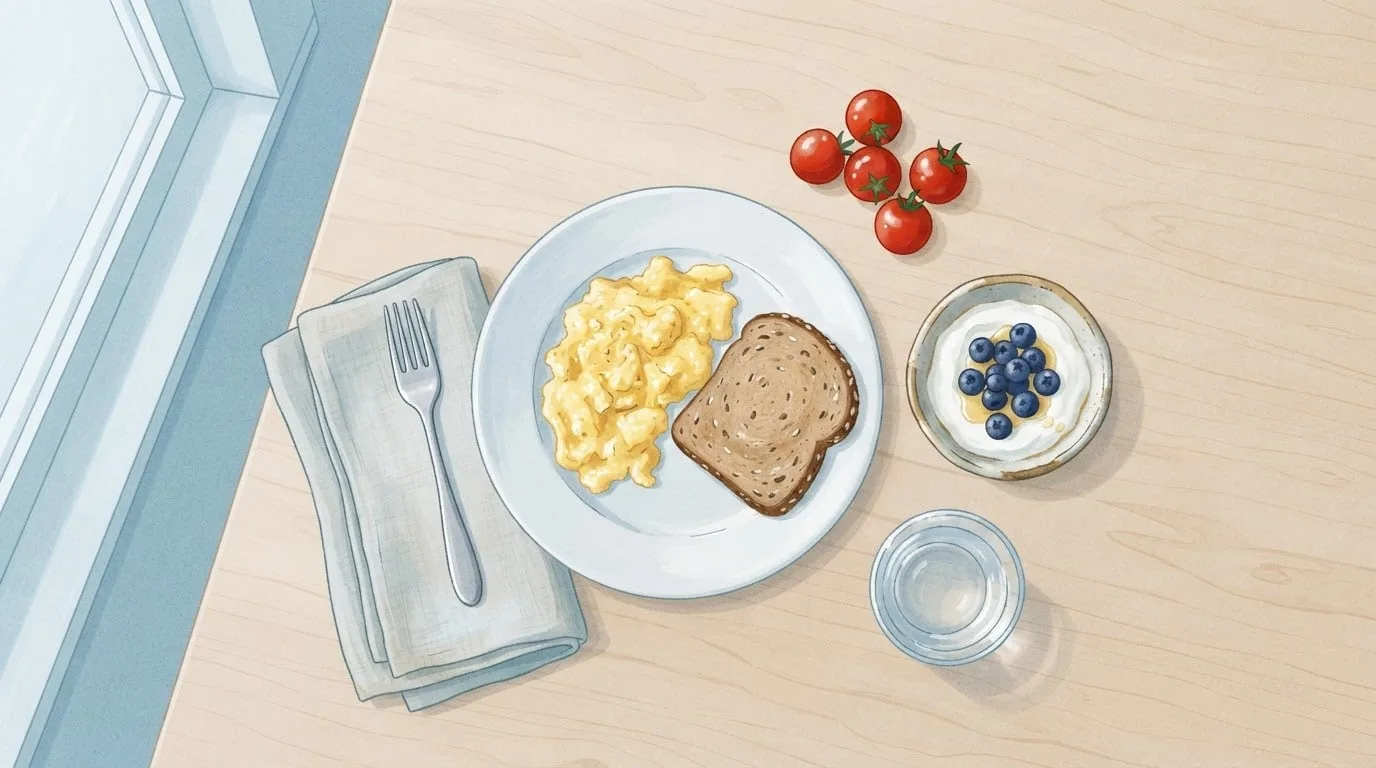
If you skip breakfast, you can still get there. Put 30 to 40 grams of protein into your first meal and your dinner, and add a protein-rich snack if you want a third dose. Eggs, Greek yogurt, cottage cheese, fish, chicken, tofu and beans all work. Our list of high protein breakfast ideas has 15 options with the grams for each, and every one of them works as a late first meal too.
Who Should Not Skip Breakfast
The trials above studied healthy adults. Four groups have specific reasons to keep eating in the morning, or to get advice before they stop.
Children and teenagers
Growing bodies need steady fuel, and the brain seems to feel it most. Adolphus and colleagues (2016) reviewed 45 studies in children and adolescents and found that eating breakfast, compared with fasting, gave a short-term boost the same morning on tasks of attention, memory and executive function. The effect was clearest in undernourished children. The review was funded by a cereal company and found few studies in teenagers, but there's no evidence that skipping helps a growing teen, and good reasons to think it can hurt school mornings.
People taking insulin or other glucose-lowering medicine
In type 2 diabetes, skipping breakfast changes the rest of the day. In a crossover trial, Jakubowicz and colleagues (2015) gave 22 adults with type 2 diabetes the same lunch and dinner on two days, one with breakfast and one without. On the day without breakfast, blood sugar after lunch was 36.8 percent higher and after dinner 26.6 percent higher, and the insulin response was lower and later. Some medicines, including insulin and sulfonylureas, can also push blood sugar too low if a meal is missed. If you take any glucose-lowering medicine, don't change your meal pattern without talking to your doctor first.
Pregnancy
Pregnancy changes how the body handles an overnight fast. Metzger and colleagues (1982) extended the overnight fast from 12 to 18 hours, the equivalent of skipping breakfast, in women in the third trimester and in non-pregnant women. In the non-pregnant women, blood sugar and ketones barely moved. In the pregnant women, blood sugar fell further while ketones and free fatty acids climbed, a pattern the authors called accelerated starvation. They advised that pregnant women avoid skipping breakfast.
A history of disordered eating
For someone who has had an eating disorder, planned long gaps without food can feed the cycle of restricting and then bingeing. Stice and colleagues (2008) followed 496 adolescent girls for five years and found that fasting, going 24 hours without food to control weight, predicted later binge eating and bulimia more consistently than ordinary dieting did. Skipping breakfast isn't a 24-hour fast, but if you have this history, regular meals are usually part of staying well. Follow the plan you've worked out with your clinician or dietitian.
How to Skip Breakfast Without the Downsides
If you're a healthy adult and skipping breakfast suits you, these habits keep it working for you:
- Make the first meal count. Give it 30 grams or more of protein plus fruit, vegetables, whole grains or dairy, the foods that drop out of the diet when breakfast goes.
- Watch for the rebound. If skipping breakfast turns into a huge lunch, constant snacking or a raid on the kitchen at 10 p.m., breakfast is probably the better tool for you.
- Drink something. Water, coffee or tea are fine in the morning. Plenty of people mistake mild thirst for hunger.
- Match food to training. Short sessions can stay fasted. Long or hard sessions go better with a small snack first.
- Keep the pattern steady. Skipping on some days and eating a big breakfast on others makes your hunger harder to read. Pick one pattern for most days.
- Run a two-week test. Try two weeks each way and note your energy, hunger at lunch, evening eating and workouts. Keep whichever pattern wins.
If your plan is intermittent fasting, skipping breakfast is how most 16:8 schedules work in practice. Our review of 16:8 intermittent fasting results covers what the trials found week by week.
What This Means for You
If you're a healthy adult who isn't hungry in the morning, you can skip breakfast without worrying that you're damaging your metabolism or your heart. The trials don't support either fear. Pay attention to the two real costs: the protein and fruit you'd have eaten at breakfast need to show up later, and long or hard workouts go better with some food in you. If you're a teen, pregnant, on glucose-lowering medicine or recovering from an eating disorder, eat breakfast or get advice first.
Breakfast matters less than the routine around it. The meal pattern you can repeat, a decent first meal and workouts that actually happen will do more for you than any rule about the clock. As Katie put it after finally sticking with a plan, "I've tried everything. This is the first time I've stuck with something past two weeks." The best pattern is the one you can keep.
Frequently Asked Questions
What happens if I skip breakfast for one day?
For a healthy adult, nothing harmful. You'll probably feel hungrier by lunch and eat a little more then: in one trial, men who skipped a 733-calorie breakfast ate about 199 calories more at lunch but still ate less over the whole day. If you train later that day, expect slightly less in the tank.
Can eating breakfast lower cortisol?
There's no trial showing it does. One small observational study found that 30 women who habitually skipped breakfast had higher cortisol from their arrival at the lab through midafternoon and a flatter daily cortisol rhythm than 35 breakfast eaters, along with higher blood pressure. Because the women chose their own habits, the study can't show that breakfast caused the difference.
Is it OK to skip breakfast if I work out in the morning?
For most short sessions, yes. A 2018 meta-analysis of 46 studies found that eating beforehand improved prolonged aerobic exercise, over about an hour, but not shorter sessions. For a 20 to 45 minute strength or interval workout, training on an empty stomach is fine if you feel good, and a protein-rich meal afterward covers recovery.
Is skipping breakfast good for weight loss?
It can help if it lowers your total calories, but it isn't magic. In a 2019 BMJ review of 13 trials, people told to skip breakfast weighed 0.44 kg less on average than breakfast eaters, a small and uncertain difference. Some people make up the calories later in the day, so the result depends on what the rest of your day looks like.
Is it better to skip breakfast or lunch to lose weight?
Whichever one you can drop without overeating later. In US survey data from 23,488 adults, skipping any meal lowered the day's intake, from about 250 calories for breakfast to about 350 for dinner, but it also lowered diet quality. If you skip a meal, make the next one carry the protein, fruit, vegetables and whole grains you would have eaten.
Is skipping dinner good for weight loss?
It cuts the most calories of any meal, about 350 a day in US survey data, but it also cut vegetables, beans, dairy and protein foods from the diet. Dinner is often the meal where those foods show up. If evening eating is your problem, a smaller, earlier dinner is usually easier to keep than none at all.
Why do I feel better when I don't eat breakfast?
Many people simply aren't hungry in the morning, and a large meal can leave some people feeling sluggish. Feeling better without breakfast is a reasonable sign that skipping suits you, as long as you're not making up for it with heavy snacking later and you're getting enough protein across the rest of the day.
Is skipping breakfast the same as intermittent fasting?
Often, yes. Most 16:8 intermittent fasting plans work by pushing the first meal to around noon, which is the same pattern the Bath Breakfast Project tested. The trials suggest it works about as well as ordinary calorie cutting for weight loss and no better, so pick it only if the schedule suits you.