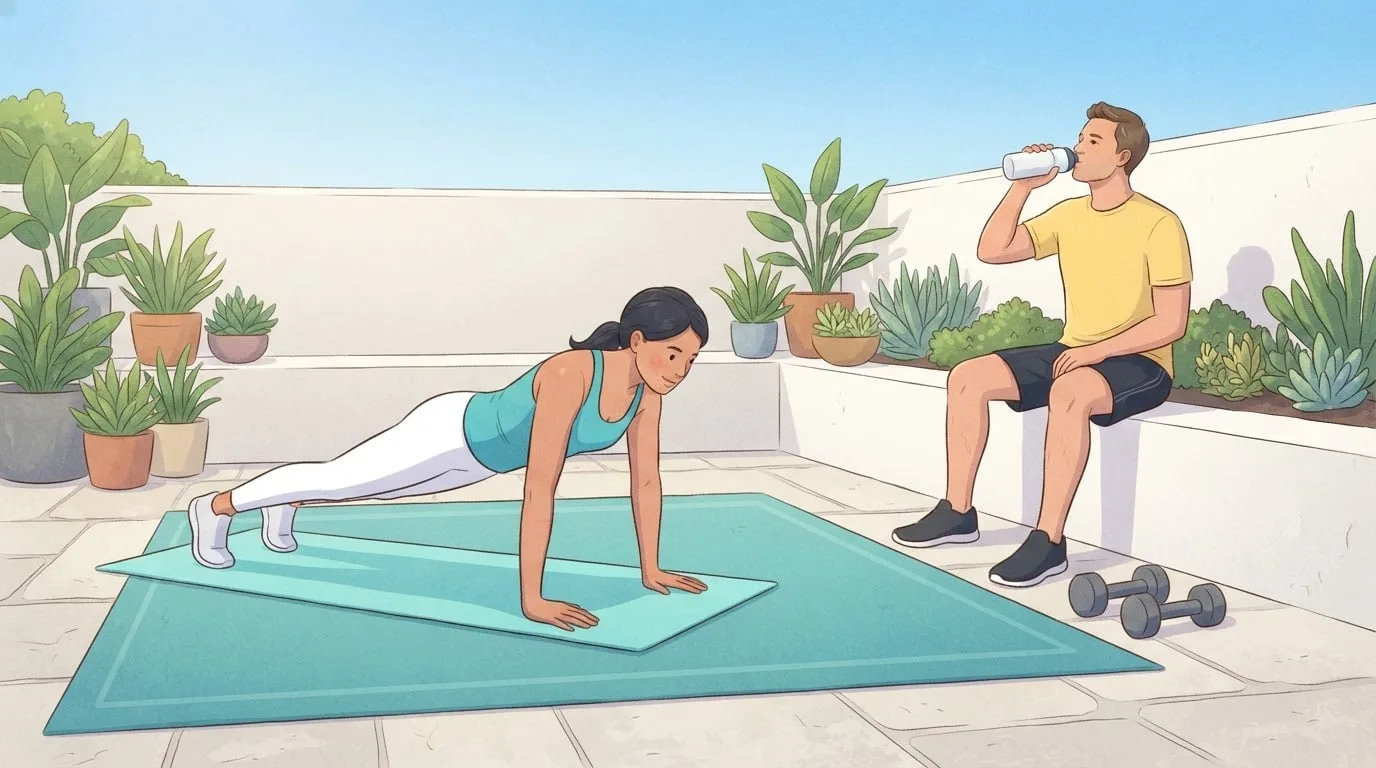
You open a workout plan and the first line reads: goblet squat, 3x8-12, rest 90 s, tempo 3-1-1-0. If you've ever stood in your living room wondering whether that means three sets or eight, you're not the problem. Workout notation is a shorthand that coaches pick up on the job and rarely explain.
That gap matters more than it seems. When a plan reads like code, the easy move is to guess, skip the parts you don't understand, or fall back on the three exercises you already know. Learning to read it takes about ten minutes, and it turns any program into steps you can follow.
This page covers what counts as a rep, what ends a set, how reps and sets fit together, what 3x10 and the other common formats mean, how AMRAP, RPE, supersets, rest and tempo are written, and a full home workout decoded line by line. How many reps to do for each goal has its own page: our guide to how many reps you should do covers the ranges for strength, muscle and endurance.
What Is a Rep in Working Out?
A rep, short for repetition, is one complete movement of an exercise, from the start position and back again. One squat, down and up, is one rep. One biceps curl, up and down, is one rep. Most reps have two phases: a lowering phase, called the eccentric, and a lifting phase, called the concentric, often with a short pause between them.
A rep counts as a full rep when it covers the whole range of motion the exercise calls for. There's evidence behind that rule. A 2021 meta-analysis of 16 studies by Pallarés and colleagues found that training through a full range of motion produced larger strength gains than partial reps (effect size 0.56) and more lower-body muscle growth (effect size 0.88). The 2026 American College of Sports Medicine position stand, an overview of 137 systematic reviews by Currier and colleagues, also lists a complete range of motion among the few training choices that improved strength.
How to count reps on one side
For single-arm and single-leg exercises, programs write "each side", "per side" or "/side". Ten reverse lunges each side means 10 on the left leg and 10 on the right. Alternating exercises, such as alternating lunges or bicycle crunches, get counted both ways in different programs. If yours doesn't say, pick one way and count it the same every session, so your numbers stay comparable.
Timed sets and holds
Some exercises have no reps at all. A plank or a wall sit is written as a time, such as 3x30 s, which means three 30-second holds with a rest after each. Some circuits run on time too, such as 40 seconds of work and 20 seconds of rest for each exercise.
What Is a Set in Exercise?
A set is a group of reps done one after another without stopping, followed by a rest. Ten push-ups in a row, then a break, is one set of 10. The next run of push-ups is your second set.
Where a set ends matters as much as how many reps it holds. Steele and colleagues (2017), writing in Muscle & Nerve, pointed out that the endpoint of a set, usually judged by how close it stops to momentary failure, is thought to be one of the main variables that decides how hard the set is, and that loose terms had made research findings harder to interpret. Programs set the endpoint in four common ways:
- A fixed number: 3x10 means you stop at 10 reps, even if you could do more.
- A range: 3x8-12 means you stop somewhere between 8 and 12 reps, usually when the next rep would break your form.
- An effort target: RPE 8 or 2 RIR means you stop with about two good reps left.
- As many as possible: AMRAP means you keep going until you can't do another rep with good form.
Warm-up sets usually don't count. When a program says 3x10, it means three working sets at the planned weight, and any lighter sets you do first to get ready come on top of those.
Reps vs Sets: How the Two Numbers Fit Together
Reps are the units inside a set, and sets are the units inside an exercise, so reps vs sets comes down to which level you're counting. A workout stacks them: reps make sets, sets make an exercise, and several exercises make a session. In a circuit, where you move through several exercises before you rest, one pass through the whole list is called a round.
| Term | What it counts | Example |
|---|---|---|
| Rep | One complete movement | One squat, down and up |
| Set | Reps done in a row before a rest | 12 squats, then a rest |
| Round | One pass through a circuit | Squats, push-ups and rows, then a rest |
| Total reps | Sets multiplied by reps | 3x10 adds up to 30 reps |
When researchers measure how much you trained, they usually count hard sets per muscle per week rather than reps. The 2026 ACSM overview found that muscle growth was enhanced by higher weekly volumes of 10 or more sets, and our review of how many sets per muscle group per week walks through the dose-response trials behind that number.
What Does 3x10 Mean?
3x10 means 3 sets of 10 reps. You do 10 reps, rest, do 10 more, rest again, and finish with a third set of 10, for 30 reps in total. Read the first number as the sets and the x as "sets of".
Every other pair of numbers works the same way:
| Written as | Read it as | Reps in total |
|---|---|---|
| 3x10 | 3 sets of 10 reps | 30 |
| 3x8 | 3 sets of 8 reps | 24 |
| 3x15 | 3 sets of 15 reps | 45 |
| 2x15 | 2 sets of 15 reps | 30 |
| 5x5 | 5 sets of 5 reps | 25 |
| 4x6-8 | 4 sets of 6 to 8 reps | 24 to 32 |
| 3x10 each side | 3 sets of 10 on each side | 30 per side |
| 3x30 s | 3 holds or efforts of 30 seconds | 90 seconds of work |
What if the numbers are the other way round?
Most programs write sets first, but some write reps first, which is why people search for things like "20 3 sets". One rule settles it: a single exercise rarely gets more than five or six sets, so in 20x3 or "20 reps, 3 sets" the 20 is the reps, and you'll do 3 sets of 20. When a weight is added, it usually sits after an @ sign or in front of the sets. So 3x10 @ 12 kg and 12 kg 3x10 both mean 3 sets of 10 reps with 12 kg dumbbells.
Knowing what to do is the easy part.
FitCraft, our mobile fitness app, pairs you with an AI coach who builds you a personalized plan around your goals, schedule, and fitness level. Every FitCraft program is designed by Domenic Angelino, MPH (Brown University) and NSCA-CSCS, with research published in the Journal of Strength and Conditioning Research and Medicine & Science in Sports & Exercise.
Take the Free Assessment Free • 2 minutes • No credit cardHow to Read a Rep Range Like 3x8-12
A rep range leaves the weight to you and tells you when to change it. 3x8-12 means 3 sets of 8 to 12 reps. Pick a weight you can lift at least 8 times with clean form. Each session, try to add a rep or two. When you can do 12 reps on all three sets, move up to the next weight and drop back toward 8. Coaches call this double progression, because the reps go up first and the weight goes up second.
The 2009 ACSM position stand on progression models turned the same idea into a number: once you can do one or two reps more than the target, raise the load by 2 to 10 percent.
Programs give you reps instead of a weight because the same weight feels very different from one exercise and one person to the next. A 2024 meta-analysis by Nuzzo and colleagues pooled 952 reps-to-failure tests from 7,289 people in 269 studies. At 70 percent of a one-rep max, people managed about 15 reps on average, but about 19 on the leg press and about 14 on the bench press. At 90 percent, the average fell to about 5. A rep target lets you find the right weight for you on each exercise.
When your dumbbells top out
At home, the jump to the next dumbbell is often too big, or you don't own a heavier pair. Keep the range and make each rep harder another way. Slow the lowering phase, add a pause at the bottom, cut the rest by 15 to 30 seconds, or switch to a harder version, such as a split squat in place of a squat. Any of these can make 12 reps hard again with the same weight.

What Does AMRAP Mean in Reps?
AMRAP means as many reps as possible. Written after a set count, such as 3xAMRAP push-ups, it means each set ends when you can't do another rep with good form, and the number you reach is your result. You'll often see it on bodyweight moves, where you can't add weight, and as one last set, such as 3x10 plus 1xAMRAP, to test how much stronger you've become.
In a timed circuit, the same letters mean as many rounds as possible: AMRAP 12 minutes means you repeat the circuit for 12 minutes and count the rounds. Either way, two habits keep AMRAP sets useful. Count only reps with a full range of motion and good form, and write the number down so you have something to beat next time. You don't need to take every set that far, either. The 2026 ACSM overview concluded that taking sets to momentary failure doesn't enhance gains in strength, muscle size or power, and suggested ending most sets with 2 to 3 reps in reserve.
What Do RPE and RIR Mean in a Workout?
RPE and RIR are two ways of writing how hard a set should feel. RIR stands for reps in reserve, the number of good reps you could still do when you stop. RPE stands for rating of perceived exertion, and on the lifting version of the scale, RPE 10 means no reps left, RPE 9 means one left and RPE 8 means two left.
That scale was tested in a 2016 study by Zourdos and colleagues in the Journal of Strength and Conditioning Research. In 29 lifters, the RPE people reported closely matched how slowly the weight moved, a strong inverse correlation in both experienced squatters (r = -0.88) and novices (r = -0.77). So 3x10 @ RPE 8 means 3 sets of 10 with a weight heavy enough that you finish each set with about 2 good reps left. If a set feels like RPE 6, the weight is too light. If you can't reach 10, it's too heavy.
Supersets, Circuits and Other Set Formats
Not every set is done on its own. These are the formats you'll see most often, and how each one is written:
| Format | How it's written | What you do |
|---|---|---|
| Straight sets | 3x10 | Do every set of one exercise, resting between them, before you move on |
| Superset | A1 / A2 | Do two exercises back to back with no rest, then rest after the pair |
| Tri-set or giant set | A1 / A2 / A3 | Do three or more exercises back to back, then rest |
| Circuit | 3 rounds | Do one set of each exercise in a row, rest, then repeat the list |
| Drop set | 1x10 + drop | After the last rep, switch to a lighter weight and keep going |
| EMOM | EMOM 10 min | Start a set at the top of every minute and rest for what's left of it |
Read the letters as groups and the numbers as the order. A1 and A2 share the letter A, so you do one set of A1, then one set of A2, then rest, until all the sets are done. Then you move on to B1 and B2.
A brief review by Robbins and colleagues (2010) in the Journal of Strength and Conditioning Research concluded that pairing exercises for opposing muscles is an efficient way to build strength and power in less time. The 2026 ACSM overview found that set structures such as drop sets and cluster sets (sets broken up by short rests) didn't consistently change training outcomes. So the format you pick is mostly about your time and your equipment. Our supersets guide covers how to pair exercises and includes two home superset workouts.
How Rest Is Written in a Workout
Rest is written as a time after the sets and reps, such as "rest 90 s", "R 2:00" or "rest 60-90 s". The clock starts when the last rep of a set ends and stops when the first rep of the next set begins. Unless the program says otherwise, that rest is the gap between sets of the same exercise, and you take a minute or so on top to set up the next exercise.
In a superset, the rest comes after the pair. "A1 / A2, rest 90 s" means no rest between A1 and A2, then 90 seconds before the next round. A circuit works the same way, with the rest after each full round. How long to rest depends on your goal, and as a rough guide:
- Heavy strength work: 2 to 5 minutes.
- Muscle growth: 1 to 3 minutes.
- Muscular endurance: 30 to 60 seconds.
Our article on how long to rest between sets explains the research behind those ranges and how to use your breathing as a guide.
What Is Tempo in a Workout?
Tempo tells you how many seconds each part of a rep should take. It's written as four numbers, with dashes, slashes or nothing between them, such as 3-1-1-0, 3/1/1/0 or 3110. In the convention described in a 2021 review by Wilk, Zajac and Tufano in Sports Medicine, the four numbers are, in order:
- The lowering phase (eccentric).
- The pause at the bottom.
- The lifting phase (concentric).
- The pause at the top.
So a goblet squat at 3-1-1-0 means 3 seconds down, a 1-second pause at the bottom, 1 second up and straight into the next rep. An X in place of a number means move as fast as you can, so 2-0-X-0 is a controlled 2-second lowering followed by an explosive lift.
For muscle growth, tempo matters less than many people think. A meta-analysis of 8 studies by Schoenfeld, Ogborn and Krieger (2015) found similar growth with reps lasting anywhere from 0.5 to 8 seconds, while very slow reps of more than 10 seconds appeared to be worse. The Wilk review judged a slower lowering phase paired with a faster lift to be the most favorable mix for muscle growth. At home, tempo is mostly a tool: a 3-second lowering makes a light dumbbell feel heavier, which helps once your weights top out.
How to Read a Workout: One Home Session, Line by Line
Here's a full-body session written the way most programs write it. It needs one pair of dumbbells and a mat.
| As written | What you do |
|---|---|
| Goblet squat 3x8-12, tempo 3-1-1-0, rest 90 s | Hold one dumbbell at your chest and do 3 sets of 8 to 12 squats. Take 3 seconds to lower, pause for 1 second, stand up in 1 second. Rest 90 seconds after each set. |
| A1. One-arm dumbbell row 3x10 each side | Do 10 rows with your left arm, then 10 with your right. That's one set of A1. Go straight to A2. |
| A2. Push-up 3xAMRAP, rest 90 s | Do as many good push-ups as you can, then rest 90 seconds and go back to A1. Repeat the pair for 3 rounds. |
| Dumbbell Romanian deadlift 3x10 @ RPE 8, rest 60-90 s | Do 3 sets of 10 with dumbbells heavy enough that you finish each set with about 2 good reps left. |
| Plank 3x30 s, rest 30 s | Hold a plank for 30 seconds three times, with 30 seconds of rest between holds. |
Counted up, that's 15 sets: 3 of squats, 6 in the row and push-up superset, 3 of Romanian deadlifts and 3 planks. With a 5-minute warm-up, the whole session takes about 30 to 35 minutes.
Before you start any workout, read each line once and check three things: how many sets there are, what ends each set (a number, a range, an effort target or AMRAP), and how long you rest. Then note what you actually did next to each line, such as the weight and the reps in each set. Next session, try to beat one of those numbers.
What This Means for You
Once you can read sets and reps, a workout stops looking like a code you don't have the key to. You can open any program, see 3x8-12 or A1 / A2 or 3-1-1-0, and know what the next half hour looks like. That matters, because guessing is where a lot of home workouts fall apart: you're not sure what to do, so you do less, or nothing at all.
The notation is the easy part. The harder part is showing up for the next session, and the one after that, long enough for the numbers in your notes to climb. Picture a few weeks from now: your goblet squats have gone from 8 reps to 12, you've picked up a heavier dumbbell, and reading a new plan takes you seconds.
If you'd rather have your workouts planned for you, an AI personal trainer app can lay them out. In FitCraft, a 3D AI coach demonstrates every exercise, the workouts adjust as you progress, and streaks keep count of the days you show up.
Frequently Asked Questions
What is the 3-3-3 rule in gym?
The 3-3-3 rule is a social media template rather than a training standard, and the details change from site to site. The most common version is three exercises, three sets of each, on three days a week. In workout notation that's three exercises written as something like 3x10, done three times a week.
What do 3 sets of 15 reps mean?
3 sets of 15 reps, written 3x15, means you do 15 reps of an exercise, rest, do another 15, rest again, then finish with a third set of 15, for 45 reps in total. Pick a weight or a version of the exercise that makes the last few reps of each set feel hard but keeps your form clean.
Is 2 sets of 20 reps enough?
2 sets of 20 reps can be enough for one exercise when both sets end close to failure. For muscle growth, though, it gives that muscle only 2 of the 10 or more weekly sets the 2026 ACSM position stand linked to better results, so add sets for the same muscle on other days or with other exercises. If 20 reps feels easy, use a harder variation or a heavier weight.
Will 12 reps build muscle?
Yes. Sets of 12 reps build muscle when the weight is heavy enough that each set ends within a few reps of failure, and when the muscle gets enough sets across the week. Muscle grows across a wide span of rep counts, and 12 is simply an easy target to progress from.
Can you do reps and sets at home without weights?
Yes. Bodyweight exercises use the same notation, so 3x10 push-ups or 3x15 squats are read exactly like a dumbbell workout. When an exercise gets easy, add reps until you reach the top of your range, then switch to a harder variation, such as moving from push-ups with your hands on a bench to push-ups on the floor. Holds such as planks are written as a time, for example 3x30 s.