
You finished a workout dripping with sweat, and now you're not sure it counted. Maybe it was a hard set of squats, a long yoga class or an afternoon spent cleaning out the garage. Your heart was pounding, but is that cardio?
The confusion is understandable. Fitness advice tends to treat cardio as running or the bike at the gym, and everything else as something less. That framing leaves a lot of people believing their activity doesn't count, which makes it easier to skip altogether. The actual definition is broader, more generous and easy to check for yourself.
This page explains what counts as cardio using the same three tests the exercise guidelines use. It covers how hard is hard enough, the heart rate ranges for your age, which everyday activities make the cut, whether strength training or yoga counts, a list of cardio exercises you can do at home, how much you need a week and which cardio burns the most fat.
What Counts as Cardio: Three Simple Tests
An activity counts as cardio when it passes all three of these tests.
- It moves large muscles in a rhythmic, repeated way. The American College of Sports Medicine describes cardiorespiratory exercise as rhythmic, continuous activity that uses the major muscle groups, in its position stand by Garber and colleagues (2011). Walking, cycling, swimming, rowing, dancing and climbing stairs all fit. Holding a plank doesn't, because nothing repeats.
- It reaches at least a moderate effort. The CDC classes activity at 3 to 5.9 METs as moderate and 6 or more as vigorous, where 1 MET is the energy you use sitting still. The simplest check is the talk test: at a moderate effort you can talk but not sing, and at a vigorous effort you can't say more than a few words without pausing for breath.
- It lasts long enough to add up. The 2018 Physical Activity Guidelines for Americans, summarized by Piercy and colleagues (2018), dropped the old rule that only bouts of 10 minutes or more count. A brisk 5-minute walk to the train now counts toward your weekly total. To build fitness, though, most cardio sessions run 20 minutes or longer.
Moderate vs Vigorous Cardio
Both intensities count, but a vigorous minute does about twice the work of a moderate one. The guidelines count one vigorous minute as two moderate minutes for that reason.
| Intensity | METs | Share of max heart rate | Talk test | Examples |
|---|---|---|---|---|
| Light | Under 3 | Under about 64% | You can sing | Slow stroll, gentle stretching |
| Moderate | 3 to 5.9 | About 64 to 76% | You can talk, not sing | Brisk walking, easy cycling, water aerobics |
| Vigorous | 6 or more | About 77 to 95% | Only a few words at a time | Running, fast cycling, jumping rope, HIIT |
What is cardio heart rate?
The heart rate ranges in the table come from the ACSM position stand: about 64 to 76 percent of your maximum heart rate for moderate cardio and 77 to 95 percent for vigorous cardio. The common 220 minus age formula underestimates maximum heart rate in older adults. Tanaka and colleagues (2001) pooled 351 studies with 18,712 people and found that 208 minus 0.7 times your age predicts it better. Here's what that gives:
| Age | Estimated max heart rate | Moderate cardio (bpm) | Vigorous cardio (bpm) |
|---|---|---|---|
| 20 | 194 | 124 to 147 | 149 to 184 |
| 30 | 187 | 120 to 142 | 144 to 178 |
| 40 | 180 | 115 to 137 | 139 to 171 |
| 50 | 173 | 111 to 131 | 133 to 164 |
| 60 | 166 | 106 to 126 | 128 to 158 |
| 70 | 159 | 102 to 121 | 122 to 151 |
These are estimates. Your true maximum can differ from the formula by 10 beats or more, and some medications, such as beta blockers, lower heart rate during exercise. If the numbers and the talk test disagree, trust the talk test. The easy end of moderate overlaps with what many people call zone 2, and our guide to zone 2 cardio covers that range and how to stay in it at home.
Does It Count as Cardio? Common Activities by METs
The 2024 Adult Compendium of Physical Activities lists measured energy costs for more than 1,100 activities. Here's where common ones land against the 3-MET line for moderate and the 6-MET line for vigorous.
| Activity | METs | Counts as cardio? |
|---|---|---|
| Hatha yoga, general | 2.3 | No, light |
| Slow walking, about 2 mph | 2.8 | No, light |
| Vacuuming, moderate effort | 3.0 | Just, at the bottom of moderate |
| Weight training, 8 to 15 reps | 3.5 | Counts as strength work; the effort comes in bursts |
| Sun salutations | 3.5 | Yes, moderate |
| Brisk walking, 3.5 to 3.9 mph | 4.8 | Yes, moderate |
| Jogging in place | 4.8 | Yes, moderate |
| Low-impact aerobic dance | 4.8 | Yes, moderate |
| Carrying groceries upstairs | 5.3 | Yes, moderate, while it lasts |
| Stationary cycling, 90 to 100 watts | 6.0 | Yes, vigorous |
| Jumping jacks and other vigorous calisthenics | 7.5 | Yes, vigorous |
| Running, 10-minute mile | 9.3 | Yes, vigorous |
| Climbing stairs, fast | 9.3 | Yes, vigorous |
| Jumping rope | 11.0 | Yes, vigorous |
| HIIT with burpees and squat jumps | 11.0 | Yes, vigorous |
Does walking count as cardio?
Brisk walking does. At 3.5 to 3.9 mph it costs 4.8 METs, well inside the moderate range, and it's the activity most people use to meet the guidelines. A slow stroll at about 2 mph doesn't reach the line. So when someone says cardio means walking, they're half right: it depends on the pace. Our article on whether walking counts as exercise goes into the step-count evidence and how to make a walk count for more.
Is swimming cardio?
Yes. Steady lap swimming reaches moderate to vigorous intensity, even though your heart rate reads lower in the water than it would on land. Our article on whether swimming is cardio explains why the numbers look different in the pool.
Does yoga count as cardio?
Most yoga doesn't. Hagins and colleagues (2007) measured 20 experienced practitioners in a metabolic chamber during a 56-minute hatha session. The session averaged 2.5 METs and about 49 percent of predicted maximum heart rate, similar to walking at 3.2 km/h, about 2 mph. The authors concluded that a typical session doesn't meet the intensity needed for cardiovascular fitness, though stretches of sun salutations lasting 10 minutes or more may. The Compendium agrees, putting sun salutations at 3.5 METs and power yoga at 4.0. Yoga still builds flexibility, balance and calm. It just isn't your cardio.
Do chores count as cardio?
Some do, while you're doing them hard. Vacuuming at a moderate effort is 3.0 METs, carrying groceries upstairs is 5.3 and playing actively with children is 3.5 to 5.8. Because bouts of any length now count, a hard half hour of yard work or cleaning adds to your weekly total. What doesn't count is the stop-start pottering in between.
Does Strength Training Count as Cardio?
Traditional strength training doesn't count toward your cardio minutes. Lifting with sets of 8 to 15 reps averages 3.5 METs in the Compendium, and the effort comes in short bursts separated by rests, so your heart rate rises and falls instead of staying up. That's why the guidelines treat muscle-strengthening as its own target, on two or more days a week, on top of your cardio.
Change the format and the answer changes. When you move from exercise to exercise with little or no rest, a strength workout becomes a circuit, and circuits raise aerobic fitness. A meta-analysis by Muñoz-Martínez and colleagues (2017) found that resistance circuit training increased VO2 max in healthy adults. The largest effects came from programs of about 14 to 30 sessions over 6 to 12 weeks, with each session lasting at least 20 to 30 minutes at 60 to 90 percent of one-rep max. Bodyweight HIIT with burpees, mountain climbers and squat jumps sits at 11 METs, about as high as the Compendium goes for home exercise.
So a heavy squat session with three-minute rests is strength work. A 25-minute dumbbell circuit that keeps you breathing hard counts as both.
Knowing what to do is the easy part.
FitCraft, our mobile fitness app, pairs you with an AI coach who builds you a personalized plan around your goals, schedule, and fitness level. Every FitCraft program is designed by Domenic Angelino, MPH (Brown University) and NSCA-CSCS, with research published in the Journal of Strength and Conditioning Research and Medicine & Science in Sports & Exercise.
Take the Free Assessment Free • 2 minutes • No credit cardWhat Counts as Cardio for Beginners
Intensity is relative to your fitness, which is good news if you're starting out. The ACSM ranges are percentages of your own maximum heart rate, so the same brisk walk that barely registers for a runner can be solid moderate cardio, or even vigorous, for someone who hasn't exercised in a while.
Beginners also improve faster. In a meta-analysis of 28 trials, Milanović and colleagues (2015) found that people who started with lower fitness gained more from both steady endurance training and interval training than fitter people did. The ACSM position stand also notes that adults who can't reach the full targets still benefit from doing less.
If you're new, start with brisk walking or a low-impact routine at home, and use the talk test rather than a heart rate number. Aim to talk in full sentences but feel your breathing pick up. Ten minutes counts. When that feels easy, make the sessions longer before you make them harder.
List of Cardio Exercises at Home
You don't need a treadmill, a bike or a gym to do cardio. These moves all count when you keep them going for a few minutes at a time:
- Marching or jogging in place: 4.8 METs at a jog, an easy way to start.
- Step-ups on a stair: step aerobics on a 6 to 8 inch step rates 7.3 METs.
- Climbing your stairs: 4.5 METs at a slow pace and 9.3 at a fast one.
- Low-impact aerobic dance: 4.8 METs, and high-impact dance reaches 8.0.
- Jumping jacks: 7.5 METs as part of vigorous calisthenics.
- Shadow boxing: punching combinations while you stay light on your feet.
- Mountain climbers: a plank with fast alternating knee drives.
- Burpees and squat jumps: the core of vigorous HIIT at 11 METs.
- Jumping rope: 11 METs for general rope skipping, if you have the ceiling height.
- A dumbbell or bodyweight circuit: five or six exercises back to back with little rest.
A simple 20-minute session: march or jog in place for 3 minutes, then repeat four rounds of 40 seconds each of step-ups, jumping jacks, shadow boxing and mountain climbers, with 20 seconds of marching between moves, and finish with an easy 1-minute march. If jumping bothers your knees, our guide to low impact cardio at home has 10 moves and three routines that keep one foot on the floor.
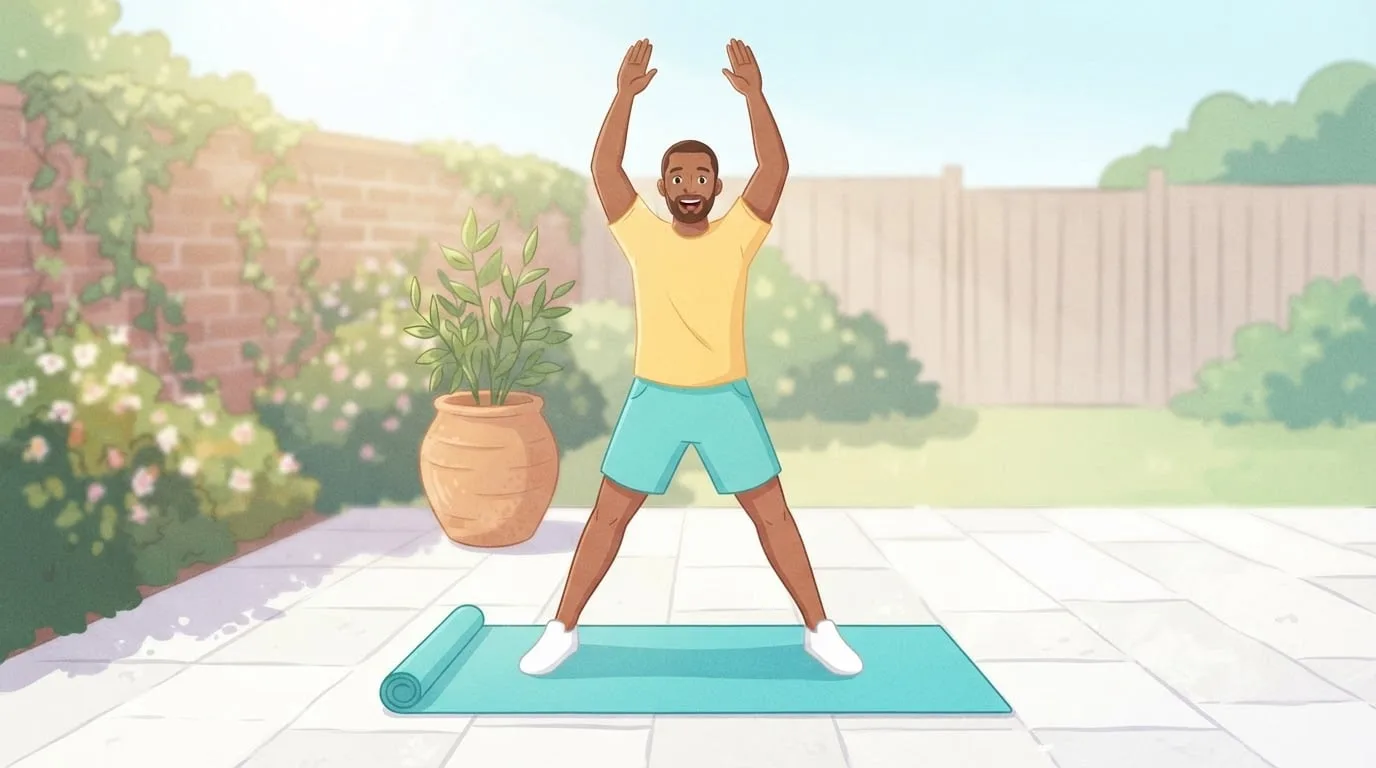
If you'd like those sessions planned and led for you, a home workout app that needs no equipment can do it. FitCraft's workouts include cardio, a 3D AI coach demonstrates each move, the workouts adjust as you progress, and streaks keep a running count of the days you show up.
How Much Cardio a Week?
Adults should get 150 to 300 minutes of moderate cardio a week, 75 to 150 minutes of vigorous cardio, or a mix of the two, according to both the US guidelines and the World Health Organization's 2020 guidelines. Both also ask for muscle-strengthening work on two or more days a week. Here are three ways to hit the minimum:
- Five brisk 30-minute walks.
- Three 25-minute runs or HIIT sessions.
- Two 30-minute bike rides plus three 15-minute home circuits.
More is better up to the top of those ranges and beyond. The guidelines note extra health benefits past 300 moderate minutes a week.
How Long Does It Take to Improve Cardio?
Measurable gains show up within about six weeks. In a trial by Gormley and colleagues (2008), healthy young adults trained on bikes for six weeks with the total energy held equal across groups. VO2 max rose 10 percent with moderate training, 14.3 percent with vigorous training and 20.6 percent with near-maximal intervals. Across 28 trials, Milanović's meta-analysis found that steady endurance training raised VO2 max by 4.9 mL/kg/min compared with no exercise. High-intensity interval training raised it by 5.5. Interval training came out ahead of steady training by a small margin of 1.2 mL/kg/min.
You'll usually feel the change before a test shows it. Stairs and hills that left you puffing start to feel ordinary after a few weeks of regular cardio, because your heart pumps more blood per beat and your muscles get better at using oxygen.
Which Cardio Burns the Most Fat?
Per minute, the highest-MET activities burn the most calories: jumping rope and vigorous HIIT at about 11 METs, running and fast stair climbing at 9.3, and vigorous elliptical work at 9.0. Your body's share of energy from fat follows a different curve. Achten and colleagues (2002) found that fat burning peaked at about 64 percent of VO2 max, around 74 percent of maximum heart rate, and fell to almost nothing above about 89 percent of VO2 max.
Over weeks, what matters is total energy spent, and both styles get there. In a meta-analysis of 13 trials in adults with overweight or obesity, Wewege and colleagues (2017) found that interval training and steady moderate cardio reduced body fat by similar amounts over about 10 weeks. The interval training took about 40 percent less time. So the cardio that burns the most fat is the kind you'll keep doing every week, ideally alongside strength training and an eating pattern you can sustain.

What This Means for You
More of your movement counts than you probably think. A brisk walk counts. So does a dance class, a session of step-ups on the stairs, or a dumbbell circuit with short rests. The things that don't count as cardio, like a slow stroll, gentle yoga or heavy lifting with long rests, still count for something else.
The bigger risk is the all-or-nothing rule that says only a gym session or a long run is real exercise. That rule makes it easy to skip a day because you can't do the "proper" workout. Picture a normal week a couple of months from now: a few brisk walks, two short home circuits and a weekend bike ride, every one of them counting toward your minutes, and stairs that no longer leave you out of breath. That's a cardio habit you can keep.
Frequently Asked Questions
Is cardio a form of workout?
Yes. Cardio, short for cardiovascular or aerobic exercise, is one of the main types of workout, alongside strength, flexibility and balance training. A cardio workout can be a 30-minute run or bike ride, a dance class, a swim, or a 20-minute circuit of jumping jacks and step-ups at home, as long as it keeps your heart rate up at a moderate effort or harder.
What is the 3-3-3 cardio rule?
The 3-3-3 rule is a social media guideline with no research behind it, and it means different things on different sites. One common version is a weekly mix of three strength sessions and three cardio sessions with rest or light activity in between, and another is a short routine of 3 minutes of incline walking, 3 minutes of light jogging and 3 sets of a strength move. Check any version against the guideline of 150 to 300 minutes of moderate cardio a week.
How many minutes of cardio a day do you need?
About 22 minutes of moderate cardio a day, or 11 minutes of vigorous cardio, meets the minimum of 150 moderate or 75 vigorous minutes a week. You can also do it in fewer, longer sessions, such as 30 minutes five days a week. Since 2018, US guidelines count bouts of any length, so two brisk 10-minute walks count as 20 minutes.
Can you overdo cardio?
Yes, most often by adding too much too quickly rather than by doing a lot. Sudden jumps in running or jumping volume raise the risk of overuse injuries, and stacking hard sessions without easy days can leave you tired, sore and sleeping badly. Build your weekly minutes gradually, keep most sessions at a talking pace and take at least one rest day a week.
What does cardio mean in medical terms?
In medical terms, cardio is short for cardiovascular, which refers to the heart and blood vessels. Cardiovascular or aerobic exercise is activity that makes the heart, lungs and blood vessels work harder to deliver oxygen to working muscles. The prefix cardio on its own means heart, as in cardiology.