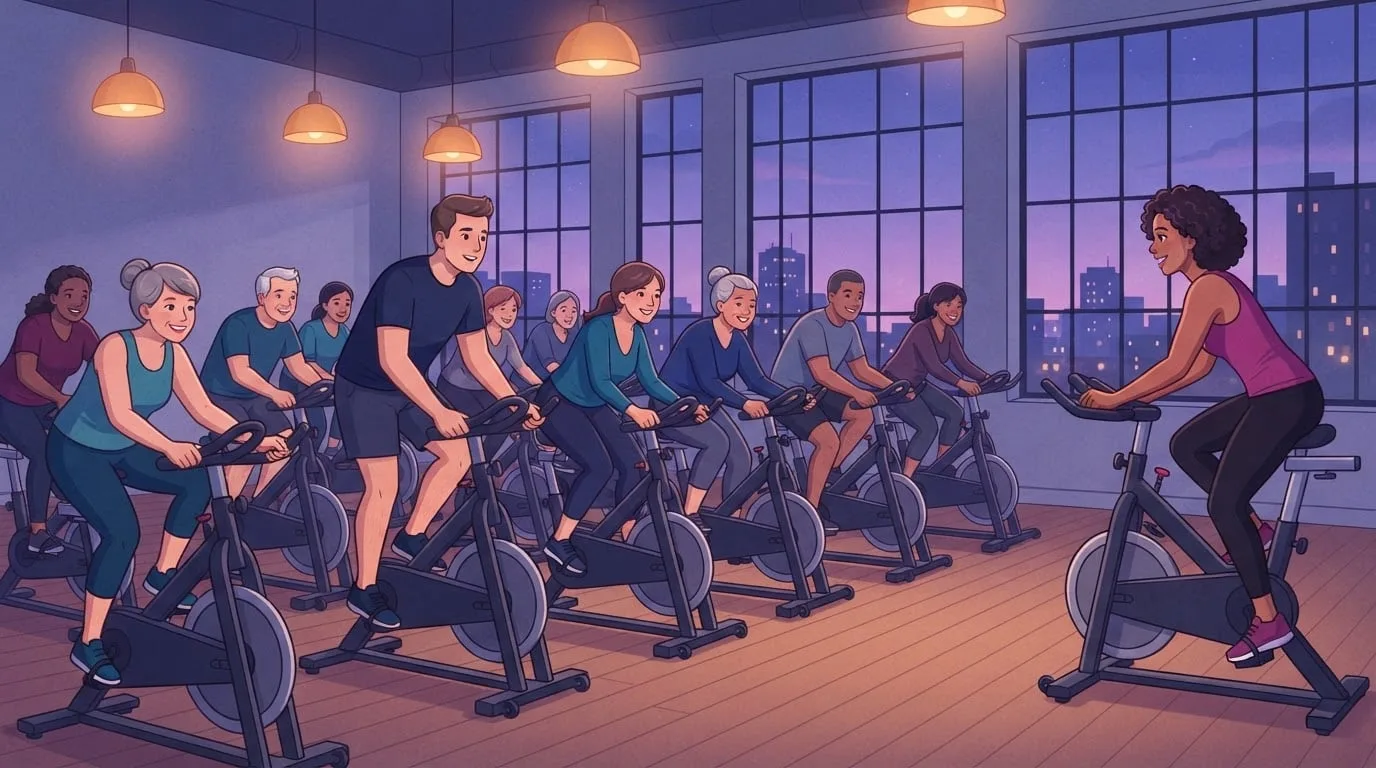
You've heard people talk about spin class as if it changed their life, or you've seen it as a punchline in a sitcom: a dark room, loud music and a row of people pedaling hard to nowhere. If you've never been, it's easy to feel that everyone else already knows the rules.
The rules are simple. You have one knob, and nobody else can see where it's set. That's the most useful thing to know before your first class, because beginners get into trouble when they try to match the room instead of riding their own ride.
What Do You Do in a Spin Class?
In a spin class you ride a stationary bike through a planned mix of warm-up, flat riding, climbs and cool-down, while an instructor calls out cadence, resistance and position over music. You adjust the resistance yourself. Most sessions in the research ran 45 to 60 minutes, usually two or three times a week.
Here's how a 45-minute class usually runs, adapted from the 50-minute session in Muyor's 2013 study. Instructors vary the order, and cadence means how fast your legs turn in revolutions per minute (rpm).
| Minutes | Block | What you do | Cadence |
|---|---|---|---|
| 0 to 8 | Warm-up | Seated, light resistance, breathing easily | 90 to 100 rpm |
| 8 to 18 | Flats | Seated, moderate resistance, a few faster efforts | 80 to 110 rpm |
| 18 to 28 | First climb | More resistance, seated at first, then standing | 60 to 80 rpm |
| 28 to 40 | Mixed block | Flats and climbs in turn, usually the hardest stretch | 60 to 110 rpm |
| 40 to 45 | Cool-down | Light resistance, then stretches off the bike | 80 to 100 rpm |
You'll hear four basic moves. In a seated flat your legs turn quickly against moderate resistance. A run is the same effort out of the saddle. In a seated climb you add resistance and your legs slow down, and a standing climb uses your body weight over the pedals against heavy resistance. Many classes add short sprints as well.
Why Is It Called Spin Class?
The name comes from a brand. Spinning and Spinner are trademarks of Mad Dogg Athletics, which cyclists John Baudhuin and Johnny Goldberg, known as Johnny G, founded in 1994 to develop an indoor cycling program and its bike. Goldberg had moved his training indoors while preparing for the Race Across America, and the company says the pair built about 150 bikes for studios and gyms in Los Angeles and New York between 1991 and 1994. People now say "spin class" for almost any instructor-led indoor cycling, and the general term for the workout is indoor cycling.
What's the Difference Between Cycling and Spin Class?
Spin class is indoor cycling led by an instructor, so your legs do the same job as on a road bike, but the effort is set by the class and there's no coasting. The energy figures below come from the bicycling table of the 2024 Adult Compendium of Physical Activities.
| Spin class | Outdoor cycling | |
|---|---|---|
| Effort set by | Instructor's cues and your resistance knob | Terrain, wind, traffic and you |
| Coasting | None on most bikes, because a weighted flywheel keeps the pedals turning | Common on descents and at lights |
| Energy cost | 9.0 METs | 7.0 METs for general riding |
| Skills needed | Very few, since the bike can't tip or steer | Balance, steering and road sense |
Our guide to whether cycling is good for weight loss compares indoor and outdoor riding in more detail.
How to Set Up a Spin Bike
Get to your first class 10 minutes early and ask the instructor to check your setup. It matters more than most people expect: a 2026 systematic review by Becerra-Patiño and colleagues reports that the usual methods for setting saddle height were correct for only 20 to 30 percent of women, against 47 to 60 percent of men.
- Saddle height: at the bottom of the pedal stroke your knee should keep a slight bend and your hips shouldn't rock.
- Handlebars: set them level with the saddle or a little higher for your first few classes.
- Stopping: find the brake before the music starts. The flywheel keeps the pedals moving after you stop pushing, so slow it with the knob or brake rather than lifting your feet.
Our stationary bike workout guide covers saddle position and what the research found on knee loads.

How Hard Is a Spin Class?
A spin class is high-intensity exercise for most people, even though you control the resistance. Here's what researchers measured in real classes:
| Study | Riders | Class | Measured intensity |
|---|---|---|---|
| Battista 2008 | 20 active women | 45 and 35 minutes | 74% and 66% of VO2 max, with 52% and 35% of class time above the ventilatory threshold |
| Muyor 2013 | 53 experienced riders | 50 minutes | 74% of heart rate reserve overall, 81% in the main block |
| López-Miñarro 2010 | 59 novices | 45 minutes | Moderate to hard, according to the 2026 review |
| Caria 2007 | 12 instructors | 50 minutes | 30 to 33 ml of oxygen per kg per minute, about 9 METs |
The ventilatory threshold is the point where your breathing jumps and steady talking gets hard. In 10 of Battista's 40 classes, riders' oxygen use briefly went past the maximum from their lab test, so the peaks can be very high. Caria's team concluded that a standard class isn't suitable for unfit or sedentary people, especially in middle age or older. That's a good reason to ride lighter than the cues when you're new.
Feel is also a poor guide here. In Muyor's study, riders' effort ratings tracked their heart rates weakly, most rated their effort lower than it measured, and he recommended controlling intensity with heart rate instead. A heart rate monitor gives you a truer read than how the room feels.
How many calories does a spin class burn?
A 45-minute spin class burns about 400 to 680 calories for most adults, using the Compendium's 9.0 METs. That's a total that includes what you'd burn sitting still.
| Body weight | 30 minutes | 45 minutes | 60 minutes |
|---|---|---|---|
| 132 lb (60 kg) | 270 | 405 | 540 |
| 176 lb (80 kg) | 360 | 540 | 720 |
| 220 lb (100 kg) | 450 | 675 | 900 |
The 9.0 figure fits a hard class, since Caria's instructors worked at about that level. Newer riders at lower intensity will burn less. In Cortis and colleagues (2021), active college-age riders burned about 275 calories in an interval session of about 30 minutes. In a test of seven cardio machines in 30 active men, Prieto-González and Yagin (2024) measured 12.45 calories a minute on a spin bike at a very hard effort, against 11.94 on an upright bike. Those were 12-minute bouts, and most people can't hold that for 45 minutes. Treat any calorie number on a bike screen or a watch as an estimate.
Knowing what to do is the easy part.
FitCraft, our mobile fitness app, pairs you with an AI coach who builds you a personalized plan around your goals, schedule, and fitness level. Every FitCraft program is designed by Domenic Angelino, MPH (Brown University) and NSCA-CSCS, with research published in the Journal of Strength and Conditioning Research and Medicine & Science in Sports & Exercise.
Take the Free Assessment Free • 2 minutes • No credit cardWhat Is Spin Class Good For?
Spin class is good for aerobic fitness, and it's low impact because your feet never leave the pedals. In a systematic review of 13 studies and 372 people, Chavarrias and colleagues (2019) found that indoor cycling may improve aerobic capacity, blood pressure, blood lipids and body composition, especially when it's combined with diet changes. They rated the evidence "very low" because most of the studies were small and few were randomized. Our exercise bike research review goes through those numbers.
Fitness can climb quickly at the start. In Ratajczak and colleagues (2020), 18 women with obesity did three 55-minute classes a week for 12 weeks at a mean of 81.5 percent of maximum heart rate, and their peak oxygen uptake rose from 16.9 to 20.6 ml/kg/min. There was no non-exercise control group, so read it as a promising result rather than proof.
A class also solves a planning problem. The time is booked, someone else decides what happens and other people are in the room.
Are spin classes good for losing weight?
Yes, spin classes are good for losing weight if you go consistently and your eating holds steady. The women in the Ratajczak study went from 95.2 to 93.0 kg on their usual diet, and their waists shrank by about 5 cm. In one trial in the Chavarrias review, indoor cycling alone took off 3.9 kg, diet alone 6.0 kg and both together 7.3 kg, though those differences weren't significant, and the diet-only group lost lean mass. Riding adds to a sensible diet and helps protect your muscle while you lose weight.
Spin Class and Rhabdomyolysis: What First-Timers Should Know
Rhabdomyolysis is a serious muscle injury in which damaged muscle releases its contents into the blood, and that can harm your kidneys. It's been reported often enough after spin classes that doctors treat it as a recognizable pattern, usually in a healthy person after a first class.
| Report | Patients | What happened |
|---|---|---|
| Masuda 2023, systematic review | 97 from 22 articles | Most were healthy women at their first class. 7 developed acute kidney injury, 2 needed temporary dialysis and 4 needed surgery for thigh compartment syndrome |
| Shroff 2022, one Singapore hospital in a year | 22 of its 62 rhabdomyolysis patients | 17 women, average age 27.7, at least 16 first-timers. All were admitted, for 4.3 days on average, and none had kidney injury |
| Kim 2015, Korea | 11 women aged 15 to 46 | All had come to the hospital 2 to 3 days after a first class, most with brown urine. They stayed 7.6 days on average, and none had kidney injury |
| DeFilippis 2014, US | 2 first-timers | A 24-year-old woman needed emergency surgery on both thighs and had kidney injury, then recovered without dialysis |
Case reports can't tell you how common this is, because nobody counts the riders who finish class with nothing worse than sore legs. Serious complications appear uncommon, and in the reports above most patients recovered well with IV fluids. The cause is well understood, though. Rawson and colleagues (2017) call unaccustomed exercise the primary determinant of exertional rhabdomyolysis, and they say risk rises with sudden jumps in intensity, duration or the muscles used. A first class is often all three at once, in a warm room.
Warning signs. Normal soreness is tender and eases as you move. Get medical care the same day if you have dark, red or cola-colored urine, muscle pain or swelling far beyond normal soreness, weakness in your thighs or much less urine than usual. Rawson's team calls dark urine the cardinal sign to seek immediate treatment. Symptoms usually appear within a few days of the class, so say "spin class" when you describe what happened.
Lowering your risk. Warm up, drink fluids before and during class, and build intensity gradually. Fidan and colleagues (2015) also advise avoiding overheating, dehydration and alcohol around hard exercise. Don't take a painkiller to push through. Rawson's review notes that anti-inflammatory drugs may reduce blood flow to the kidneys.
Is Spin Class Hard for Beginners?
Yes, spin class is hard for beginners who match the room, and manageable for those who don't. Here's how to start:
- Pick a beginner class of 30 to 45 minutes if your studio offers one, and tell the instructor it's your first time.
- Stay seated for most of it. Keep the resistance lighter than the cues, and skip the standing work if it feels like too much.
- Back off whenever you need to. Turn the resistance down and keep your legs moving. Nobody can tell.
- Stop early if your thighs feel unusually tight or painful. You don't have to finish a first class.
- Give it three days before you book a second class, and watch for the warning signs above.
- Build slowly. Stick to one or two classes a week for the first few weeks, then add more resistance before you add more classes.
A Home Alternative to Spin Class
If there's no studio near you, or a dark room full of strangers isn't your idea of fun, you can get a similar workout at home.
With a bike: copy the class structure on any stationary bike, using the table above for your blocks, or try one of the four rides in our stationary bike guide.
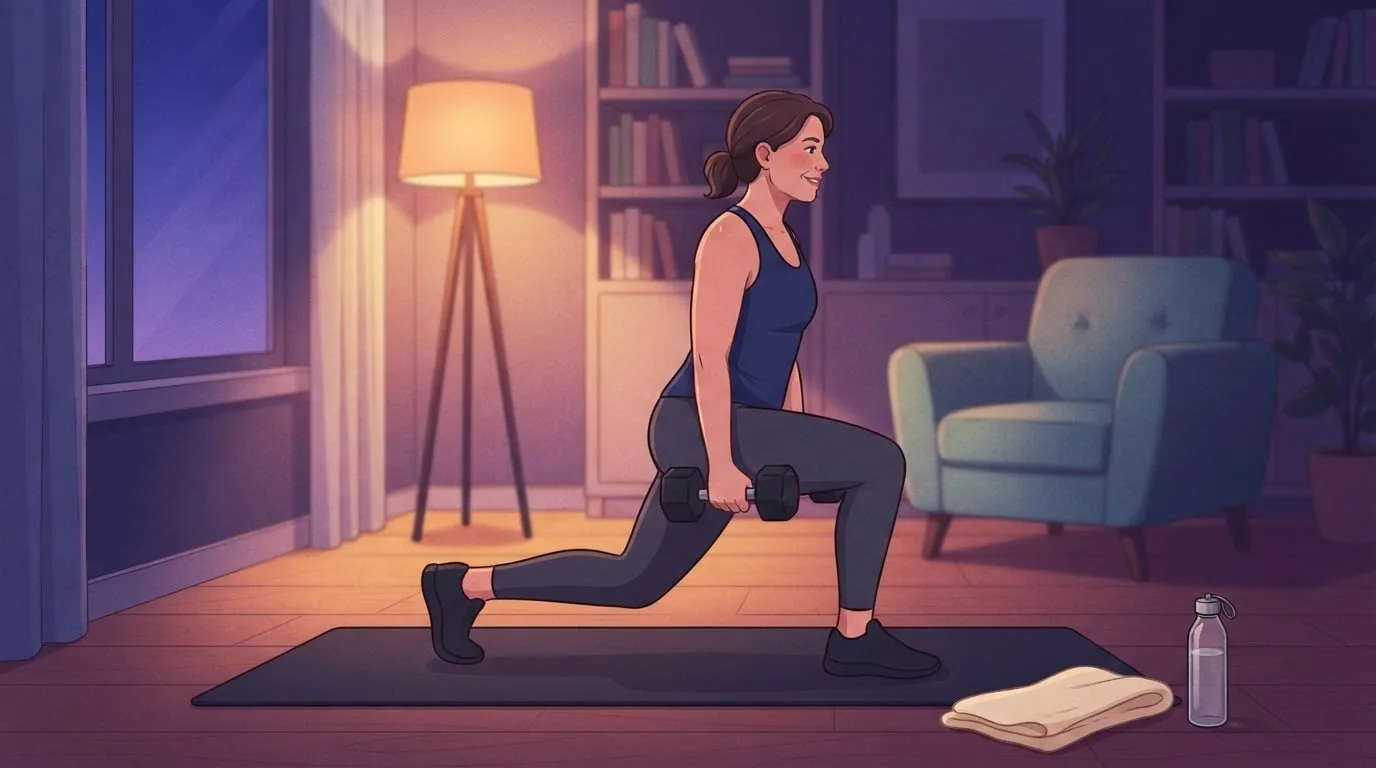
Without a bike: do a 30-minute interval circuit with dumbbells and body weight. The Compendium rates vigorous calisthenics at 7.5 METs against 9.0 for a spin class, so it burns a little less per minute, about 300 calories in 30 minutes for a 176 lb adult. It also trains your upper body, which a bike doesn't. Warm up for 5 minutes, do 40 seconds of work and 20 seconds of rest for each move, repeat for 4 rounds, then cool down for 5 minutes:
- Goblet squats, holding one dumbbell at your chest
- Mountain climbers
- Rear lunges, holding a dumbbell in each hand
- Push-ups, with your hands on a bench if you need to
- Jumping jacks, or a step-out version for your knees
What This Means for You
A spin class is a hard group workout, and the knob in front of you decides how hard. It suits anyone who wants a booked time and someone else running the session. Ride your first few classes well below what the room is doing, and the fitness gains will still come.
What people love about a good class is that someone tells them what to do and other people are there to keep up with. A workout app that keeps you motivated can bring that home. In FitCraft, your 3D AI coach demonstrates each cardio and strength move on an interactive model, says your name during the workout and adapts your workouts as you progress, while streaks, leaderboards and a new quest every month give you a reason to come back. As one FitCraft user, Matt, put it: "The real win is I actually want to work out now. That's never happened before."
Frequently Asked Questions
Is 3 spin classes a week enough to lose weight?
Three spin classes a week can be enough to lose weight if your eating stays steady. In a 12-week program of three 55-minute classes, women with obesity lost about 2.2 kg (5 lb) on their usual diet. Three 45-minute classes burn about 1,620 calories a week for a 176 lb adult.
Can spin class burn belly fat?
Spin class can reduce belly fat as part of overall fat loss, but it can't target your stomach. In the same 12-week program, waist size in women with obesity fell by about 5 cm. Where fat comes off first depends on your body, so aim to lower your total body fat.
Is spin class a good workout?
Yes, spin class is a good workout for your heart and legs, and it's low impact. It doesn't train your upper body or load your bones, so pair it with two short strength sessions a week.
How often should you do spin class?
Two or three spin classes a week suits most people, and that's what most of the indoor cycling studies used. Leave at least two days after your first class, then keep a rest day between classes while your legs adapt.
What should you wear to a spin class?
Wear close-fitting shorts or leggings, ideally padded, and a breathable top, because loose fabric can catch and the room gets hot. Stiff-soled sneakers work on most bikes, and many studios have clip-in cycling shoes you can borrow. Bring a water bottle and a small towel.