
You've been riding for a month. Your legs feel stronger, the hills feel smaller and the scale hasn't moved. You read somewhere that biking burns 800 calories an hour, so you're starting to wonder what you're doing wrong.
You're probably doing nothing wrong. Cycling trials range from 4.2 kg of fat lost in six months to no change at all in 10 weeks, and the difference comes down to how long people rode, how much they rode and what they ate. The first few weeks are the easy part. Staying consistent is the real test, and it's the same test for almost everyone.
What the Trials Show About Cycling and Weight Loss
The strongest cycling evidence comes from a Danish trial that turned the commute into the workout. Quist and colleagues (2018) randomized 130 inactive adults with overweight or obesity to six months of biking to work, moderate or vigorous exercise in their free time, or no change. Riders aimed to burn 320 calories a day for women and 420 for men, five days a week, at their own pace. Compared with the control group, the bike commuters had lost 3.6 kg of fat by three months and 4.2 kg by six. The vigorous group lost about the same (4.5 kg), and the moderate group lost less (2.6 kg).
Not every cycling trial looks like that:
| Trial | Who rode | How much | Result |
|---|---|---|---|
| Quist 2018 | Inactive adults with overweight or obesity | Biking to work for 6 months | 4.2 kg less fat than controls |
| Ratajczak 2020 | 18 women with obesity | Indoor cycling classes of about 55 minutes, 3 times a week for 12 weeks, usual diet | Body mass fell from 95.2 to 93.0 kg |
| Wilmore 1999 (HERITAGE) | 557 people aged 16 to 65 | Stationary cycling 3 days a week for 20 weeks, building to 50 minutes at 75% of VO2 max | Fat fell and lean mass rose, changes called "significant, but small" |
| Novis 2025 | 26 healthy adults, half of them riding | Commuting about 148 minutes a week for 10 weeks | No change in body mass, fitness up 10.5% |
Together, these trials say cycling works for weight loss when the dose is big enough and lasts long enough. The HERITAGE authors argued that activity has a major effect only when there's more of it, sustained for much longer. Ten weeks of commuting in healthy adults didn't move the scale. Six months in people with overweight did.
The longest data set agrees. Lusk and colleagues (2010) followed 18,414 premenopausal women for 16 years, during which they gained 9.3 kg on average. Each extra 30 minutes a day of leisure cycling, outdoors or on a stationary bike, went with 1.59 kg less weight gain, and 3.23 kg less in women who already had overweight or obesity. That's observational, so it can't prove cause, but it fits the trials: riding helps most when it lasts.
How Many Calories Does Cycling Burn?
Cycling burns about 410 to 800 calories an hour for most adults riding at 10 to 14 mph. These figures come from the bicycling table of the 2024 Adult Compendium of Physical Activities (Herrmann 2024).
| Riding style | METs | 132 lb (60 kg) | 176 lb (80 kg) | 220 lb (100 kg) |
|---|---|---|---|---|
| Leisure ride, under 10 mph | 4.0 | 240 | 320 | 400 |
| E-bike, light assist | 6.0 | 360 | 480 | 600 |
| Commuting at your own pace, or 10 to 11.9 mph | 6.8 | 410 | 540 | 680 |
| 12 to 13.9 mph | 8.0 | 480 | 640 | 800 |
| Mountain biking, general | 8.5 | 510 | 680 | 850 |
| Indoor cycling class | 9.0 | 540 | 720 | 900 |
| 14 to 15.9 mph | 10.0 | 600 | 800 | 1,000 |
| 16 to 19 mph | 12.0 | 720 | 960 | 1,200 |
All figures are calories per hour, rounded. For your own number, multiply the METs by your weight in kilograms. These totals include what you'd burn sitting still, about 80 calories an hour for a 176 lb adult, and they assume you're pedaling, so coasting and waiting at lights bring the real number down.
How much weight can you lose biking 30 minutes a day?
Expect roughly 2 to 5 kg (4 to 10 lb) over six months if your eating doesn't rise much. A 176 lb adult riding at 12 to 14 mph burns about 280 calories above resting in 30 minutes. Five rides add 1,400 calories a week, or about 36,000 over six months. At the old rule of thumb of 3,500 calories per pound, that's about 10 lb on paper. The low end assumes you keep about 40 percent of that, which is what people managed in the E-MECHANIC trial covered below.
How many minutes should you cycle a day to lose weight?
Start with 30 minutes on five days a week, then build toward 45 to 60 minutes if your eating isn't changing. That start meets the CDC's minimum of 150 minutes of moderate activity, and the CDC says losing weight takes a high amount of physical activity unless you also adjust your diet. Our guide to cardio for fat loss sets out the weekly doses.
Smaller amounts can still stop the slow gain. In the Lusk cohort, women with overweight or obesity who rode 2 to 3 hours a week had 46 percent lower odds of gaining more than 5 percent of their body weight.
Is Biking Good Exercise?
Yes, biking is good exercise. It raises your heart rate enough to count toward your weekly activity, and it's low impact. The CDC lists bicycling slower than 10 mph on level ground as moderate intensity and faster than 10 mph as vigorous.
It pays off even when your weight doesn't change. In the Novis trial, about 148 minutes of commuting a week raised VO2 max by 10.5 percent in 10 weeks, and resting heart rate dropped from 61 to 58 beats a minute, with no change in body mass.
The long-term numbers point the same way. A 2023 review by Logan and colleagues reports that about 100 minutes of cycling a week went with a 17 percent lower risk of early death in pooled cohort data, rising to 30 percent at about 570 minutes. These are associations, and the benefits look broadly similar to other physical activity. Our comparison of cycling vs running covers the UK Biobank commuting results.
Biking doesn't load your bones or train your upper body, as our exercise bike research review explains, and road riding carries crash risk. Logan's review concludes that the health benefits outweigh the collision risk.
Biking to Work: What the Commuting Studies Found
People who bike to work gain less weight over time, though these cohorts can't prove the bike is the reason. Healthier people may simply be more likely to ride.
| Study | People | Finding |
|---|---|---|
| Grøntved 2016, Sweden | 23,732 working adults, median 10 years | Keeping or starting a bike commute went with 39% lower odds of obesity, and staying on the bike rather than switching to a car or bus with 57% lower odds |
| Dons 2018, seven European cities | 2,316 adults tracked over time | BMI fell 0.30 in people who started or increased cycling and rose 0.42 in frequent riders who stopped |
The Danish riders also held on to their results. In a follow-up about 15 months after the trial ended, the 14 bike commuters who returned were 4.5 kg of fat below their starting point and the 14 moderate exercisers were 1.2 kg below, though that sample is very small.
Logan's review puts the effect in prospective studies at under 1 kg of body weight, with a 15 to 25 percent lower risk of developing obesity. The real advantage of a bike commute is that it happens twice a day, with no decision to make.
Knowing what to do is the easy part.
FitCraft, our mobile fitness app, pairs you with an AI coach who builds you a personalized plan around your goals, schedule, and fitness level. Every FitCraft program is designed by Domenic Angelino, MPH (Brown University) and NSCA-CSCS, with research published in the Journal of Strength and Conditioning Research and Medicine & Science in Sports & Exercise.
Take the Free Assessment Free • 2 minutes • No credit cardIndoor vs Outdoor Cycling for Weight Loss
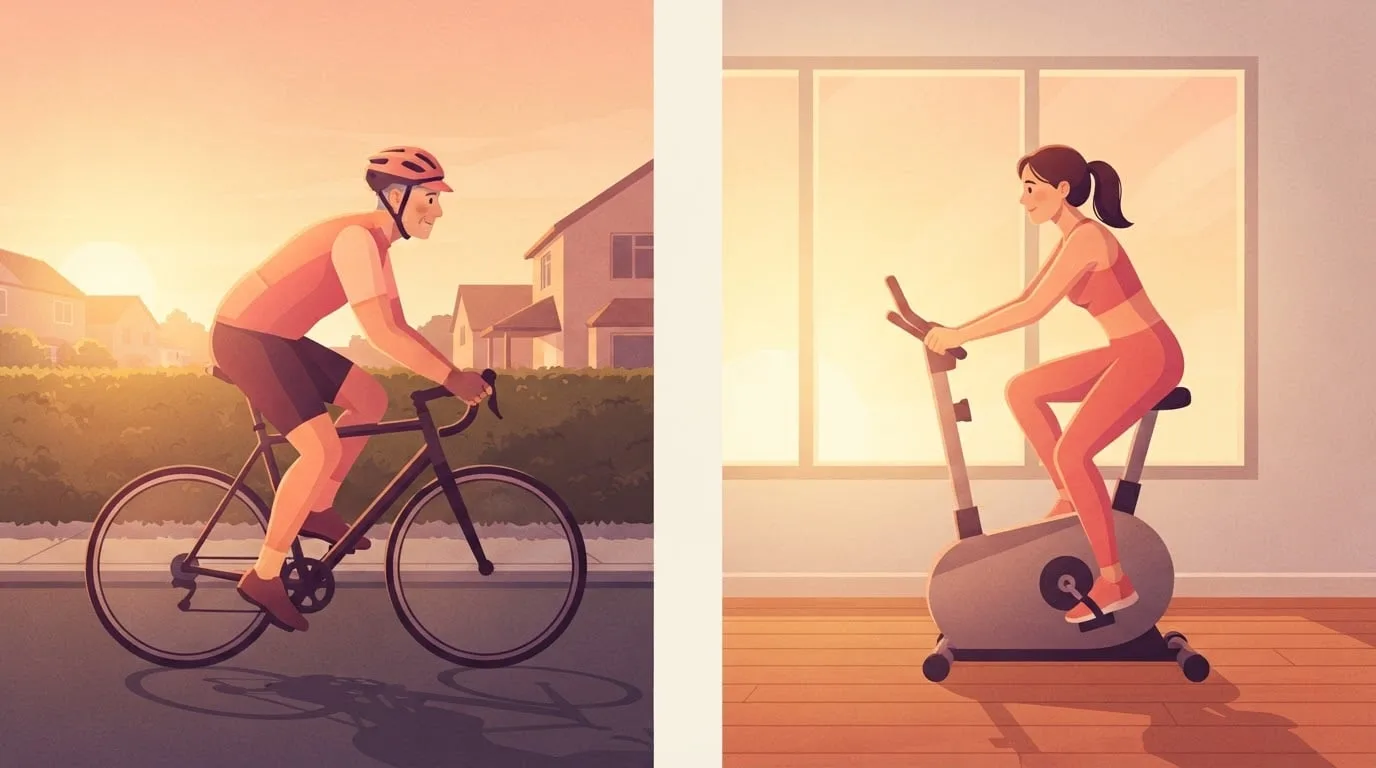
Indoor and outdoor cycling burn about the same at the same effort: the Compendium lists general stationary cycling at 6.8 METs and general outdoor cycling at 7.0. What changes is how hard you tend to ride.
When Mieras and colleagues (2014) had 12 trained men ride 40 km in a lab and on a paved trail at the same perceived effort, they averaged 163 watts inside and 208 watts outside, about 27 percent more power. Olsson and colleagues (2024) saw a similar pattern in 20 commuters, who rated their legs at 11.5 on a 6-to-20 scale on the road against a predicted 14.2 for the same intensity in the lab.
Riding outside feels easier for the same work. Riding inside has no traffic, no weather and no coasting. Use whichever you'll repeat. If indoor riding is your plan, our stationary bike workout for weight loss gives you four rides and a 4-week schedule, and our explainer on what a spin class is covers the group version.
Intervals vs Steady Rides
Intervals help a little, but they aren't a shortcut. In a meta-analysis of 29 studies and 807 young and middle-aged adults, Guo and colleagues (2023) found that high-intensity intervals beat steady training by 0.48 percentage points of body fat and 0.96 cm of waist, with no difference in fat mass or BMI. The authors called the clinical benefit limited. The stationary bike trials point both ways, and our bike workout guide covers them.
Effort still counts, and it doesn't have to come in intervals: the Compendium rates a steady 14 to 16 mph ride at 10.0 METs against 8.8 for interval cycling. Build your week on steady rides you can repeat, and add one interval ride if you enjoy it.
Why Appetite Can Undo It
Exercise rarely takes off as much weight as the math says, and the best evidence points to food. In the E-MECHANIC trial (Martin 2019), 198 adults with overweight or obesity did supervised exercise for 24 weeks, burning about 700 or 1,760 calories a week. They lost only 36 and 41 percent of the weight the exercise predicted. Energy intake, measured with doubly labeled water, rose by about 91 and 124 calories a day, while resting metabolism and everyday activity didn't change significantly.
That catch-up seems to grow with time. In a systematic review of 61 studies, Riou and colleagues (2015) found that 18 percent of the energy burned was compensated for on average, approaching 84 percent in programs of about 80 weeks. In the Quist trial, bike commuters compensated for an estimated 38 percent of what they burned, against 77 percent in the moderate group and 21 percent in the vigorous group, though the margins of error were wide.
Two habits protect the deficit:
- Don't eat back the screen. Watches and bike consoles give rough estimates, so leave your meals alone.
- Skip the ride snack. A 30 to 45 minute ride rarely calls for more than water.
Will I Lose Belly Fat by Cycling?
Yes, you'll lose belly fat by cycling if your total body fat falls, but you can't choose where it comes off first. In the same Danish trial, intra-abdominal fat, the deep fat around your organs, fell in the bike commuters and both leisure groups compared with controls after six months (Blond 2019). Riding doesn't target your stomach or thighs, and our guide to the best exercises to lose belly fat explains why spot reduction fails.
Pair Cycling With Strength Training
Cycling leaves your upper body and much of your leg muscle untrained, and that matters more when you're eating less. In a trial of 160 adults around age 70 with obesity, Villareal and colleagues (2017) paired the same calorie-cut diet with aerobic training (treadmill walking, stationary cycling and stair climbing), strength training or both. All three groups lost about 9 percent of body weight. The aerobic group lost 2.7 kg of lean mass and the combined group lost 1.7 kg, and physical function rose 21 percent with both against 14 percent with aerobic work alone.
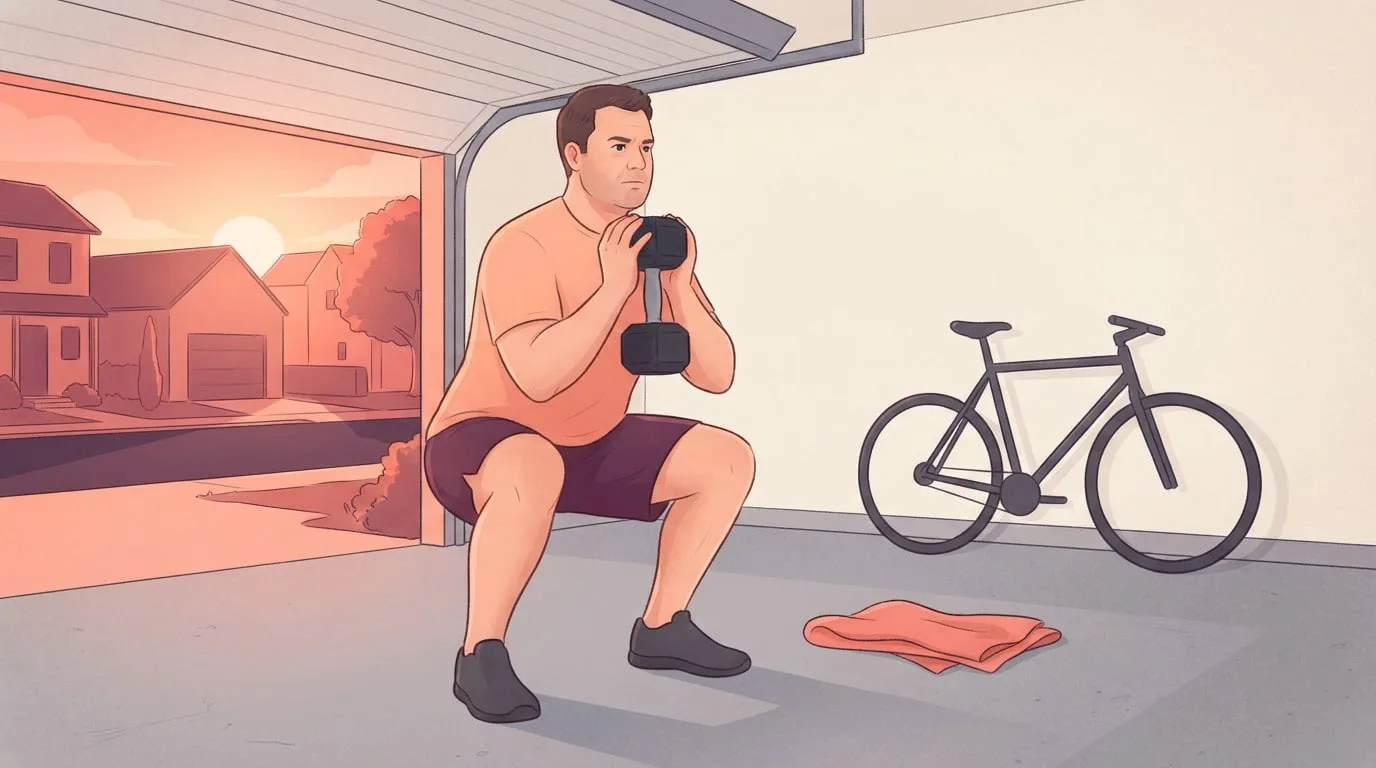
You don't need a gym for this. Two 30-minute sessions with dumbbells and body weight cover most of what the bike misses, including the hinge and lowering work that pedaling skips. A simple week has steady rides or bike commutes on Monday and Wednesday, strength on Tuesday and Friday, and a long ride on Saturday.
What This Means for You
Cycling is good for weight loss when you ride enough, keep riding for months and don't quietly eat the difference. The first signs it's working may be a lower resting heart rate or the hill that stopped being hard. The scale usually follows over months, not weeks.
Picture six months from now: the ride is simply part of your day, your jeans fit differently and two short strength sessions sit on your calendar. Our roundup of the best workout apps for weight loss compares the options for your strength days and the days you can't ride. In FitCraft, a 3D AI coach demonstrates each dumbbell and bodyweight exercise on an interactive model you can zoom in on, says your name during the workout and adapts your workouts as you progress, while streaks and calendar rewards keep you coming back. As one FitCraft user, Jim, put it: "I kept telling myself I'd start Monday. FitCraft made me start on a Wednesday and I haven't stopped."
Frequently Asked Questions
How much cycling equals 10,000 steps?
About 50 minutes of riding at 10 to 12 mph matches 10,000 steps by energy cost, or about 85 minutes at a leisurely pace under 10 mph. Walking 10,000 steps takes most adults about 90 minutes at roughly 3.8 METs, which comes to about 340 MET-minutes. Many step trackers don't count pedaling, so log the ride separately.
Is biking 10 miles a day enough exercise?
Yes, biking 10 miles a day is enough exercise for most adults. At 12 mph it takes 50 minutes and burns about 530 calories for a 176 lb rider, and five rides a week add up to 250 minutes, well past the CDC's 150-minute minimum.
Which burns more calories, biking or walking?
Biking burns more per minute at everyday paces. The 2024 Compendium rates a moderate walk at 3.8 METs and riding at 10 to 12 mph at 6.8 METs, so a 176 lb adult burns about 300 calories an hour walking and about 540 riding.
Which is healthier, walking or cycling?
Both are healthy, and neither wins outright. Among 18,414 women followed for 16 years, an extra 30 minutes a day of brisk walking went with 1.81 kg less weight gain and cycling with 1.59 kg less, while slow walking made no difference. Cycling burns more per minute, and walking loads your bones, which cycling doesn't.
Is cycling better than running?
Neither is better for weight loss, because matched for effort they burn similar calories. Running takes less time since you can't coast, and cycling is easier on your joints, so it's often the better choice if running hurts.
Does biking actually build muscle?
Yes, but modestly, and mostly in the front of your thighs. Our page on whether cycling builds muscle shows which leg muscles grew in the MRI studies and which didn't.
What is the 75% rule in cycling?
The 75% rule in cycling is a coaching rule of thumb: keep about 75 percent of your riding time at or below 75 percent of your maximum heart rate, and do the rest harder. It comes from cycling advice columns, and the versions we found cite no study. It's still a reasonable shape for a week because most of your minutes stay easy enough to repeat.
Is 1 hour cycling a day good?
Yes, one hour of cycling a day is good for most healthy adults who have built up to it. Seven hours a week is nearly three times the CDC's 150-minute minimum, and an hour at 10 to 12 mph burns about 540 calories for a 176 lb rider.