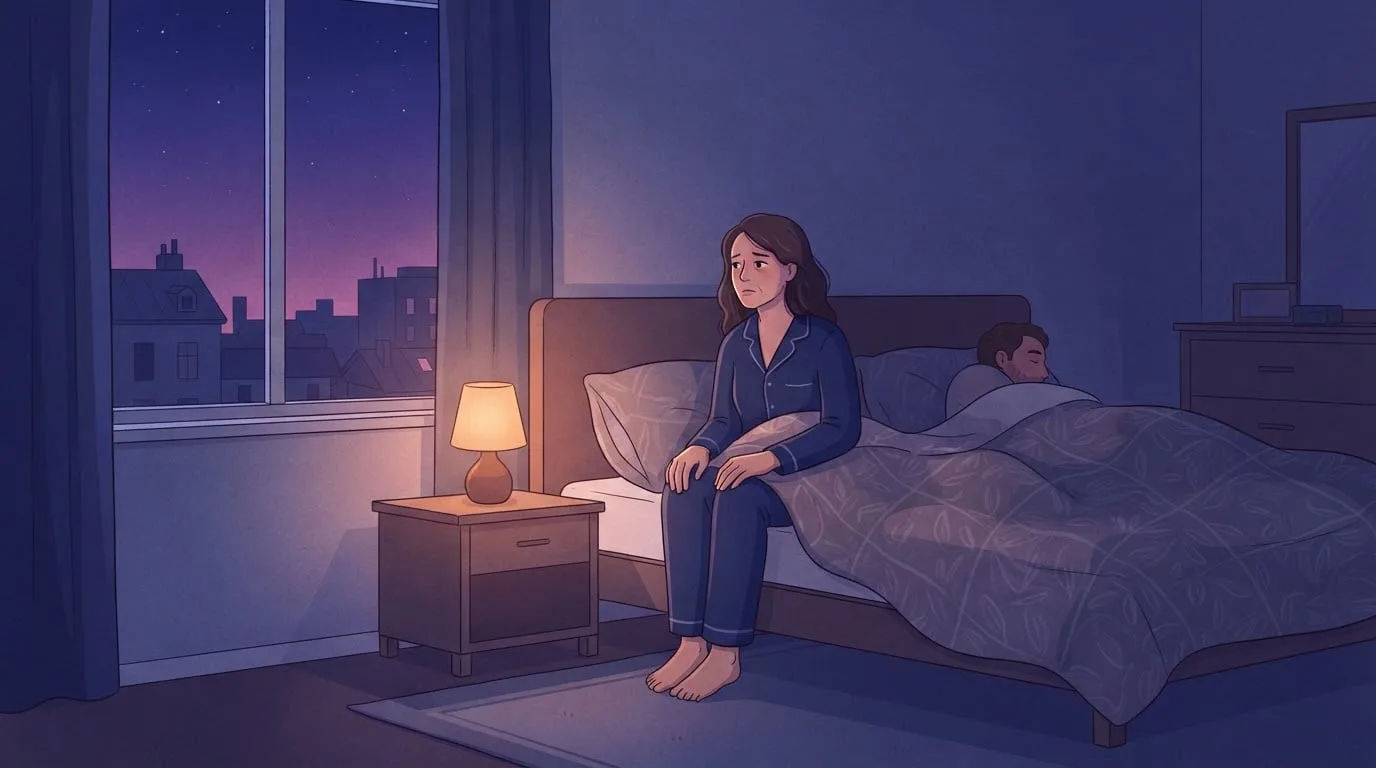
It's dark and quiet, and you're suddenly wide awake. You don't need to check to know the time, because it's the same as last night: somewhere around 3am. Your body feels heavy, and your mind is already running through tomorrow.
If you've typed "why do I keep waking up at 3am" into a search bar, you've probably found theories ranging from hormones to hidden meanings. The real explanation is more ordinary. A normal night is built so that the early-morning hours are the easiest time to wake, and a few everyday habits push you over the edge. That's good news, because most of those habits can change.
Below you'll find how a night of sleep is put together and why 3am is its weak point, the triggers with the best evidence, what to do when you're lying awake, the daytime habits that help you sleep through, and the signs that point to a sleep disorder or low mood rather than a habit.
Why Do I Keep Waking Up at 3am? How a Normal Night Is Built
Sleep isn't one even block. You cycle through light sleep, deep sleep and REM (dreaming) sleep every 80 to 100 minutes, four to six times a night, and you may wake briefly between cycles, according to the National Heart, Lung, and Blood Institute's guide to sleep stages. You won't remember most of those brief wakings. What changes across the night is the mix inside each cycle, and that mix is what makes the early-morning hours fragile.
Deep sleep comes first, lighter sleep and REM come later
Deep sleep is front-loaded. In a classic lab study, Dijk and Czeisler (1995) had eight men live on a 28-hour day for more than a month, so their sleep fell at every hour of their body clock. Slow-wave activity, the signature of deep sleep, was highest at the start of every sleep episode and fell steadily across it. REM sleep did the opposite. It built up as sleep went on, peaked late in the biological night, and was highest when the end of sleep lined up with the person's usual wake-up time.
So if you fell asleep around 11pm, by 3am you've had most of the night's deep sleep. Your drive to sleep has dropped, and what's left is lighter sleep and longer REM periods, which you wake from far more easily. A noise, a warm duvet or a passing thought that wouldn't have touched you at midnight is now enough to bring you to the surface.
Cortisol starts its morning climb around 2 to 3am
Your body also starts getting ready for morning hours before your alarm. Cortisol, often called the stress hormone, follows a daily rhythm. In their review of that rhythm, Chan and Debono (2010) describe levels at their lowest around midnight, starting to rise at around 2 to 3am and peaking in the morning. That rise is normal and healthy. It's part of how you wake up alert.
Your brain even learns when morning is coming. In a study published in Nature, Born and colleagues (1999) told sleepers they would be woken at an early hour. Their ACTH, the hormone that tells your adrenal glands to release cortisol, rose about an hour before that time while they were still asleep. Stress can turn the same system up. A review by Kalmbach and colleagues (2018) describes how people whose sleep is easily knocked off course by stress show disrupted regulation of this hormone system and of the fight-or-flight nervous system.
That's why "my cortisol is high" is the wrong way to read a 3am wake-up. A rising level at that hour is expected. The real question is what turns that gentle nudge into being wide awake.
Why it happens at the same time every night
If you go to bed at about the same time each night, your sleep cycles fall at about the same clock times, so the lightest stretch of the night lands in the same place. Habit does the rest. Once you've woken at 3am a few times, you start expecting it, and checking the clock teaches you to notice it. In experiments by Tang and colleagues (2007), people told to watch a clock while trying to sleep worried more and took longer to fall asleep than people who weren't, and that held for good sleepers as well as people with insomnia.
Waking in the night is very common. In a telephone survey of 8,937 adults in Texas, New York and California, Ohayon (2008) found that 35.5% woke during the night at least three nights a week and 23% woke every single night. More than 90% of them said it had been going on for over six months.
What Wakes You Up at 3am: The Usual Triggers
Lighter sleep makes 3am a weak point. These are the things most likely to push you through it, starting with the ones that have the clearest evidence.
Alcohol in the evening
Alcohol is the classic cause of waking up at 3am. A review of every known study of alcohol and sleep in healthy volunteers by Ebrahim and colleagues (2013) found that alcohol, at all doses, helps you fall asleep sooner and consolidates sleep in the first half of the night, then increases sleep disruption in the second half. It also delays the first REM period of the night. As your body clears the alcohol, sleep turns light and broken, right around the early-morning hours.
If you're waking up at 3am every night and you have a drink or two most evenings, that's the first thing to test. Try two weeks without alcohol and see whether the wake-ups change. It's a cheap experiment, and it gives you a clear answer.

Stress, worry and a mind that switches on
Stress is the other big trigger. In a six-week diary study, Åkerstedt and colleagues (2012) had 50 people rate their stress each day and their sleep each morning for 42 days. Stress and worries at bedtime were the main predictors of how badly they slept that night.
The early hours make worry worse. When you wake at 3am, your sleep drive is low and your morning hormones are already rising, so a work problem or a money worry arrives fast and feels bigger than it will at 9am. Kalmbach's review notes that worry and rumination amplify the effect of stress on sleep, especially in people whose sleep is sensitive to it. Thinking it through in bed rarely solves anything, and it keeps you awake.
A warm bedroom
Your core body temperature falls through the night, reaches its lowest point in the early morning and then starts rising toward waking, and a hot room makes it harder to stay asleep through that stretch. Reviewing the lab evidence, Okamoto-Mizuno and Mizuno (2012) concluded that heat exposure increases time awake and reduces deep sleep and REM, and that humid heat is worse. A duvet that felt right at 11pm can be too warm by 3am, especially in summer or with the heating on.
Caffeine after lunch
Caffeine doesn't only delay sleep. It makes the whole night lighter and more broken. Gardiner and colleagues (2023) pooled 24 studies and found caffeine added about 12 minutes of time awake after first falling asleep, cut total sleep by 45 minutes, increased light sleep and reduced deep sleep. In a home study by Drake and colleagues (2013), 400 milligrams of caffeine, about four cups of brewed coffee, still disrupted sleep when it was taken 6 hours before bed. Gardiner's team suggests finishing a regular coffee at least 8.8 hours before bedtime, which means about 2pm for an 11pm bedtime.
A full bladder
Needing the bathroom is one of the most common reasons people give for waking at night. Doctors call it nocturia, and it isn't only an older person's problem. A review of 43 community studies by Bosch and Weiss (2010) found that 11% to 35% of men aged 20 to 40 and 20% to 44% of younger women woke at least once a night to urinate, rising to about 69% to 93% of people over 70. Large drinks in the evening, alcohol and caffeine all add to it. Sometimes the bladder isn't what woke you, though, as the section on seeing a doctor explains.
Getting older
Sleep gets lighter and more broken with age, which is why waking in the early hours often starts in midlife. Van Cauter and colleagues (2000) pooled sleep recordings from 149 healthy men aged 16 to 83. Deep sleep fell from about 19% of the night in men aged 16 to 25 to about 3% in men aged 36 to 50, and lighter sleep took its place. From midlife to old age, time awake during the night rose by about 28 minutes per decade. A meta-analysis of 65 studies covering 3,577 people (Ohayon and colleagues, 2004) found the same direction in adults: time awake after falling asleep goes up with age, while deep sleep and REM go down.
Perimenopause and menopause
For many women, the years around menopause add hot flashes and night sweats to the list. In their review, Baker and colleagues (2018) report that about 26% of women going through the menopausal transition have sleep problems severe enough to count as insomnia, and that many hot flashes are linked to awakenings recorded in the sleep lab. Everything else on this page still applies, but hot flashes have their own treatments, so they're worth raising with a doctor.
Knowing what to do is the easy part.
FitCraft, our mobile fitness app, pairs you with an AI coach who builds you a personalized plan around your goals, schedule, and fitness level. Every FitCraft program is designed by Domenic Angelino, MPH (Brown University) and NSCA-CSCS, with research published in the Journal of Strength and Conditioning Research and Medicine & Science in Sports & Exercise.
Take the Free Assessment Free • 2 minutes • No credit cardWhat Does It Mean When You Wake Up at 3am?
Most of the time, it means your sleep is doing what it normally does in the early hours and something nudged you awake. An occasional 3am wake-up that you drift back from within 20 minutes or so isn't a sign that anything is wrong.
You'll also read that 1 to 3am is "the liver's hour" or that waking then carries a spiritual meaning, but no sleep study supports either idea, and the lighter sleep and cortisol rise described above explain the timing.
It means more when the pattern starts to change your days. Waking most nights, lying awake for a long time, feeling unrefreshed or sleepy during the day, or waking far earlier than you need to and being unable to get back to sleep for weeks all deserve attention. Trouble staying asleep on 3 or more nights a week for 3 months is how the National Heart, Lung, and Blood Institute describes chronic insomnia, and the section on seeing a doctor lists the other warning signs.
How Can I Fall Back Asleep Quickly?
What you do in the first few minutes decides whether a 3am wake-up lasts five minutes or two hours. The aim is to keep your body calm and avoid waking your brain up any further.
- Don't check the time. Turn the clock to face the wall before bed and leave it there. Knowing it's 3:12 starts the arithmetic of lost sleep, which is exactly the kind of worry the clock-watching experiments linked to taking longer to fall asleep.
- Leave your phone alone. Both the light and whatever's on the screen wake you up. In a lab study by Chang and colleagues (2015), reading on a light-emitting device in the evening suppressed melatonin and pushed the body clock later compared with reading a printed book. A 3am scroll adds alertness at the worst possible time.
- Breathe slowly and let your body go loose. Make each breath out longer than the breath in, and relax your face, jaw and shoulders. Our guide on how to fall asleep faster walks through the breathing and relaxation methods that have study support.
- Get up if you're still awake after what feels like 20 minutes. Go to another room, keep the lights low and do something calm, such as reading a paper book, until you feel sleepy, then go back to bed. This is stimulus control, a core part of cognitive behavioral therapy for insomnia (CBT-I), and the American Academy of Sleep Medicine's guideline (Edinger and colleagues, 2021) suggests it as a treatment on its own.
- Park the worry on paper. If one problem keeps circling, write it down in a sentence on a notepad by the bed and decide when tomorrow you'll deal with it. Then let it go for tonight.
- Get up at your usual time anyway. Sleeping in after a broken night feels fair, but a late morning pushes the next night later and makes another broken night more likely.
How to Stop Waking Up at 3am: The Daytime Fixes
The night is shaped by the day before it. These habits make the second half of the night sturdier, and they work over one to two weeks rather than overnight.
Keep the same wake-up time every day
A fixed wake-up time, seven days a week, anchors your body clock and builds steady sleep pressure for the next night. Our guide to the best time to go to bed shows how to set the bedtime that goes with it, and the guide on how to wake up early covers moving the wake-up time itself. Resist the urge to go to bed early to catch up after a bad night. More time in bed usually means more time lying awake in it, and the same guideline that backs stimulus control also suggests sleep restriction therapy, which deliberately trims time in bed, as a treatment for chronic insomnia. That version is best done with a clinician.
Exercise most days, and finish hard sessions early
Exercise is one of the best-supported ways to sleep more soundly without a pill. Kredlow and colleagues (2015) pooled 66 studies and found that a single bout of exercise had a moderate benefit on time spent awake after first falling asleep, while regular exercise improved overall sleep quality. Our review of exercise and sleep research covers the newer trials and the doses that seem to work best.
Timing matters for the hard stuff. In a year of wearable data from 14,689 people, Leota and colleagues (2025) found that high-strain workouts late in the evening were linked with later and shorter sleep and a higher overnight heart rate, while sessions that ended at least 4 hours before sleep showed no link with sleep at all. Put strength work and hard cardio in the morning, at lunch or straight after work, and keep the last hours of the evening for yoga, mobility or a walk.
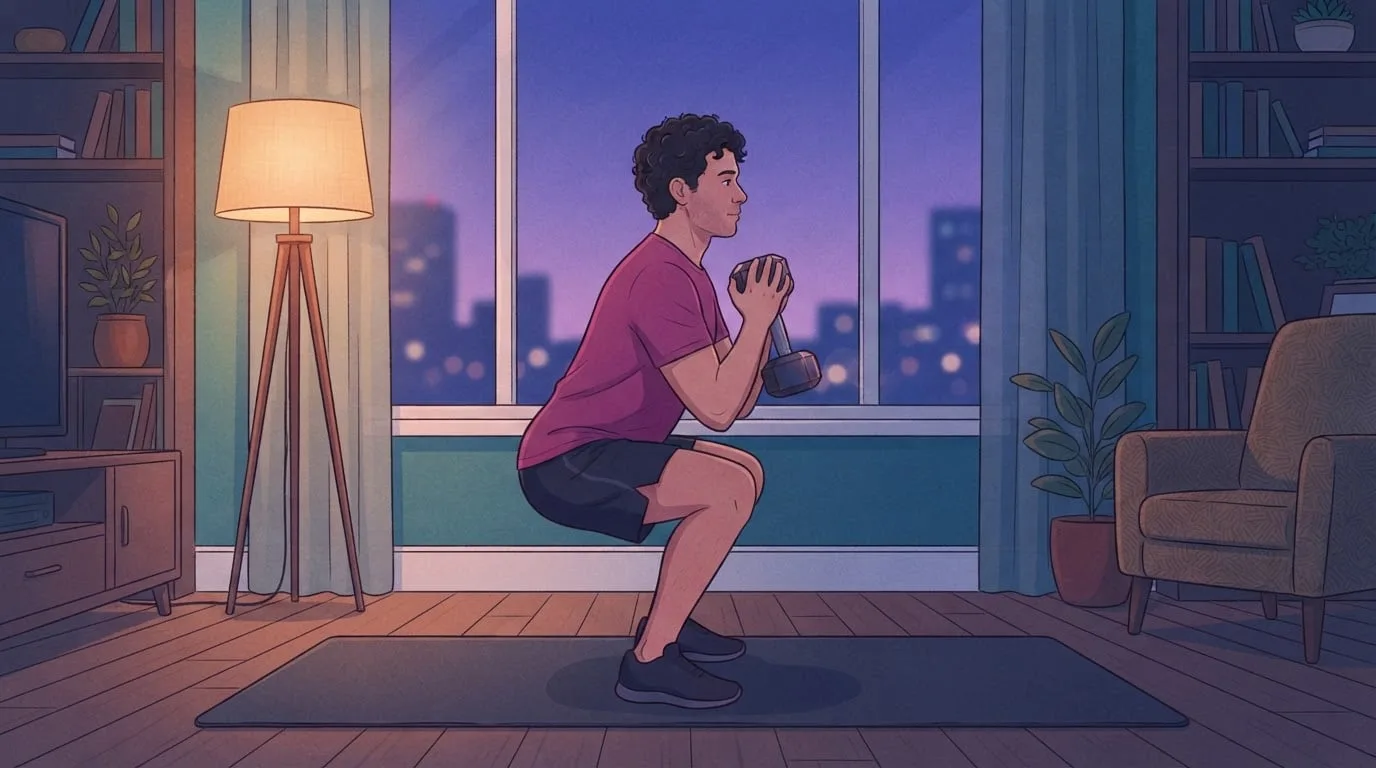
The difficult word is "regular." Most people know exercise helps them sleep and still stop by week three. Our roundup of the best fitness apps for staying consistent compares the options built for the weeks when motivation fades. FitCraft is one of them. A 3D AI coach demonstrates every exercise and says your name during the workout, a streak gives you a reason to show up again tomorrow, and the yoga, mobility, dumbbell and bodyweight sessions let you do the strength work earlier and keep the gentle sessions for the evening.
Get bright days and dark nights
Spend time outdoors in daylight, especially in the morning, and dim the lights for the last couple of hours before bed. A strong day-night contrast keeps your body clock steady. In summer, blackout curtains matter too, because early dawn light through thin curtains can wake you in the lightest part of your sleep.
One exception is worth knowing. If you get sleepy very early in the evening, fall asleep by 8 or 9pm and wake at 3 or 4am for good, your body clock may have shifted early, a pattern that becomes more common with age. Morning light would push it earlier still. For adults with this advanced pattern, the American Academy of Sleep Medicine's guideline (Auger and colleagues, 2015) suggests timed light therapy, and it's worth setting up with a doctor or sleep specialist.
Move alcohol and caffeine earlier, and cool the room
Put the last coffee or tea before about 2pm for an 11pm bedtime, and keep alcohol light and early, or skip it for a couple of weeks to see what changes. Keep the bedroom cool enough that you want a blanket, with bedding you can push off without fully waking.
When Should I See a Doctor About Sleep?
See a doctor if you've been waking most nights for three months, or sooner if it's wearing down your days. Book an appointment sooner, too, if any of these apply:
- Loud snoring, gasping or pauses in your breathing, or waking with a dry mouth or a headache. These are signs of obstructive sleep apnea, which Benjafield and colleagues (2019) estimated affects about 936 million adults aged 30 to 69 worldwide.
- Getting up to urinate two or more times a night. In a sleep-clinic study by Pressman and colleagues (1996), 80 patients being tested for a suspected sleep disorder woke and urinated during the night. The recordings showed that 79% of those awakenings were set off by sleep apnea, snoring or leg movements, not by the bladder, and the patients named the real cause only about 5% of the time. That was a clinic sample, not the general public, but it shows why repeated bathroom trips deserve a check.
- Waking far too early with low mood, lost interest or hopelessness. Disturbed sleep is a core symptom of depression (Riemann and colleagues, 2001), and insomnia raises the risk of it: across 21 long-term studies, people with insomnia had about twice the odds of developing depression (Baglioni and colleagues, 2011).
- Hot flashes or night sweats that wake you most nights.
- An uncomfortable urge to move your legs at night, or a partner who says your legs twitch while you sleep.
- Sweating, a pounding heart or nightmares at night if you take insulin or other diabetes medicine that can lower blood sugar.
- A new medicine that started around the time the wake-ups did.
- Drowsiness while driving or at work. Get help now rather than later.
If no other cause turns up, ask about CBT-I. It's the first-line treatment for chronic insomnia, and it works on exactly the problem of waking in the night. A meta-analysis of 20 trials in 1,162 adults with chronic insomnia (Trauer and colleagues, 2015) found it cut time awake during the night by about 26 minutes and helped people fall asleep about 19 minutes sooner, and the gains seemed to last.
What This Means for You
A 3am wake-up is usually your body's normal early-morning lightness plus one or two triggers you can find. Start with the cheapest experiments: two weeks without evening alcohol, caffeine finished by early afternoon, a cooler room, the clock turned to the wall and the same wake-up time every day. Give the changes two weeks before you judge them.
Then build the habit that helps nearly everything else: regular exercise, done earlier in the day. It's the change that takes the longest to stick, which is why it's worth making it something you enjoy. As one FitCraft user, Matt, put it: "The real win is I actually want to work out now. That's never happened before."
And if the wake-ups come with snoring, low mood or months of broken nights, see a doctor. Sleep apnea, depression, menopause symptoms and chronic insomnia all have treatments that work, and none of them is something you should have to push through alone.
Frequently Asked Questions
What is your body telling you when you wake up at 3am?
Usually that your sleep has moved into its lighter early-morning phase and something nudged you awake. By 3am most of your deep sleep for the night is done, REM periods are getting longer and cortisol has started its normal climb toward morning. The usual nudges are evening alcohol, stress, a warm room, late caffeine and a full bladder.
Why do I wake up at 4am instead of 3am?
The same causes apply, a little later in the night. Your lightest sleep comes in the last third of the night, so its timing follows your bedtime. If you fall asleep very early in the evening and wake at 4am for good, your body clock may have shifted early, which becomes more common with age and is worth raising with a doctor or sleep specialist.
Does alcohol make you wake up at 3am?
It often does. A review of every known study of alcohol and sleep in healthy volunteers found that alcohol at all doses helps you fall asleep and deepens sleep in the first half of the night, then increases sleep disruption in the second half. Two alcohol-free weeks is the simplest test of whether drinking is behind your early-morning wake-ups.
Is waking up at 3am a sign of depression?
Not on its own. Waking much earlier than you need to and being unable to get back to sleep can be part of depression, though, especially with low mood, lost interest or hopelessness lasting two weeks or more. Insomnia also roughly doubles the odds of developing depression later, so long-running broken sleep is worth a doctor's visit either way.
What are the benefits of getting enough sleep?
Sleeping at least 7 hours a night on a regular basis supports health, mood, performance and safety. The joint consensus statement of the American Academy of Sleep Medicine and the Sleep Research Society links regularly sleeping less than 7 hours to weight gain, diabetes, high blood pressure, heart disease, depression, weaker immunity, more errors and more accidents. Good sleep also helps your body recover from training.
Can exercise stop you waking up at 3am?
It helps. A meta-analysis of 66 studies found a single workout had a moderate benefit on time spent awake after first falling asleep, and regular exercise improved overall sleep quality. Finish hard sessions at least 4 hours before bed. The hard part is doing it most days, which is why a routine you'll keep matters more than the perfect workout.