Quick Comparison
| App | Best for | Pricing structure | Who sees you train | The honest catch |
|---|---|---|---|---|
| FitCraft | Private coaching and confidence-building progression | Free version plus paid upgrade | Nobody. No leaderboards, no social feed | No human form review or live classes |
| FitOn | Class-style workouts without the class | Free tier plus paid upgrade | Nobody, unless you join challenges | Videos don't adapt to your level |
| Nike Training Club | A fully free library | Fully free | Nobody | You plan your own path through it |
| Daily Burn (True Beginner) | Absolute beginners easing in | Paid only | Nobody in the True Beginner program | No free tier, and the program ends after 30 days |
Why the gym feels like a stage
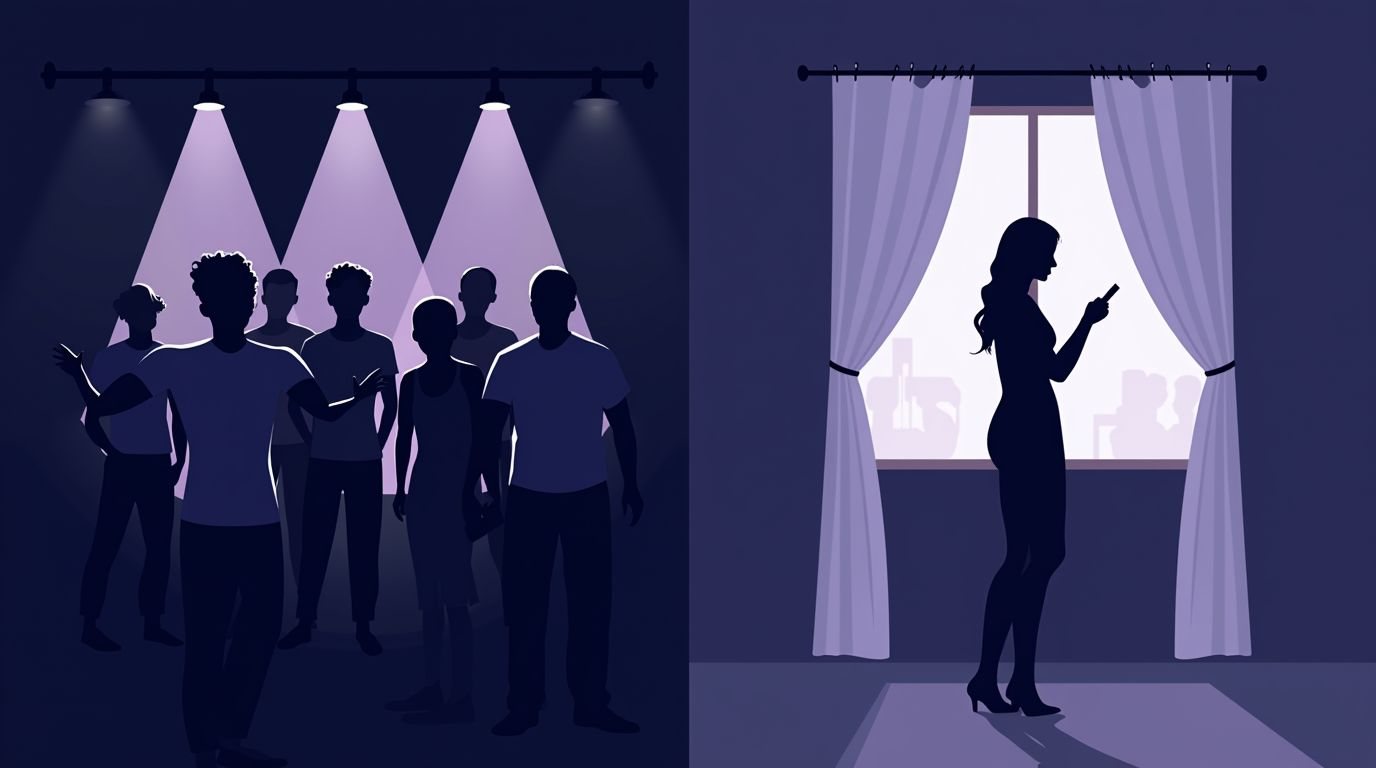
If walking onto a gym floor makes your chest tighten, you're in the majority. A 2025 UK survey cited in a 2026 Frontiers in Sports and Active Living paper by Quinn found 47% of adults feel uncomfortable at the very thought of joining a gym, and 32% expect to be judged if they do. The paper's core argument: gym intimidation is a reasonable response to a space where fitness, experience, and belonging are visibly unequal. It's social discomfort, not a character flaw, and for most people not a clinical condition either.
The discomfort changes behavior. Horenstein and colleagues (2021) found in Body Image that people with higher body weight were more motivated to avoid exercise, but mainly when social anxiety was also high. The barrier isn't the exercise. It's the audience. Even people who make it through the door train differently: a 2004 study by Brewer and colleagues found exercisers with higher physique anxiety picked spots at the back of the room and wore concealing clothing. That's energy spent managing being seen instead of getting stronger.
So the apps below were chosen on one blunt question: how completely does this remove the audience while still building real fitness? One note before the list. This article is about social discomfort around gyms. If what you're feeling looks more like anxiety or low mood that makes any exercise feel impossible, our guide to fitness apps for anxiety and depression covers that territory properly.
Which apps actually work for people intimidated by the gym?
1. FitCraft: Best overall for training away from an audience
FitCraft was built for people who have tried and quit, and gym dread is one of the biggest reasons people quit. Everything happens at home. Your coach is a 3D character who demonstrates every exercise on an interactive 3D model you can rotate and zoom, talks to you during the workout, and motivates you by name. It's the closest thing to a personal trainer who is incapable of judging you.
Three design choices matter for this audience. There are no leaderboards and no social feed, so your workout is never ranked against a stranger's. You start with a free assessment that meets you at your actual level, and workouts adapt as you progress, so early sessions build confidence instead of burying you. And the game layer (XP, leveling up, collectible cards, calendar rewards) hands you visible wins from day one. That matters: a 2022 meta-analysis of randomized controlled trials in JMIR found gamified interventions significantly increased physical activity versus controls.
The honest limitation: there's no human watching your form, and if instructor-led live classes are what motivates you, FitCraft doesn't offer them. It coaches; it doesn't stream.
See what FitCraft would build for you
FitCraft, our mobile fitness app, pairs you with an AI coach who builds you a personalized plan around your goals, schedule, and fitness level. Every FitCraft program is designed by Domenic Angelino, MPH (Brown University) and NSCA-CSCS, with research published in the Journal of Strength and Conditioning Research and Medicine & Science in Sports & Exercise.
Take the Free Assessment Free • 2 minutes • No credit card2. FitOn: Best for class-style workouts without the class
Some people miss the energy of a group class and only dread the room itself. FitOn solves exactly that. Its free tier includes thousands of follow-along video classes across strength, HIIT, yoga, Pilates, barre, dance, and meditation, led by well-known human trainers. You get the instructor's voice and the class structure with zero eyes on you. Challenges and a live leaderboard exist for people who want them, but they're features you join rather than a default part of every workout. A paid upgrade adds structured programs, meal plans, music stations, and offline downloads, but the free tier is genuinely usable on its own.
The honest limitation: follow-along videos don't adapt. The instructor moves at the class pace whether you're keeping up or dying quietly on your mat, and the sheer size of the library means you decide what to do every single day. For someone whose barrier is second-guessing themselves, that's real friction.
3. Nike Training Club: Best fully free option
Nike made its entire training library free in 2020 and has kept it that way. Hundreds of trainer-led home workouts across strength, HIIT, yoga, and mobility, with clearly labeled beginner sessions, no locked content, and no ads. If cost is the reason you'd talk yourself out of starting, NTC removes the excuse completely. We compare it with FitCraft head to head in FitCraft vs Nike Training Club, and it also tops our roundup of the best free workout apps.
The honest limitation: NTC is a library, not a coach. Nothing tracks your progression or picks tomorrow's session for you, so you're the one assembling a plan and deciding whether you're ready to move up. The production is polished and the trainers are extremely fit, which some anxious beginners find inspiring and others find like more of the same intimidation, just on a screen.
4. Daily Burn (True Beginner): Best when "beginner" videos still feel too advanced
Plenty of "beginner" content quietly assumes a baseline of fitness. Daily Burn's True Beginner program assumes nothing. It's a 30-day progressive program of bodyweight-only sessions in the 20 to 30 minute range, built around teaching movement patterns (squat, hinge, push, plank) before adding any intensity. One trainer leads every session and modifications are shown throughout, so there's always a version you can do. For someone whose fear is "I won't even be able to do the workout," this is the most patient front door in mainstream fitness apps.
The honest limitation: Daily Burn is paid only, with no free tier to test the water. And True Beginner is a 30-day program, so when it ends you graduate into the general library, which is a noticeable step up in assumed fitness and in decisions you make yourself.
How We Evaluated
Star ratings tell you almost nothing about whether an app works for someone who dreads being watched. We judged these four on criteria specific to this audience:
- Audience removal. Can you complete an entire program without another human ever seeing you train, ranking you, or commenting? Leaderboards and default-on social feeds were disqualifying for the top spot.
- Judgment-free coaching. Does the guidance feel supportive or evaluative? An app that scolds you for missed days recreates the exact feeling this audience is escaping.
- True beginner fit. Does the easiest content assume zero fitness, and are modifications shown rather than implied?
- Confidence trajectory. Does difficulty progress from what you can already do, so each week ends with proof you're improving rather than proof you're behind?
- Restart friendliness. What happens after a missed week? Anxiety-prone exercisers quit at the first broken streak more than anyone.
We know FitCraft from the inside. For the other three we worked from their current published content, help documentation, and app store listings as of July 2026, not from multi-week wear tests, and we've said where each one beats us.
FitCraft Studios publishes this site and makes FitCraft; the ranking on this page reflects the criteria above, and the fairest way to judge any of these apps, ours included, is to run their free trials yourself.
Which Should You Choose?
Match the app to the specific shape of your discomfort:
- You want a coach, not a video, and zero audience: FitCraft. Private, adaptive, and built to make consistency feel like winning a game rather than passing an inspection.
- You miss group-class energy but not the group: FitOn wins this one. Human instructors, class formats, nobody looking back at you.
- You don't want to spend anything: Nike Training Club wins, full stop. The whole library is free and it's excellent.
- You've genuinely never exercised and want your hand held: Daily Burn's True Beginner is the most patient structured on-ramp of the four. Our guide to starting from zero fitness pairs well with it.
- Your equipment is a living room floor and nothing else: all four work bodyweight-only, and our no-equipment home workout app page goes deeper on training without gear.
The Verdict
The best workout app for gym anxiety is the one that deletes the audience without deleting the coaching. FitCraft does both, which is why it leads this list. But the real enemy is the belief that fitness has to happen in front of people. It doesn't. Nearly half of adults feel uncomfortable at the thought of joining a gym. Pick the app that matches your discomfort, train where nobody's watching, and let the confidence come to you.
Frequently Asked Questions
What is the best workout app for gym anxiety?
FitCraft is the best workout app for gym anxiety in 2026 because it removes the audience entirely. Every workout happens at home, a 3D AI coach demonstrates each exercise and encourages you by name, and there are no leaderboards or social feeds. FitOn, Nike Training Club, and Daily Burn's True Beginner program are strong alternatives depending on whether you want instructor-led classes, a fully free library, or the gentlest possible on-ramp.
Is gym anxiety normal?
Yes, it is extremely common. A 2025 UK survey cited in Frontiers in Sports and Active Living found 47% of adults feel uncomfortable at the thought of joining a gym, and 32% expect to be negatively judged if they do. Feeling watched in a room full of fit strangers is a normal social response, not a personal failing or a disorder.
Can you get properly fit at home without ever going to a gym?
Yes. Strength, cardio, yoga, and mobility can all be trained at home with bodyweight, resistance bands, or a pair of dumbbells. Progressive overload works the same in a living room as it does on a gym floor. Consistency matters far more than location, and for people with gym anxiety, home training usually produces more consistency.
Does working out at home help you get over gym intimidation?
Often, yes. Competence is one of the strongest antidotes to social discomfort. After weeks of home training you know the movements, you know your working weights, and you have visible proof you can finish a session. Many people who start at home eventually walk into a gym feeling prepared rather than exposed. Others simply keep training at home forever, which is also a win.
Which free workout app is best if the gym intimidates me?
Nike Training Club is the best fully free option: the entire library of trainer-led home workouts costs nothing, with no locked content. FitOn's free tier is the best free option if you prefer class-style follow-along videos with human instructors. FitCraft also has a free version if you want coaching and game-style progression rather than a video library.