The square walk is simple on purpose. You step forward, step sideways, step backward, and step sideways again to close the square. Each step gets a controlled torso twist, so the drill feels more like a moving coordination pattern than plain marching in place.
Quick Facts: Square Walk
- Equipment needed: None
- Difficulty: Beginner
- Modality: Low-impact cardio and coordination
- Body region: Full body, with lower-body and rotational core emphasis
- FitCraft quest category: Cardio
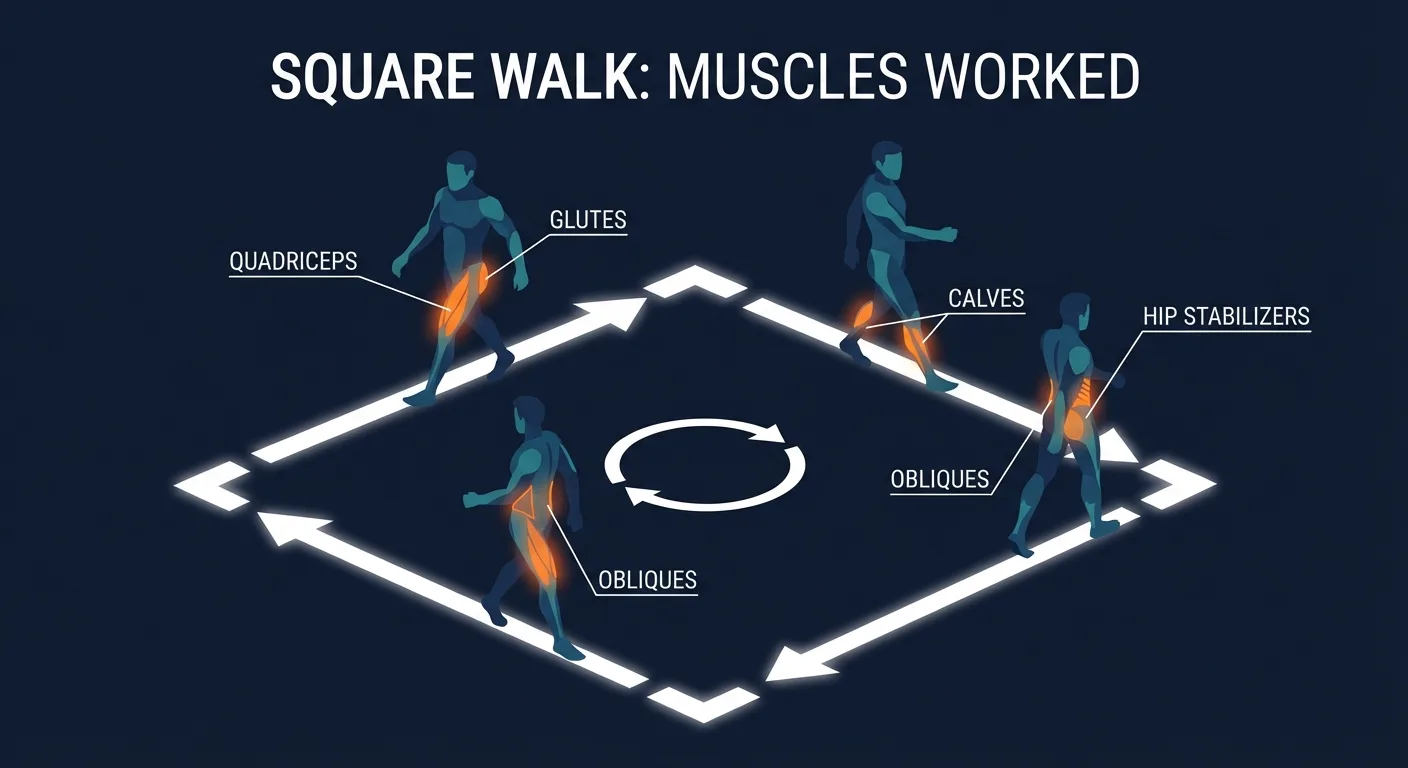
Muscles & Systems Worked
Primary movers: The quadriceps extend the knee as you step into each corner, while the glutes help control the hips and drive the small push-off into the next direction. The calves assist each step by lifting the heel and helping the foot roll cleanly from contact to push-off.
Secondary movers: The hip abductors and adductors manage the sideways portions of the square. The hip flexors help pick the leg up for the forward and backward steps, and the obliques rotate the rib cage as the twist follows each foot placement.
Stabilizers: The transverse abdominis, rectus abdominis, spinal erectors, and deep hip stabilizers keep the trunk stacked while you rotate. The peroneals, tibialis anterior, tibialis posterior, and small foot muscles steady each landing as the pattern changes direction.
Systems worked: Square walks are conditioning work, so the cardiovascular system and oxidative energy system carry the longer intervals. Faster versions add more glycolytic demand because the repeated steps and turns leave less time for recovery between foot strikes.
Step-by-Step: How to Do the Square Walk
- Mark your square. Picture a small square on the floor, about two feet on each side. Stand at one corner with your feet hip-width apart, chest tall, shoulders relaxed, and core lightly braced.
Coach Ty's cue: "Small square first. Clean corners before speed."
- Step forward and twist. Step your lead foot to the front corner and bring the back foot to meet it. Rotate your torso over the lead leg as your feet come together.
Coach Ty's cue: "Let your shoulders follow the step."
- Step sideways and twist. Step to the side corner, bring the trailing foot in, and rotate toward the new direction. Keep your posture tall instead of sliding across the floor.
Coach Ty's cue: "Step, meet, turn. Keep the beat."
- Step backward and twist. Step back to the rear corner, bring the other foot to meet it, and rotate again. Use a short backward step so you stay balanced without looking down.
Coach Ty's cue: "Trust the small step. Stay tall."
- Step sideways home and repeat. Step to the last corner, meet your feet, and twist one more time to complete the square. Continue for time, then switch which leg leads the next lap.
Coach Ty's cue: "Own every corner, then change leads."
Get this exercise in a personalized workout
FitCraft, our mobile fitness app, uses its AI coach Ty to program conditioning work like this into your plan at the right volume and intensity, based on your level, goals, and equipment. Ty was designed and trained by Domenic Angelino, MPH (Brown University) and NSCA-CSCS, with research published in the Journal of Strength and Conditioning Research and Medicine & Science in Sports & Exercise.
Take the Free Assessment Free • 2 minutes • No credit card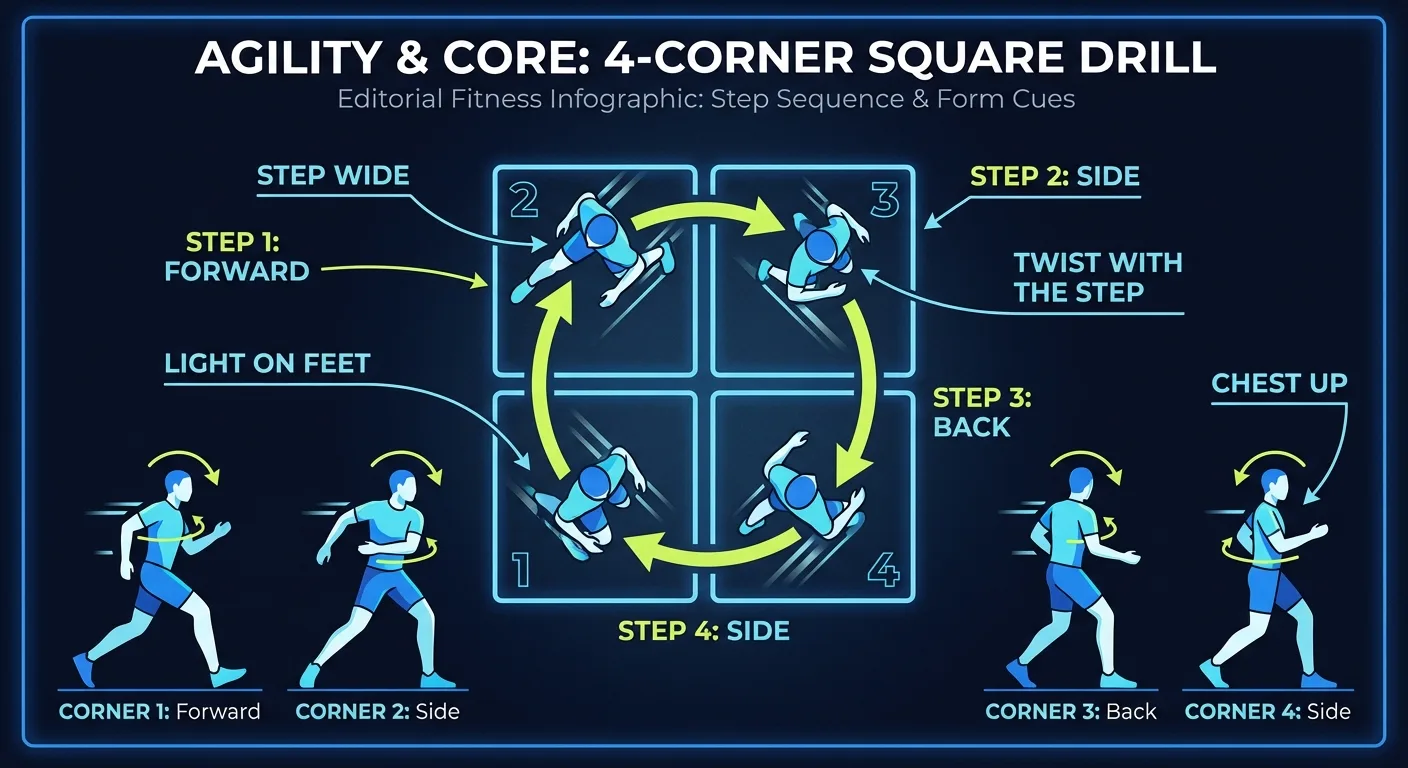
Common Mistakes
Shuffling Instead of Stepping
What it looks like: Your feet slide across the floor and barely leave the ground.
Why it matters: Shuffling lowers the conditioning effect and makes the direction changes less deliberate.
The fix: Pick each foot up, place it softly, and bring the other foot to meet it before you turn.
Skipping the Twist
What it looks like: Your feet move through the square while your chest stays locked forward.
Why it matters: The twist is what brings the obliques and hip rotation into the drill.
The fix: Turn your ribs, shoulders, and eyes toward the next corner. Keep the motion gentle and controlled.
Looking Down the Whole Time
What it looks like: Your head drops, your upper back rounds, and your steps get smaller because you are watching your feet.
Why it matters: The dropped posture limits rotation and can make balance worse.
The fix: Mark the corners with tape or use a tile pattern. Keep your chest up and track the floor with peripheral vision.
Rushing Before the Pattern Is Automatic
What it looks like: You speed up right away, miss corners, and lose the forward-side-back-side sequence.
Why it matters: Speed only helps once the pattern is clean. Before that, it turns the drill into tangled footwork.
The fix: Spend the first round at half speed. Add pace only when every corner feels predictable.
Square Walk Variations: Regressions and Progressions
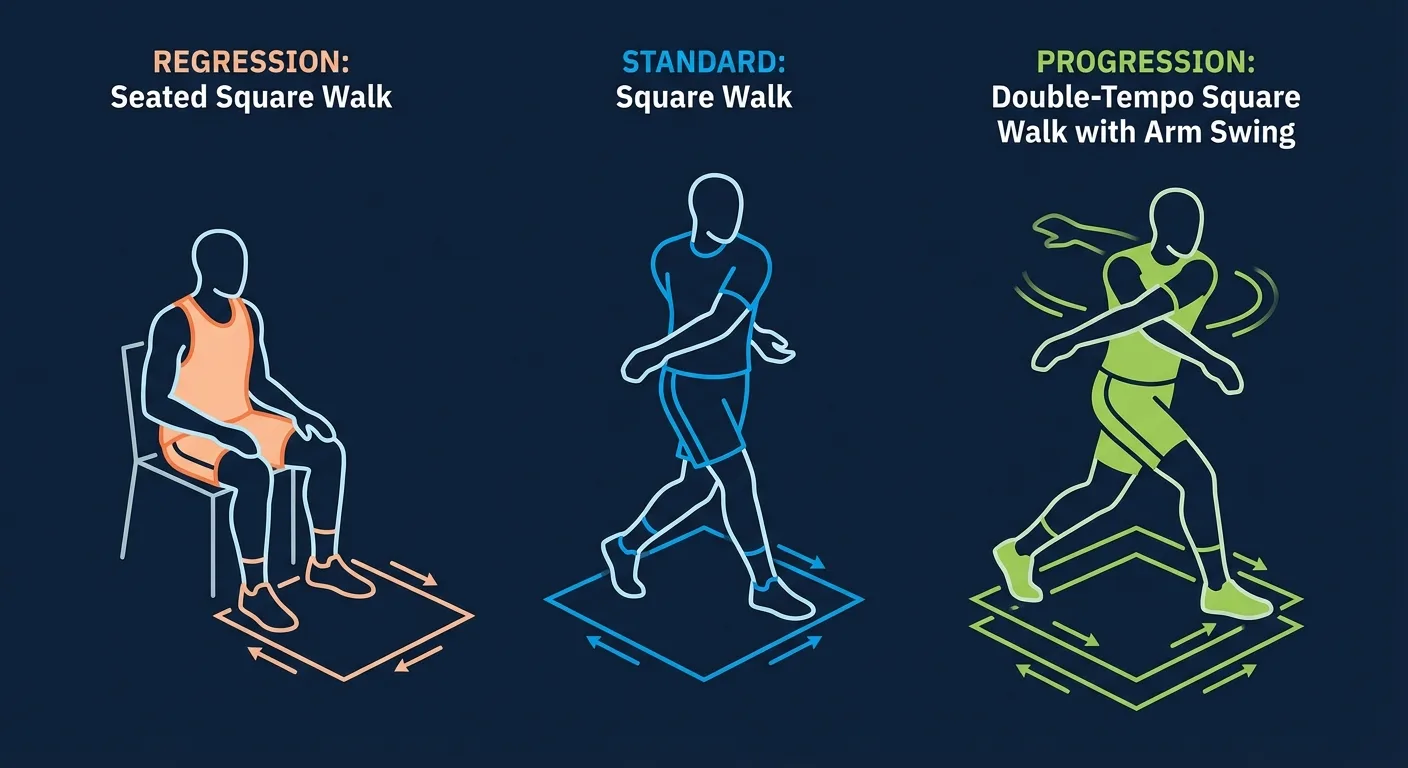
Square Walk Without the Twist
Use the same four-corner foot pattern but keep your torso facing forward. This regression helps you learn the steps before adding rotation.
Chair-Supported Square Walk
Place one hand lightly on a chair or counter and make the square smaller. This works well if balance is the limiting factor.
Square Walk with Arm Swing
Add a cross-body arm swing with each twist. The arms increase rhythm, coordination demand, and upper-body involvement without adding impact.
Double-Tempo Square Walk
Once standard rounds feel smooth, move through the corners at a faster cadence. Keep the steps small so the knees and ankles stay quiet.
When to Avoid or Modify Square Walks
Square walks are low impact for most healthy adults, but the turns and backward steps still need respect. Always consult your physician if you are starting or returning to exercise after illness, injury, pregnancy, or a long layoff.
- Knee, ankle, hip, shin, or foot pain. Make the square smaller, slow the pace, or use walking in place until symptoms settle.
- Known cardiovascular disease or uncontrolled hypertension. Keep the drill easy, stay inside your prescribed heart-rate range, and get medical clearance before using faster intervals.
- Vertigo, balance disorders, or vestibular symptoms. Use chair support, remove the twist, or choose marching in place because the direction changes can increase fall risk.
- Pregnancy or early postpartum recovery. Use a smaller square, slower tempo, and no forced twist. Get clearance from a qualified clinician, especially if you have pelvic-floor symptoms.
- Asthma or exercise-induced bronchoconstriction. Warm up longer, keep medication accessible if prescribed, and stop if breathing feels tight instead of simply elevated.
- Poor coordination on the backward step. Practice the pattern without speed first, or mark the corners clearly so you do not trip.
Related Exercises
- Lower-impact alternative: Step-N-Clap keeps the rhythm low impact while adding a larger arm pattern.
- Same category: Walking in Place is the simplest conditioning fallback when turns feel awkward.
- Rhythm progression: Marching in Place adds more knee lift without needing extra floor space.
- Higher-impact progression: Jumping Jacks raise intensity when your joints tolerate impact well.
- Faster lateral cardio: Quick Shuffles train direction changes at a higher speed.
- Core foundation: Deadbugs build the trunk control that keeps the twist crisp.
How to Program Square Walks
Ratamess et al., 2009 gives the broader progression model: match exercise dose to training status, add volume gradually, and let technique set the ceiling. For square walks, progression comes from interval length, tempo, square size, arm motion, and how well you recover between rounds.
| Level | Work | Rest between sets | Frequency |
|---|---|---|---|
| Beginner | 20-30 seconds | 60-90 seconds | 2-3 sessions/week |
| Intermediate | 30-45 seconds | 45-60 seconds | 3-4 sessions/week |
| Advanced | 45-60 seconds | 30-45 seconds | 3-5 sessions/week |
Where in your workout: Use square walks as a warm-up, low-impact cardio block, circuit station, or short finisher after strength training. If you are doing hard strength work, place faster conditioning after the lifting so your legs and balance are fresh for loaded exercises.
Form floor over time targets: Stop the interval when your feet start shuffling, the backward step gets uncertain, the twist becomes a neck turn, or your breathing feels uncontrolled instead of elevated.
FitCraft's AI coach Ty can place low-impact cardio drills like square walks inside a broader plan that fits your level. The key is using the right version, not forcing the fastest variation on day one.
Frequently Asked Questions
What is the square walk exercise?
The square walk is a low-impact cardio drill where you step through a small four-corner pattern: forward, side, back, and side. Each step includes a gentle torso rotation, so the movement trains conditioning, coordination, balance, and rotational control without jumping.
What muscles does the square walk work?
Square walks use the quads, glutes, calves, hip abductors, hip adductors, obliques, hip flexors, and ankle stabilizers. The heart, lungs, and energy systems also work because the drill is continuous and rhythmic.
Can I do square walks with knee pain?
Use caution if knee pain changes your step, balance, or confidence. Make the square smaller, slow the pace, skip the deep twist, or use walking in place until symptoms settle. Stop if pain sharpens or your knee feels unstable.
How long should I do square walks?
Start with 20 to 30 seconds of work, rest 60 to 90 seconds, and repeat for 10 to 15 minutes. Build toward 30 to 45 second intervals, then 45 to 60 second intervals as your rhythm and breathing improve.
Can I do the square walk in a small space?
Yes. The movement fits inside a small floor square. A rug corner, tile pattern, or light tape marker can give you enough visual reference without needing a large room.