Most cardio drills move straight ahead. Quick shuffles add the side-to-side pattern your hips, ankles, and knees still need for sport, hiking, stairs, uneven sidewalks, and quick balance saves. You stay in an athletic stance, move laterally with short steps, and reverse direction before your posture pops up.
The drill feels simple until speed climbs. The gluteus medius has to keep the hips level, the quads hold the low stance, and the calves make each foot contact quick. If your cardio work is mostly jumping jacks, high knees, or running in place, quick shuffles give you a different plane of motion without equipment.
Quick Facts: Quick Shuffles
- Equipment needed: None
- Difficulty: Intermediate
- Modality: Cardio, agility, and conditioning
- Body region: Lower body, hips, ankles, and core
- FitCraft quest category: Cardio
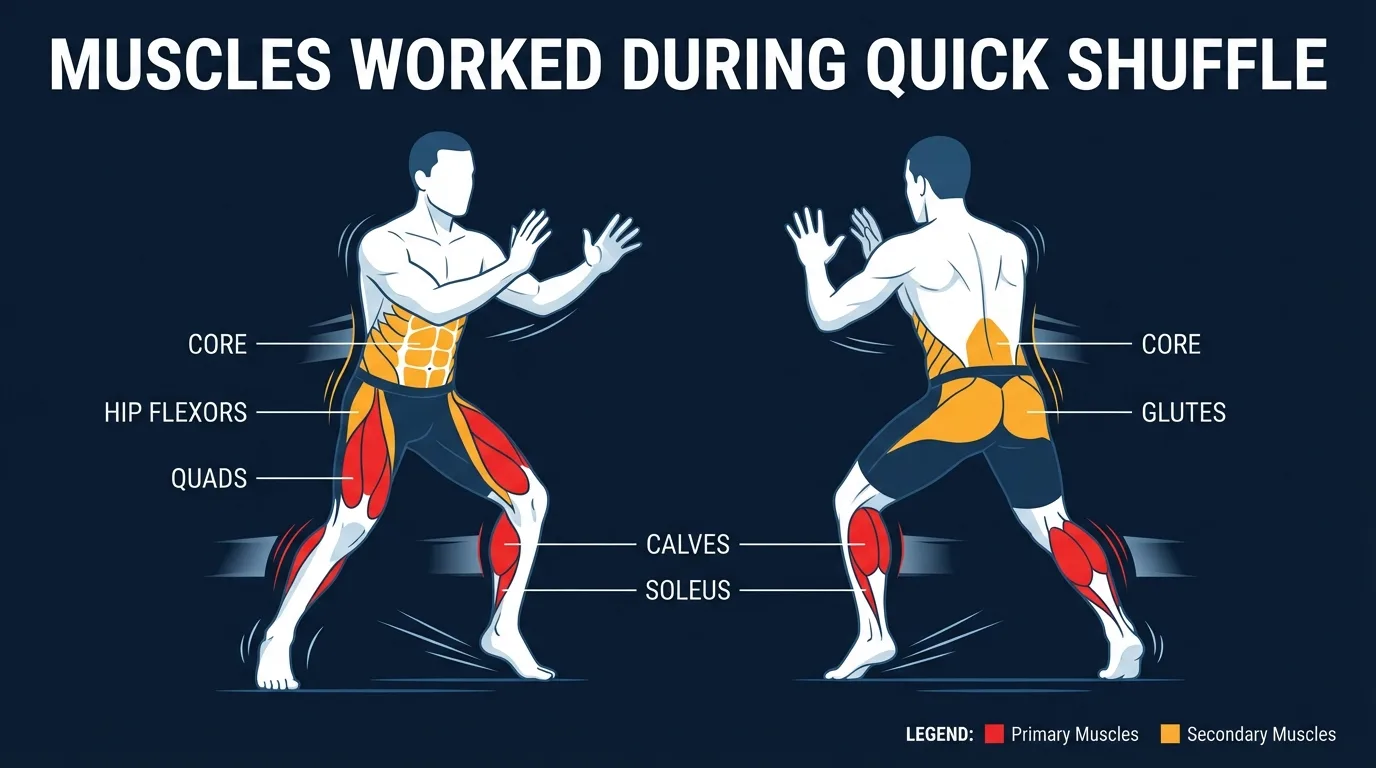
Muscles & Systems Worked
The quadriceps hold the low athletic stance and help absorb each stop. The gluteus medius and gluteus maximus drive the lateral push, especially when you change direction and push the floor away with the outside foot. The calves help create quick, springy contacts through the balls of the feet.
The hamstrings assist with hip control and deceleration, while the hip adductors help pull the trailing leg back under the body. Hip flexors lift the feet just enough to keep turnover fast without turning the drill into big side steps.
The obliques, transverse abdominis, rectus abdominis, spinal erectors, tibialis anterior, tibialis posterior, and peroneals work isometrically to keep the trunk, pelvis, and ankles from wobbling as speed increases.
The cardiovascular and metabolic systems carry the conditioning load. Lyu et al. (2024) used repeated lateral-shuffle protocols and measured blood lactate, heart rate, perceived exertion, ankle proprioception, and countermovement-jump loss after the work bouts.
How to Do Quick Shuffles (Step-by-Step)
- Set your athletic stance. Stand with feet shoulder-width apart, knees bent to about 30 degrees, hips hinged slightly back, chest up, and weight on the balls of your feet. Keep the arms bent at about 90 degrees in front of you.
Coach Ty's cue: "Stay low before you move. Your legs should already be working."
- Push off laterally. Drive off the inside edge of your trailing foot to move sideways. The power comes from the leg you're moving away from. Keep your head at the same height instead of popping up between steps.
Coach Ty's cue: "Push the floor away. Let the lead foot catch you."
- Slide and land softly. Let the lead foot receive your weight on the ball of the foot, then bring the trailing foot back to shoulder-width stance. Your feet should stay separated and never cross.
Coach Ty's cue: "Fast feet, wide base, quiet landings."
- Build speed. Once the pattern feels clean, use quick, light steps with minimal ground contact time. Short steps keep you balanced and make the next direction change faster.
Coach Ty's cue: "Think drumroll feet, not heavy marching."
- Change direction. When you reach your boundary, plant the outside foot, decelerate, and drive back the other way. Stay low through the transition instead of standing up to reset.
Coach Ty's cue: "Plant, push, go. Same height the whole time."
Get this exercise in a personalized workout
FitCraft, our mobile fitness app, uses its AI coach Ty to program conditioning work like this into your plan at the right volume and intensity, based on your level, goals, and equipment. Ty was designed and trained by Domenic Angelino, MPH (Brown University) and NSCA-CSCS, with research published in the Journal of Strength and Conditioning Research and Medicine & Science in Sports & Exercise.
Take the Free Assessment Free · 2 minutes · No credit card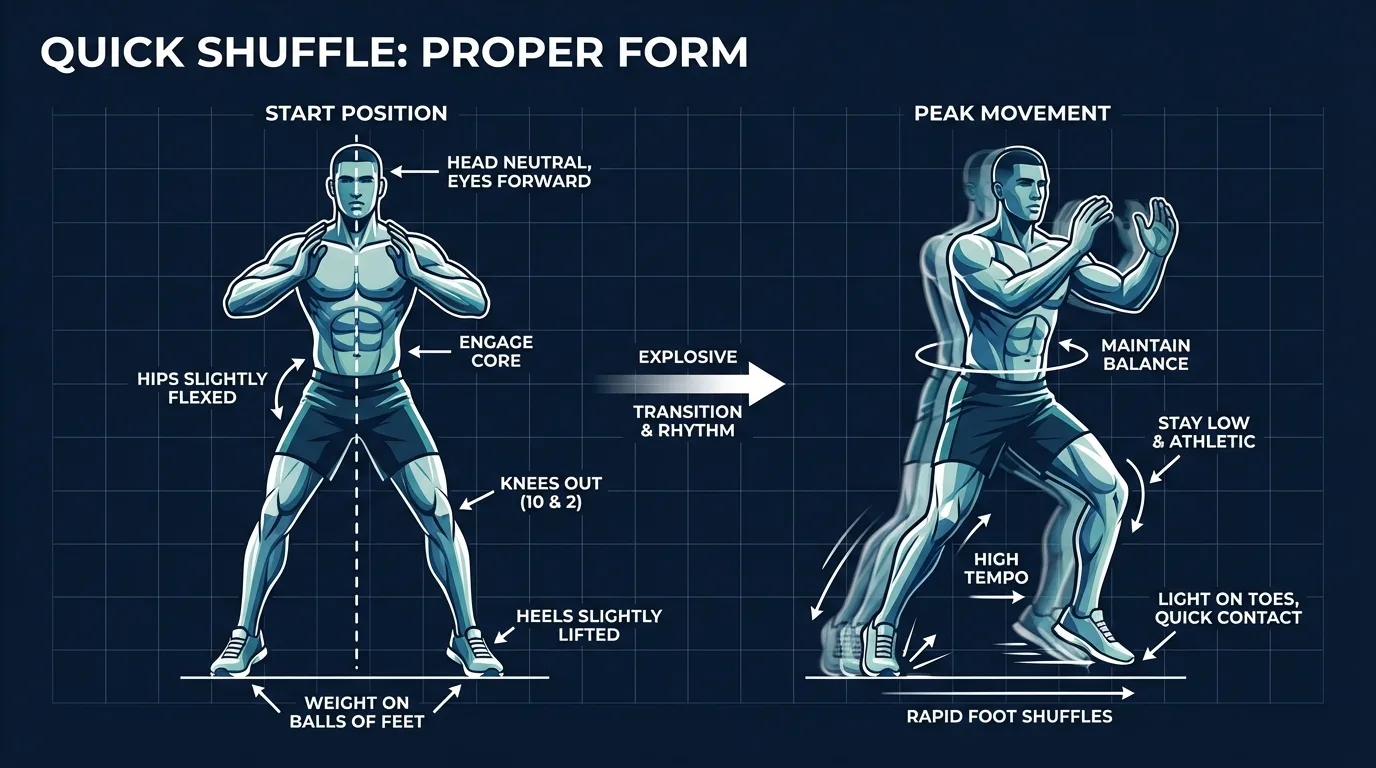
Common Mistakes to Avoid
Quick shuffles look like simple side steps, but small technical leaks get expensive fast. Fix these before you chase speed.
- Standing too tall. Upright shuffles unload the quads and hips. Drop the hips, bend the knees, and keep the chest proud.
- Crossing your feet. Crossed feet shrink your base of support and raise the risk of a stumble. Keep the feet separated through every step.
- Taking big strides. Long steps slow the drill down and make direction changes harder. Use short, rapid contacts instead.
- Bouncing up and down. Your head should travel mostly sideways. If it rises and falls with each step, push laterally instead of vertically.
- Letting the arms go dead. Stiff or dangling arms make the feet slower. Pump from the shoulders with elbows bent around 90 degrees.
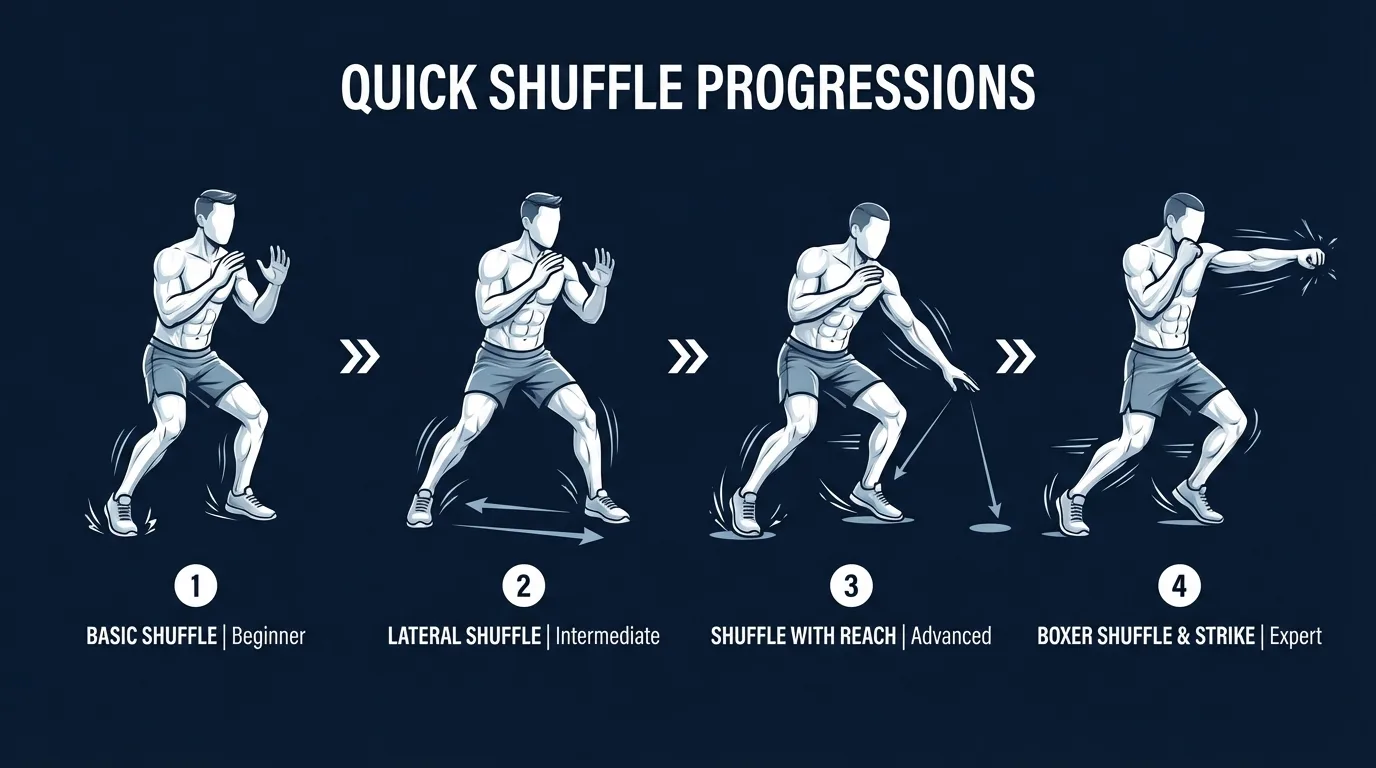
Quick Shuffle Variations and Progressions
Slow Lateral Step-Touch
Use this regression if speed makes your feet messy. Step sideways, bring the trailing foot in, pause, and repeat while keeping the hips low.
Half-Speed Shuffle
Move at about half your top speed so you can practice pushing from the trailing foot, landing softly, and reversing direction with control.
Banded Quick Shuffle
Place a light mini band above the knees or around the ankles. The band increases the hip-stability demand, so keep the knees tracking in line with the toes.
Shuffle with Floor Touch
Touch the floor with the outside hand each time you change direction. This adds a deeper stance, more deceleration demand, and a harder conditioning effect.
Defensive Slide Shuffle
Hold a lower stance, similar to a shallow wall sit, and move for 45 to 60 seconds. This shifts the drill toward quad endurance and controlled lateral defense.
When to Avoid or Modify Quick Shuffles
Quick shuffles are safe for many healthy adults, but the lateral speed and repeated direction changes deserve respect. Always consult your physician before starting or returning to intense conditioning work, especially if any of the following apply.
- Known cardiovascular disease or uncontrolled hypertension. HIIT can spike heart rate and blood pressure quickly. Use low-intensity walking in place until your clinician clears harder intervals.
- Knee, ankle, hip, shin, or foot pain. Lateral cuts can aggravate irritated joints and soft tissue. Use step-n-clap or slow step-touches until symptoms settle.
- Pregnancy, early postpartum recovery, or stress incontinence. Fast direction changes can challenge pelvic-floor control. Choose low-impact conditioning and get clearance from a qualified provider.
- Vertigo, balance disorders, or vestibular symptoms. Rapid lateral movement and quick reversals can raise fall risk. Marching drills are a better starting point.
- Asthma or exercise-induced bronchoconstriction. Warm up longer, keep your inhaler accessible if prescribed, and use lower-intensity intervals when symptoms are active.
Related Exercises
- Lower-impact cardio alternative: Step-n-clap keeps conditioning work upright and lower impact.
- Similar cardio intensity: Jumping jacks and high knees build faster rhythm with simpler footwork.
- Floor-based conditioning: Mountain climbers train heart rate, hip flexion, and core control.
- Core stability foundation: Forearm planks and deadbugs help you keep the trunk steady while the feet move fast.
- Ankle and calf preparation: Calf raises build the lower-leg capacity that supports faster foot contacts.
How to Program Quick Shuffles
The ACSM resistance-training position stand by Ratamess et al., 2009 supports progressing exercise volume, intensity, and frequency based on training status. For quick shuffles, use time-based intervals because the conditioning stimulus depends on pace and work-to-rest ratio.
| Level | Work interval | Rest between sets | Frequency |
|---|---|---|---|
| Beginner | 20-30 seconds | 60-90 seconds | 2-3 sessions per week |
| Intermediate | 30-45 seconds | 45-60 seconds | 3-4 sessions per week |
| Advanced | 45-60 seconds | 30-45 seconds | 3-5 sessions per week |
Place quick shuffles in a dynamic warm-up at moderate speed, in a standalone HIIT block, or after resistance training as a short metabolic finisher. Avoid doing hard shuffle intervals before heavy lower-body strength work because fatigue can reduce landing control.
Keep the form floor higher than the time target. Stop the set when your feet cross, your knees cave inward, your stance rises, or you can't reverse direction without stumbling.
Frequently Asked Questions
What muscles do quick shuffles work?
Quick shuffles primarily target the quadriceps, gluteus medius, and calves. Assisting muscles include the hamstrings, hip adductors, hip flexors, obliques, and transverse abdominis. The gluteus medius works especially hard because it generates the lateral push that propels you sideways and stabilizes your hips with each step.
Can I do quick shuffles with knee or ankle pain?
Modify or skip quick shuffles if knee, ankle, hip, shin, or foot pain changes your landing mechanics. Use marching in place, step-n-clap, or slow lateral step-touches until you can move without pain, and get medical clearance if symptoms are sharp, new, or persistent.
How long should I do quick shuffles?
For cardio conditioning, perform 30 to 60 second intervals with 15 to 30 seconds rest between sets. For agility work, use shorter bursts of 10 to 15 seconds at maximum speed. Beginners should start with 20-second intervals and build up. Three to five sets is a solid starting point for most fitness levels.
Can I do quick shuffles in a small space?
Absolutely. Quick shuffles can be performed in as little as 6 to 8 feet of lateral space. Just shuffle 3 to 4 steps in one direction, change direction, and repeat. The shorter the distance, the more direction changes you get, which actually increases the agility and deceleration demands of the exercise.
Are quick shuffles good cardio?
Yes. Quick shuffles performed at high intensity elevate your heart rate rapidly. Lyu et al. (2024) studied lateral-shuffle fatigue and tracked blood lactate, heart rate, perceived exertion, ankle proprioception, and jump performance after repeated shuffle protocols.