You know exercise would help. You've probably read that it helps ADHD specifically. You've bought the shoes, downloaded the app, done four great days, and then watched the whole thing evaporate without ever deciding to quit.
That loop is exhausting, and it's worse than an ordinary failed attempt because you can see exactly what you're supposed to do. The instructions aren't the missing piece. You've had them the whole time.
Here's the reframe that matters: the standard advice for building an exercise habit is written for a brain that finds starting cheap, waiting tolerable, and repetition acceptable. If yours doesn't, the advice isn't wrong so much as aimed at the wrong part of the machine. Symptomatic ADHD affects roughly 6.8% of adults worldwide by Song and colleagues' 2021 estimate, which is a lot of people being handed instructions built for someone else.
Why Working Out Is Harder With ADHD
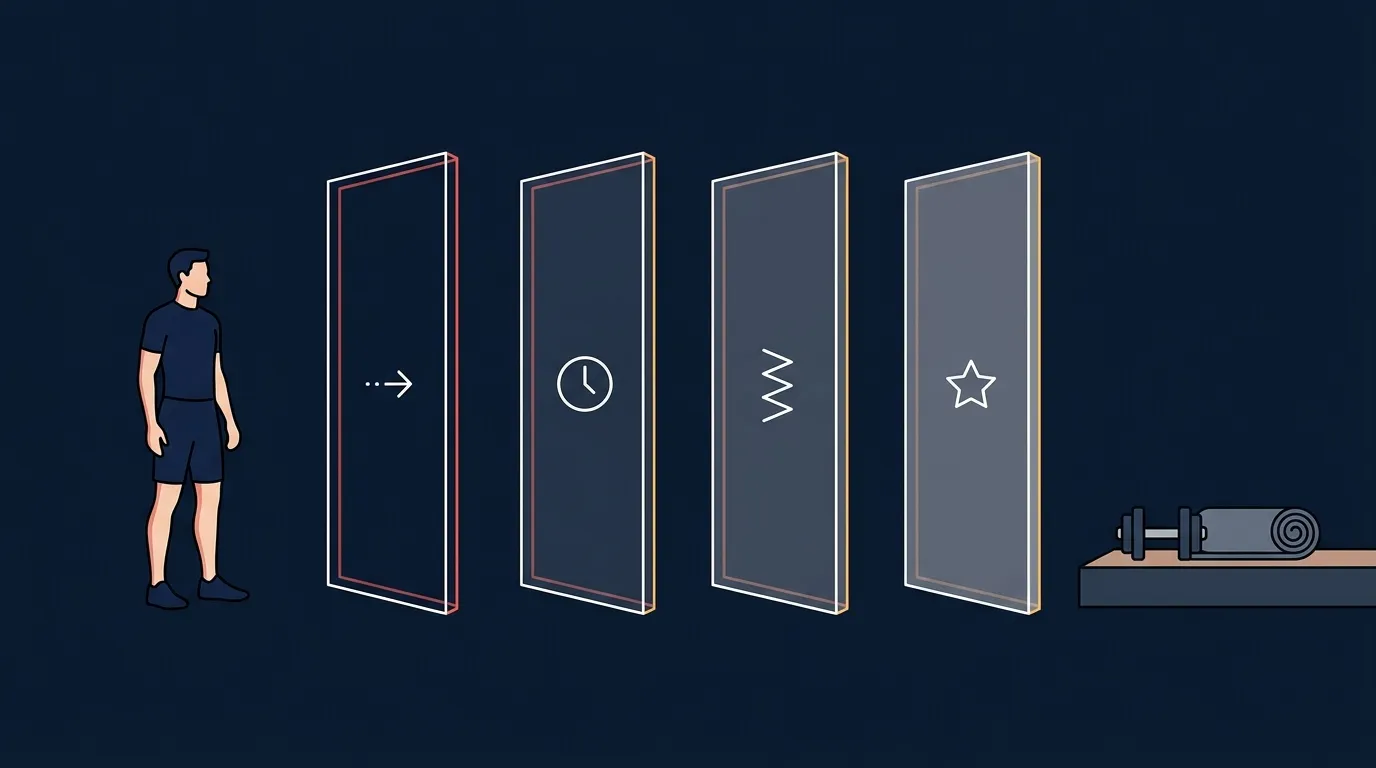
Four things go wrong, and they go wrong at four different points. Fixing one of them and leaving the other three is why most attempts feel like they almost worked.
Starting is a separate skill from wanting
Task initiation is an executive function. It's the ability to begin something without undue delay, and it sits in the same family as working memory, planning, and time management, which is the family ADHD affects.
So you can hold full intent, know the exact plan, feel no reluctance whatsoever, and still not convert any of that into standing up. That's not procrastination in the everyday sense, where a person decides to delay. Nothing was decided. The handoff between wanting and doing just didn't fire.
Which is why every piece of advice that begins with "you have to really want it" lands on the one part of the system that was already working. We've broken the initiation problem down in more detail in the guide on how to start working out with ADHD.
The payoff arrives far too late to count
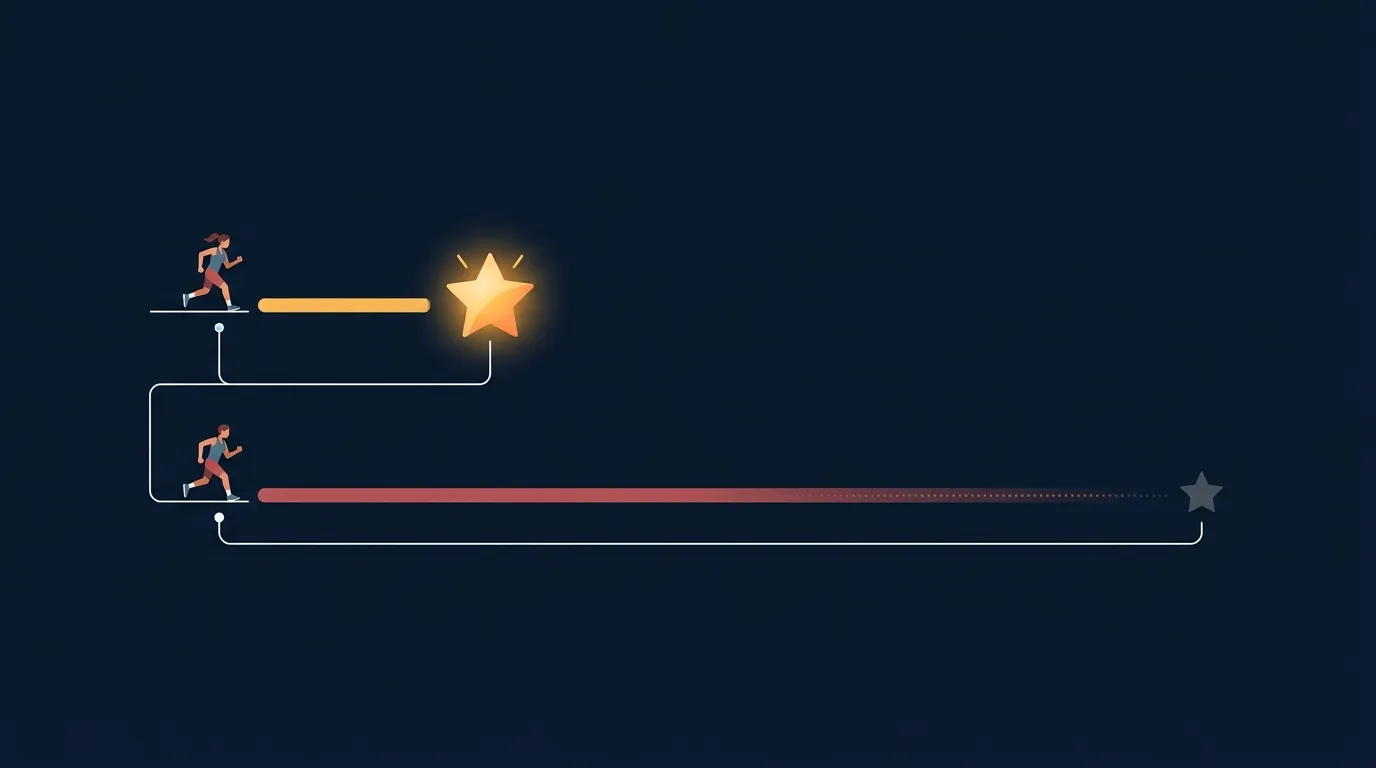
Fitness pays in eight weeks. ADHD brains price eight weeks at close to zero.
This is one of the most replicated findings in the field. Marx and colleagues (2021) pooled 37 group comparisons covering 3,763 participants and confirmed that people with ADHD pick small immediate rewards over larger delayed ones more often than controls, across two different experimental paradigms. Notably, offering real rewards rather than hypothetical ones almost doubled the odds ratio, which suggests the effect involves both a steeper discount on delay and a flat demotivation by rewards that aren't tangible.
Translate that into a Tuesday evening. The thing you're being asked to trade away is an hour of your evening right now. The thing you're being offered is a slightly different body in two months, hypothetically. That's close to the worst possible offer you could construct for an ADHD reward system, and no amount of discipline changes the exchange rate. The relationship between exercise and dopamine is real, but it's not what makes you open the door.
Your plan is built on time estimates that aren't reliable
"I'll go later" is a sentence that requires accurate internal timekeeping to mean anything, and internal timekeeping is measurably weaker in ADHD. A meta-analysis by Zheng and colleagues (2022), pooling 27 studies with 1,620 participants with ADHD and 1,249 controls, found significant timing deficits: less accurate perception of duration (Hedges' g greater than 0.40), less precise timing (g = 0.66), and a stronger tendency to overestimate elapsed time. That work was done in children and adolescents, so read it as background on the mechanism rather than a direct measurement of adults.
The practical version is familiar to anyone who lives it. Ninety minutes of "I'll go soon" costs the same subjective amount as ten. The window closes without any moment where it felt like it was closing.
Repetition is a stopping condition, not a minor annoyance
Most programs are built on repetition. Same five lifts, same progression, twelve weeks, and the boredom is treated as a character test you're supposed to pass.
For a lot of people with ADHD that's not a test, it's a wall. Once a routine stops holding attention, the sessions don't get worse, they stop happening. And because this usually hits around week three or four, it gets misfiled as a motivation failure right when the habit was supposed to be forming.
Why Exercise Pays Off More Than Average When You Have ADHD
Here's the frustrating part. The activity that's hardest for you to start is also one that appears to do more for you than it does for most people.
The strongest adult-specific evidence right now is a 2026 systematic review and meta-analysis by Xu, Zhao and Hu in Psychology of Sport and Exercise. Across 14 studies reviewed and 8 pooled, a single bout of exercise produced a moderate improvement in inhibitory control in adults with ADHD (Hedges' g = 0.55, 95% CI 0.32 to 0.79) and a small improvement in core symptoms (g = 0.23, 95% CI 0.03 to 0.43). Inhibitory control is the capacity to not do the thing, which is the executive function most people with ADHD would nominate first if asked what they'd like more of.
The mechanism has been looked at directly. Mehren and colleagues (2019) put 23 adults with ADHD and 23 matched controls through a Go/No-go task in an MRI scanner after 30 minutes of moderate-intensity cycling. The ADHD group showed increased brain activation during successful inhibition after exercise compared with the control condition. Behavioral scores didn't improve for the group as a whole, but the participants who started with the worst inhibition showed the largest exercise-related gains, which the authors read as a ceiling effect in the better performers.
For sustained training rather than one session, the picture is thinner but encouraging. A 2025 Swedish randomized controlled trial, the START study by Svedell and colleagues, assigned adults with clinically confirmed ADHD to either a protocolized 12-week exercise program or treatment as usual. In the 41 participants analyzed, the exercise group improved more on the ASRS symptom checklist, a mean difference of 6.98 points (95% CI 1.65 to 12.30, p = 0.012), with no serious adverse events. The sample was small and dropout was substantial, so treat it as a promising signal rather than a settled result. Xu and colleagues reached the same cautious conclusion about longer-term programs: mixed, and in need of better trials.
Two honest caveats before you build anything on this. Most of the ADHD exercise literature is done in children, not adults. And exercise is a complement to professional ADHD care, never a substitute for medication, therapy, or the judgment of your clinician.
Find out what's really holding you back
FitCraft, our mobile fitness app, pairs you with an AI coach who builds you a personalized plan around your goals, schedule, and fitness level. Every FitCraft program is designed by Domenic Angelino, MPH (Brown University) and NSCA-CSCS, with research published in the Journal of Strength and Conditioning Research and Medicine & Science in Sports & Exercise.
Take the Free Assessment Free • 2 minutes • No credit cardWhat Actually Makes It Stick
Each of these targets one of the four barriers directly. They're unglamorous on purpose, because the interventions that survive contact with an ADHD week are structural, not motivational.
Shrink the session until starting isn't a decision
The instinct is to plan a proper workout, because a small one feels like cheating. Invert that for the first month.
Ten to twenty minutes. A session that small is hard to build an argument against, and you're not training your legs yet, you're training the handoff between intending and moving. This is the same logic behind exercise snacks, short bouts scattered through the day, which suit people whose limiting factor is starting rather than capacity.
Set a ceiling too. Minimum ten minutes, maximum thirty. The floor protects you on bad days. The ceiling stops the hyperfocus session that leaves you too wrecked to come back for a week, which is the most common way a promising first week ends.
Put the reward where the effort is
Given what the delay-discounting research says, waiting eight weeks for the payoff isn't a plan. So move a reward to the same day.
It can be small and it can be arbitrary. What matters is that something registers as finished within minutes of finishing. Mark the day on a calendar you can see. Bank a point. Log the session. Have the shower and the specific coffee. Game mechanics work here for exactly this reason, which is why the research on gamification in fitness keeps showing up in ADHD discussions: points, levels, and visible streaks convert a distant abstract payoff into one that arrives now.
The point isn't that the point is valuable. The point is that it arrives.
Keep the skeleton fixed, rotate what hangs on it
This is the fix people most often get backwards. Faced with boredom, they change everything, which means every session becomes a new planning task, and planning is expensive.
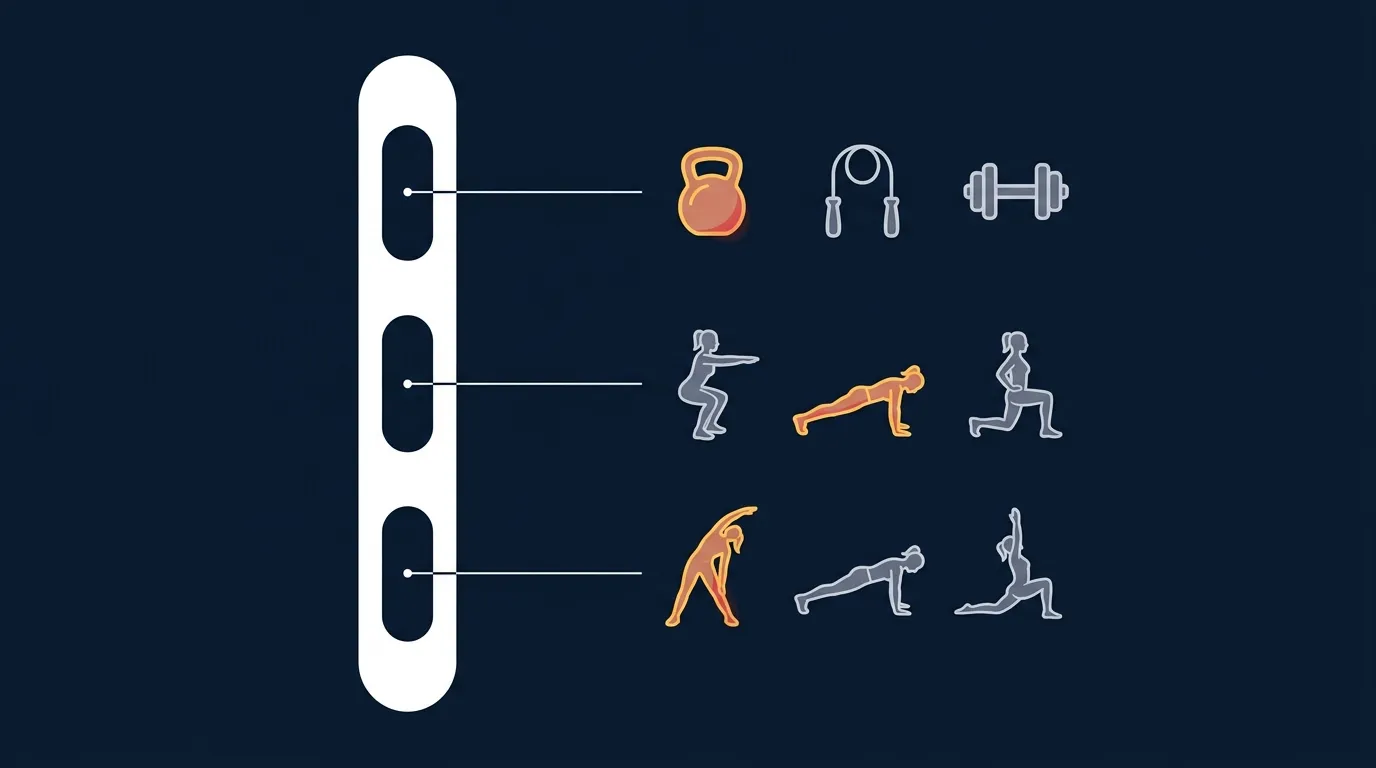
Do the opposite. Freeze the structure, the time, the place, the order, the number of blocks, and rotate only the contents. You get novelty without paying an initiation cost for it.
Variety isn't just a comfort measure either. Sylvester and colleagues (2016) randomly assigned 121 inactive university students to a high-variety or low-variety six-week exercise program and found the high-variety group adhered significantly better, with the effect mediated by how much variety participants perceived. That was a general population, not an ADHD sample, but it points the same direction as everything people with ADHD report. If you want a sense of which modalities to rotate through, our breakdown of the best type of exercise for ADHD ranks them by what the cognitive research actually supports.
Move the plan out of your head
If the plan lives only in working memory, it's competing for the resource that's already stretched, and it has to survive until the exact moment it becomes relevant.
So write it somewhere physical, or let something else hold it. A class with a start time. A calendar block. A person expecting you. An app that opens on one chosen session rather than a library you have to shop in. The mechanism is identical in each case: the structure exists outside you, so maintaining it costs no executive function.
Deciding in advance is worth doing properly. Gollwitzer and Sheeran (2006) pooled 94 independent tests covering more than 8,000 participants and found that if-then implementation intentions had a medium-to-large effect on goal attainment, d = 0.65, with the effect concentrated on initiating goal striving. Write the sentence in the format "when I put my bag down, I'll change and start block one", and anchor it to an event rather than a clock time, since noticing that it's 6pm is itself a task.
Borrow someone else's momentum
Body doubling, working alongside another person who is doing their own separate thing, is a technique the ADHD community arrived at long before researchers got interested in it. The formal evidence base is thin, so treat this as practitioner wisdom rather than a finding. But it's cheap to test, and the adjacent literature on social accountability in exercise points the same way.
In practice it's a training partner, a video call with someone stretching while you lift, a gym class where other people are visibly mid-set, or a virtual coworking service. The other person doesn't need to be doing your workout. They need to be present.
An ADHD Workout Plan You Can Use Today
Here's the whole template. Four blocks, roughly 20 minutes, identical every single session. Only the fourth column changes.
| Block | Time | Fixed rule | What rotates |
|---|---|---|---|
| 1. Same first move | 2 min | The identical opening movement every session, forever | Nothing. This block never changes |
| 2. Main work | 10 to 15 min | Two or three movements with countable sets, so each one has a visible end | Which movements, and which equipment |
| 3. Something you like | 3 min | One thing chosen purely because it's enjoyable | Stretch, walk, a favorite song, whatever |
| 4. Mark it | 30 sec | Log the session before you leave the room | Nothing. This block never changes |
Block one exists so that starting is never a fresh decision. The same movement every time means block one requires zero planning, and once you're through it you're already in the session. Block two is where sets earn their keep: a set of eight ends by itself, which makes it far easier to finish than twenty open-ended minutes on a bike. That structural argument is the reason strength training suits ADHD better than its share of the research would suggest. Block three buys the next session. Block four collects the reward before your attention leaves the room.
A workable first week is four sessions, alternating two upper-body-led days and two lower-body-led days, with the template above holding all four. Miss one and you don't restart, you resume at the same size. The gap costs you very little. Deciding the gap means starting over is what costs you everything.
Apps That Help, and What Each One Actually Does
Apps aren't a solution to ADHD and no app is a treatment. What a good one does is take a specific piece of executive work off your plate. So it helps to be clear about which piece.
General ADHD apps for adults
These don't make you exercise. They lower the executive load around it, which is often the thing that was actually blocking you.
- Visual planners. Tiimo was built by and for neurodivergent people and shows the day as visible blocks with a focus timer, which is a direct workaround for unreliable internal timekeeping. It has a free version covering planning, to-do lists, and the timer.
- Task-breakdown tools. Goblin Tools is free and its Magic ToDo feature splits a vague item like "work out" into concrete steps. Useful when the task feels too big to begin, which is most of the time.
- Body-doubling services. Focusmate pairs you with a stranger for a timed session of virtual coworking. It's free for a limited number of sessions each week, and while people mostly use it for desk work, it works for a home session just as well.
Free apps for ADHD adults, and where free stops being enough
The three above all have free options, and for planning and initiation the free versions genuinely cover the job. Free tends to run out in one specific place: nobody's free tool decides what your workout is or progresses it for you. That's the piece worth paying attention to, because deciding what to do is one of the four barriers, and a reminder app can't remove it.
Workout apps: the one question worth asking
The tools above won't decide what your workout is or progress it for you, and that decision is one of the four barriers. So there's really only one question to put to a workout app: when you open it on a bad day, is today's session already chosen, or are you handed a library to shop in?
We've compared eight of them against ADHD-specific criteria, including where FitCraft loses to other apps, in the guide to the best fitness app for ADHD, so there's no point restating it here. For how FitCraft removes the planning step specifically, see FitCraft's ADHD workout app, or the gamified workout app page if the same-day reward loop is the part you care about.
Two situations need more specific advice than a general app comparison can give. Body doubling for workouts covers external accountability, while exercise, ADHD, and burnout for women covers late diagnosis and capacity changes across the menstrual cycle.
To be plain about it: FitCraft is a fitness app, not a treatment for ADHD, and it makes no clinical claims.
What Progress Actually Feels Like
Week one is easy and it will mislead you. Novelty is doing the work, and novelty is the one resource you can't budget.
Weeks three and four are where it usually breaks, and it breaks quietly. Not a decision to stop, just two skipped sessions that turn into a fortnight. If you know that's coming you can plan a rotation for it in advance rather than trying to think your way out of it in the moment.
Somewhere in weeks six to eight the acute effects start being something you notice on purpose. Not a transformation. A measurable difference in how the afternoon after a session goes, compared with the afternoon after a skipped one. That's the effect the meta-analytic data describes, and it's small enough that you have to be paying attention to catch it.
The Bottom Line
You've never had a motivation problem. You have four structural problems that happen to produce the same visible outcome, and they need four different fixes.
Make the session small enough that starting isn't a decision. Put a reward the same day. Fix the skeleton and rotate the contents. Keep the plan somewhere other than your own head.
Then let the session be boring and short and unimpressive for a while, because the version of this that works is the one you're still doing in March.
Frequently Asked Questions
What is the best workout for ADHD?
The best workout for ADHD is the one you can start without a negotiation, which in practice means short, structured, and varied. Sessions of roughly 15 to 25 minutes built from movements that have a clear end point, such as sets and reps rather than open-ended cardio, are easier to begin and easier to finish. Beyond that, modality matters less than adherence: an activity you find interesting and can repeat four times a week will beat an optimal program you abandon in week three.
Why is working out so hard with ADHD?
Four separate things stack up. Task initiation is an executive function and it's one of the functions ADHD affects most, so wanting to exercise and starting to exercise are handled by different systems. Distant rewards are heavily discounted, and Marx and colleagues' meta-analysis covering 37 group comparisons and 3,763 participants confirmed that people with ADHD choose small immediate rewards over larger delayed ones more often than controls. Time estimation is less reliable, so a plan for later today quietly evaporates. And repetition is genuinely harder to tolerate, so a program that works by doing the same thing for twelve weeks runs out of road early.
Does exercise help ADHD symptoms?
The evidence in adults is promising but still early. A 2026 systematic review and meta-analysis by Xu, Zhao and Hu found that a single bout of exercise produced a moderate improvement in inhibitory control in adults with ADHD (Hedges' g = 0.55) and a small improvement in core symptoms (g = 0.23), while the evidence for longer training programs was mixed. A 2025 Swedish randomized controlled trial of a 12-week exercise program reported better ADHD symptom scores than usual care alone. Exercise is a complement to professional ADHD care, not a replacement for it.
How long should an ADHD workout be?
Start at 10 to 20 minutes and treat that as a real workout rather than a warm-up to a real one. A short session is much harder to argue your way out of, and with ADHD the thing you're training first is the act of starting. Set a ceiling as well as a floor, because a hyperfocus session that runs 90 minutes on day one is one of the most reliable ways to lose the next week to soreness.
What are the best apps for ADHD adults who want to exercise?
Two different categories do two different jobs. General ADHD apps for adults, such as visual planners and task-breakdown tools, reduce the executive load around the workout: they hold the schedule, break a vague intention into concrete steps, and provide a visual sense of elapsed time. Workout apps carry the session itself, and the ones that suit ADHD are those that pick the workout for you, keep the default session short, deliver a reward the same day, and let you resume after a lapse without restarting. Most people benefit from one of each rather than expecting a single app to do both.
Are there free apps for ADHD adults?
Yes, and several of the most useful ones cost nothing to try. Goblin Tools is free and its task-breakdown feature turns an intimidating item like exercise into a short list of concrete steps. Tiimo, a visual planner built by and for neurodivergent people, has a free version covering planning, to-do lists, and its focus timer. Focusmate offers virtual body doubling and is free for a limited number of sessions each week. FitCraft also has a free version of its workout app.