You've probably seen it on your feed: a tub of cottage cheese, a spoon, and a caption calling it the weight-loss food nobody talks about. Then you remember the lumpy scoop on a 1980s diet plate and wonder whether it deserves a second chance.
If you've tried to lose weight before, you know the hard part usually isn't knowing what to eat. It's being hungry at 3 p.m. and again at 9 p.m., and losing that fight to whatever is in the cupboard. Each lost fight feels like proof you lack willpower. It isn't. A plan that leaves you hungry all day is a badly designed plan, and a food that fills you up for very few calories is one of the simplest design fixes there is.
Cottage cheese can be that food, though not for every reason you've heard. Below you'll find how much protein each type holds, what the casein and bedtime studies did and didn't show, how it compares with Greek yogurt, the sodium and lactose catch, and eight ways to eat it that fit a calorie deficit.
Is Cottage Cheese Good for Weight Loss?
Yes, as part of a calorie deficit. But be clear about what the evidence is. No randomized trial has tested cottage cheese on its own as a weight-loss food. The case comes from three bodies of research that it fits neatly into: high-protein diets, dairy during weight loss, and the studies on its main protein, casein.
The protein evidence is the strongest. In a study by Weigle and colleagues (2005), 19 adults moved from a diet with 15% of calories from protein to one with 30%. When they could eat as much as they liked, they ate 441 fewer calories a day and lost an average of 4.9 kilograms (about 11 pounds) over 12 weeks, 3.7 kilograms of it fat. A meta-analysis by Wycherley and colleagues (2012) pooled 24 trials with 1,063 people on calorie-matched diets. The higher-protein versions produced slightly more weight loss (0.79 kilograms) and fat loss (0.87 kilograms), and they protected 0.43 kilograms of lean mass that the standard-protein diets lost.
The dairy evidence comes with a condition. Chen and colleagues (2012) pooled 29 trials with 2,101 people and found that adding dairy didn't cause weight loss by itself. It helped only when people were also cutting calories. A later meta-analysis by Stonehouse and colleagues (2016) looked only at calorie-restricted trials: people given extra dairy (2 to 4 servings a day, or whey protein) lost about 1.2 kilograms more weight and 1.5 kilograms more fat than people eating little dairy, and kept a little more lean mass. Most of those participants were women.
Put together, cottage cheese works the way any lean, high-protein food works. It makes a calorie deficit easier to live with. It's one of the staples in our list of the best snacks for weight loss for exactly that reason.
Cottage Cheese Protein: How Much Is in Each Type?
A cup of low-fat (1%) cottage cheese holds 28 grams of protein for 163 calories, according to USDA FoodData Central. That works out to about 17 grams of protein per 100 calories, almost exactly the same as plain nonfat Greek yogurt and close to skinless chicken breast (about 19 grams). A whole egg gives about 9 grams per 100 calories.
Here's how the common types compare, per 4-ounce (113-gram) serving, which is about half a cup:
| Type (4 oz, about 1/2 cup) | Calories | Protein (g) | Protein per 100 calories (g) | Sodium (mg) | Calcium (mg) |
|---|---|---|---|---|---|
| Low-fat 1% | 81 | 14.0 | 17.2 | 459 | 69 |
| Low-fat 1%, no salt added | 81 | 14.0 | 17.2 | 15 | 69 |
| Full-fat (creamed, about 4%) | 111 | 12.6 | 11.3 | 356 | 94 |
| Nonfat dry curd | 81 | 11.7 | 14.4 | 420 | 97 |
| Low-fat plain Greek yogurt, for comparison | 82 | 11.2 | 13.6 | 38 | 130 |
Figures are calculated from USDA FoodData Central entries per 100 grams. Brands vary, so check the label on your tub, especially for sodium.
Two things stand out. First, 1% cottage cheese is the sweet spot: it has the most protein per calorie of the common types. Second, sodium varies more than anything else, from 15 milligrams in a no-salt-added tub to over 450 in a regular one. Cottage cheese also has very little carbohydrate, about 3 grams per half cup of 1%, which is why it fits most eating styles.
Why Cottage Cheese Keeps You Full: Protein First, Casein Second
Most of the milk protein in cottage cheese is casein, because the curds are made from casein and much of the whey drains away. Casein digests slowly. In a classic tracer study, Boirie and colleagues (1997) showed that whey produced a sharp, short rise in blood amino acids, while casein produced a long, moderate plateau, probably because it clots in the stomach and empties slowly.
It's tempting to conclude that slow means more filling. The evidence doesn't back that up. When Hall and colleagues (2003) gave people a drink with 48 grams of whey or 48 grams of casein, the whey group ate less at a buffet 90 minutes later, and their gut fullness hormones (CCK and GLP-1) rose more. So casein isn't a magic satiety protein. Our casein vs whey comparison covers how the two differ for muscle.
What keeps you full is the amount of protein, and cottage cheese makes a big dose easy and cheap. A review of breakfast trials by Gwin and Leidy (2018) found the biggest effects on appetite and fullness came from solid breakfasts with at least 30 grams of protein and at least 350 calories. A cup of 1% cottage cheese gets you to 28 grams before you add anything. Add fruit and a slice of whole-grain toast and you're there.

Cottage Cheese Before Bed: What the Casein Studies Found
Eating cottage cheese before bed comes from sports nutrition research on casein, and the results depend on what you want from it.
- For muscle, it helps. Res and colleagues (2012) gave 16 young men 40 grams of casein 30 minutes before sleep after an evening strength workout. Overnight muscle protein synthesis ran about 22% higher than with a placebo, a borderline result, and whole-body protein balance turned positive.
- For morning appetite, one study found a benefit. In Ormsbee and colleagues (2015), 37 sedentary women with obesity had a 140 to 150 calorie serving of casein, whey or carbohydrate within 30 minutes of sleep every night for 4 weeks while doing supervised training 3 days a week. Casein raised morning fullness more than whey or carbohydrate. All three groups lost fat and gained lean mass, which came from the training.
- Cottage cheese itself did nothing special for metabolism. Leyh and colleagues (2018) gave 10 active young women cottage cheese with 30 grams of protein, a matched casein shake or a placebo 30 to 60 minutes before bed. Next-morning resting metabolism and appetite were the same in all three conditions.
- Across the research, the effect is small. A systematic review by Dela Cruz and Kahan (2021) of 11 studies found limited to no effect of 24 to 48 grams of pre-sleep casein on metabolism or appetite.
So a bowl of cottage cheese at night is a sensible way to add protein, especially if you train in the evening. It won't raise your metabolism or burn fat while you sleep, and its calories count like any others. Our review of pre-sleep protein research goes deeper on the muscle side.
Low-Fat vs Full-Fat Cottage Cheese for Weight Loss
Low-fat 1% cottage cheese has about 30 fewer calories per half cup than full-fat creamed cottage cheese (81 against 111) and slightly more protein (14 grams against 12.6). Over a full cup the gap grows to about 60 calories. If you eat cottage cheese daily, low-fat is the easier choice for a calorie deficit.
Full-fat isn't bad for you, though. A review by Kratz and colleagues (2013) found that in 11 of 16 observational studies, people who ate more high-fat dairy actually had less body fat. Those studies show links, not cause and effect, but they don't support the fear that full-fat dairy makes people gain weight. Some people find the creamier texture more satisfying and eat less of other things. If full-fat is the version you'll actually eat, it beats a low-fat tub that sits untouched.
Is low-fat cottage cheese bad for you? No. Some low-fat and nonfat brands add thickeners such as gums to replace the creamy texture, which are safe for most people. Nonfat "dry curd" cottage cheese is a different product with no creamy dressing. It's drier, a little lower in protein per calorie, and works best blended into recipes.
Find out what's really holding you back
FitCraft, our mobile fitness app, pairs you with an AI coach who builds you a personalized plan around your goals, schedule, and fitness level. Every FitCraft program is designed by Domenic Angelino, MPH (Brown University) and NSCA-CSCS, with research published in the Journal of Strength and Conditioning Research and Medicine & Science in Sports & Exercise.
Take the Free Assessment Free • 2 minutes • No credit cardIs Cottage Cheese or Greek Yogurt Better for Weight Loss?
On protein per calorie, it's a tie. Plain nonfat Greek yogurt and 1% cottage cheese both give about 17 grams of protein per 100 calories. The low-fat Greek yogurt in the table above carries more fat, so it lands lower per calorie. Where they differ:
- Sodium: Greek yogurt wins easily. Plain low-fat Greek yogurt has about 34 milligrams of sodium per 100 grams against 406 for regular 1% cottage cheese.
- Calcium: Greek yogurt again, with about 115 milligrams per 100 grams against 61.
- Live cultures: Yogurt is always made by fermenting milk with bacterial cultures. Only some cottage cheeses add live cultures, so check the label if that matters to you.
- Versatility: Cottage cheese wins for savory food. It works on toast, in eggs, in dips and in pasta sauce, where yogurt can taste too sour.
The practical answer is to rotate them. Use Greek yogurt when you've already had a salty day and cottage cheese when you want something savory.
Is There a Downside to Eating Cottage Cheese Every Day?
For most healthy adults, a daily serving is fine. There are three things to watch, plus a few people who should check with a doctor first.
Sodium
This is the main one. A cup of regular 1% cottage cheese has about 918 milligrams of sodium. The FDA sets the Daily Value at less than 2,300 milligrams a day, so one cup uses 40% of it. If you have high blood pressure or eat a lot of other packaged food, buy no-salt-added cottage cheese, which has about 13 milligrams per 100 grams. An old trick is to rinse it: Vermeulen and colleagues (1983) found a 3-minute rinse cut the sodium in cottage cheese by 63%, but it also washed out about half the calcium.
Lactose
Cottage cheese has more lactose than aged cheeses because it's fresh. A cup of 2% has about 9 grams and a cup of full-fat about 6, based on USDA data. A systematic review by Shaukat and colleagues (2010) of 36 trials found that most adults with lactose intolerance tolerate 12 to 15 grams of lactose, about a cup of milk. So half a cup usually goes down fine. Lactose-reduced versions exist if it doesn't.
Calcium Is Lower Than You'd Expect
Is cottage cheese good for your bones? It helps less than other dairy. A cup of 1% has about 138 milligrams of calcium, roughly a tenth of the 1,300-milligram Daily Value, because much of milk's calcium leaves with the whey when the curds form. A 7-ounce tub of low-fat Greek yogurt has about 230 milligrams. Cottage cheese's protein does support bone, but don't count on it as your main calcium source.
Who Should Check With a Doctor First
- People with kidney disease, because of the protein, phosphorus and sodium.
- People with high blood pressure or heart failure who've been told to limit sodium.
- Anyone with a milk protein allergy, which is different from lactose intolerance. Lactose-reduced cottage cheese still contains milk protein.
Can You Lose Weight on a Cottage Cheese Diet?
The "cottage cheese diet" means eating little except cottage cheese for a few days. You'd lose weight, because you'd be eating very little. But no study has tested it, and it has clear problems. Cottage cheese has no fiber, and four cups of regular 1% would give you about 3,670 milligrams of sodium, well over the daily limit, for only about 650 calories. Much of the early weight loss on any very low-calorie crash plan is water and stored carbohydrate, and it comes back when you eat normally.
Treat cottage cheese as one high-protein food in a balanced diet rather than the whole diet.
How to Eat Cottage Cheese for Weight Loss: 8 Easy Ways
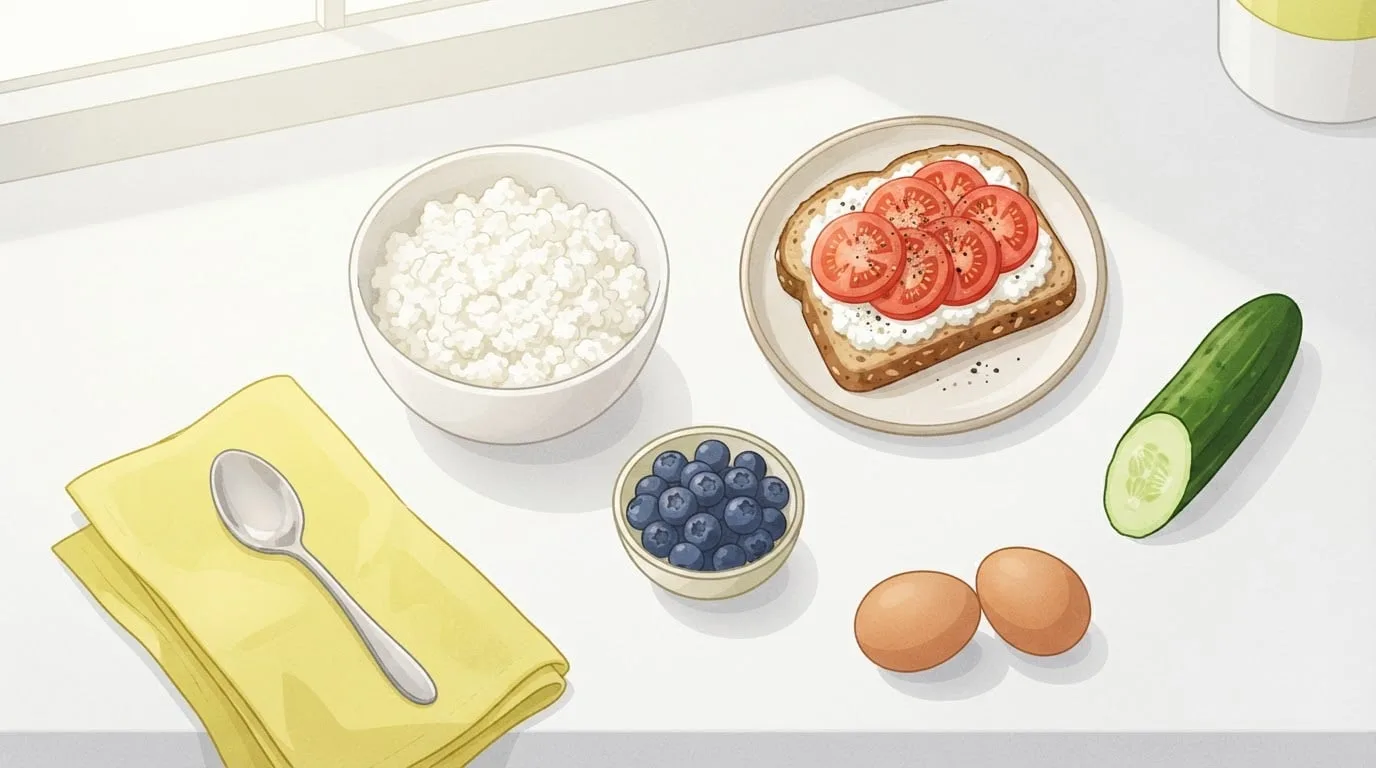
The goal is to let cottage cheese replace something less filling, not to add it on top of what you already eat. Pair it with fruit, vegetables or whole grains so you get the fiber it lacks.
- Berry breakfast bowl. A cup of 1% cottage cheese with a handful of berries and a pinch of cinnamon gives about 29 grams of protein for about 200 calories.
- Savory snack bowl. Half a cup with sliced cucumber, cherry tomatoes and black pepper. It's filling, crunchy and close to 100 calories.
- On toast. Spread it on a slice of whole-grain toast and top with sliced tomato or a little everything seasoning, in place of butter or cream cheese.
- In scrambled eggs. Stir a few spoonfuls into eggs near the end of cooking. They come out creamier and you get more protein without more eggs.
- Blended into pancakes. Blend half a cup of 1% cottage cheese, two eggs and half a cup of rolled oats, then cook small pancakes. Our high protein breakfast ideas include this one with the protein counts.
- Whipped into a dip. Blend it until smooth with lemon juice, garlic and herbs and serve it with raw vegetables instead of a sour cream dip.
- In pasta sauce. Blend it into tomato sauce or a little pasta water for a creamy sauce with far less fat than cream.
- Evening bowl. If dinner was early and you train at night, half a cup to a cup before bed is a protein-rich snack that fits a deficit. Count it in your day's calories.
How Cottage Cheese Fits a Calorie Deficit
Cottage cheese helps only if your total calories still come in under what you burn. Its value is in the swaps it makes easy. A cup of 1% cottage cheese with berries in place of a bakery muffin, or half a cup with vegetables in place of chips in the afternoon, can save a few hundred calories a day while leaving you fuller. That's how the protein studies above produced their results: people ate less without feeling deprived.
Protein also protects muscle while you lose weight, which is why the higher-protein diets in the Wycherley meta-analysis kept more lean mass. Strength training protects it further. That doesn't need a gym: dumbbell and bodyweight workouts two or three times a week are enough for most beginners. The hard part is keeping it up past the first few weeks, which is what our comparison of the best workout apps for weight loss looks at. FitCraft is one of the options: a 3D AI coach demonstrates each exercise, says your name during the workout, and keeps a streak going so you have a reason to come back tomorrow. As Sarah, 27, who lost 18 pounds in 3 months, put it: "First app that made exercise feel like something I chose, not forced."
The Bottom Line
Cottage cheese is good for weight loss because it's one of the cheapest ways to get a lot of protein for few calories: 28 grams for 163 calories in a cup of 1%. That protein helps you stay full and keep muscle in a calorie deficit. Its slow-digesting casein and bedtime timing are minor details, and the evidence for them is weak.
Choose 1% or no-salt-added 1% for the best protein per calorie, keep an eye on sodium, pair it with fruit or vegetables for fiber, and use it to replace less filling foods rather than to add to them.
Frequently Asked Questions
How much cottage cheese should you eat each day?
Half a cup to one cup a day suits most people trying to lose weight. A cup of 1% cottage cheese gives 28 grams of protein for 163 calories, but it also carries about 918 milligrams of sodium, 40% of the 2,300-milligram daily limit, so sodium is usually what caps the portion. A no-salt-added tub lets you eat more without that problem.
Can I eat cottage cheese every day to lose weight?
Yes, if it fits your calories and you watch the sodium. Daily cottage cheese is a cheap way to raise your protein, which helps you stay full and keep muscle while you eat less. Weight loss still depends on the calorie deficit across your whole day, not on any single food.
Is cottage cheese good for your bones?
It helps a little, but less than most dairy. A cup of 1% cottage cheese has about 138 milligrams of calcium, roughly a tenth of the 1,300-milligram Daily Value, because much of milk's calcium drains away with the whey when the curds form. Its protein supports bone, but yogurt and milk are better calcium sources.
What are the different types of cottage cheese?
Cottage cheese comes in nonfat, low-fat (1% or 2% milkfat) and full-fat or creamed (usually 4%) versions, with small or large curds. You can also find no-salt-added, lactose-reduced and whipped versions, plus tubs mixed with fruit or vegetables. For weight loss, plain 1% or no-salt-added 1% gives the most protein per calorie.
What is the best time to eat cottage cheese for weight loss?
The best time is whenever it replaces a higher-calorie meal or snack you'd otherwise eat, often breakfast or the mid-afternoon slump. Eating it before bed is fine if it fits your calories, but a study in active women found pre-sleep cottage cheese didn't change next-morning metabolism or hunger, and a review of 11 casein studies found little effect overall.
How can you tell if cottage cheese is bad?
Throw it out if it smells sour or yeasty, tastes bitter, shows any mold or pink, yellow or green patches, or has a lot of watery liquid with a changed texture. Keep the tub sealed in the fridge at 40 degrees Fahrenheit (4 degrees Celsius) or colder, use a clean spoon, and eat it within about a week of opening.