
Every ski season starts the same way for a lot of people. The first morning feels great, and by lunch your thighs are on fire, your turns get sloppy and you're sitting back on your skis just to get down. By day three you're skipping the afternoon.
It's frustrating to lose half a trip you planned and paid for months ago, and it's easy to blame your age or your fitness. Your legs aren't the problem. Most people simply don't train the way skiing actually uses them.
Running and gym routines build legs that push. Skiing needs legs that hold and brake, often on one leg, for a minute or more at a time. A ski workout that trains those jobs for 6 weeks gets you ski fit before the trip instead of halfway through it. This guide gives you the 10 exercises, why each one matters on the snow, a 6-week ski workout plan you can do at home, and what the research says about protecting your knees.
10 Exercises for Skiing That Match the Slopes
The best exercises for skiing are grouped here by the job they train: holding and braking (1 and 2), side-to-side strength (3 to 5), balance and landing on one leg (6 to 8), and the trunk (9 and 10, covered in the core section below). Each needs only your bodyweight, with a dumbbell or a mini band as an option.
| # | Exercise | What it does on the slopes | Sets x reps |
|---|---|---|---|
| 1 | Wall sit | Holds a low stance without your thighs giving out | 3 x 30 sec, building to 90-120 sec |
| 2 | Tempo squat with a 4-second lowering | Brakes through each turn | 3-4 x 6-10 |
| 3 | Lateral lunge | Strength out to the side and a wider stance | 3 x 8 per side |
| 4 | Skater hops with a stuck landing | Edge-to-edge power and landing control | 3 x 5 per side |
| 5 | Lateral band walk in a ski stance | Keeps the knees from caving in | 2 x 12 steps each way |
| 6 | Single-leg Romanian deadlift with a reach | Balance on one ski and hamstring strength | 3 x 8 per leg |
| 7 | Copenhagen plank | Inner-thigh strength for a stable stance | 2 x 15-30 sec per side |
| 8 | Jump and stick | Soft, bent-knee landings off bumps | 3 x 5 |
| 9 | Hollow hold and back extension | Front and back trunk strength | 3 x 20-30 sec, 2 x 10 |
| 10 | Half-kneeling band chop | Upper body quiet while the legs turn | 2 x 10 per side |
1. Wall sit
Lean your back flat against a wall and slide down until your knees are bent to about 90 degrees, with your feet hip-width apart and slightly in front of your knees. Hold it. A ski run asks your thighs to stay bent under load for the whole way down, and the wall sit trains exactly that. Isometric strength carries over best to joint angles near the one you train, as our isometric exercise research review explains, so do some sets at 90 degrees and some a little higher, closer to your skiing stance. Build from 3 holds of 30 seconds toward 90 to 120 seconds, then shift most of your weight onto one leg for 10 to 20 seconds at a time.
2. Tempo squat with a 4-second lowering
Hold one dumbbell against your chest, or use no weight at all. Lower over 4 full seconds to the depth of a deep turn, pause for 2 seconds, then stand up at a normal speed. The slow lowering is the whole point. Your thighs lengthen under load on the way down, which is how they brake through every turn on the snow. When 10 reps get easy, add weight before adding reps.
3. Lateral lunge
Step wide to one side, push your hips back and bend the stepping knee while the other leg stays straight, then push back to the middle. Keep the bent knee pointing over your toes and your chest up. Skiing loads your legs from the side as much as from the front, and this is the simplest way to build strength in that direction, plus the inner-thigh flexibility a wide stance needs. Hold a dumbbell at your chest once 10 per side feels easy.
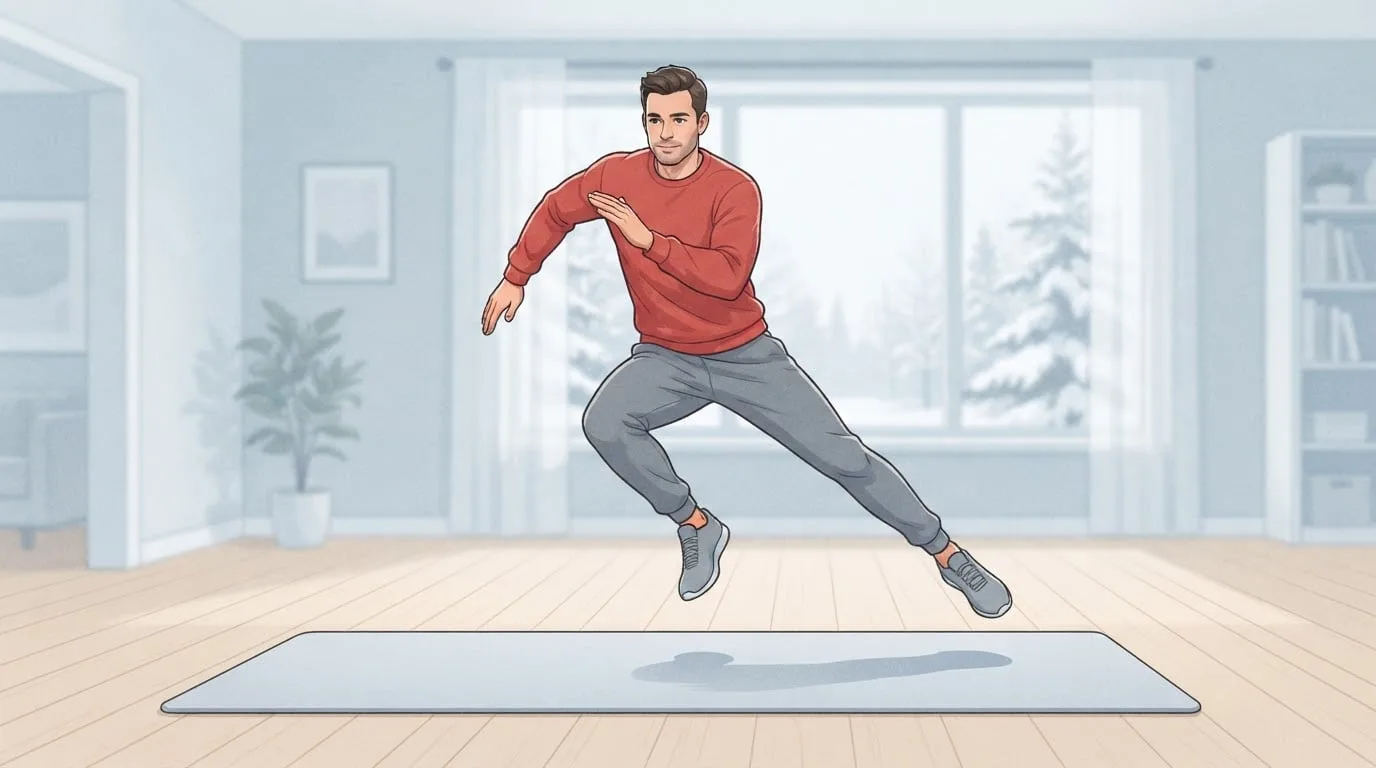
4. Skater hops with a stuck landing
Jump sideways off one foot and land softly on the other, like a speed skater, sinking into a quarter squat with your knee over your toes. Hold that landing for 2 seconds before the next hop. Start with short hops and make them longer only while your landings stay quiet and steady. This is the closest home drill to moving from edge to edge, and the stuck landing trains the knee control that injury prevention programs build around.
5. Lateral band walk in a ski stance
Loop a mini band just above your knees, sink into a quarter squat with your feet hip-width apart, and take 12 small side steps each way without letting your knees cave in or your hips rise. The muscles on the side of your hip keep your knees tracking over your feet. When the knee collapses inward and twists, the knee ligaments take the strain, and that valgus and external rotation pattern is the most often reported mechanism of ski ACL injuries.
6. Single-leg Romanian deadlift with a reach
Stand on one leg with a dumbbell in the opposite hand, and hinge forward as your free leg lifts behind you, reaching the weight toward the floor in front of your standing foot. Return to standing without touching down. This trains balance on one ski, and it strengthens the hamstrings, which help the ACL keep your shin from sliding forward under your thigh. Start without the dumbbell if you wobble.
7. Copenhagen plank
Lie on your side with your top leg resting on a chair seat and your bottom leg underneath it. Press your top leg down into the chair to lift your hips into a side plank, and hold. Start with the chair under your knee, which is easier, and slide it toward your ankle as you get stronger. Your adductors, the inner-thigh muscles, help stabilize your hips and knees in a wide stance, and few home exercises load them this hard.
8. Jump and stick
From a quarter squat, jump forward about one foot length and land softly in the same quarter squat, knees over toes, then hold it for 3 seconds. Once that's steady, jump sideways, then progress to small jumps on one leg. Landing on bent knees is what protects the knee when you drop off a mogul or land a small jump. Landing on straight legs lets the back of the ski boot push the shin forward, one of the classic ways skiers tear an ACL.
Find out what's really holding you back
FitCraft, our mobile fitness app, pairs you with an AI coach who builds you a personalized plan around your goals, schedule, and fitness level. Every FitCraft program is designed by Domenic Angelino, MPH (Brown University) and NSCA-CSCS, with research published in the Journal of Strength and Conditioning Research and Medicine & Science in Sports & Exercise.
Take the Free Assessment Free • 2 minutes • No credit cardCore Exercises for Skiing
Your trunk keeps your upper body quiet and facing downhill while your legs turn underneath it, and it matters for your knees too. Raschner and colleagues (2012) tested 370 young competitive ski racers every year for a decade, and 57 of them tore an ACL. Core strength turned out to be a leading predictor: in both sexes, the balance between trunk flexion and extension strength was linked to who got hurt. Train the front and the back of the trunk, plus rotation.
9. Hollow hold and back extension
For the hollow hold, lie on your back, press your lower back into the floor, and lift your shoulders and legs a few inches with your arms reaching past your head. Hold for 20 to 30 seconds, and bend your knees to make it easier. Then roll onto your stomach for back extensions: lift your chest and legs off the floor, hold for 2 seconds, and lower. Doing both trains the flexion and extension strength that Raschner's study measured.
10. Half-kneeling band chop
Kneel on one knee, side-on to a band anchored high on a door or post. Pull the band diagonally down across your body toward the opposite hip, rotating through your trunk rather than your arms, then control it back up. Good skiers turn their legs under a calm upper body, and the chop trains the trunk to create and resist that twist.
Why Skiing Is So Hard on Your Legs
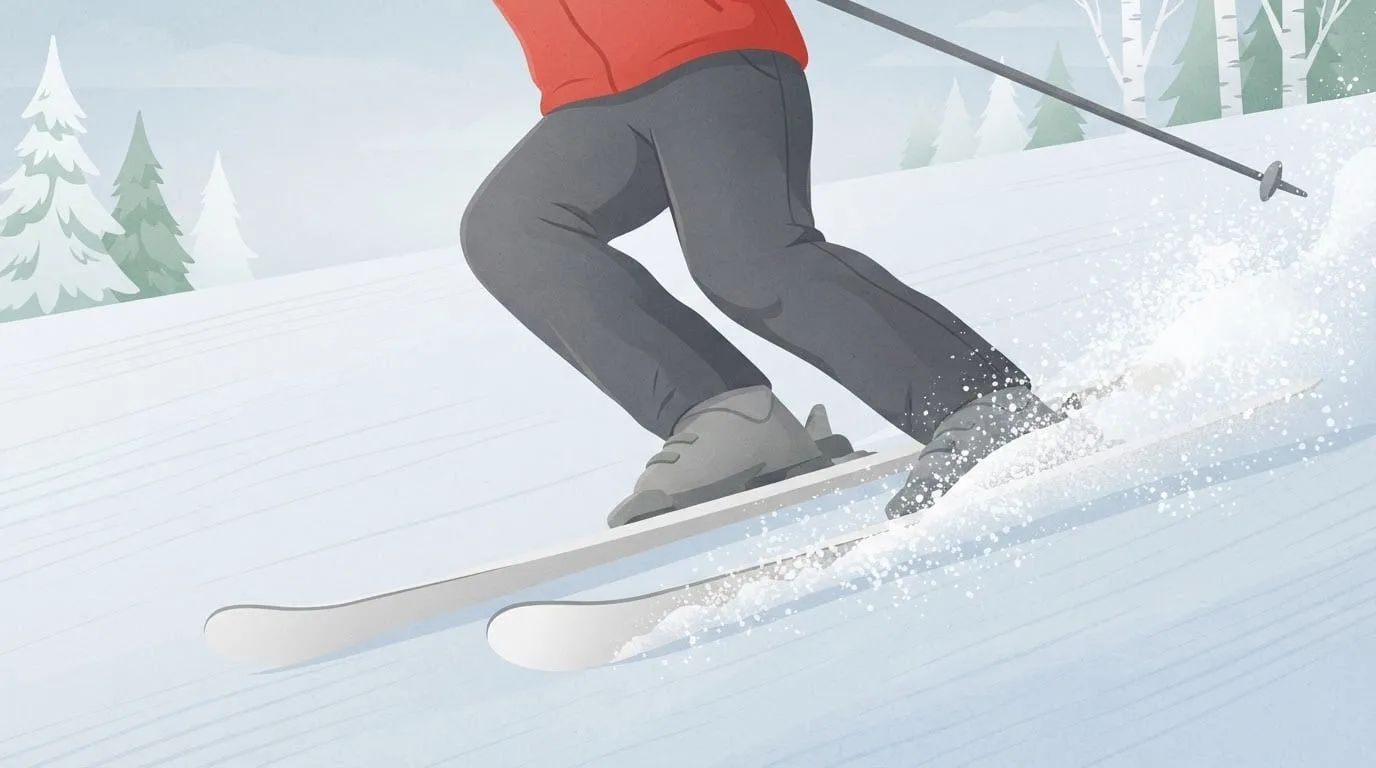
Skiing loads your muscles in an unusual way. Berg and Eiken (1999) recorded elite racers in super G, giant slalom and slalom and found a marked predominance of eccentric over concentric muscle actions, meaning the thighs spent more time lengthening and braking than shortening and pushing. Thigh muscle activity reached near-maximal levels in every turn, and the outside knee bent to between 60 and 100 degrees at its deepest point, a range a wall sit covers.
The contractions are also long. A review by Ferguson (2010) describes ski racing as 90 to 120 seconds of high-intensity work built from repeated high-force isometric and eccentric contractions. Those contractions squeeze the blood vessels inside the muscle, so less oxygen gets in and metabolites build up. That's the burn in your thighs halfway down a long run, and the same fatigue can cost you motor control, which is when sloppy turns and falls happen.
Training the lengthening phase works for skiers. In a 6-week study by Gross and colleagues (2010), junior alpine skiers who added eccentric cycling, resisting pedals driven by a motor, to their weight training gained thigh muscle and jump height that the weights-only group didn't. You won't have an eccentric bike at home. Slow-lowering squats and long wall sits are the home version of the same idea.
The general case for strength training, that heavier loads build more strength and that strength work lowers injury risk across sports, is the same for skiers as for runners. Our guide to strength training for runners lays out those trials. What changes on the slopes is the kind of work your muscles do, which is why this list looks so different from a runner's.
Exercises to Prepare for Skiing: A 6-Week Ski Workout Plan
Here's the ski workout laid out week by week, all of it doable at home. Start 6 weeks before your first ski day, or 8 if you can, by repeating weeks 3 and 4. Session A builds strength, Session B builds power and balance, and Session C, from week 3, is a ski-length leg circuit. Warm up for 5 minutes with marching, bodyweight squats and leg swings.
| Weeks | Sessions | Session A: strength | Session B: power and balance | Session C: ski circuit |
|---|---|---|---|---|
| 1-2 | A and B, 2 a week | Wall sit 3 x 30-45 sec; tempo squat 3 x 8; lateral lunge 3 x 8 per side; single-leg Romanian deadlift 3 x 8 per leg; Copenhagen plank from the knee 2 x 15 sec per side; hollow hold 3 x 20 sec | Skater hops 3 x 4 per side; jump and stick 3 x 4; band walk 2 x 12 steps each way; band chop 2 x 10 per side; back extension 2 x 10 | None yet |
| 3-4 | A, B and C, 3 a week | Wall sit 3 x 60 sec; tempo squat with a dumbbell 4 x 6-8; lateral lunge 3 x 10 per side; single-leg Romanian deadlift with a dumbbell 3 x 8 per leg; Copenhagen plank 2 x 20 sec per side | Skater hops 3 x 6 per side; jump and stick sideways 3 x 5; single-leg wall sit 3 x 15 sec per leg; band walk and chop as before | 3 rounds: 20 squats, 10 lunges per leg, 10 skater hops, rest 2 min |
| 5-6 | A, B and C, 3 a week | Wall sit 2 x 90-120 sec; tempo squat heavier, 4 x 6; lateral lunge with a dumbbell 3 x 8 per side; Copenhagen plank from the ankle 2 x 20-30 sec per side; hollow hold 3 x 30 sec | Skater hops 3 x 8 per side; single-leg jump and stick 2 x 4 per leg; single-leg wall sit 3 x 20 sec per leg; band walk and chop as before | 4 rounds: 20 squats, 10 lunges per leg, 10 jump lunges, 10 squat jumps, rest 2 min |
Each round of the ski circuit takes about 60 to 90 seconds, close to the length of a hard run, and the 2-minute rest is your lift ride. If your landings get loud or your knees start drifting in, swap the jumps for bodyweight squats for the rest of the round. Three or four days before your trip, do one short, easy session with no jumps and arrive with fresh legs.
How to tell you're ski fit
By the end of week 6, aim to hold a 90-second wall sit, do 8 clean skater hops per side with every landing stuck, and finish 4 rounds of the circuit without your knees caving in. If you can do all three, your legs are ready for full ski days. If you can't yet, keep training while you ski: a short Session A on a rest evening keeps your strength up through the trip.
If you'd like the reps and the weekly structure handled for you, a home workout app with no equipment can do that. FitCraft's bodyweight workouts are led by a 3D AI coach who demonstrates every exercise on a model you can pinch to zoom, workouts adjust as you progress, and streaks and calendar tracking keep the pre-season sessions from slipping while you're busy getting ready for the trip.
How to Protect Your Knees When Skiing
The knee is the most commonly injured body part in alpine skiing, at 27% to 41% of all injuries in the studies reviewed by Davey and colleagues (2019). ACL tears happen at about 0.23 per 1,000 skier days. That review describes the classic ways skiers tear an ACL: a forward fall that catches an inside edge and twists the knee inward, the phantom foot fall, where you're off balance to the rear with your hips below your knees, and the boot-induced injury, where you land a jump on a straight leg and the boot drives your shin forward.
Knowing those falls helps on its own. Ettlinger and colleagues (1995) showed ski patrollers and instructors at 20 ski areas videotaped scenes of knee injuries. In the next season, serious knee sprains among the trained staff fell by 62% compared with the two seasons before, while the 22 areas without the training saw no decline. That program was education, not exercise, and it involved ski staff rather than recreational skiers.
For exercise, the best ski-specific data come from racers. Westin and colleagues (2020) gave 305 Swedish ski high school students an indoor and on-snow program of core stability and neuromuscular control, aimed at skiing equally well on both legs. Over two seasons, 3.9% tore an ACL, against 8.1% of 431 students from earlier seasons. The study wasn't randomized, so the comparison is suggestive rather than proof. Most randomized trials of knee injury prevention come from field and court sports, where warm-up programs that include jumping and landing practice cut ACL injuries by about 60%, as our plyometric training research review describes. The stuck landings, single-leg work and core exercises in this plan follow the same pattern.
- Stop when your legs are cooked. Fatigue costs you motor control, and tired skiers sit back. The last run of the day is the one to skip.
- Land on bent knees. Off moguls, jumps and drop-offs, absorb the landing the way you practiced the jump and stick.
- Don't fight a backward fall. Trying to recover from the back seat with your hips below your knees is the phantom foot position. Let the fall happen.
Ski Exercises for Seniors and Skiers Over 50
Skiing itself is good training later in life. In the Salzburg Skiing for the Elderly Study, Müller and colleagues (2011) randomized adults aged 60 to 76 to 12 weeks of guided skiing, about 28 ski days, or to no skiing. The skiers improved their VO2 max by 7.2%, their dynamic leg strength by 16% and their jump height by about 6%, while the control group's jump height fell by 11.7%. Balance didn't change in either group.
The same plan works for older skiers with three changes. Hold wall sits a little higher, with knees bent less than 90 degrees, and build the time before the depth. Replace skater hops and jumps with side steps and step-and-stick landings until your landings feel steady. And add a balance drill most days: stand on one leg while you brush your teeth, then try it with your eyes closed. Start 8 weeks out rather than 6, and get your doctor's go-ahead if you have heart disease, osteoporosis or a knee replacement.
Is Skiing a Good Workout?
Yes, while you're actually skiing. The 2024 Adult Compendium of Physical Activities rates downhill skiing at 4.3 METs for light effort, 6.3 METs for moderate effort and 8.0 METs for vigorous effort, counting active skiing time only. Anything at 6 METs or more counts as vigorous activity, so moderate skiing already qualifies, and the long eccentric and isometric holds give your thighs a strength workout on top. Lift rides and lunch breaks dilute it, so a full ski day is less intense per hour than those numbers suggest. In the Salzburg study's design report, the older skiers averaged about 72% of their maximal heart rate while skiing.
The Bottom Line
The best exercises for skiing train your legs to hold and brake rather than just push: wall sits, slow-lowering squats, lateral lunges, skater hops with stuck landings, single-leg balance and a strong trunk. Six weeks of the ski workout above, 2 to 3 times a week, gets most people ski fit before the trip, and the knee-protection habits keep them on the slopes.
If you hike in the warmer months, the downhill stretches load your thighs in a similar lengthening way at a slower pace, and our hiking workout covers the training for that. You don't need more willpower to last the whole trip. You need legs trained for the way skiing works them.
Frequently Asked Questions
What are the best leg exercises for skiing?
The best leg exercises for skiing are wall sits and slow-lowering squats for the thighs, lateral lunges and skater hops for side-to-side strength, and single-leg Romanian deadlifts and stuck landings for knee control. Add hollow holds and band chops for the trunk. Together they match how skiing works your muscles: long bent-knee holds and lengthening contractions, one leg at a time.
How many weeks before ski season should I start training?
Start 6 to 8 weeks before your first ski day, with 2 sessions a week for the first two weeks and 3 after that. Strength and muscle endurance take several weeks to build, and the last few days before your trip should be easy so you arrive with fresh legs.
How many calories does skiing burn?
Moderate downhill skiing is rated at 6.3 METs during active skiing time, which is about 440 calories an hour for a 70 kg (154 lb) person. Light skiing is rated at 4.3 METs and vigorous skiing at 8.0. Lift rides and breaks aren't included, so a full ski day burns less per hour on the hill.
Can I get ski fit at home without equipment?
Yes. Wall sits, slow-lowering squats, lateral lunges, skater hops, stuck landings, single-leg balance work and trunk holds need only a wall and some floor space. A single dumbbell makes the squats and lunges harder as you progress, and a mini band adds side-hip work.
What muscles do you use when skiing?
Skiing works the quadriceps hardest, holding and braking at near-maximal effort through each turn. The glutes, hamstrings and inner thighs stabilize the hips and knees, the calves and shins control your boots, and the trunk keeps your upper body quiet while your legs turn beneath it.
Why do my thighs burn when I ski?
Your thighs burn because skiing holds them in long, forceful bent-knee contractions that squeeze the blood vessels inside the muscle, so less oxygen arrives and metabolites build up. Wall sits and slow squats before the season raise your tolerance, and on the hill, standing a little taller between turns and taking short breaks help.