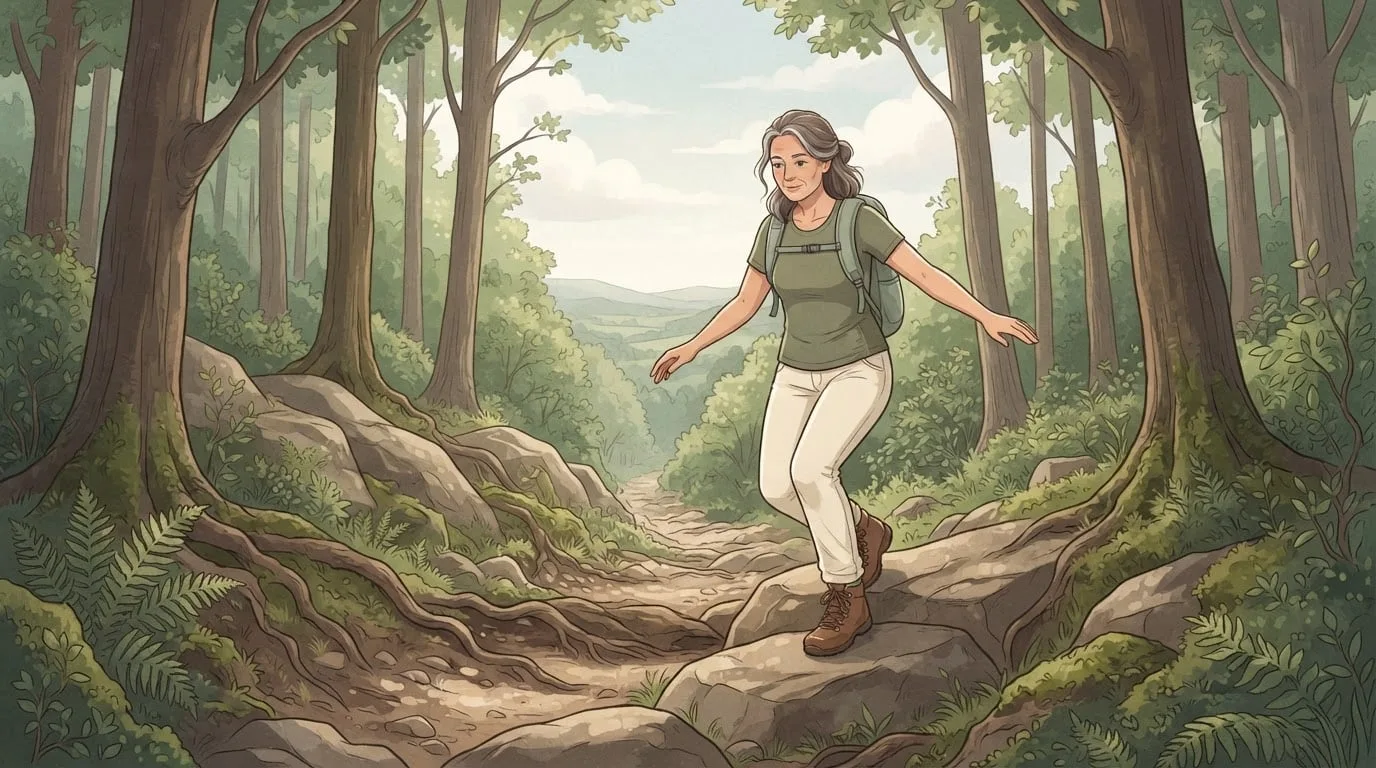
This guide is about training for hiking, not about hiking as your workout. If you want to know how hiking compares with walking for calories and effort, our walking vs hiking guide covers that. Here, the question is how to prepare for a hike so the trail feels like a good day out instead of a test.
Maybe you've booked a trip with friends, or a summit you've had your eye on for a year. You walk most days and feel fit enough, and then the first steep mile leaves you gasping, the pack straps dig in by lunch, and the long way down turns your thighs to jelly. The next morning the stairs at home feel like the hardest part of the trip.
It's not that you're out of shape. Daily walking trains you for flat ground with nothing on your back, and a trail asks for climbing, braking and carrying, often for hours. Strength training for hiking fills that gap. This guide gives you 10 exercises chosen for those three jobs, the research on climbing, descending and carrying a pack, and a 6-week hiking workout plan you can do at home with dumbbells, a backpack and a staircase.
10 Exercises for Hiking the Trail Asks For
These are the best exercises for hiking, grouped by what the trail asks for: climbing (1 and 2), descending (3 and 4), carrying (5 to 7), balance and trunk (8 and 9), and stamina with the pack (10).
| # | Exercise | What it does on the trail | Sets x reps |
|---|---|---|---|
| 1 | Dumbbell step-up | The push that lifts you up every step of a climb | 3 x 8-10 per leg |
| 2 | Lateral step-up | Side steps over logs, rocks and switchbacks | 3 x 10 per leg |
| 3 | Slow step-down | Braking on steep descents | 3 x 8 per leg |
| 4 | Walking lunge with a loaded backpack | Big steps down and over obstacles with weight on your back | 2-3 x 10 per leg |
| 5 | Farmer's carry | Grip, posture and stamina under load | 4 x 30-40 m |
| 6 | Suitcase carry | A trunk that stays upright when the load pulls to one side | 3 x 30 m per side |
| 7 | Backpack Romanian deadlift | Back and hip strength to lift and carry a pack | 3 x 10 |
| 8 | Single-leg balance on a pillow | Steady ankles on roots and loose rock | 3 x 30 sec per leg |
| 9 | Bird dog | A stable trunk under a pack | 2 x 8 per side |
| 10 | Backpack stair climb | Climbing stamina with the weight you'll carry | 10-30 min |
1. Dumbbell step-up
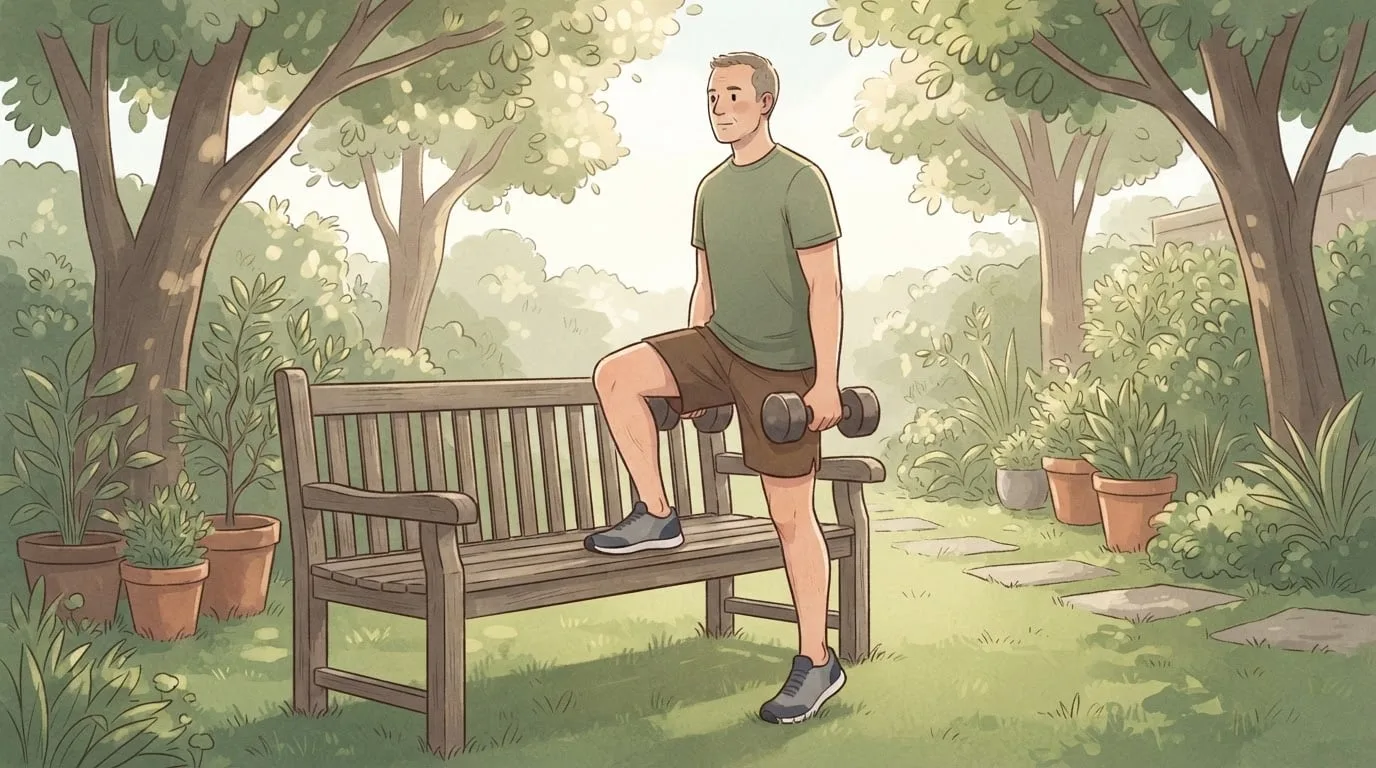
Stand facing a sturdy step, bench or stair about knee height with a dumbbell in each hand. Put your whole foot on the step and drive through that heel until you're standing tall on top, without pushing off the floor with your back foot. Step down with the same leg and repeat. Each rep is one step of a climb, which is why this is the core exercise of any hiking workout. Use a higher step or heavier dumbbells as 10 reps get easy.
2. Lateral step-up
Stand side-on to the step with a dumbbell in each hand or a loaded backpack on. Place the near foot on the step and push up sideways until both feet are on top, then step back down the same side. Trails aren't straight staircases, and stepping up sideways over roots and rocks loads the hip muscles that keep your knee lined up over your foot.
3. Slow step-down
Stand on a step on one leg, with the other foot hanging off the side. Bend your standing knee and lower your free heel toward the floor over 3 to 4 seconds, touch it lightly, then stand back up. Keep your standing knee over your middle toes rather than letting it drift inward. This trains your thighs to brake while they lengthen, the eccentric work that every step of a descent asks for. Start on the bottom stair and move to a higher step as you get stronger.
4. Walking lunge with a loaded backpack
Load a backpack with books or water bottles, put it on with the hip belt fastened, and take long lunge steps across the room, letting your back knee drop close to the floor. The pack shifts your balance the way it does on the trail, and the long steps rehearse stepping down off rocks and over fallen trees.
5. Farmer's carry
Pick up the heaviest pair of dumbbells you can hold with a tall posture and walk 30 to 40 meters, or for 30 to 40 seconds, with short, steady steps. Your grip, shoulders, trunk and legs all work to keep you upright while you walk under load, which is the job a pack gives you for hours. Our farmer's carry research review covers what loaded carries train and how heavy to go.
6. Suitcase carry
Carry one dumbbell in one hand and walk tall without leaning toward it or away from it, then switch hands. A load on one side, like a shifting pack or a bag in one hand, tries to bend your trunk sideways, and resisting it trains the muscles on the opposite side of your waist. It also makes every step a brief single-leg balance with an uneven load.
7. Backpack Romanian deadlift
Hold your loaded backpack by its straps in front of your thighs, soften your knees, and push your hips back until the pack reaches about mid-shin, keeping your back flat. Then drive your hips forward to stand. The muscles along your spine, glutes and hamstrings hold your posture under a pack, and you'll use this exact movement every time you lift the pack off the ground. Switch to two dumbbells once the backpack feels light.
8. Single-leg balance on a pillow
Stand on one foot on a folded towel or a firm pillow for 30 seconds, then switch. Once that's easy, close your eyes, or turn your head slowly from side to side. Rocks, roots and loose gravel make ankles roll, and balance training is one of the best-studied ways to protect them. In a trial of 522 athletes who had recently sprained an ankle, Hupperets and colleagues (2009) found that an 8-week unsupervised home balance program cut repeat sprains from 33% to 22%.
9. Bird dog
Start on your hands and knees. Reach one arm forward and the opposite leg back until both are level with your trunk, hold for 2 seconds without letting your hips twist or your back sag, then switch sides. A pack pulls your trunk back and side to side with each step, and the bird dog trains your trunk to stay still while your arms and legs move.
10. Backpack stair climb
Put on your loaded backpack and climb a staircase at a steady pace you could keep up for a long time, walking down carefully between climbs. If you live in a building with several floors, use the stairwell. A step machine or a steep street works too. This is your stamina session, and it trains your heart, lungs and legs together with the weight you'll carry on the trail.
Find out what's really holding you back
FitCraft, our mobile fitness app, pairs you with an AI coach who builds you a personalized plan around your goals, schedule, and fitness level. Every FitCraft program is designed by Domenic Angelino, MPH (Brown University) and NSCA-CSCS, with research published in the Journal of Strength and Conditioning Research and Medicine & Science in Sports & Exercise.
Take the Free Assessment Free • 2 minutes • No credit cardUphill and Downhill: Why Your Legs Need Both
Climbing is mostly a fitness problem. Minetti and colleagues (2002) measured the energy cost of walking on a treadmill tilted from steeply downhill to steeply uphill. Walking on the flat cost about 1.6 joules per kilogram per meter. At a 45% uphill grade it cost about 17, more than 10 times as much for the same distance. That's why a steep mile on a trail can take as long and feel as hard as several flat ones, and why stair and hill sessions belong in a hiking workout.
Descending is mostly a muscle problem. Going down, your thighs brake while they lengthen, and that kind of work damages muscle and causes soreness in a way climbing doesn't. Our walking vs hiking guide explains the knee forces on descents and what trekking poles do about them. The good news is that muscle adapts to downhill work fast.
Maeo and colleagues (2017) had 36 untrained young men walk down a steep 28% treadmill grade for 40 minutes carrying 10% of their body weight. One group had done just 5 minutes of the same downhill walking a week earlier. After the long descent, that group lost 9.9% of its thigh strength against 19.2% in the group that hadn't, and its soreness score was about a third as high. Five minutes of level walking a week earlier gave no protection. An earlier study by the same group found that the protection from a 20-minute downhill walk lasted at least four weeks (Maeo 2015). And over four weekly sessions, downhill walking that ramped up from 10 to 70 minutes built about as much thigh strength as a damaging 40-minute version, without the muscle damage (Maeo 2016).
So the plan trains both directions: step-ups and stair climbs for the climb, slow step-downs and lunges for the descent, and a short steep downhill walk in the weeks before a big hike.
The general case for strength training, that it builds stronger muscles and tendons and lowers overuse injuries across sports, applies on the trail just as it does on the road. Our guide to strength training for runners covers those trials. What's different for hikers is the climbing, the descending and the load on your back.
How to Train for Carrying a Pack
A pack changes everything about a hike. It adds weight to every step up, pulls your posture backward, and makes your trunk and grip work for hours. The best evidence on training for it comes from military research. In a systematic review of 10 studies, Knapik and colleagues (2012) found that resistance training or aerobic training alone produced smaller and less consistent gains in load-carriage speed. Combining strength and aerobic training produced large gains, and programs that also included progressively heavier pack walks produced the largest. The big effects came from training at least 3 times a week for at least 4 weeks.
For a hiker, that means three ingredients: strength work like the carries and the backpack deadlift, cardio like the stair climbs, and practice walking with your pack.
- Start light. Begin with a daypack holding water and a jacket, and add a kilogram or two (2 to 4 lb) a week until you're carrying what you'll take on the trail.
- Train in the pack you'll hike in. Fasten the hip belt so your hips carry most of the weight, and fix any strap that rubs before the trip, not on it.
- Carry it on hills and stairs. Flat walks with a pack help, but the climbs are where a heavy pack costs you the most.
Hiking Stamina: Stairs, Hills and Long Days
Stamina for hiking comes from two places: a stronger heart and lungs, and legs used to being on their feet for hours. Stairs are the easiest way to build the first at home. Boreham and colleagues (2005) had sedentary young women climb a 199-step public staircase, about 2 minutes a climb, 5 days a week. They started with one climb a day and built to five, and after 8 weeks their VO2 max was 17% higher than the control group's.
The second part comes only from time on your feet. Treat the weekend hike like a runner's long run: make it a little longer every week or two, and work up to about three quarters of the time your goal hike will take. A hike that's 6 hours on the map needs at least one 4- to 5-hour training day with your pack. Long days build the endurance of your feet, ankles and back that no 30-minute session can.
A 6-Week Hiking Workout Plan
This hiking workout plan has two strength sessions, one stamina session and a weekend hike each week. If you already walk or hike regularly, you can start at week 3 for a 4-week version. Warm up for 5 minutes before each strength session with easy marching, bodyweight squats and a few slow step-downs on the bottom stair.
| Weeks | Strength A: climb and brake | Strength B: carry and balance | Stamina session | Weekend hike |
|---|---|---|---|---|
| 1-2 | Step-up 3 x 8 per leg, light dumbbells; slow step-down 2 x 8 per leg; backpack Romanian deadlift 3 x 10; bird dog 2 x 8 per side | Farmer's carry 3 x 30 m; suitcase carry 2 x 30 m per side; lateral step-up 2 x 10 per leg; single-leg balance 3 x 30 sec per leg | Stair climb or hill walk, 10-15 min, light daypack | 1.5-2 hours with a light daypack |
| 3-4 | Step-up 3 x 8-10 per leg, heavier dumbbells; slow step-down 3 x 8 per leg; walking lunge with backpack 2 x 10 per leg; backpack Romanian deadlift 3 x 10 | Farmer's carry 4 x 30-40 m, heavier; suitcase carry 3 x 30 m per side; lateral step-up with backpack 3 x 10 per leg; balance with eyes closed 3 x 30 sec per leg | Stair climb with backpack, 15-20 min, plus a 5-10 min steep downhill walk | 2.5-3.5 hours, pack at about half your trip weight |
| 5 | Step-up from a higher step 3 x 10 per leg; slow step-down from a higher step 3 x 8 per leg; walking lunge with backpack 3 x 10 per leg; bird dog 2 x 8 per side | Farmer's carry 4 x 40 m; suitcase carry 3 x 40 m per side; lateral step-up 3 x 12 per leg; balance with head turns 3 x 30 sec per leg | Stair climb with trip-weight pack, 20-30 min | 4-5 hours, or about three quarters of your goal hike, with your trip pack |
| 6 | One easy session early in the week at half the sets | Carries and balance, light, early in the week | 10-15 min easy, no heavy pack | Your goal hike, or a short easy walk if the trip is later |
Leave at least a day between the two strength sessions, and keep the stamina session away from the day before your weekend hike. The steep downhill walk in weeks 3 and 4 is your protection against the soreness a big descent causes, so don't skip it, and keep it short. Rest the last two or three days before the goal hike, apart from easy walking.
If you'd like the sessions planned and the reps tracked for you, a home workout app with no equipment can carry that part. FitCraft's bodyweight and dumbbell workouts are led by a 3D AI coach who shows every exercise on a model you can pinch to zoom, workouts adjust as you progress, and streaks and calendar tracking keep the weekday sessions from slipping once the planning for the trip gets busy.
How to Prepare for a Hike in the Final Week
The last week is about arriving fresh, with your legs and your gear tested.
- Do your last long training hike 7 to 10 days out. It should leave enough time for any soreness to clear and any blister or strap problem to get fixed.
- Keep one short session early in the week. Half the sets of your usual strength work keeps your legs sharp without making them sore.
- Plan for the descent. Budget time for the way down, bring poles if you've trained with them, and shorten your steps on steep ground.
- Start slower than you think you need to. The first hour of a big climb sets the tone for the day, and a pace you can talk at saves your legs for the descent.
- Rest the last two days. Easy walking is fine, but no steep downhills, heavy carries or new exercises.
The Bottom Line
A good hiking workout trains the climb, the descent and the pack. Step-ups and stair climbs make the uphill easier, slow step-downs and a short steep downhill walk protect you from the soreness of the descent, and carries plus progressively heavier pack walks get your body used to the load. Four to six weeks of two strength sessions, one stamina session and a growing weekend hike is enough for most day hikes.
If you ski in the winter, your thighs face a similar braking job at higher speed, and our guide to exercises for skiing covers the training for that. You don't need to be a natural hiker. You need legs that have practiced the trail before you get there.
Frequently Asked Questions
How do I train for a hike?
Train for a hike with 4 to 6 weeks of two short strength sessions a week (step-ups, slow step-downs, carries and balance work), one stairs or hill session with your pack, and a weekend hike that grows toward the length of your goal hike. Practice the downhill as deliberately as the climb, because descents cause most of the soreness.
Is hiking a good workout?
Yes. Hiking works your legs, heart and lungs harder than walking on the flat, especially on steep climbs and with a pack, and the descents add braking work for your thighs. A steep enough climb costs several times more energy per meter than flat walking, so even a slow uphill pace is hard work. Our walking vs hiking guide compares the calories and the effort.
How do I get in shape for hiking at home?
Use a staircase or a sturdy step for step-ups, slow step-downs and stair climbs, carry dumbbells or a loaded backpack for farmer's and suitcase carries, and practice balancing on one leg on a folded towel or pillow. Three sessions a week for 4 to 6 weeks gets most people ready for a full day hike.
How heavy should my backpack be when I train?
Start with a light daypack and add a kilogram or two (2 to 4 lb) a week until you're carrying what you'll take on the trail. In a review of 10 studies, programs that included progressively heavier pack walks improved load-carriage performance more than any other kind of training.
Why do my legs hurt more after hiking downhill?
Going downhill, your thigh muscles brake while they lengthen, and that eccentric work causes far more muscle damage and next-day soreness than climbing. A short downhill walk a week before a big descent protects you: in one trial, 5 minutes of downhill walking halved the strength loss from a 40-minute descent a week later.
How do I build stamina for hiking?
Build stamina with stair or hill climbs during the week and a weekend hike that gets longer every week or two. Short stair climbs work: in one trial, sedentary women who climbed a 199-step staircase a few times a day, 5 days a week, had a VO2 max 17% higher than a control group after 8 weeks.