Most runners know they should lift, and few keep it up for long. The strength session is the first thing cut in a busy week. When it does happen, it's often a random circuit of light lunges and planks that leaves your legs heavy for the next run and changes nothing you can feel on the road.
Then a calf twinges or a knee starts to ache at mile five, and the guilt shows up. You knew you should have been doing the strength work. It's easy to decide you're just not the kind of runner who sticks with it.
Usually the plan is the problem. It doesn't fit a running week, its weights are too light to change anything, and it vanishes at the first race. This guide gives you the evidence on what running strength training does, ten exercises chosen for the jobs your legs do on every stride, a two-day plan built on dumbbells and bodyweight, and a schedule that works around hard runs, long runs and races. If you'd like the muscle-by-muscle tour of the stride first, start with our article on what muscles running works.
Running and Strength Training: What the Research Shows
In the trials, strength work does three things for runners. It lowers the energy cost of holding a pace, it helps you hold that pace when you're tired, and, done steadily for months, it lowers some injury risks.
Each mile gets cheaper and the last ones get faster
Beattie and colleagues (2017) followed 20 competitive distance runners for 40 weeks. The 11 who added strength training improved their maximal and reactive strength, their running economy and their speed at VO2 max, the pace at which they reach their aerobic ceiling. They gained no muscle size and their body composition didn't change. The 9 who only ran didn't improve on any of those measures.
The payoff also shows up late in races. Damasceno and colleagues (2015) gave 18 endurance runners 8 weeks of strength training or none. The strength group ran its 10 km time trial 2.5% faster, while the control group got 0.7% slower, and most of the gain came in the final seven laps, the last 2.8 km. Running economy didn't change in that study, so the strength group's edge was holding speed while tired. Our running economy research review pools the economy trials and covers shoes, cadence and how economy is measured.
Heavy lifting beats jumping alone, so do both
Eihara and colleagues (2022) compared the two main methods across 22 studies of distance runners. Heavy resistance training produced a small improvement in running economy and plyometric jumping a trivial one (effect sizes of 0.32 and 0.13). The heaviest programs, at 90% of one-rep max or loads you could lift no more than four times, did best. Most of the jumping programs lasted six weeks or less, so jumps may need more time than they got. The practical answer is to lift heavy and jump a little, which is how the plan below is built.
Injuries drop when the work is progressive and kept up
Across sports, strength training beats the other common injury prevention methods. A meta-analysis of 25 trials by Lauersen and colleagues (2014) found it cut sports injuries to about a third and nearly halved overuse injuries. Our review of strength training for injury prevention covers that research in depth.
Running-specific trials are more mixed. In a trial by Taddei and colleagues (2020), 118 recreational distance runners were randomized to an 8-week foot and ankle strengthening program, which they kept doing at home for the rest of the year, or to a control group. Over 12 months, the control runners were 2.42 times as likely to get a running injury. A short routine did nothing, though. In a study of 720 first-time New York City Marathon runners, a 10-minute self-guided routine done three times a week left overuse injuries that kept runners from finishing almost unchanged, at 7.1% with it and 7.3% without it (Toresdahl 2020). The foot program was coached, progressed and kept up for a year. The marathon routine was short, light and done alone.
Lifting won't slow you down
Beattie's runners got stronger without any muscle growth. In well-trained women, Vikmoen and colleagues (2016) did see leg muscle fibers grow during 11 weeks of heavy training, twice a week at 4 to 10 reps per set, and a 40-minute all-out run neither slowed down nor sped up. A second report on the same athletes found that the strength group did 4.7% better in a 5-minute all-out effort run after 90 minutes of steady running (Vikmoen 2017). Strength shows up most when you're already tired.
The 10 Best Strength Exercises for Runners
These ten strength exercises for runners cover the jobs your legs and trunk do on every stride: absorbing the landing, pushing off, driving the hip, slowing the swinging leg, keeping the pelvis level and staying springy. Each one uses dumbbells, bodyweight or a light band. The table gives the sets and reps, and the plan further down splits them into two sessions.
| # | Exercise | What it does for your running | Sets x reps | Day |
|---|---|---|---|---|
| 1 | Rear-foot-elevated split squat | Single-leg strength for landing and push-off | 3-4 x 4-6 per leg | A |
| 2 | B-stance Romanian deadlift | Hamstring and glute strength for hip drive | 3 x 5-6 per leg | A |
| 3 | Single-leg calf raise | Calf and Achilles strength for push-off | 3 x 6-10 per leg | A and B |
| 4 | Sliding hamstring curl or Nordic lower | Hamstrings that can brake the swinging leg | 3 x 6-8, or 3 x 3-5 | B |
| 5 | Single-leg hip thrust | Glute power for hills and the finishing kick | 3 x 8-10 per leg | B |
| 6 | Side plank with top-leg lift | Side-hip and trunk control so the pelvis stays level | 2-3 x 20-30 sec per side | A |
| 7 | Foot doming and toe presses | The small muscles that hold up your arch | 2 x 10 five-second holds | B |
| 8 | Pogo hops and bounds | Stiff, springy ankles and a longer stride | 3 x 10-15 hops, 3 x 20 m bounds | B |
| 9 | Push-ups and one-arm dumbbell rows | Arm swing and posture when your legs are tired | 3 x 6-12 each | A and B |
| 10 | Pallof press with a band | A trunk that resists twisting | 2 x 10 per side | B |
1. Rear-foot-elevated split squat
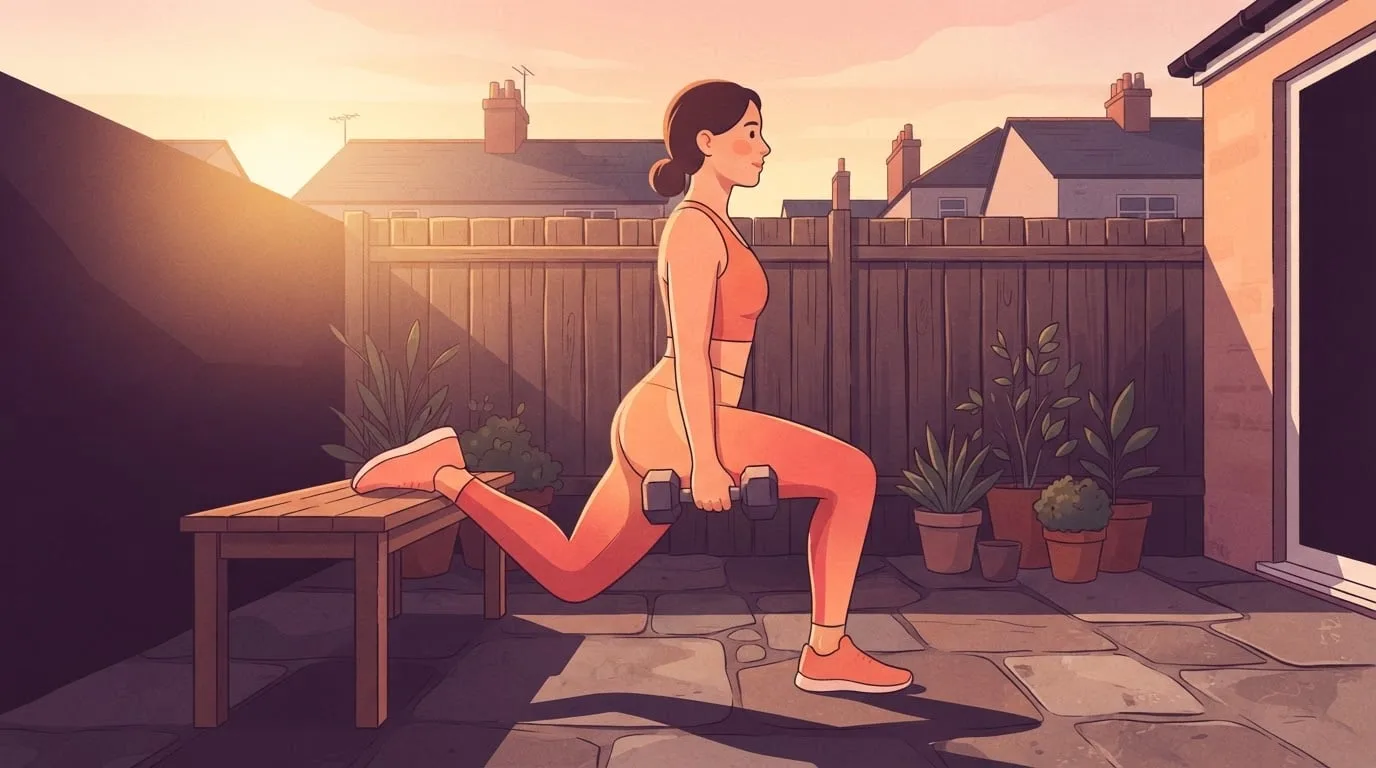
Stand a long stride in front of a bench or sofa, rest the top of your back foot on it, and hold a dumbbell in each hand. Lower until your back knee nearly touches the floor, then push up through your front foot. Your front leg carries almost all of your body weight plus both dumbbells, which is how a modest pair of weights gets heavy enough to count. If you can do more than 6 reps with your heaviest pair, take 3 seconds on the way down.
2. B-stance Romanian deadlift
Stand with most of your weight on your front foot and the toes of your back foot on the floor beside your front heel, like a kickstand. Hold the dumbbells in front of your thighs, push your hips back with a long spine, and lower the weights along your front shin until your hamstring feels a strong stretch. Then drive your hips forward to stand tall. The back foot handles the balance, so the front leg can take far more load than it could in a true single-leg deadlift. Your hamstrings and glutes extend the hip at every push-off, and they matter more as you speed up or climb.
3. Single-leg calf raise
Stand on one foot on the edge of a step, hold a dumbbell on the same side, and rest your other hand on a wall. Lower your heel below the step over 3 seconds, then rise as high as you can. Your calves do much of the pushing at easy and steady paces, and the Achilles tendon above your heel takes that load on every step. On Day B, do the same raise with your knee bent about 30 degrees, which shifts more of the work to the soleus, the deeper of the two calf muscles.
4. Sliding hamstring curl or Nordic lower
Lie on your back with your heels on a towel on a smooth floor, lift your hips into a bridge, and slide your heels away slowly until your legs are nearly straight. Pull them back in and repeat. The slide out is the part that counts, so take 3 to 4 seconds. At the end of each swing, your hamstrings slow the lower leg while they lengthen, and that's when fast running strains them. The harder version is the Nordic lower: kneel with your ankles hooked under a heavy sofa and lower your chest toward the floor as slowly as you can, catching yourself with your hands. In a meta-analysis of 15 studies and 8,459 athletes, injury prevention programs that included the Nordic hamstring exercise cut hamstring injuries by about half (van Dyk 2019).
5. Single-leg hip thrust
Sit on the floor with your upper back against the edge of a sofa, one foot flat and the other leg lifted. Drive through the planted heel until your hips line up with your knee and shoulders, squeeze for a second, then lower. Rest a dumbbell on the working hip once 12 reps feel easy. Your glutes extend the hip as you push off and climb, and training one side at a time shows you if one is lagging.
6. Side plank with top-leg lift
Lie on your side propped on your forearm, lift your hips until your body forms a straight line, then raise your top leg a few inches and hold it there. This trains the muscles on the side of your hip that keep your pelvis level each time you land on one leg, along with the trunk muscles beside them. In a year-long study of 629 novice runners, those with strong eccentric hip abduction strength at the start were less likely to develop kneecap pain in their first 50 km (Ramskov 2015). That's an association, not proof, and the exercise takes two minutes. Start from your knees if the full version shakes.
7. Foot doming and toe presses
Stand or sit barefoot with your foot flat. Without curling your toes, draw the ball of your foot toward your heel so your arch lifts into a small dome, hold for 5 seconds and relax. For toe presses, push your big toe into the floor while lifting the other four, then swap. These train the small muscles inside your foot that support the arch, the same intrinsic foot muscles Taddei's foot and ankle program targeted. You can do them while you brush your teeth.
8. Pogo hops and bounds
Pogo hops are small, quick bounces on the balls of your feet with your knees nearly straight, spending as little time on the ground as you can. Bounds are exaggerated running strides on grass, each one covering as much ground as you can with a tall body and a quiet landing. Both teach your legs to store and return energy like a spring. Do them first on Day B while you're fresh, and end a set as soon as your contacts get slow or loud. If you're new to jumping, start with pogo hops only and add bounds after three or four weeks.

9. Push-ups and one-arm dumbbell rows
Your arms swing once for every stride, and a tired upper body slumps late in a race. Push-ups train the chest, shoulders and triceps; put your hands on a bench if you can't do 6 good ones from the floor. For the row, put one hand and one knee on a bench, pull a dumbbell to your hip and lower it slowly. Neither makes you faster on its own, but both keep your posture together when your legs are tired.
10. Pallof press with a band
Anchor a light resistance band at chest height to a sturdy post or a door anchor and stand side-on to it. Hold the band at your chest with both hands, press it straight out in front of you without letting your trunk turn toward the anchor, hold for 2 seconds and bring it back. Your arms and legs swing in opposition, so your trunk resists rotation on every step, and the Pallof press trains exactly that.
Find out what's really holding you back
FitCraft, our mobile fitness app, pairs you with an AI coach who builds you a personalized plan around your goals, schedule, and fitness level. Every FitCraft program is designed by Domenic Angelino, MPH (Brown University) and NSCA-CSCS, with research published in the Journal of Strength and Conditioning Research and Medicine & Science in Sports & Exercise.
Take the Free Assessment Free • 2 minutes • No credit cardA Two-Day Strength Training Plan for Runners
This strength routine for runners splits the ten exercises into two sessions. Day A is heavy: low reps, long rests and the most weight your dumbbells allow. Day B is spring and control: hops first, then lighter strength work for the hamstrings, glutes, calves, back and trunk. Each takes 30 to 40 minutes after a 5-minute warm-up of easy jogging or marching, 10 bodyweight split squats per leg and 10 slow calf raises.
Day A: heavy strength (about 35 minutes)
| Order | Exercise | Sets x reps | Rest |
|---|---|---|---|
| 1 | Rear-foot-elevated split squat, two dumbbells | 3-4 x 4-6 per leg | 2 min |
| 2 | B-stance Romanian deadlift, two dumbbells | 3 x 5-6 per leg | 2 min |
| 3 | Single-leg calf raise, straight knee, one dumbbell | 3 x 6-10 per leg | 90 sec |
| 4 | Push-ups | 3 x 6-12 | 60 sec |
| 5 | Side plank with top-leg lift | 2-3 x 20-30 sec per side | 30 sec |
Day B: spring and control (about 35 minutes)
| Order | Exercise | Sets x reps | Rest |
|---|---|---|---|
| 1 | Pogo hops | 3 x 10-15 hops | 60 sec |
| 2 | Bounds on grass | 3 x 20 m | Walk back |
| 3 | Single-leg hip thrust | 3 x 8-10 per leg | 60 sec |
| 4 | Sliding hamstring curl, or Nordic lower | 3 x 6-8, or 3 x 3-5 | 90 sec |
| 5 | Single-leg calf raise, knee bent | 2 x 12-15 per leg | 60 sec |
| 6 | One-arm dumbbell row | 3 x 8-10 per side | 60 sec |
| 7 | Pallof press with a band | 2 x 10 per side | 30 sec |
| 8 | Foot doming and toe presses | 2 x 10 five-second holds | None |
How heavy, and how to progress
On Day A, use dumbbells you could lift only one or two more times at the end of each set. That's the near-maximal zone that did best in the Eihara analysis. Progress with the 2-for-2 rule: when you can do two reps more than the top of the range on your last set in two sessions in a row, go heavier. If you're already on your heaviest dumbbells, lower over 3 to 4 seconds or pause for 2 seconds at the bottom. On Day B, add load when the reps get easy, but keep the hops crisp instead of adding more of them.
For the first two weeks, do 2 sets of everything and stop 3 or 4 reps short of failure. New exercises make you sorest the first few times you do them, and that soreness fades quickly once the movements are familiar. Then give the full plan 8 weeks before you judge it. The programs in the trials above ran from 8 to 40 weeks.
What you need for strength training for runners at home
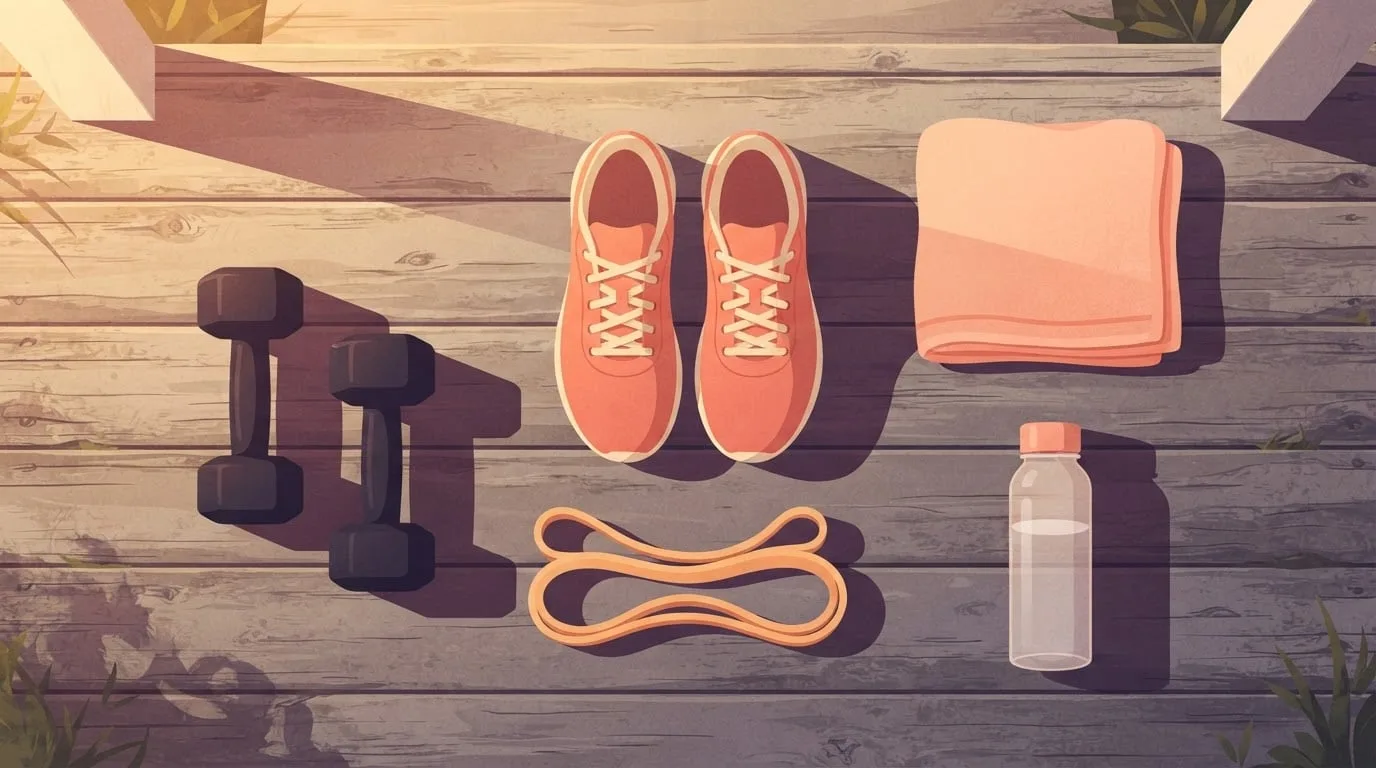
A pair of dumbbells, a sturdy bench or step, a towel and a light resistance band cover the whole plan. Adjustable dumbbells are worth having, because the split squat and the Romanian deadlift outgrow light weights within a few weeks. Weight training for runners doesn't need a gym, but it does need weights heavy enough to make the last rep hard.
If you'd rather have the sets, weights and progression planned for you, a dumbbell workout app can take that part off your plate. FitCraft's strength workouts are built on dumbbells and bodyweight, and your AI coach demonstrates every exercise on an interactive 3D model you can pinch to zoom, so you can check a split squat or a hip hinge before your first rep. Workouts adjust as you progress, and streaks and calendar tracking make it obvious when a busy running week has pushed the strength days out.
Where Strength Training Fits in Your Running Week
Lifting leaves fatigue in your legs, and the trick is to let it land where it costs the least. A review by Doma and colleagues (2017) found that a single resistance session can impair endurance performance for several hours to days when recovery is short, through soreness, lower muscle glycogen and less efficient movement. Three rules follow from that.
- Lift on hard-run days, after the run. Your easy days stay easy, and the fatigue piles onto a day that's already hard. If your day allows, leave a few hours between the run and the lift.
- Run first when running is the priority. In a meta-analysis of 10 concurrent training studies, the order of exercise in a session didn't change aerobic fitness, while lifting first gave about 7% more lower-body strength (Eddens 2018). In an off-season block where strength is the goal, lift first.
- Protect the long run. Leave at least 48 hours between Day A and your next key run, and never put a strength session the day before a long run or a race.
| Day | 3 runs a week | 4 runs a week | 5 runs a week |
|---|---|---|---|
| Mon | Rest | Easy run | Rest |
| Tue | Hard run, then Day A | Hard run, then Day A | Hard run, then Day A |
| Wed | Rest or a walk | Rest | Easy run |
| Thu | Easy run, then Day B | Easy run, then Day B | Tempo run, then Day B |
| Fri | Rest | Rest | Rest |
| Sat | Long run | Long run | Long run |
| Sun | Rest | Rest | Easy run |
What to Skip Before a Race
Strength work pays off over months, and none of it pays off in race week. The wrong session can still cost you on race day. Marcora and Bosio (2007) had 30 moderately trained runners do 100 drop jumps from a 35 cm bench. Two days later, their 30-minute treadmill time trial was about 4% worse, and the authors traced the loss to a higher sense of effort rather than any change in running economy. A 4% loss is about a minute in a 25-minute 5K.
A good taper keeps the intensity and cuts the volume, and strength work follows the same rule. In Spiering and colleagues' 2021 review, one session a week with one set per exercise kept strength for up to 32 weeks, as long as the weights stayed heavy. So keep the dumbbells the same and drop the sets.
| When | Do | Skip |
|---|---|---|
| 3 or more weeks out | The normal two-day plan | Any exercise you haven't done before |
| 7 days out (5K to half marathon), 10 to 14 days out (marathon) | Your last full Day A | Extra sets or a new personal best on any lift |
| Race week | One short session early in the week, half the sets at your usual weights | Hops, bounds, slow lowering and sets to failure |
| Last 3 days | Easy mobility and walking | All strength work |
| After the race | Restart once soreness is gone and easy runs feel normal, at half the sets for a week | Heavy lifting while your legs are still sore |
Our guide on how to train for a marathon covers the running side of the taper.
Once a Week Strength Training for Runners
Once a week builds strength slowly, but it's enough to keep what you've built. Use it in peak mileage weeks, through a busy race season, or when life gets crowded. Do the first three exercises of Day A plus pogo hops, keep the weights heavy, and do 1 or 2 hard sets of each. That takes about 20 minutes. In Spiering's review, intensity was the key variable for keeping strength, even when people trained less often and did fewer sets.
For marathon runners, a common shape is two sessions a week in the base and build phases, one a week in the peak weeks, and one light session early in the taper. The longer your race, the more the long run deserves a fresh pair of legs, so the 48-hour gap matters more in a marathon build than in a 5K block.
Strength Training for Beginner Runners
If you've never lifted, start during an easy block of running, not three weeks before a race. For the first four weeks, use the simplest version of each move: split squats with both feet on the floor, two-leg Romanian deadlifts with light dumbbells, two-leg calf raises on a step, glute bridges instead of hip thrusts, side planks from your knees, and pogo hops as your only jumps. Do 2 sets of each and stop 3 reps short of failure. Your first easy run after the first two sessions may feel heavy, which is normal and passes. By week five, move on to the full plan.
Start with one session a week if two feels like too much on top of your running. A session you repeat every week does more than a perfect plan you drop by the third week.
The Bottom Line
Strength training for runners comes down to heavy single-leg work, calf raises, a few hops and a schedule that keeps it going: twice a week through training, once a week at peak, almost nothing in race week. Give it eight weeks, and it should show up where you feel it most, late in a run when your form usually starts to slip.
If you also ski or hike, your legs face different demands there. Our guide to exercises for skiing covers the eccentric and isometric quad strength skiers need, and our hiking workout covers climbing, descending and carrying a pack.
Consistency is the hard part, and it's a design problem more than a willpower one. As Mike, 23, put it after four months of training with FitCraft: "The streak system got me hooked. I didn't want to break my chain." You're not a runner who can't stick with strength work. You just need a plan that fits your running week.
Frequently Asked Questions
How often should runners do strength training?
Two sessions a week is a common dose in the running trials, and once a week is enough to keep your strength through peak training or a race season if the weights stay heavy. Put the sessions on hard-run days, after the run, and keep them off the day before a long run or a race.
Should runners lift heavy weights?
Yes. In a 22-study meta-analysis of distance runners, programs at 90% of one-rep max, or loads you could lift no more than four times, improved running economy the most, while lighter loads showed only a trivial effect. At home, single-leg exercises such as the rear-foot-elevated split squat make a pair of dumbbells heavy enough.
Should I lift before or after running?
Lift after the run on days when the run matters most, ideally a few hours later. In a meta-analysis of 10 studies, the order of a session didn't change aerobic fitness, but lifting first gave about 7% more lower-body strength, so lift first only in a block where getting stronger is the main goal.
Can I strength train the day before a long run?
It's better not to. A single strength session can leave fatigue in your legs for several hours to days, and in one trial, muscle damage from 100 drop jumps made runners about 4% slower in a time trial two days later. Lift at least two days before your long run, ideally on the same day as a hard run earlier in the week.
Will strength training make me bulky or slower?
Not slower, and not bulky for most runners. Competitive distance runners who strength trained for 40 weeks improved their running economy and their speed at VO2 max without gaining muscle size. Well-trained women who added 11 weeks of heavy leg training gained some leg muscle, yet were no slower in a 40-minute all-out run and did 4.7% better in a hard 5-minute effort after 90 minutes of steady running.
Do female runners need a different strength plan?
No, the same plan works for women. The trials in well-trained female athletes used heavy sets of 4 to 10 reps twice a week, and their legs got much stronger without hurting their running. Start lighter if you're new to lifting, progress by the same rules, and get medical advice before adding impact or heavy loads if you've had a stress fracture.