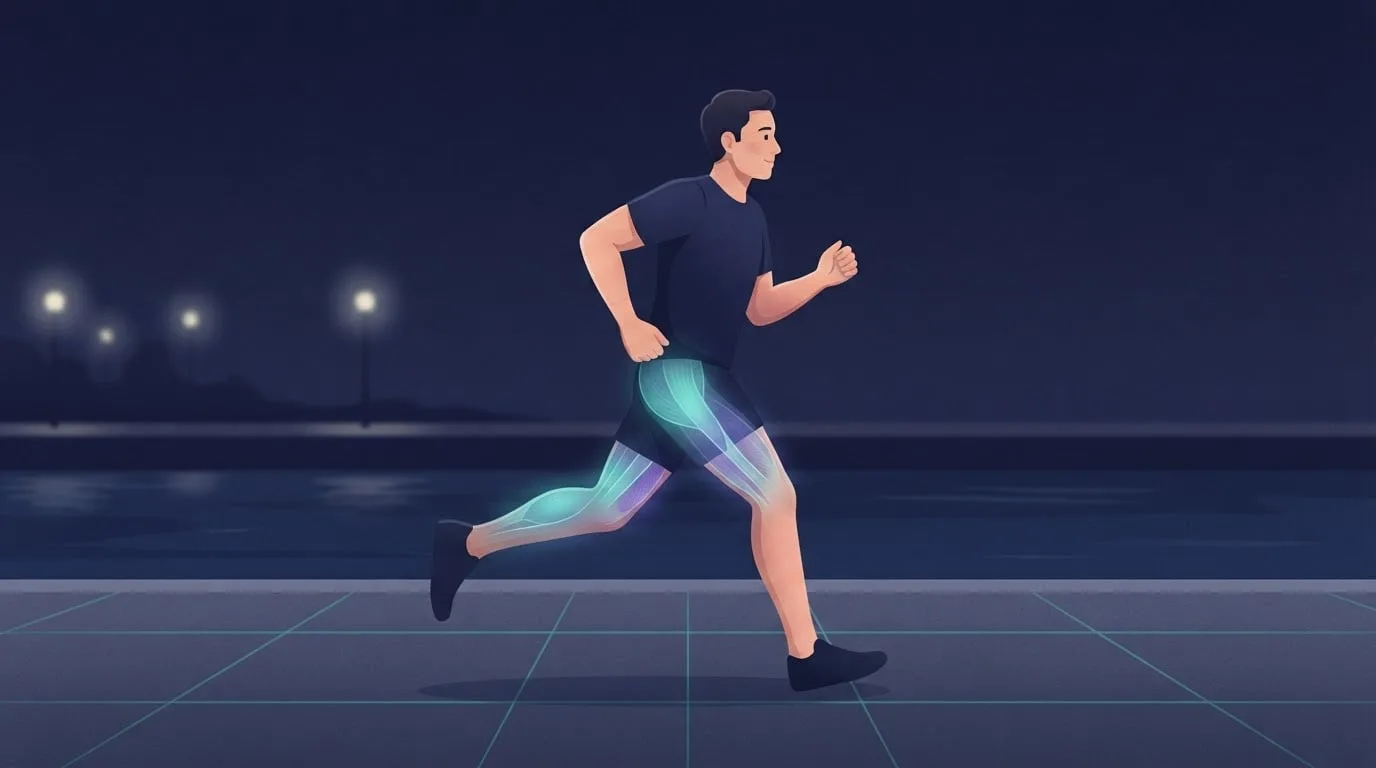
Ask a few runners where they feel a run and you'll hear different answers. One feels it in the calves after a fast session, another in the glutes after a hilly route, and a third in the fronts of the thighs after a long descent. They're all right. Running doesn't use one fixed set of muscles, and the mix changes with each phase of the stride, with your speed and with the slope under your feet.
That's worth knowing. The muscles that carry your runs are the ones worth strengthening, and strength work is one of the few things shown to make the same pace cost less energy. It also explains why months of flat miles can still leave your legs giving out on hills: hills lean on your hips far more.
This page uses two kinds of research: sensor studies, which record when each muscle switches on (electromyography, or EMG), and motion-capture models, which calculate how hard each muscle pushes. They show the main muscle in running, what works in each phase of the stride, what changes uphill and in a sprint, and which dumbbell and bodyweight exercises target the muscles running depends on.
The Muscles Running Works and the Job Each One Does
Running is a series of bounds. Each time a foot lands, your body has to stop falling, then spring forward and up into the next stride. Five muscle groups in each leg do most of that work, and your trunk and arms keep the rest of you steady. The table shows each group's job and when it works hardest.
| Muscle group | Its job in the stride | When it works hardest |
|---|---|---|
| Calves (soleus and gastrocnemius) | Hold your weight up and push you forward and upward | Second half of each foot contact |
| Quadriceps | Brake the landing and stop the knee from folding | First half of each foot contact |
| Glutes (gluteus maximus and medius) | Keep your trunk from tipping forward, hold the pelvis level and slow the swinging leg | Landing, and late in the swing |
| Hamstrings | Slow the lower leg before it lands and help extend the hip | Late swing, most of all in sprints |
| Hip flexors (iliopsoas and rectus femoris) | Pull the thigh forward after the foot leaves the ground | Early swing, most of all in sprints |
| Adductors (inner thigh) | Help hold you up just after landing and steady the leg | Throughout the stride |
| Shin muscles (tibialis anterior) | Lift the toes during the swing and control the foot as it lands | Swing and landing |
| Abdominals, obliques and lower back | Brace the trunk and control how the pelvis twists | Around each foot strike |
| Shoulders and arms | Swing to balance the twisting of the legs | The whole stride, more as you speed up |
Two rows surprise most people. An MRI study found the adductors, which rarely make lists of running muscles, the most heavily used group in hard running, and your arms add almost nothing to the push itself. Both come up again below.
What Is the Main Muscle When Running?
The main muscle when running is the soleus, the broad, flat calf muscle that sits underneath the gastrocnemius and joins your heel through the Achilles tendon. Hamner and Delp (2013) built muscle-driven computer simulations of 10 runners from motion-capture and force data at speeds from 2 to 5 meters per second, roughly a 13:25 mile up to a 5:22 mile. At every speed the soleus gave the body the largest upward push of any muscle, peaking at the equivalent of about two body weights of ground force at the fastest speed. It also gave the largest forward push, which grew as the runners sped up.
An earlier simulation from the same lab, built from one runner at about a 6:46 mile pace, split the work by phase (Hamner, Seth and Delp, 2010). The quadriceps were the largest contributors to braking and support in the first half of each foot contact. The soleus and gastrocnemius were the largest contributors to propulsion and support in the second half. The authors concluded that the quadriceps and the calf muscles that point the foot are the major contributors to moving the body during running. That ranking only changes in an all-out sprint, when the hip muscles take over, as the sprint section below explains.
Soleus or gastrocnemius?
The gastrocnemius is the calf muscle you can see, the two bulges at the top of your lower leg. It crosses both the knee and the ankle, while the soleus crosses only the ankle. That matters when you train them. A bent knee slackens the gastrocnemius, so calf raises with your knees bent hand more of the work to the soleus, while straight-knee calf raises load both. Runners need both versions, which is why the routine below includes them.
Which Muscles Work in Each Phase of the Running Stride
A running stride runs from one foot strike to the next strike of the same foot. Coaches split it into stance, when that foot is on the ground, and swing, when it travels through the air, with two short flight phases when neither foot touches down. Stance gets shorter as you speed up. In a classic sensor study, Mann, Moran and Dougherty (1986) timed foot contact at 620 milliseconds in walking, 260 in jogging, 220 in running and 140 in sprinting. Here's what works in each phase.
Just before landing: the muscles switch on early
Your leg muscles fire before your foot touches the ground. Kyröläinen, Avela and Komi (2005) recorded five leg muscles in 17 elite middle-distance runners, from the gluteus maximus down to the tibialis anterior on the front of the shin. Activity in all five rose with speed, most of all just before contact and during braking, and at the faster speeds four of them went past the level they reached in an all-out test contraction. The authors linked this early switch-on to stretch reflexes that stiffen the muscle and tendon, so the leg is ready to take the impact and give the force back. That springy stiffness does even more of the work in jumping rope, which our article on what muscles jumping rope works explains.
Landing and early stance: the quadriceps and glutes brake
When your foot lands, your body is still dropping. Your quadriceps work eccentrically here, which means they lengthen while contracting, to stop the knee from folding, and in the 2010 Hamner simulation they produced most of the braking in the first half of contact. Your hips help hold you up. In the same model, the gluteus medius, gluteus maximus and adductor magnus together supplied about half of the peak upward support just after the foot landed. Meanwhile the tibialis anterior on the front of your shin controls how your forefoot comes down.
The gluteus maximus has a second job at landing. Lieberman and colleagues (2006) recorded it in people walking and running and found it mostly quiet during level and uphill walking but strongly active in running. Its main jobs there are to stop your trunk pitching forward over the landing leg and to slow the swinging leg. That's one reason a run works your glutes in a way a brisk walk doesn't.
Midstance to toe-off: the calves push
Once your body passes over the foot, braking turns into pushing. This is where the soleus and gastrocnemius do their biggest work, holding your weight up and driving you forward and up into the next flight phase. At the same time, the gluteus medius on the side of the standing hip keeps your other hip from dropping. That small job turns out to matter for injuries, as the strength section shows.
Early swing: the hip flexors pull the thigh through
As your foot leaves the ground, your hip flexors pull the thigh forward: the iliopsoas, deep in the front of the hip, and the rectus femoris, the one quadriceps muscle that also crosses the hip. At an easy pace this is modest work. In a sprint it becomes one of the biggest jobs in the stride, because swinging the leg through faster is how you take more steps per second.
Late swing: the hamstrings brake the lower leg
In the last part of the swing your lower leg whips forward, and your hamstrings work to slow it before the foot lands. Chumanov, Heiderscheit and Thelen (2011) simulated 12 runners at 80 to 100 percent of their top speed, which averaged 7.8 meters per second. The hamstrings were stretched under load through most of the swing, and the load on the biceps femoris rose with speed until, at top speed, it was greater in the swing than during foot contact. That's why the authors think sprinting hamstring strains mostly happen late in the swing. Your gluteus maximus helps slow the swinging leg too.
Do Your Core and Arms Work When You Run?
Yes, but their job is steadying, not pushing. Saunders and colleagues (2005) recorded the abdominal and lower back muscles with fine-wire and surface electrodes in seven people walking and running on a treadmill at up to 5 meters per second. Trunk muscle activity came in two bursts linked to each foot strike. The transversus abdominis, the deep muscle that wraps around your waist, stayed switched on the whole time, and activity in the other abdominal muscles and the lower back's multifidus rose as the runners went faster. Your core works hardest around the moment your foot hits the ground, controlling how your pelvis twists and tilts.
Your arms are counterweights. In the 2010 Hamner simulation they produced less than 1 percent of the peak forward and upward acceleration of the body, but they cancelled out the twisting of the swinging legs, and in the 10-runner model arm swing grew with speed to match. Swinging them also saves energy. When Arellano and Kram (2014) had runners hold their hands behind their back, their arms across their chest or their hands on top of their head, running cost 3, 9 and 13 percent more energy than with a normal arm swing, and the runners' shoulders and pelvis twisted more.
So your shoulders, upper back and arms work on every run, just not as engines. Keep them relaxed and swinging, and let your legs and hips do the driving.
Knowing what to do is the easy part.
FitCraft, our mobile fitness app, pairs you with an AI coach who builds you a personalized plan around your goals, schedule, and fitness level. Every FitCraft program is designed by Domenic Angelino, MPH (Brown University) and NSCA-CSCS, with research published in the Journal of Strength and Conditioning Research and Medicine & Science in Sports & Exercise.
Take the Free Assessment Free • 2 minutes • No credit cardFlat vs Uphill vs Sprinting: How the Muscle Mix Changes
The same muscles work on every run. What changes is how hard each one works, and the two biggest levers are speed and slope.
What percentage of your leg muscles does running use?
About two-thirds of your leg muscle, at least during very hard running. Sloniger and colleagues (1997) used MRI scans to measure how much of each leg muscle had been working in 12 young women after runs to exhaustion lasting 2 to 4 minutes, at 115 percent of their peak oxygen uptake. Flat running used 67 percent of the muscle volume in the leg and uphill running 73 percent. No muscle was fully used, and the adductors topped the list on both surfaces, at 90 percent on the flat. Easy running uses less, so treat any single percentage for running with caution, and be especially wary of whole-body figures.
The most important muscles for long distance running
For distance running, the calves come first and the quadriceps second. Dorn, Schache and Pandy (2012) combined gait data from nine runners with a detailed musculoskeletal model, from slow running up to a full sprint. Up to about 7 meters per second, roughly 15.7 mph or a 3:50 mile pace, the runners got faster mainly by pushing harder against the ground with the soleus and gastrocnemius to lengthen each stride. Few people hold that speed for more than a few seconds. Your quadriceps absorb each landing, and over a long run those landings add up to thousands of repetitions at a modest force, so endurance in the calves and quadriceps matters most.
Uphill running: the hips take over
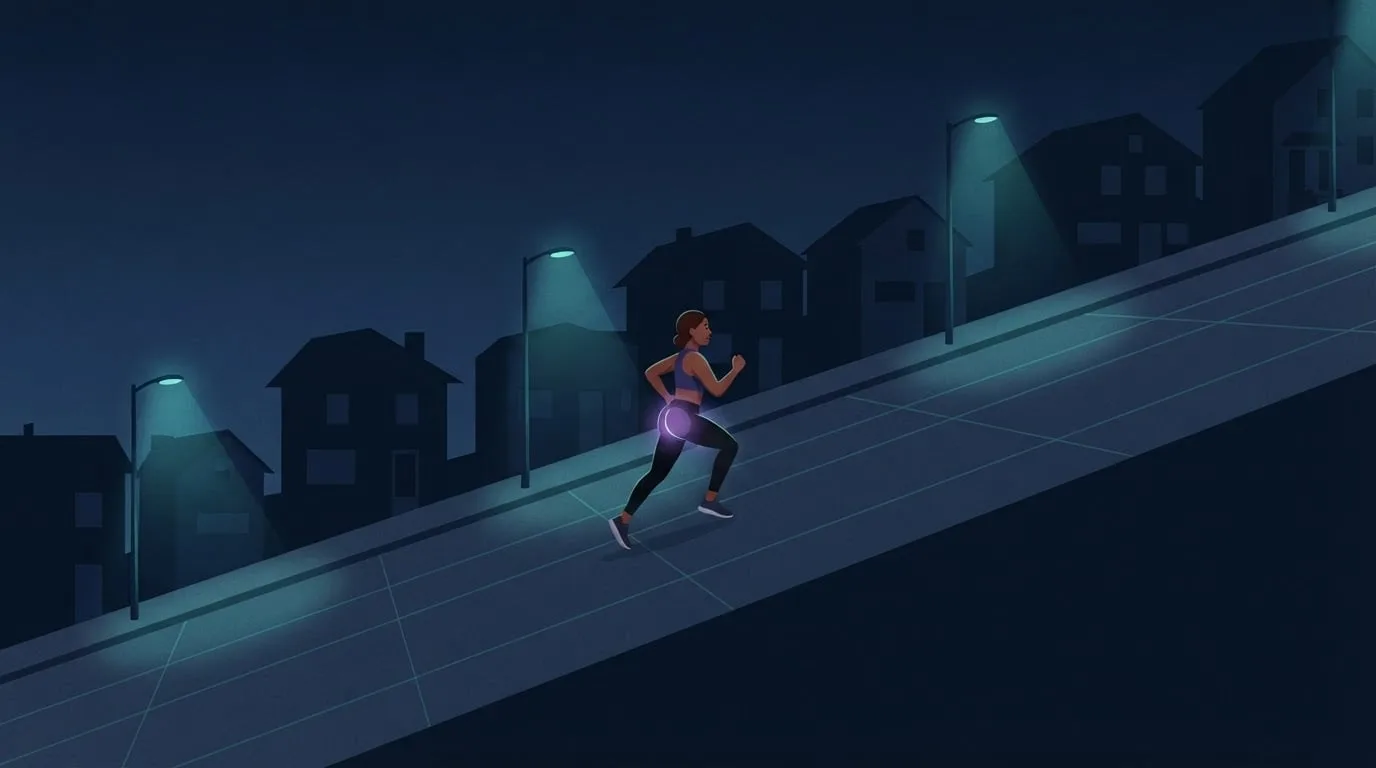
Running uphill means lifting your body on every stride, and almost all of that extra work lands on your hips. Roberts and Belliveau (2005) measured runners at a moderate speed on level ground and on 6 and 12 degree inclines. The net work done at the hip rose from slightly below zero on the level to 0.88 joules per kilogram per step at 12 degrees, while the knee and ankle did similar work at every incline. That points to the hip extensors, mainly your glutes and hamstrings, as the muscles doing the extra climbing work.
Other methods agree on the hips. In a force-plate and modeling study of six distance runners on a 9.1 percent grade, Yokozawa, Fujii and Ae (2007) found that at high speed the hamstrings and iliopsoas worked harder during the swing uphill, and the rectus femoris did more at every speed, helping lift the knee and hold the forward lean. In Sloniger's MRI scans, the gluteal group, the gastrocnemius and the vastus group (three of the four quadriceps) joined the five most-used muscles uphill. The studies disagree about the quadriceps, possibly because one tested steady runs and the other runs to exhaustion.
Hills change the forces under your feet too. On a force-measuring treadmill at 3 meters per second, a 9 degree climb removed the impact peak of landing altogether and raised the forward push by 75 percent (Gottschall and Kram, 2005). A review by Vernillo and colleagues (2017) adds that runners take quicker steps uphill and shift toward landing on the midfoot or forefoot, so more of each landing goes through the front of the foot and the calves.
Downhill running: the quadriceps brake harder
Downhill running reverses the problem: you absorb energy instead of producing it, so the braking muscles work overtime. A review by Eston, Mickleborough and Baltzopoulos (1995) describes how descending exaggerates the eccentric work of the knee extensors, the muscles at the front and back of the shin and the hip extensors. Gottschall and Kram measured the result: on a 9 degree descent, the impact peak rose 54 percent and the braking force 73 percent. That's why a long downhill can leave your quadriceps sorer than the climb did.
The most important muscles for sprinting
Sprinting turns the order upside down. Once Dorn's runners passed about 7 meters per second, the calves could no longer produce force fast enough in the brief ground contact, so extra speed came from the iliopsoas, gluteus maximus and hamstrings swinging the legs through faster. A clinical review by Schache and colleagues (2014) sums it up: going from a jog to a sprint depends mostly on the ankle and hip muscles, and the top end demands far more power at the hip, which loads the iliopsoas, gluteus maximus, rectus femoris and hamstrings.
The hamstrings stand out. Higashihara and colleagues (2010) recorded the biceps femoris and semitendinosus in eight track athletes running at 50 to 95 percent of their top speed on a treadmill. Going from 85 to 95 percent raised hamstring activation in the late swing, even though the leg movements barely changed. In 6-second sprint accelerations on an instrumented treadmill, Morin and colleagues (2015) found that the men who produced the most horizontal force, the force that drives you forward, were the ones who activated their hamstrings most just before ground contact and had the strongest eccentric hamstrings.
If you want to run faster, then, strong calves aren't enough. Hill sprints and short, fast strides train your hip flexors, glutes and hamstrings at the speeds where they matter, and our hill sprints guide shows how to add them without wrecking the rest of your week.
Does Running Build Leg Muscle?
Running trains your leg muscles mainly for endurance. Each stride asks for a modest force, repeated thousands of times, so the muscles get tougher and more economical far more reliably than they get bigger. Beginners can add a little leg muscle at first, and long downhill running is the one form of running with real growth evidence behind it, but high mileage can even shrink individual muscle fibers. Our review of whether running builds muscle goes through those studies one by one. The practical answer is short: if you want bigger or stronger legs, add strength training, which also happens to make you a better runner.
Strength Training for Runners: Dumbbell and Bodyweight Exercises
Strength training does more for runners than fill gaps. It makes the running itself cheaper. Blagrove, Howatson and Hayes (2018) reviewed 24 studies of experienced middle- and long-distance runners who added heavy, explosive or plyometric strength training for four weeks or more. Running economy, the oxygen it costs to hold a given pace, improved by 2 to 8 percent in most of the 20 studies that measured it, time trials over 1.5 to 10 km tended to get faster, and body composition didn't suffer. In five controlled trials of 93 highly trained runners, Balsalobre-Fernández, Santos-Concejero and Grivas (2016) found a large gain in running economy from two to four lower-body exercises plus some jumps and short sprints, two or three times a week for 8 to 12 weeks.
Most of those trials used gym equipment. You can train the same muscles at home with dumbbells and your bodyweight. The limit is load, so the routine below leans on single-leg exercises, which put far more weight through each leg without heavier dumbbells.
The muscle on the side of your hip
The gluteus medius, on the side of your hip, keeps your pelvis level each time you land on one leg. Bramah and colleagues (2018) compared 72 runners with kneecap pain, iliotibial band syndrome, shin splints or Achilles tendinopathy against 36 healthy runners. The injured runners showed more contralateral pelvic drop, the opposite hip sagging at midstance, and each extra degree of drop raised the odds of being in the injured group by 80 percent. That's a link, not proof that strengthening the muscle prevents injury, but side-hip exercises take only a few minutes.
A twice-a-week strength routine for runners
Do this after an easy run or on a rest day, never the day before a long or hard run. Use dumbbells heavy enough that you could manage only two or three more reps at the end of each set.
| Exercise | Main muscles | Sets and reps | Why runners need it |
|---|---|---|---|
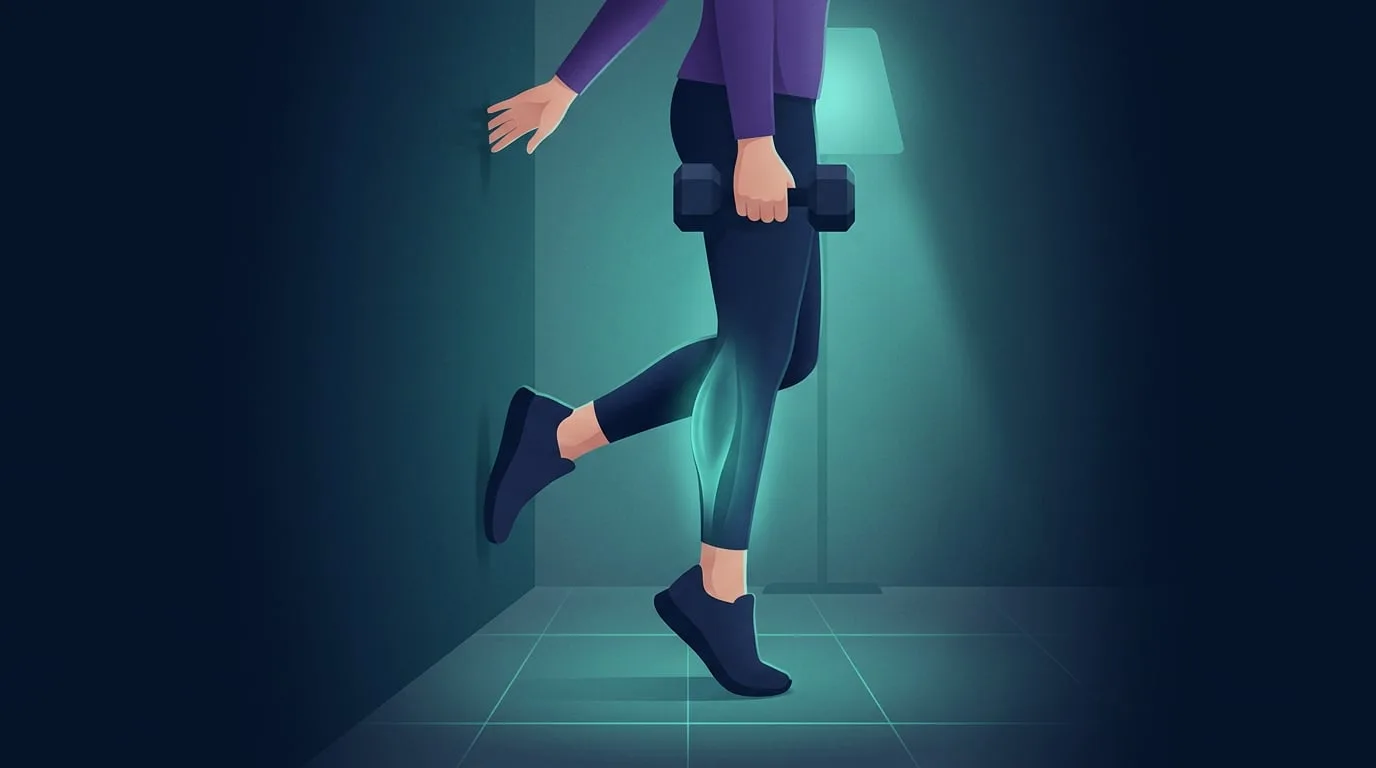
| Single-leg calf raises, straight knee, holding a dumbbell | Gastrocnemius and soleus | 3 x 10 to 12 per leg | The main pushing muscles of every stride |
| Bent-knee calf raises | Soleus | 2 x 12 to 15 per leg | Bending the knee hands more of the work to the soleus |
| Bulgarian split squats | Quadriceps and glutes | 3 x 8 to 10 per leg | Single-leg braking strength for each landing |
| Single-leg Romanian deadlifts | Hamstrings and gluteus maximus | 3 x 8 to 10 per leg | Trains the hip extensors that drive hills and sprints |
| Clamshells or side planks | Gluteus medius and obliques | 2 x 15 per side, or 30-second holds | Keeps your pelvis level when you land |
| Reverse lunge to knee drive | Quadriceps, glutes and hip flexors | 2 x 10 per leg | Rehearses the knee drive of early swing |
| Dead bugs | Deep abdominals | 2 x 8 per side | Bracing while your arms and legs move, as they do when you run |
The routine takes about 30 minutes. Rest a minute between sets, add a rep or a little weight when the last set feels easy, and keep the first two weeks light so soreness doesn't spill into your runs. The trials ran for 8 to 12 weeks, so give it two to three months before you judge it.
Knowing the routine is one thing. Doing it twice a week for three months, on top of your runs, is where most people drift. If that's the part that slips for you, a workout app built to keep you motivated can take the planning off your plate. FitCraft's strength programs use dumbbells and bodyweight, and your AI coach demonstrates every exercise on an interactive 3D model you can pinch and zoom to check the form. The workouts adjust as you progress, and streaks and leaderboards make a missed week easy to notice.
What This Means for You
Running is mostly a calf and quadriceps job on flat ground, a hip job on hills and a hip flexor and hamstring job in a sprint, with your glutes, core and arms holding everything steady. Where you feel a run is usually a fair guide to what it asked of you: calves after faster flat running, glutes and hamstrings after climbs, quadriceps after descents. On days when your legs need a break from impact, our article on what muscles the elliptical works shows how much of this work a low-impact machine keeps.
You don't have to change how you run to use any of this. Two short strength sessions a week aimed at those muscles can make the same pace feel easier within a few months. Picture the hill on your usual route a season from now: you're still breathing hard at the top, but your legs aren't the thing that gives out. Consistency is what gets you there, and as Mike, 23, said of FitCraft's streak system, "I didn't want to break my chain."
Frequently Asked Questions
What muscles does jogging work?
Jogging works the same muscles as running: mainly the calves, quadriceps, glutes, hamstrings and hip flexors, with your core and arms helping you balance. Each muscle just works less hard. In sensor studies, activity in all the main leg muscles rose with speed, and in a 10-runner simulation the soleus calf muscle gave the largest push at every speed from a slow jog upward.
Does running reduce belly fat?
Running can help reduce belly fat because it burns a lot of energy, but it can't target your belly. Fat comes off your whole body when you burn more than you eat for weeks at a time, so the results of running for weight loss show up everywhere, belly included. Your abdominal muscles do work on every run, bracing your trunk around each foot strike, but that work doesn't burn the fat sitting over them.
What is the 80% rule for running?
The 80% rule, also called 80/20 training, means doing about 80 percent of your runs at an easy, conversational effort and about 20 percent hard. It comes from studies of elite endurance athletes, who tend to settle on roughly that split of easy and hard sessions, as Seiler (2010) reviewed. The easy 80 percent builds endurance in your calves and quadriceps, and the faster 20 percent asks much more of your glutes, hamstrings and hip flexors.
Is a 10 minute run worth it?
Yes. In a study of 55,137 adults followed for an average of 15 years, runners had a 30 percent lower risk of death from any cause and a 45 percent lower risk of death from cardiovascular disease than non-runners, and the benefit held even for people running 5 to 10 minutes a day at under 6 mph (Lee and colleagues, 2014). US guidelines also count bouts of any length toward the weekly target of 75 to 150 vigorous minutes (Piercy and colleagues, 2018).
What happens if I run 7 days a week?
Your running muscles get more practice and less recovery. Running every day can work for experienced runners if most runs are easy and the weekly distance rises gradually, but your calves, Achilles tendons and shins take load every day, so the risk of overuse injury climbs if you add too much too fast. Most people do better with at least one rest day a week, or a strength session in place of one run.