What muscles does the elliptical work? The machine's reputation says everything: legs, glutes, core and arms in one low-impact, full-body workout. After 30 minutes, though, it's usually the fronts of your thighs that are doing the complaining.
Both impressions are partly right. The elliptical does use most of your major muscles, but not equally, and the way you stand, use the handles and set the ramp moves the work around more than most people expect. The elliptical is also genuinely low impact, and that comes with a trade-off in which muscles get trained.
This page uses the studies that put sensors on people's muscles while they used ellipticals, treadmills and their own two feet. It covers which muscles do the work, how the elliptical compares with walking and running, what the handles add, how incline and resistance shift the load, what pedaling backward changes, and the dumbbell and bodyweight moves that cover what the machine misses. For calories, see our article on whether the elliptical is good for weight loss, and for choosing a machine, our elliptical vs treadmill guide.
The Muscles the Elliptical Works and the Job Each One Does
An elliptical moves your feet around an oval path without ever letting them leave the pedals. Your legs push the pedals down and back, your hips extend and flex through a range a little bigger than in walking, and your arms push and pull if the handles move. The table shows each muscle group's job and how hard it works.
| Muscle group | Its job on the elliptical | How hard it works |
|---|---|---|
| Quadriceps | Push the pedal down and forward by straightening the knee | Hardest, the main driver |
| Glutes (gluteus maximus) | Extend the hip as the pedal travels down and back | High, more than in walking |
| Hamstrings | Help extend the hip and bend the knee as the pedal comes back | Moderate, the inner hamstrings less than in walking |
| Hip flexors | Lift the thigh as the pedal rises | Light to moderate |
| Calves and shins | Steady the ankle on the pedal | Light, less than in walking |
| Abdominals and lower back | Hold your trunk upright and control twisting | Light to moderate, depending on stride, speed and grip |
| Chest, front shoulders and triceps | Push the moving handles forward | Light, and only if you push |
| Upper back, lats and biceps | Pull the moving handles back | Light, and only if you pull |
The surprise is how little your lower legs do. Your feet never land and never push off, so the calves and shins that work hard in walking and running mostly hold the ankle steady. That's the opposite of running, where the soleus calf muscle gives the biggest push of any muscle, as our article on what muscles running works explains.
Elliptical vs Walking vs Treadmill: What the Muscle Studies Found
The most detailed comparison comes from Burnfield and colleagues (2010), who recorded leg muscle activity and joint motion in 20 adults walking and using four different ellipticals. Compared with walking, the ellipticals increased activity in the gluteus maximus and the vastus lateralis, the large outer quadriceps muscle. They reduced it in the medial hamstrings, gastrocnemius, soleus and tibialis anterior, while the gluteus medius and the lateral hamstring changed little. Every machine also bent the trunk, pelvis, hips and knees more than walking did, and one of the four moved much more like walking than the others.
Moreside and McGill (2012) looked higher up the body. They recorded 16 trunk and gluteal muscle sites in 40 healthy young men walking and using an elliptical at two stride lengths, two speeds and three hand positions. Gluteal activity was consistently higher on the elliptical. The lower back bent forward and twisted more on the machine, while the back extensors, lats and internal obliques worked harder only in some combinations of stride, speed and grip.
On movement alone, the elliptical sits between walking and cycling. Damiano and colleagues (2011) found treadmill walking almost indistinguishable from walking on the ground, while the elliptical was closer to walking than cycling was but still clearly different from all three. A companion sensor study from the same lab (Prosser and colleagues, 2011), covered in our elliptical vs treadmill guide, found the rectus femoris working harder on the elliptical than in any of the other tasks.
Does the elliptical work your glutes?
Yes, more than walking does. Both Burnfield's and Moreside's studies recorded higher gluteus maximus activity on the elliptical than in ordinary walking. It's still endurance work at a light load rather than glute strength training, and the incline and resistance section below shows how to raise the demand.
Is the Elliptical Low Impact?
Yes. Your feet stay on the pedals, so there's no landing, and a motion-analysis study covered in our elliptical vs treadmill guide measured lower pedal forces and loading rates than the ground forces of walking. The trade-off is more bend at the hips and knees and more work for the quadriceps. That's why the elliptical suits joints that dislike impact but doesn't automatically suit knees that dislike deep bending under load.
Elliptical vs running: less muscle for the same effort
At the same energy cost the elliptical asks less of your leg muscles than running does. In a master's thesis by Alfi (2017), running produced greater peak and average muscle activity across the stride than elliptical exercise at a similar metabolic cost and heart rate. That's the flip side of low impact: the machine takes the landing out, and with it much of the muscle work that landing demands.
Knowing what to do is the easy part.
FitCraft, our mobile fitness app, pairs you with an AI coach who builds you a personalized plan around your goals, schedule, and fitness level. Every FitCraft program is designed by Domenic Angelino, MPH (Brown University) and NSCA-CSCS, with research published in the Journal of Strength and Conditioning Research and Medicine & Science in Sports & Exercise.
Take the Free Assessment Free • 2 minutes • No credit cardHandles vs No Handles: How Much Does Your Upper Body Work?
Moving handles turn the elliptical into a light push-pull workout for your upper body. Pushing a handle away works your chest, front shoulders and triceps, and pulling it back works your upper back, lats, rear shoulders and biceps. How hard those muscles work hasn't been measured well. Burnfield's team listed the unmeasured upper-body effort as a limitation of their own study, and we found no sensor study that isolates it.
What has been measured is how your hands change your trunk. Moreside and McGill tested three hand positions, hands free, a fixed central bar and the moving handles, and found that hand position, along with stride length and speed, changed both lower back motion and trunk muscle activity. Their abstract doesn't single out a best grip, so be wary of claims that one hand position fires up your core.
The handles do raise the energy cost of a session, which our article on the elliptical and weight loss covers. For upper-body strength, though, they won't get you far. Push-ups and dumbbell rows load the same muscles far harder, as the last section shows.
Incline and Resistance: Moving the Work to Your Glutes and Hamstrings
Most ellipticals let you raise the ramp, which makes each stride more of a climb. In a small study, Wu and colleagues (2008) recorded leg muscles in eight volunteers at 0, 9.3 and 18.6 percent incline. Activity rose with incline in most of the muscles measured, while the tibialis anterior on the front of the shin worked less.
Resistance may matter more than the ramp. In Alfi's thesis, which tested three resistance levels and three ramp angles, raising the resistance increased the energy cost by 30 percent and raised average activity in five of the eight leg muscles measured. Steepening the ramp added only 2 to 6 percent to the energy cost, though it raised tibialis anterior activity by 30 percent, the opposite of Wu's finding for that muscle. The two studies used different machines and small samples, so treat them as hints rather than rules.
The practical version: turn up the resistance first when you want your glutes, hamstrings and quadriceps to work harder, then add incline for variety. If the session starts to feel easy, a heavier pedal is a better lever than a faster stride.
Pedaling Backward on the Elliptical: What Changes?
Most ellipticals run in reverse, and pedaling backward is often sold as a hamstring and glute workout. The direct evidence for that claim is thin. The one EMG study we found that tested it, by Khoshbaten and Farahpour (2022), recorded leg muscles in 24 men, half of them with kneecap pain, during walking, cycling, a frog-kick machine and forward and backward elliptical training. Backward elliptical training produced the highest activity of any task in the vastus medialis oblique, the teardrop-shaped inner quadriceps muscle above the knee, and a higher ratio of inner to outer quadriceps activity.
That makes reverse pedaling a quadriceps variation more than a glute one. The authors suggested it might suit people with kneecap pain, but that's a hypothesis from one small study, not a tested treatment. Backward motion also feels less familiar, so slow the pace and hold the handles while you get used to it.
Does the Elliptical Work Your Stomach?
Your abdominals and lower back work on the elliptical, but gently. In Moreside and McGill's study the lower back bent forward and twisted more than in walking, and trunk muscles such as the internal obliques and back extensors worked harder only in some conditions. That's posture and stabilizing work, not the kind of load that builds your abs, and it won't burn belly fat in particular. Belly fat comes off along with the rest of your body fat when your overall energy balance tips, so the elliptical helps there as a calorie burner rather than as an ab exercise.
What the Elliptical Doesn't Train, and What to Add
Burnfield's data shows the gaps. Your calves, shins and inner hamstrings work less than in walking, and with no landing there's no impact to load your bones. The fixed path takes balance out of the movement, and the handles do little for upper-body strength. Two short sessions a week of these dumbbell and bodyweight moves fill the gaps.
| Exercise | Sets and reps | The gap it fills |
|---|---|---|
| Single-leg calf raises | 3 x 10 to 15 per leg | Calves and ankles, which the pedals barely use |
| Split squats with dumbbells | 3 x 8 to 10 per leg | Single-leg strength and balance |
| Single-leg Romanian deadlifts | 3 x 8 to 10 per leg | Hamstrings and glutes under real load |
| Push-ups | 3 x 8 to 15 | Chest, shoulders and triceps |
| Bent-over dumbbell rows | 3 x 10 per arm | Upper back, lats and biceps |
| Side planks | 2 x 30 seconds per side | Side core strength |
The circuit takes about 25 minutes, and it fits on a rest day or straight after a short, easy elliptical session.
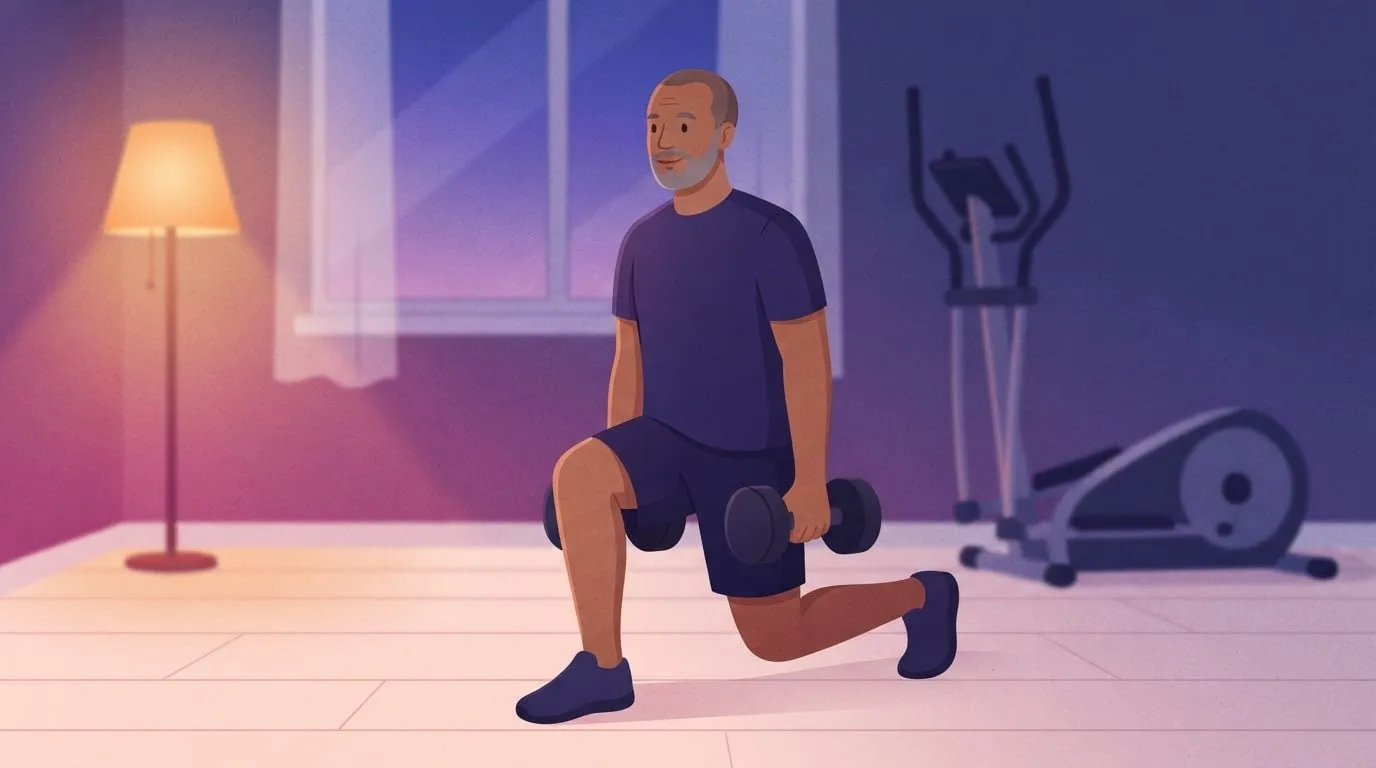
Planning those sessions yourself is where most people slip. A home workout app that needs no equipment can plan and lead them for you instead. In FitCraft, your AI coach shows each bodyweight or dumbbell exercise on an interactive 3D model you can pinch and zoom to check your form, and the workouts get harder as you progress.
What This Means for You
The elliptical is a quadriceps and glute machine first, with light work for your hamstrings, core and, if you push and pull, your upper body. It spares your joints from impact, and in exchange it gives your calves, bones and balance less to do. Turn up the resistance when you want your legs to work harder, and treat the handles and the reverse setting as variety rather than as a separate workout.
Used that way, it's an easy machine to come back to on days when your knees or feet want a break. Picture a few months of it: steady sessions you can do while the evening winds down, legs that handle stairs without a second thought, and two short strength sessions a week covering what the machine leaves out. If you want the opposite end of the impact spectrum, our article on what muscles jumping rope works shows what a high-impact option does for your calves and ankles.
Frequently Asked Questions
What are the key differences between a cross-trainer and an elliptical?
For your muscles, none that matter. Cross trainer is the usual British name for an elliptical with moving handles, and in the US the same machine is simply called an elliptical. Some ellipticals have fixed handles or none at all, so check that the handles move if you want your arms, chest and back to work.
Is 30 minutes of elliptical a day enough?
For cardio, yes: 30 moderate minutes on five days meets the weekly guideline of 150 moderate minutes. For your muscles, 30 minutes trains the quadriceps and glutes for endurance but builds little strength, and it leaves your calves, balance and upper body largely untrained. Two short strength sessions a week cover those gaps.
Are ellipticals good cardio?
Yes. An elliptical keeps your large leg muscles moving rhythmically and can push your heart rate into the moderate or vigorous range, depending on resistance and pace, so it counts toward cardio guidelines like running or cycling. It's a good choice when impact is a problem, because your feet never leave the pedals.
What are the downsides of using an elliptical?
From a muscle point of view, the elliptical gives your calves, shins and inner hamstrings less work than walking, provides no impact to load your bones, follows a fixed path that doesn't train balance, and leans heavily on the quadriceps, which can bother sore knees. The handles also do little for upper-body strength, so pair the machine with some strength training.
Is 3 miles on the elliptical the same as running 3 miles?
No. Elliptical miles are estimates the machine calculates from your strides, and the movement asks less of your muscles than running. In one master's thesis, running produced more muscle activity than the elliptical at the same energy cost and heart rate. Compare the two by time and effort instead of distance.
Are ellipticals better than treadmills?
Neither is better overall. The elliptical spares your joints from impact and works your quadriceps and glutes hard, while a treadmill trains walking or running itself, with more work for your calves and the bone-loading impact the elliptical removes. Pick by your goal and your joints, and use both if you like.