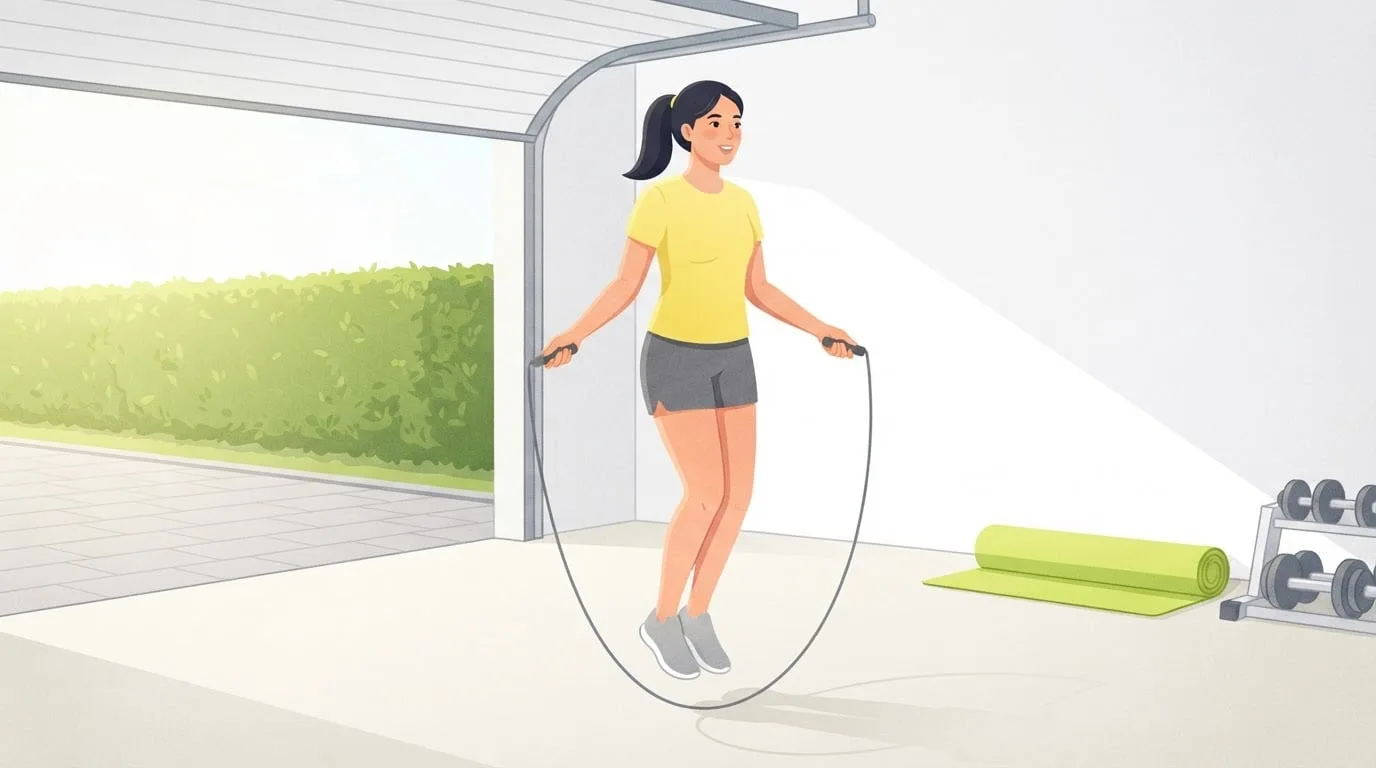
What muscles does jump rope work? If you've tried it for five minutes, your calves have already given you their answer. They burn first, they're the muscles you notice the next morning, and they're usually why a session ends sooner than you planned.
The rest of the answer is less obvious. Your thighs, hips and core work too, and so do your shoulders and forearms, each in a different way, and the footwork you choose moves the work from one muscle group to another. Jumping rope is also a plyometric exercise in miniature, so it trains your tendons as well as your muscles.
This page covers the muscles jump rope works and why the calves and ankles carry it, the spring-like stretch-shortening cycle behind every bounce, whether jump rope counts as plyometrics, what your arms and shoulders actually do, and how the bounce, the alternate-foot step, single-leg hops and double unders change the load. For calories and weight loss, see our article on whether jump rope helps you lose weight. For heart and lung fitness, see our jump rope cardio research review.
What Muscles Does Jump Rope Work?
Jump rope works almost every muscle below your neck, but the load is lopsided. The lower legs do the jumping, the thighs and hips cushion and steady each landing, the trunk holds you upright, and the arms turn the rope. The table shows each group's job.
| Muscle group | Its job when you jump rope | How hard it works |
|---|---|---|
| Calves (gastrocnemius and soleus) | Absorb each landing and push you back up | Hardest of all, on every jump |
| Achilles tendon and feet | Stretch on landing and spring back | Every jump |
| Shin muscles (tibialis anterior) | Control the foot and ankle as you land | Moderate, more in a two-foot bounce |
| Quadriceps | Cushion the landing with a slight knee bend | Moderate, more with higher jumps |
| Hamstrings and glutes | Steady the hips and knees, and drive higher jumps | Moderate, more in double unders and high knees |
| Hip flexors | Lift the knees in running-style steps | Light in a bounce, heavy in alternate-foot steps |
| Abdominals and lower back | Keep your trunk upright and still | Steady, low-level bracing |
| Shoulders and upper back | Hold your upper arms in position | Light, more with a weighted rope |
| Forearms and wrists | Turn the rope and grip the handles | Constant |
Compared with running, the work sits lower in the leg. In running the calves also do the most pushing, as our article on what muscles running works explains, but every stride also asks your hips to swing a leg through. A rope bounce keeps both feet together and the knees only slightly bent, so the ankle takes a bigger share of the job.
Why Your Calves and Ankles Do Most of the Work
When you bounce in place, your leg behaves like a spring, and the stiffness of that spring decides how high and how quickly you rebound. Farley and Morgenroth (1999) had five people hop at 2.2 hops a second, first at a comfortable height and then as high as they could. Leg stiffness roughly doubled for the maximum hops. The ankle became 1.9 times stiffer and the knee 1.7 times stiffer, but when the researchers fed those changes into a computer model, the stiffer ankle alone doubled leg stiffness while the stiffer knee barely changed it. The ankle is the main dial.
That rate of 2.2 hops a second isn't arbitrary. In an earlier study, Farley and colleagues (1991) found it was the rate people chose for themselves when hopping in place. At that rate and faster, the body bounced like a simple spring. At slower rates it stopped behaving like one, and less elastic energy was likely recovered. A steady rope pace of around 120 to 130 turns a minute sits close to that natural rhythm, which may be part of why a quick, low bounce feels easier than slow, high jumps.
Sensor data points the same way. Lin and colleagues (2022) recorded six leg muscles in 16 experienced teenage skippers. In a two-foot bounce, the inner and outer heads of the gastrocnemius worked at about 42 and 34 percent of their maximum, and the semitendinosus, a hamstring that helps control the knee, at about 38 percent. The two hip flexors they measured, the rectus femoris and the iliopsoas, stayed near 5 percent.
All those quick, controlled landings train ankle control as well as strength. In a randomized trial, Trecroci and colleagues (2015) added 15 minutes of jump rope to the start of soccer practice twice a week for eight weeks in 11-year-old players. The rope group cut their time on a coordination circuit by about 9 percent and improved their single-leg balance reach on both legs, while the soccer-only group barely changed.
The Stretch-Shortening Cycle: Why Each Bounce Feels Springy
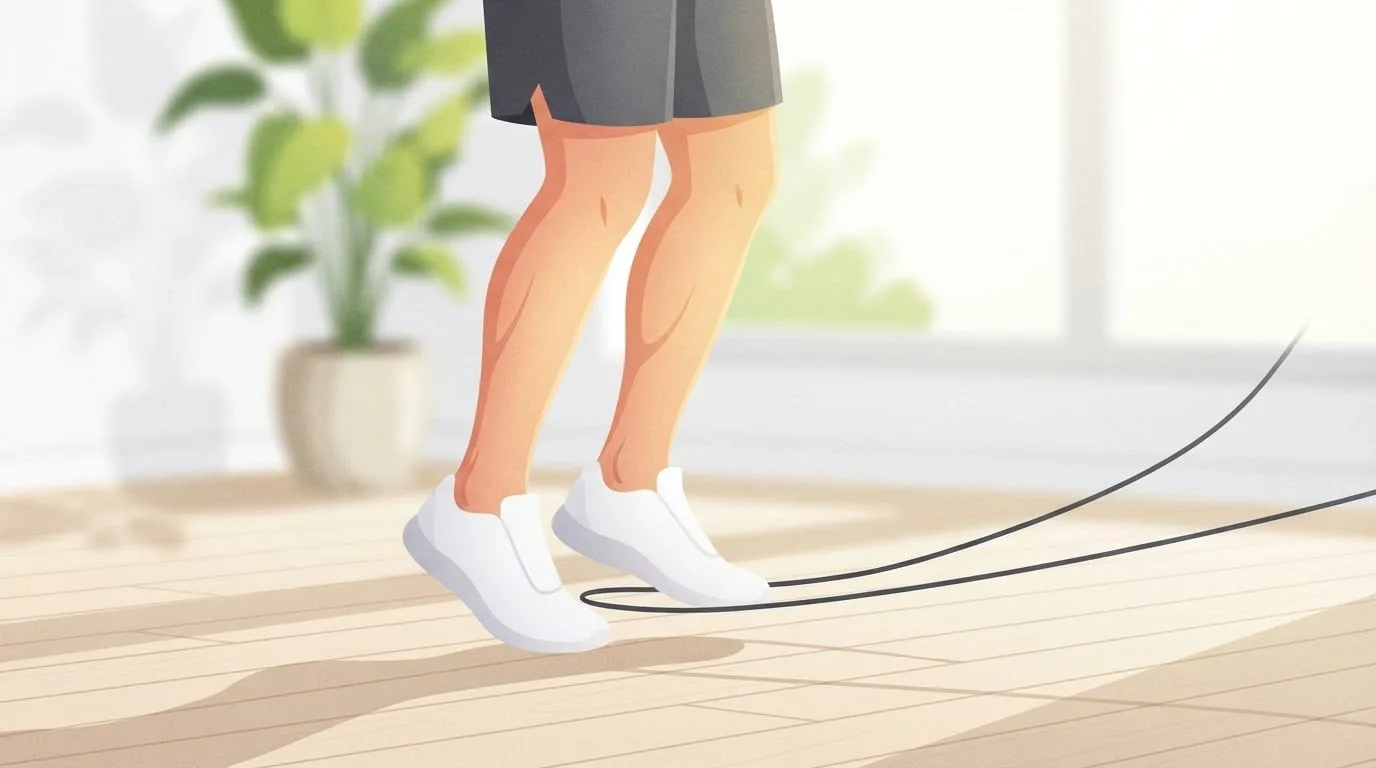
Every bounce is a stretch-shortening cycle. As you land, your calf muscles and Achilles tendons are stretched, and then they shorten to push you off, with almost no pause in between. Komi's (2000) review describes how a muscle that is stretched just before it shortens produces more force and power in the push than it could from a standstill. That's the springy feeling of a good rope rhythm.
Part of the boost comes from the tendon. Lichtwark and Wilson (2005) tracked the Achilles tendon with ultrasound in 10 men hopping on one leg. The tendon stretched by an average of 8.3 percent at peak and gave back about 38 joules per hop as it recoiled, roughly 16 percent of the total mechanical work of the hop. So the spring is real, but your calf muscles still do most of the work, which is why they're the first thing to tire.
Tendons adapt to this kind of loading, but slowly. In a randomized trial, Fouré, Nordez and Cornu (2010) found that 14 weeks of plyometric training cut the energy the Achilles tendon wasted on each stretch by 35 percent. Stiffness trended up by about 24 percent, though that change wasn't statistically significant. Those changes take months, so add rope minutes gradually even when your fitness says you could do more.
Knowing what to do is the easy part.
FitCraft, our mobile fitness app, pairs you with an AI coach who builds you a personalized plan around your goals, schedule, and fitness level. Every FitCraft program is designed by Domenic Angelino, MPH (Brown University) and NSCA-CSCS, with research published in the Journal of Strength and Conditioning Research and Medicine & Science in Sports & Exercise.
Take the Free Assessment Free • 2 minutes • No credit cardIs Jump Rope Plyometrics?
Yes. Plyometrics are exercises built on a fast stretch-shortening cycle, and a rope bounce is a small, quick one, so basic jumping rope is a low-intensity plyometric. The ground contacts are brief. In Muay Thai athletes skipping at 2.2 jumps a second, each two-foot contact lasted about 0.22 seconds (Kaewjaratwilai and colleagues, 2025).
Double unders turn the intensity up. Miyaguchi, Sugiura and Demura (2014) tested 76 young men with a rebound jump index, a score that rewards jumping higher while spending less time on the ground. It averaged 1.34 for double unders against 0.60 for basic jumps, and the authors suggested double unders could be used to train stretch-shortening ability, especially in people who are weak at it. Higher, faster jumps load the same calves and tendons harder, so give double unders the same gradual build-up as any jump training.
What Muscles Are Used When Jumping?
A rope bounce and a maximal jump use the same muscles in very different proportions. In a big countermovement jump, the kind you'd use to touch a high branch, Bobbert and van Ingen Schenau (1988) found that the muscles of 10 skilled jumpers reached their peak activation in order from the hips down. The hamstrings came first, then the gluteus maximus, the quadriceps and finally the soleus and gastrocnemius, a hip-to-ankle sequence that passes energy down the leg into the push.
A rope bounce barely bends your hips and knees, so most of that chain sits idle and the ankle carries the job. That's why skipping trains your calves and ankles far more than the big hip and thigh muscles a high jump depends on, and why it pairs well with squats and lunges.
What Jumping Rope Does for Your Shoulders, Arms and Forearms
Your arms turn the rope with small circles from the wrists, with your elbows close to your sides and your shoulders holding your upper arms steady. So your forearm and wrist muscles work on every turn, your grip works the whole time you hold the handles, and your shoulders and upper back do light, steady holding work. A wide, big-armed swing is a common beginner habit, and it tires the shoulders quickly without turning the rope any faster.
The grip work adds up. In a 12-week randomized trial of 60 middle-school students, Yang and colleagues (2020) gave two groups 30 minutes of rope work three times a week, one doing traditional jump-count skipping and one doing freestyle routines with tricks. Right-hand grip strength rose about 11 to 12 percent and left-hand grip about 9 to 13 percent in the two rope groups, and standing long jump distance improved too. Our jump rope research review covers a separate trial in university students that found similar grip gains.
What we couldn't find is a study that put electrodes on the shoulders during skipping, so most claims about rope skipping and shoulder muscles rest on mechanics rather than measurement. That includes claims about weighted ropes. A heavier rope takes more force to turn, so expect more forearm and shoulder fatigue, and expect it to slow your pace.
Footwork Variations and the Muscles They Shift To
Change your feet and you change which muscles do the work. Here's what the evidence shows for the common variations.
Two-foot bounce: calves and shins
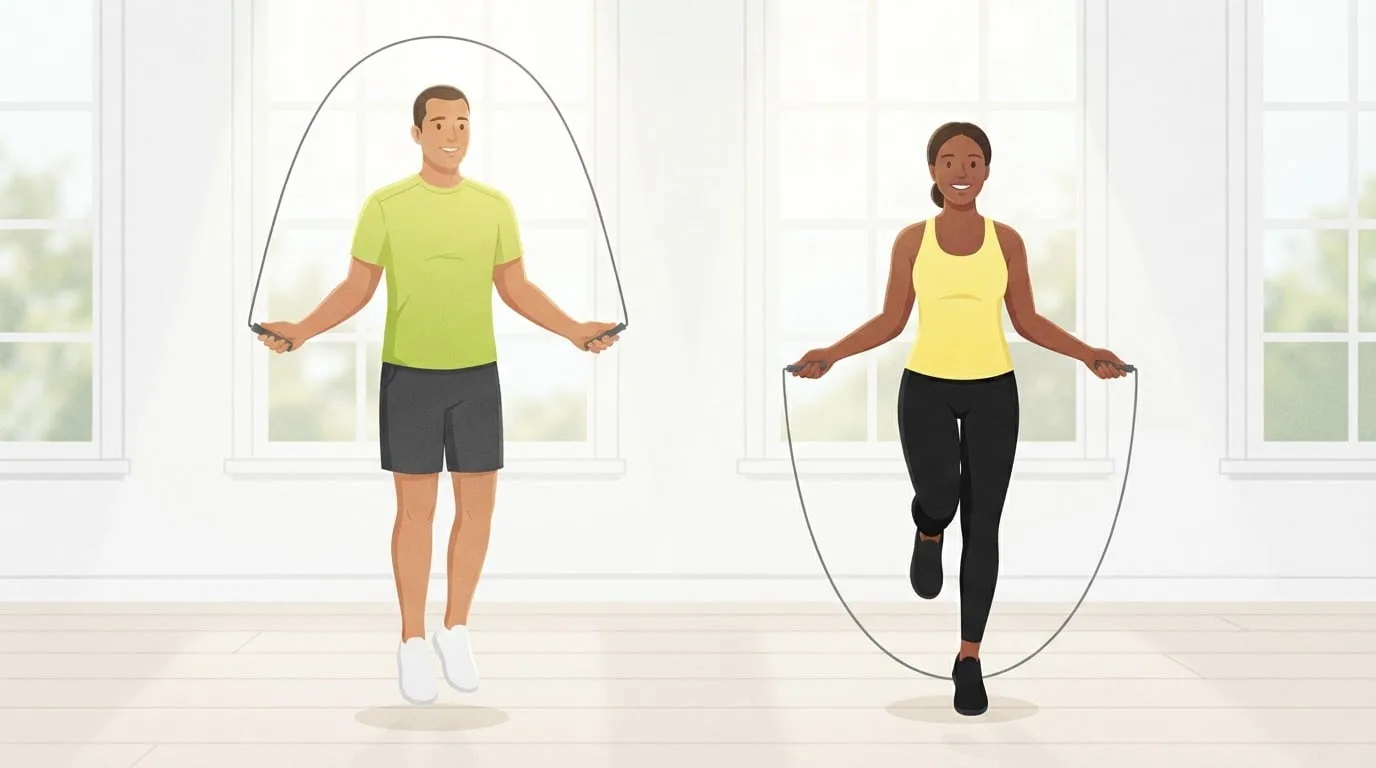
In Lin's sensor study, the basic bounce produced more activity in the outer calf (about 34 percent of maximum, against 23 percent for the alternate-foot step) and in the tibialis anterior on the front of the shin. It also landed with lower forces and loading rates, which is why the authors recommended the bounce for teenagers.
Alternate-foot step: hip flexors and hamstrings
The alternate-foot step, landing on one foot and then the other as if jogging in place, flipped the pattern. The iliopsoas, nearly silent in the bounce, worked hard, and the semitendinosus rose from about 38 to 52 percent of its maximum. Lin's team concluded that the bounce leans on the calf muscles and the alternate step on the thigh muscles.
Single-leg hops: more load on each leg
Hopping on one foot puts all of each landing through one leg. In the Kaewjaratwilai study, single-leg skipping at the same 2.2 jumps a second lengthened ground contact from about 0.22 seconds to 0.26 to 0.28 seconds and made the bounce less springy, with lower leg stiffness and shorter flights. The one working leg took a peak force of about 2.8 to 3.3 kilonewtons, while two-foot skipping peaked at about 4.0 to 4.4 kilonewtons shared between both legs, so each working leg carried a much bigger share.
High knees: the hip flexors and abdominals
High knees take the alternate-foot step further. Lifting each thigh toward hip height on every turn puts your hip flexors and abdominals to work, much like the knee drive of a sprint, and it's the quickest way to move a rope session off your calves.
Double unders: higher, faster, harder on the calves
Double unders need a higher jump and a faster rope, since the rope passes under your feet twice per jump. That more than doubled the reactive jump score in Miyaguchi's study, and it makes your wrists and forearms spin the rope twice as fast. Learn them in short sets once a basic bounce feels easy for a few minutes at a time.
Does Jump Rope Build Muscle?
Some, mostly in the calves and mostly if you're new to training. Skipping is a high-repetition, low-load activity, so it builds endurance and springiness in the lower legs far more than size. The strength trials, including that university study, are summed up in our jump rope research review. If you want bigger legs, glutes or arms, a rope won't get you there on its own, and two strength sessions a week will.
Does Jump Rope Give You Abs?
Not on its own. Your abdominals and lower back work as stabilizers on every jump, holding your trunk upright and still, but that steady, low-level bracing doesn't build much muscle. Visible abs depend mostly on your body fat, and the evidence on that side is covered in our article on jump rope and weight loss.
Strength Work That Makes Jumping Rope Easier
Jumping rope leaves big gaps: almost no pushing or pulling for the upper body, little deep knee or hip bending, and only light work for the glutes and hamstrings. It also hammers the calves and Achilles tendons, so they benefit from slower, heavier work that builds their capacity. These six moves cover both. Do them twice a week, on days you skip lightly or not at all.
| Exercise | Sets and reps | What it adds to jumping rope |
|---|---|---|
| Slow single-leg calf raises, three seconds down | 3 x 10 to 12 per leg | Calf and Achilles strength for longer sessions |
| Goblet squats or bodyweight squats | 3 x 10 to 12 | The deep knee and hip bend a bounce never reaches |
| Glute bridges or single-leg bridges | 3 x 12 | Glute and hamstring strength for higher jumps |
| Push-ups | 3 x 8 to 15 | Chest, shoulders and triceps, which skipping skips |
| Bent-over dumbbell rows | 3 x 10 per arm | Upper back and lats for posture and pulling |
| Side planks | 2 x 30 seconds per side | Side core strength for steady landings |
The whole circuit takes about 25 minutes. If you'd rather have it planned and coached, a home workout app built around bodyweight training can do that. FitCraft's workouts cover strength, cardio, yoga and mobility, your AI coach demonstrates every move on an interactive 3D model you can pinch and zoom, and streaks keep count of the days you show up.
What This Means for You
Jumping rope is, above all, a calf and ankle workout, with your thighs, hips and core steadying the landings and your forearms turning the rope. The basic bounce is the gentlest version, and alternate-foot steps, high knees and double unders spread the work to your hips or raise the load on your lower legs. Picture a few months from now: the rhythm comes without counting, your calves no longer cut the session short, and a few minutes of skipping is the easy part of your warm-up.
Build your minutes slowly, because your tendons adapt more slowly than your heart and lungs, and pair the rope with two short strength sessions a week. If impact is the problem rather than the cure, our article on what muscles the elliptical works shows what a no-impact machine can do for your legs.
Frequently Asked Questions
Is 10 minutes of jump rope enough?
For your calves and ankles, yes. Ten minutes of steady skipping at about 120 turns a minute is roughly 1,200 jumps, a big workload for the lower legs, so build up to it over a few weeks. For your heart, 10 hard minutes count toward the weekly guideline of 75 to 150 vigorous minutes, because US guidelines count bouts of any length (Piercy and colleagues, 2018).
What happens if I do 100 jump ropes a day?
A hundred jumps take under a minute at a steady pace, so on their own they're more of a warm-up for your calves and ankles than a workout. Done every day, they'll get your lower legs used to landing and sharpen your rhythm and timing. To build fitness, treat 100 as one set and add more sets with short rests until you reach 10 minutes or more.
Is 20 minutes of jump rope a day enough?
Twenty minutes a day is plenty for most cardio goals, because jumping rope is vigorous exercise and 140 vigorous minutes a week sits near the top of the 75 to 150 minute guideline. It's also a lot of calf and Achilles loading, so work up to it over several weeks, rest when your calves stay sore, and add two strength sessions a week for the muscles skipping doesn't train.
Does jumping rope work your glutes?
A little. In a basic two-foot bounce your glutes mostly steady your hips while your calves do the jumping. Higher jumps, double unders, high knees and alternate-foot steps ask more of your hip muscles, and in one sensor study the alternate-foot step used far more hip flexor and hamstring activity than the bounce. For glutes you can see, add bridges, squats or split squats.
What muscles do star jumps work?
Star jumps work your calves and quadriceps to jump and land, your outer hips and inner thighs as your legs spread wide and snap back together, and your shoulders as your arms sweep overhead. They're a bigger, more explosive version of the jumping jack, so they raise your heart rate quickly too. Our jumping jacks page shows the form.
What muscles does a weighted jump rope work?
A weighted rope works the same leg muscles as a regular rope, plus more of your forearms, wrists, shoulders and upper back, because a heavier rope takes more force to turn. There's little research on weighted ropes, though, and the extra weight usually slows your pace, so you may get fewer jumps per minute. For upper-body strength, push-ups and dumbbell rows will do more than any rope.