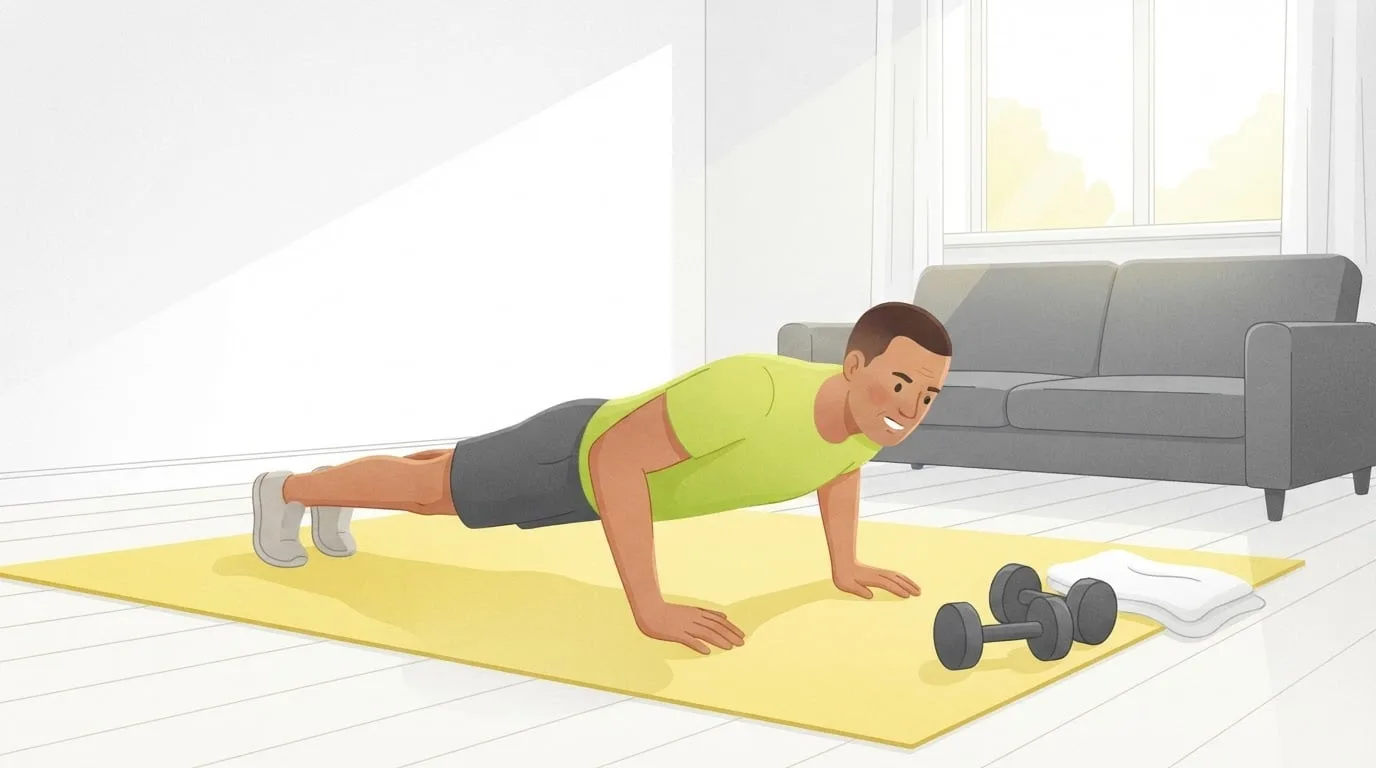
You finish your last set, and the video you're following says it's time for the finisher: five minutes of burpees, a 100-rep push-up challenge or an ab circuit that ends with you flat on the floor. Social media makes it look like the part of the workout that really counts.
Sometimes it is useful. Often it's the part that leaves you so sore you skip the next session, or so tired that your form falls apart on the last reps. And if you're already working hard just to show up three times a week, a finisher that flattens you for two days is the last thing your routine needs.
This guide explains what a finisher workout is, when one helps and when it hurts your recovery. It also gives you 12 workout finishers with dumbbells or bodyweight, grouped by goal: core, cardio, muscle and beginner-friendly.
What Is a Finisher in a Workout?
A finisher is a short, intense block of exercise at the end of a workout, usually 3 to 10 minutes long. It's sometimes called a metabolic finisher, or a burnout when it's a single exercise taken close to failure. A good finisher has one job, and you pick it to fit your goal: more conditioning, more core endurance, or more work for one muscle that's lagging behind.
Most finishers use one of six formats:
| Format | How it works | Example |
|---|---|---|
| Tabata or timed intervals | Work and rest on a clock, such as 20 seconds on and 10 off for 4 minutes | Squat thrusts and high knees |
| EMOM | A set number of reps at the start of every minute; the rest of the minute is rest | Dumbbell core EMOM |
| AMRAP | As many rounds as possible of a short circuit in a fixed time | 8-minute dumbbell AMRAP |
| Ladder | Reps go up or down each round, such as 1, 2, 3 and on up | Wall sit and push-up ladder |
| Burnout or drop set | One exercise close to failure, then an easier version without resting | Push-up drop set |
| Timed hold or carry | Hold a position or carry a load for time | Plank ladder, farmer's march |
If the EMOM and AMRAP formats are new to you, our guides to the EMOM workout and the AMRAP workout cover how to pace and scale each one.
12 Finisher Workouts by Goal
A good finisher workout is short, matches your goal and leaves the muscles you just trained hard alone. Pick one of these per session, not three.
| # | Finisher | Goal | Equipment | Time |
|---|---|---|---|---|
| 1 | Plank ladder | Core | Bodyweight | 4 to 5 min |
| 2 | Dumbbell core EMOM | Core | One dumbbell | 6 min |
| 3 | 5-minute ab circuit | Core | Bodyweight | 5 min |
| 4 | 4-minute Tabata | Cardio | Bodyweight | 4 min |
| 5 | Light dumbbell complex | Cardio and strength endurance | Two light dumbbells | 6 to 8 min |
| 6 | 8-minute dumbbell AMRAP | Cardio | Two dumbbells | 8 min |
| 7 | Push-up drop set | Chest and triceps | Bodyweight, a bench | 3 min |
| 8 | Dumbbell curl 21s | Biceps | Two dumbbells | 3 min |
| 9 | Lateral raise drop set | Shoulders | Two light dumbbells | 3 min |
| 10 | Goblet squat burnout | Legs and glutes | One dumbbell, a wall | 4 min |
| 11 | Farmer's march | Beginner: grip, posture, light cardio | Two dumbbells | 4 min |
| 12 | Wall sit and incline push-up ladder | Beginner: full body | A wall, a counter | 4 to 5 min |
Core Finishers
A core finisher, or ab finisher, fits almost any day. Core work done before squats and presses makes them harder to do well, so the end of the session is the right time for it.
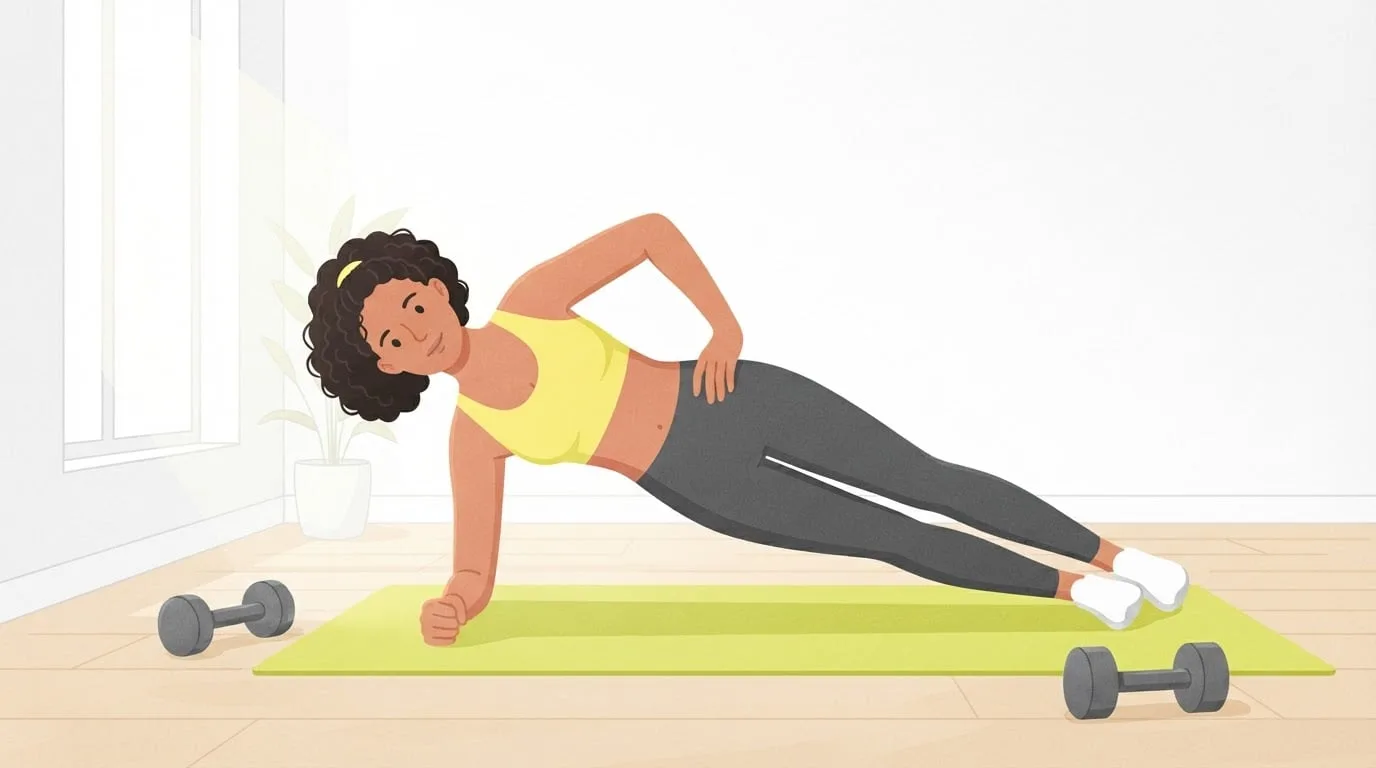
1. Plank ladder (bodyweight, 4 to 5 minutes)
Hold a front plank for 30 seconds, a side plank on your left for 30 seconds, a side plank on your right for 30 seconds, then do 30 seconds of slow dead bugs. Rest 30 seconds and repeat once. Drop your knees to the floor in the planks if your hips sag, and add 10 seconds to each hold every week or two.
2. Dumbbell core EMOM (one dumbbell, 6 minutes)
Set a timer for 6 minutes. In minute 1, hold a dumbbell in your left hand like a suitcase and march in place for 30 seconds, standing tall without leaning toward the weight. In minute 2, lie on your back holding the dumbbell over your chest with both hands and do 10 dead bugs, lowering one leg at a time. In minute 3, march with the dumbbell in your right hand. Rest for whatever's left of each minute, then repeat the three minutes once.
3. 5-minute ab circuit (bodyweight, 5 minutes)
Work for 40 seconds and rest for 20 through five moves: reverse crunches, bicycle crunches, plank shoulder taps, a hollow hold (bend your knees to make it easier) and slow mountain climbers. This 5-minute core finisher hits the front and sides of your trunk and needs only a mat.
Cardio Finishers
A cardio finisher raises your heart rate for a few minutes after strength work, so you get some conditioning without a separate cardio day. Keep it short. The longer a hard cardio block runs, the more it eats into the recovery your strength training needs.
4. 4-minute Tabata (bodyweight, 4 minutes)
Alternate squat thrusts and high knees for 8 rounds of 20 seconds of work and 10 seconds of rest. For a squat thrust, put your hands on the floor, step or hop your feet back to a plank, then step or hop them back in and stand up. Stepping instead of hopping, and marching instead of high knees, takes the impact out without changing the clock.
5. Light dumbbell complex (two light dumbbells, 6 to 8 minutes)
Do 6 Romanian deadlifts, 6 bent-over rows, 6 squats and 6 overhead presses in a row without putting the dumbbells down. That's one round. Rest 60 to 90 seconds and do 3 rounds. Pick dumbbells you could overhead press about 12 times when fresh, because the press comes last and your arms will already be tired. If your lower back rounds on the deadlifts or rows, the dumbbells are too heavy for a complex.
6. 8-minute dumbbell AMRAP (two dumbbells, 8 minutes)
Do as many rounds as you can in 8 minutes of 8 dumbbell squat-to-presses (squat down, then press the dumbbells overhead as you stand), 8 mountain climbers on each side and 8 alternating reverse lunges. Write down your rounds and try to beat the number in two weeks. Pace the first round so you could keep that speed for all 8 minutes.
Find out what's really holding you back
FitCraft, our mobile fitness app, pairs you with an AI coach who builds you a personalized plan around your goals, schedule, and fitness level. Every FitCraft program is designed by Domenic Angelino, MPH (Brown University) and NSCA-CSCS, with research published in the Journal of Strength and Conditioning Research and Medicine & Science in Sports & Exercise.
Take the Free Assessment Free • 2 minutes • No credit cardMuscle-Building Finishers
These finishers add a few hard sets for one muscle group at the end of a session. They're useful for a muscle that's lagging, such as side delts or biceps, because extra weekly sets add up to extra growth over time.
7. Push-up drop set (bodyweight, about 3 minutes)
Do push-ups with your feet on a bench or step until you're 1 or 2 reps short of failure. Without resting, switch to regular push-ups on the floor until you're close to failure again, then move your hands to the bench for incline push-ups and finish there. Each switch makes the push-up easier, so you keep working after the harder version runs out. Rest 2 minutes and repeat once. Use it after a lower-body day, not after heavy pressing.
8. Dumbbell curl 21s (two dumbbells, about 3 minutes)
Do 7 curls from the bottom to halfway up, 7 from halfway up to the top, then 7 full curls, without resting. That's one set. Rest 60 seconds and do a second set. Use about 60% of the weight you'd normally curl for 10 reps, because the last 7 reps arrive on tired arms.
9. Lateral raise drop set (two light dumbbells, about 3 minutes)
Do straight-arm lateral raises until you're 1 or 2 reps short of failure. Without putting the dumbbells down, bend your elbows to 90 degrees, which shortens the lever and makes the lift easier, and keep raising to shoulder height until you're close to failure again. Rest 90 seconds and repeat once. Lead with your elbows and stop at shoulder height.
10. Goblet squat burnout (one dumbbell, about 4 minutes)
Do 20 goblet squats with a dumbbell held at your chest, then 10 split squats on each leg, then hold a wall sit for 30 seconds. Do it once. This is the hardest finisher on the list to recover from, so use it only on a day when your legs get at least two days off afterward, and skip it after a heavy leg session.
Finisher Workouts for Beginners
If you've been training for a few weeks or less, a finisher should leave you feeling like you did a little extra. These two build grip, posture and leg endurance at a moderate effort.
11. Farmer's march (two dumbbells, about 4 minutes)
Hold a dumbbell in each hand at your sides, stand tall with your shoulders down, and march in place for 40 seconds, lifting each knee to about hip height. Rest 30 seconds and do 4 rounds. It trains your grip, your upper back and the muscles that keep your trunk upright, and it raises your heart rate without any impact. Use heavier dumbbells as your grip gets stronger.
12. Wall sit and incline push-up ladder (bodyweight, 4 to 5 minutes)
Hold a wall sit for 20 seconds, then do incline push-ups with your hands on a kitchen counter. Do 3 push-ups in round 1, 4 in round 2, 5 in round 3 and 6 in round 4, resting 30 seconds between rounds. Slide a little lower on the wall each week, and lower the push-up surface as the counter gets easy.
When a Finisher Helps
It adds sets for a muscle that's falling behind
Muscle growth rises with the number of hard sets a muscle gets each week. Schoenfeld, Ogborn and Krieger (2017), in the Journal of Sports Sciences, pooled 15 studies and found a graded dose-response: each extra weekly set was linked to about 0.37% more muscle growth. A lateral raise finisher of two hard sets twice a week adds four weekly sets for your side delts, without a separate shoulder day.
It gets cardio done on a strength day
If cardio keeps getting skipped, a 4 to 8 minute finisher after strength work is a practical way to fit some in. It won't replace longer cardio for building endurance, but a few hard minutes two or three times a week is more than zero.
It gives you a number to beat
An AMRAP score or a plank time is easy to track. Seeing it move from week to week gives a short block a purpose, and a clear target is more motivating than "do some abs."
When a Finisher Hurts Your Recovery
Burnout sets to failure slow recovery
Going all the way to failure costs more recovery than stopping just short of it. Morán-Navarro and colleagues (2017), in the European Journal of Applied Physiology, had 10 resistance-trained men do bench press and squats three ways. Sets to failure caused a larger drop in performance afterward and slowed recovery by up to 24 to 48 hours, even compared with the same total volume done without failure. And failure isn't needed for results: Grgic and colleagues (2022), in the Journal of Sport and Health Science, pooled 15 studies and found no significant difference in strength or muscle growth between training to failure and stopping short. So end every finisher set 1 or 2 reps before your form breaks, especially for muscles you'll train again within two days.
Hard running on top of strength training blunts gains
Endurance training can get in the way of strength gains when you combine the two, an effect called the interference effect. Wilson and colleagues (2012), in the Journal of Strength and Conditioning Research, analyzed 21 studies: adding running to strength training reduced gains in muscle size and strength, adding cycling didn't, and longer, more frequent endurance work interfered more. Order matters too. In a meta-analysis of 10 studies, Eddens, van Someren and Howatson (2018), in Sports Medicine, found that doing resistance training first and endurance work second produced about 7% more lower-body strength gain than the reverse order, with no difference in muscle growth.
Finishers already come last, which is the right order. The lesson is to keep cardio finishers short, and to choose a core finisher or a low-impact one after a hard leg day rather than sprints or jumping.
Signs to skip the finisher today
- You slept badly or you're still sore from your last session.
- Your form was already slipping in the main workout.
- Tomorrow is a hard session for the same muscles.
- Something hurts, beyond ordinary muscle burn.
- You've done three finishers this week already.
Do Finishers Burn Fat?
Only a little, and less than the "metabolic finisher" label suggests. When Emberts and colleagues (2013) measured a bodyweight Tabata session, people burned about 14.5 calories a minute, so a 4-minute finisher at that pace burns roughly 50 to 60 calories. The afterburn adds little to that. A review by LaForgia, Withers and Gore (2006) in the Journal of Sports Sciences found the extra oxygen used after exercise came to only 6% to 15% of the oxygen cost of the exercise itself. Our page on the EPOC afterburn effect covers the research in more detail.
Ab finishers don't burn belly fat either. Vispute and colleagues (2011), in the Journal of Strength and Conditioning Research, randomly assigned 24 sedentary adults to 7 ab exercises, 5 days a week for 6 weeks, or to no exercise, with everyone's diet held steady. Belly fat, waist size and body fat didn't change, though ab endurance improved. Do core finishers for a stronger trunk, and expect fat loss to come from your diet and your total activity.
How to Add a Finisher to Your Workout
Pick a finisher that works muscles your main session didn't hammer, or one that trains a different quality:
| Your main workout | Good finishers | Skip |
|---|---|---|
| Upper-body or push day | Core finishers, goblet squat burnout, farmer's march | Push-up drop set after heavy pressing |
| Lower-body or leg day | Core finishers, push-up drop set, curl 21s, lateral raise drop set | Goblet squat burnout, jumping Tabatas, sprints |
| Full-body day | 4-minute Tabata, dumbbell complex, plank ladder | Anything that ends in sets to failure |
| Short or easy day | Farmer's march, wall sit and push-up ladder | The 8-minute AMRAP |
Then follow five rules:
- Keep it to 3 to 10 minutes. Past 10 minutes, a finisher has turned into a second workout.
- Do two or three a week. Not every session needs one, and the ones you skip help you recover for the next.
- Work at 7 to 9 out of 10. Hard, but with every rep still clean. Stop a rep or two before your form breaks.
- Pick one finisher and repeat it for 3 or 4 weeks. Repeating it is what lets you see progress.
- Track one number. Rounds, reps or seconds held. When it stops improving, change the finisher.
Short sessions and short finishers work for the same reason: they fit into a busy week. Our guide to quick workouts under 20 minutes shows how to build the main session around the time you have.
Is 2 Rest Days in a Week Too Much?
No. Two rest days a week is normal for most people who train four or five days a week, and many beginners do well with three. Rest days matter more once your workouts include finishers, because a short, hard block at the end adds to the fatigue you carry into the next session. Our guide on how many rest days a week you need explains how to set them by training age and intensity.
Make the Last Few Minutes Count
A finisher should leave you a little better trained and still ready for your next session. Missed sessions hurt your results far more than a missing burnout set does, so build the habit first and add finishers to a routine you already keep.
FitCraft's strength workouts use dumbbells and bodyweight, plus a handful of resistance-band exercises, and an AI coach demonstrates each move on an interactive 3D model you can rotate and zoom, so you can check your lateral raise or squat form before you speed it up in a finisher. Workouts adjust as you progress, and streaks and leaderboards help you keep showing up. If you train at home with dumbbells, see how the FitCraft dumbbell workout app builds programs around them.
The Bottom Line
A finisher workout is a 3 to 10 minute block that adds one thing your main session didn't: conditioning, core endurance or a few extra sets for a lagging muscle. Choose a core finisher after upper-body days, a short cardio or upper-body finisher after strength work, and save burnouts for muscles that get two days off afterward. Do two or three a week, stop short of failure, and track one number. Done that way, a finisher adds to your training without taking from your recovery.
Frequently Asked Questions
What is a finisher in a workout?
A finisher is a short, hard block of exercise, usually 3 to 10 minutes, done at the end of a workout. It has one job: extra conditioning, core endurance or extra work for one muscle. Common formats are a 4-minute Tabata, a short EMOM or AMRAP, a ladder, a burnout set or a timed plank or carry.
What is a good finisher workout?
A good finisher workout is short, matches your goal and doesn't hammer the muscles you just trained to exhaustion. After an upper-body day, a plank ladder or a dumbbell core EMOM works well. After a full-body day, try a 4-minute bodyweight Tabata or a light dumbbell complex. Stop each set a rep or two before your form breaks.
What is a core finisher?
A core finisher is a 3 to 6 minute block of ab and trunk exercises at the end of a workout, such as a plank ladder, a 5-minute ab circuit or a dumbbell suitcase march. Core work fits at the end because a tired core makes squats and presses harder to do well. It builds core endurance, but it won't burn belly fat on its own.
How long should a workout finisher be?
Three to 10 minutes. Four to 6 minutes is enough for most people, and beginners can start with 3. If a finisher runs past 10 minutes, it has become a second workout and will cost you more recovery than it's worth.
Should you do a finisher every workout?
No. Two or three finishers a week is plenty for most people. Skip it when you slept badly, when you're still sore from the last session, when your form is already slipping, or when the next day is a hard session for the same muscles.
Do finishers burn fat?
A little. A 4-minute bodyweight finisher burns roughly 50 to 60 calories, and the afterburn adds only a small fraction of that. In a 6-week study, ab exercises alone didn't reduce belly fat. Fat loss comes mostly from your overall diet and total activity, and a finisher is a small part of that.
Is 2 rest days in a week too much?
No. Two rest days a week is normal for most people who train four or five days, and many beginners do well with three. Rest days matter more when your workouts include finishers, because short, hard blocks at the end of a session add to the fatigue you need to recover from.