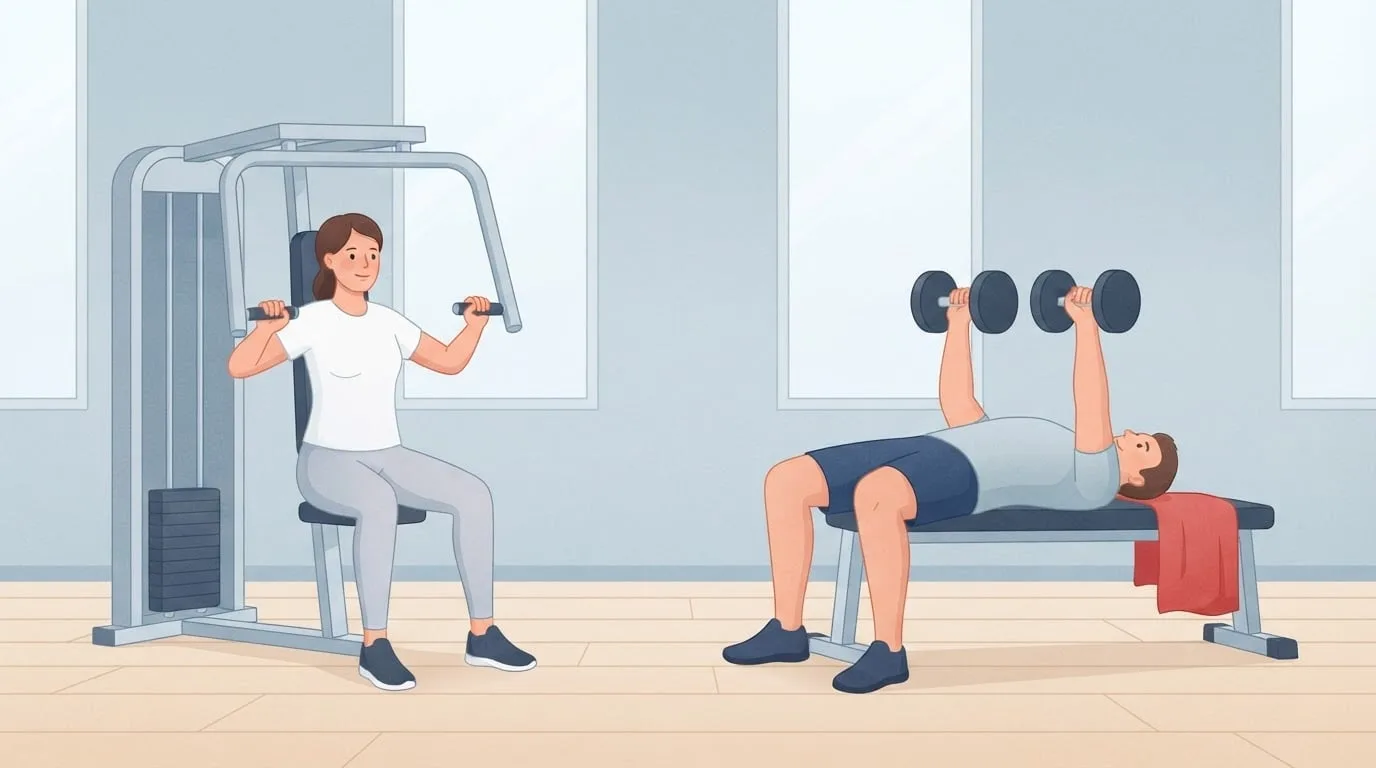
You're standing between the dumbbell rack and a row of machines, and every opinion you've read pulls you a different way. One camp says machines are for beginners and real strength comes from free weights. The other says machines are safer and build just as much muscle.
So you pick whatever looks least likely to make you look lost, and you wonder whether you're wasting the session. If walking into the gym is the hard part, our guide to gym anxiety has a step-by-step way in.
Weight machines vs free weights is one of the oldest arguments in strength training, and the research on it is calmer than the arguments. Trials that put people on free weights or machines for 6 weeks or longer find similar muscle growth and similar overall strength, with one consistent twist: you get strongest on the equipment you train with. The real choice comes down to your goal, your space and where you train, and the sections below give the numbers for each.
Free Weights vs Machines at a Glance
This table sums up the trade-offs before the evidence. "Free weights" means dumbbells, barbells and kettlebells, and "machines" means the pin-loaded and plate-loaded stations in a gym.
| Free weights | Machines | |
|---|---|---|
| Muscle growth | Same as machines in head-to-head trials | Same as free weights in head-to-head trials |
| Strength gains | Largest on free-weight lifts | Lean toward machine lifts |
| Stabilizing muscles | Work harder, because you balance the load | Work less, because the machine sets the path |
| Learning curve | A few sessions to get the movement smooth | Usable in your first session |
| Training hard alone | Fine with dumbbells you can set down; a barbell needs safety arms | Fine: the weight stack stops when you do |
| Injuries seen in hospitals | Most weight-training injuries, and a larger share of fractures | Fewer, but a bigger share of injuries in lifters 55 and older |
| Isolating one muscle | Possible, but other muscles chip in | Easy |
| Exercise variety | Dozens of exercises from one pair of dumbbells | One or two movements per machine |
| Space at home | A pair of dumbbells and a bench fit in a corner | Each machine needs its own patch of floor |
| Best for | Home training, carryover to everyday lifting, one setup for the whole body | Gym beginners, isolation work, pushing close to failure without a spotter |
What Is the Difference Between Free Weights and Machines?
Free weights are loads you hold and move through space yourself: dumbbells, barbells and kettlebells. Nothing guides the path, so your muscles have to lift the weight and steady it at the same time. Weight machines guide the load along a fixed track. On most gym machines you sit or lie in a frame, set a pin in a stack of plates, and push or pull a handle that moves on a set arc.
Two kinds sit in between. Cable machines fix the line of pull, while your hands can still travel freely. The Smith machine is a barbell locked to vertical rails, which is why researchers use it to test what happens when you take the balancing out of a free-weight lift. Whether you or the machine controls the path explains most of the differences that follow.
Free Weights vs Machines for Muscle Growth
For muscle growth, the equipment matters much less than how hard you train. Five of the 13 studies that Haugen and colleagues (2023) pooled in BMC Sports Science, Medicine and Rehabilitation measured muscle size, and the gap between free-weight and machine training was close to zero, a standardized mean difference of -0.06. Every study in the review lasted at least 6 weeks and trained adults aged 18 to 60.
The clearest single trial shows the same thing. Schwanbeck and colleagues (2020) randomized 46 young adults, 26 of them women, to train with free weights or with machines for 8 weeks. Each muscle was trained 2 or 3 times a week for 3 or 4 sets of 4 to 10 reps. Biceps and quadriceps thickness increased in both groups, with no difference between them.
The 2026 ACSM position stand by Currier and colleagues reached the same conclusion across its body of reviews. Equipment type didn't consistently change results, while doing 10 or more sets per muscle a week did increase muscle size. Your muscles respond to hard sets repeated over months, whichever equipment provides them.
Free Weights vs Machines for Strength
Strength is where the two part ways, and the rule is specificity: you get strongest at the lift you practice. In Haugen's meta-analysis, strength tested on free-weight lifts improved more after free-weight training, with a small effect (standardized mean difference 0.21). Strength tested on machines leaned the other way, toward machine training (0.29), though that difference fell short of statistical significance. When both groups were compared on the same overall strength measures, there was no difference.
Schwanbeck's trial shows the size of that effect. On the machine bench press, the machine group gained 13.9 percent and the free-weight group 8.6 percent. On the free-weight bench press, the free-weight squat and the Smith machine squat, both groups gained 11 to 19 percent, with no difference between them. Machine training carried over to the free-weight lifts in that trial, while free-weight training carried over to the machine press a little less.
So if one lift matters to you, train that lift. For everyday strength, either tool gets you there.
Stability and Transfer: What a Free Path Adds
Free weights make more muscles work at once, because they have to steady the load as well as move it. Schwanbeck, Chilibeck and Binsted (2009) recorded muscle activity in six adults doing 8-rep sets of a free-weight squat and a Smith machine squat at the same relative effort. Averaged across the seven muscles they measured, activity was 43 percent higher in the free-weight squat. The biggest differences showed up in the inner thigh, the calf and the hamstrings.
Does that extra activity transfer to athletic movement? Less than you might expect. The five studies in Haugen's analysis that tested countermovement jumps found no clear difference between free-weight and machine training. More muscle activity in one session isn't the same thing as more muscle or more power after months of training.
Free weights still practice something machines don't: controlling a load that can move in any direction, which is what lifting a suitcase into a car or a child out of a crib asks of you. That's a coaching argument rather than a trial result, and it's one reason to keep some free-weight work in any program.
Why Can I Lift More on Machines Than Free Weights?
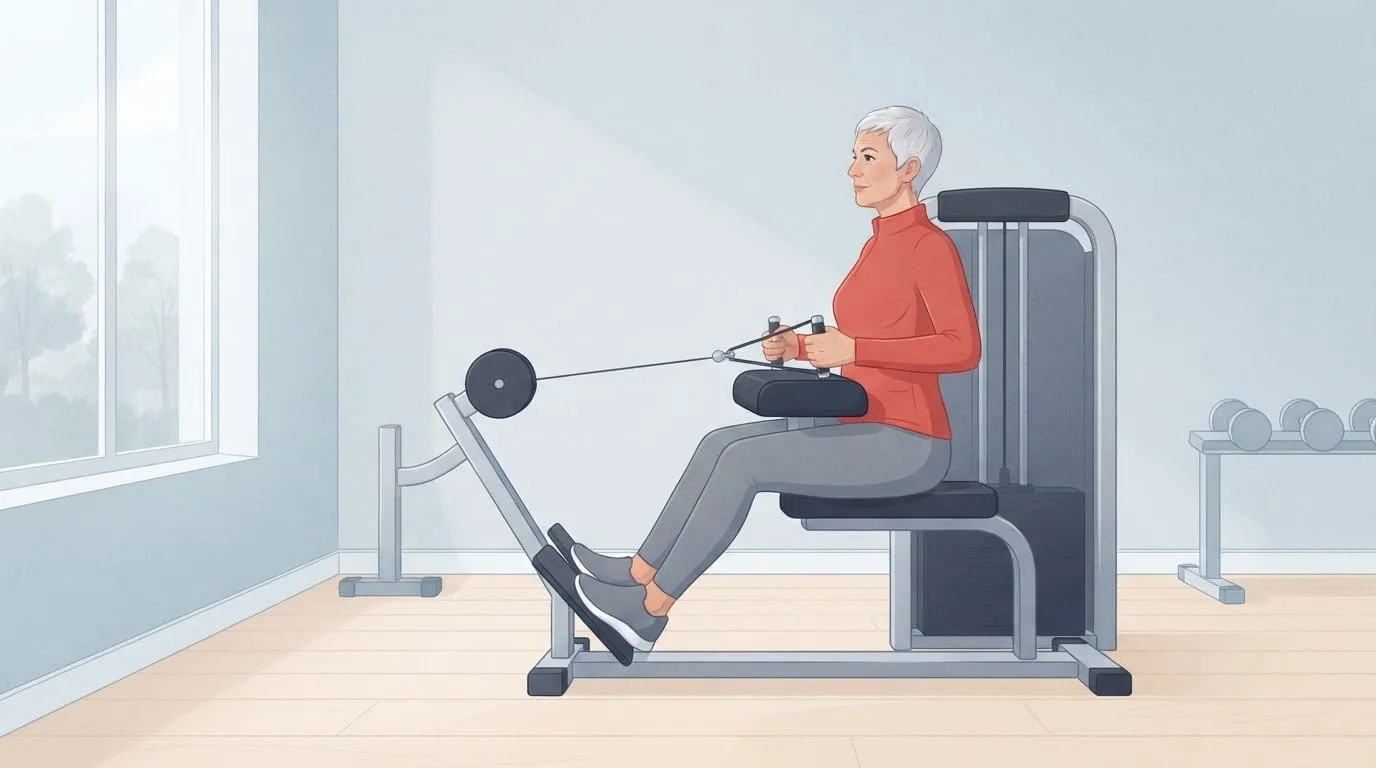
Usually because the machine does the balancing and changes the leverage. On a machine, none of your effort goes into keeping the weight on track. Pulleys, cams and lever arms also mean the number on the weight stack isn't the force at your hands, so a stack set to 100 pounds can feel lighter or heavier than 100 pounds of dumbbells. Stack numbers don't compare across machines, or with free weights.
You don't lift more on every machine, though. Cotterman, Darby and Skelly (2005) tested the one-rep max of 16 men and 16 women on the squat and the bench press, once with free weights and once on a Smith machine. The women squatted more on the Smith machine, while both the men and the women bench pressed more with free weights. Keep separate numbers for each piece of equipment and judge your progress on each one by itself.
Find out what's really holding you back
FitCraft, our mobile fitness app, pairs you with an AI coach who builds you a personalized plan around your goals, schedule, and fitness level. Every FitCraft program is designed by Domenic Angelino, MPH (Brown University) and NSCA-CSCS, with research published in the Journal of Strength and Conditioning Research and Medicine & Science in Sports & Exercise.
Take the Free Assessment Free • 2 minutes • No credit cardSafety and the Learning Curve
Machines are easier to learn and easier to push hard on your own. The seat and pads put you in position, the path is set, and when you can't finish a rep the weight stack simply comes to rest. That makes machines a reasonable place to train close to failure without a spotter, which is much harder to do safely with a barbell over your chest.
The injury data show where the risks sit. Looking at US emergency department records from 1990 to 2007, Kerr, Collins and Comstock (2010) found that fractures and dislocations made up 23.6 percent of free-weight injuries and 9.7 percent of machine injuries. Machines aren't injury-proof, though. Among injured lifters aged 55 and older, 18.2 percent were hurt on machines, against 9.3 percent of younger lifters. The data count injuries rather than injury rates, so they can't tell you which equipment is riskier per hour of use. Our barbell vs dumbbell guide covers what the same study found about free weights.
Free weights take longer to learn. Expect a few sessions before a dumbbell press or Romanian deadlift feels smooth, which is why it pays to start light and slow. That practice pays off, because the control you build is part of what free-weight strength is.
Can You Get in Shape Just Using Machines?
Yes. In Schwanbeck's trial, the machine-only group built as much muscle as the free-weight group and gained just as much strength on free-weight squats and bench presses. A machine routine that covers your legs, hips, back, chest, shoulders and arms also meets the muscle-strengthening part of the CDC's physical activity guidelines, which ask adults for 2 or more days a week of activities that work all the major muscle groups.
The gaps are small and easy to fill. Machines rarely train your grip, your balance or carrying a load, so a few free-weight or bodyweight moves round out a machine-based week.
Cost and Space: Why Home Training Means Free Weights and Bands
Machines are built for gyms. Each one trains one or two movements and needs its own patch of floor, and a set that covers the whole body fills a room. A single gym-quality machine can also cost more than a complete home setup of dumbbells, a bench and a few bands.
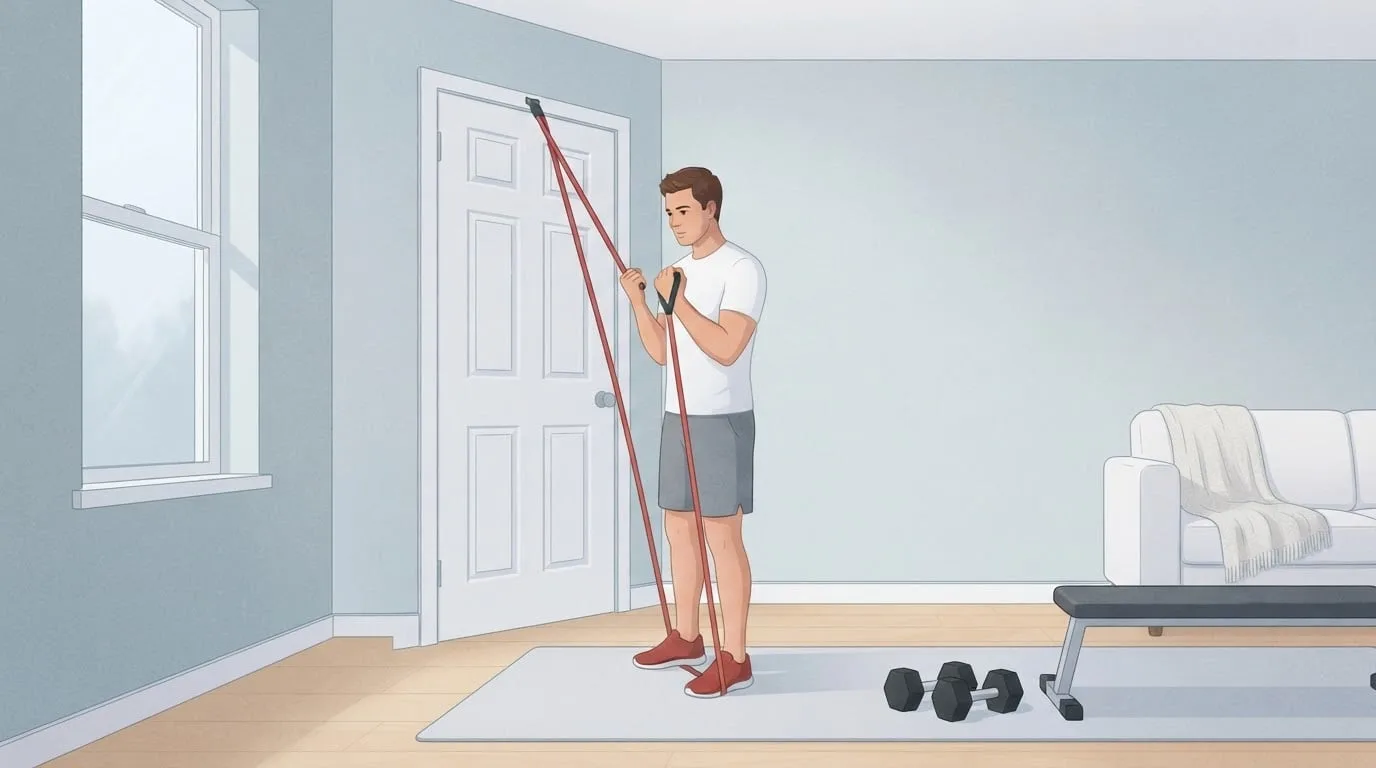
Free weights and bands fit in a corner. An adjustable pair of dumbbells, a flat bench and two or three bands cover the movements a row of machines trains: presses, rows, squats, hinges, lunges, curls and, with a band anchored high on a door, pulldowns. Bands hold their own for strength, too. In a meta-analysis of eight trials, Lopes and colleagues (2019) found that training with elastic bands and tubing built about as much upper- and lower-body strength as training with weight machines and dumbbells. Our guide to resistance bands vs weights covers where bands run out.
FitCraft's home workouts are built on that setup. If you want the sessions laid out, our full body dumbbell workout gives a beginner and an intermediate session. If you'd rather have them planned and progressed for you, a dumbbell workout app can take that part off your plate: FitCraft's strength workouts use dumbbells, bodyweight and a handful of band exercises, your AI coach demonstrates each exercise on an interactive 3D model, and your workouts adjust as you progress.
Dumbbells vs Machines: Who Should Choose Which
Choose free weights if:
- you train at home, or want one setup that trains your whole body in a small space;
- you want strength that carries over to free-weight lifts and to lifting things in daily life;
- you're happy to spend a few sessions learning each movement.
Choose machines if:
- you're new to a gym and want to train hard from your first session;
- you want to take sets close to failure without a spotter;
- you want to work one muscle on its own, for example during rehab with a physical therapist's guidance;
- balance or coordination problems make free weights hard for now.
In a gym, many lifters use both: free-weight lifts while they're fresh, then machines to add work for one muscle. At home, free weights and bands are the realistic choice, and the trials that compared free weights with machines found no difference in muscle growth.
The Bottom Line
Free weights and machines build the same amount of muscle. Strength gains lean toward whichever one you train with. Free weights make your stabilizers work and fit in a home, while machines are easier to learn and safer to push hard on your own.
Practical rule: at home, train with dumbbells and bands; in a gym, use whichever equipment you'll keep coming back to.
The equipment you use every week will do more for you than the perfect equipment you avoid. As Tim put it: "I didn't think an app could replace my trainer. My AI coach proved me wrong."
Frequently Asked Questions
Are free weights better than machines?
Free weights are no better than machines for building muscle: a 2023 meta-analysis of 13 studies found no difference in muscle growth or in overall strength. Free weights and dumbbells do work your stabilizing muscles harder and carry over better to free-weight lifts, while machines are easier to learn and safer to push hard without a spotter. The better choice is the one that fits your goal, your space and your habits.
Are 20 lb dumbbells enough to build muscle?
Yes, for most upper-body exercises and for a beginner's leg work, as long as you take your sets close to failure. A meta-analysis of 21 studies found that loads of 60 percent of your one-rep max or less built as much muscle as heavier loads when sets went to failure, although heavier loads built more maximal strength. When 20 lb dumbbells feel light for your legs, switch to single-leg exercises or slower reps to keep each set hard.
How often should I lift weights?
Lift weights at least two days a week and work all the major muscle groups, which is the CDC guideline for adults. Two or three full body sessions a week on non-consecutive days suit most people, and the 2026 ACSM position stand links muscle growth to 10 or more sets per muscle each week. Those sets count the same whether you do them with free weights, machines or bands.
Why can I lift more on machines than free weights?
Machines do the balancing for you, so all your effort goes into moving the load, and pulleys, cams and levers mean the number on the weight stack isn't the true force at your hands. You don't lift more on every machine: in one study, women squatted more on a Smith machine than with free weights, but men and women both bench pressed more with free weights. Treat machine numbers and free-weight numbers as separate scales.
Can you get in shape just using machines?
Yes. In an 8-week trial, people who trained only on machines built as much muscle as a free-weight group and gained just as much strength on free-weight squats and bench presses. A machine routine that works your legs, hips, back, chest, shoulders and arms twice a week meets the adult guideline for muscle-strengthening activity. A few free-weight or bodyweight moves add the grip, balance and carrying work that machines leave out.
Are machines safer than free weights for beginners?
Machines are easier to learn and let you train close to failure without a spotter, and in US emergency department data, fractures made up a smaller share of machine injuries than of free-weight injuries. Machines aren't injury-proof: among injured lifters aged 55 and older, about 18 percent were hurt on machines, twice the share among younger lifters. Light dumbbells and slow, controlled reps make free weights a sensible place for beginners to start too.