Regular squats have started to feel easy. Maybe you've seen someone online rattling off Hindu squats in a fast rhythm, heels popping up and arms swinging, and wondered whether it's a better exercise or just a different one.
It's a different one. The Hindu squat, also called the Indian squat, swaps load for repetitions. That turns a strength move into a conditioning drill that also works your calves and the front of your knees, which makes it a great tool for some people and a poor one for others.
This guide explains where the exercise comes from, how to do it step by step, how it differs from a regular squat, who should go easy, and how to build up to continuous sets over four weeks.
What Is a Hindu Squat, or Indian Squat?
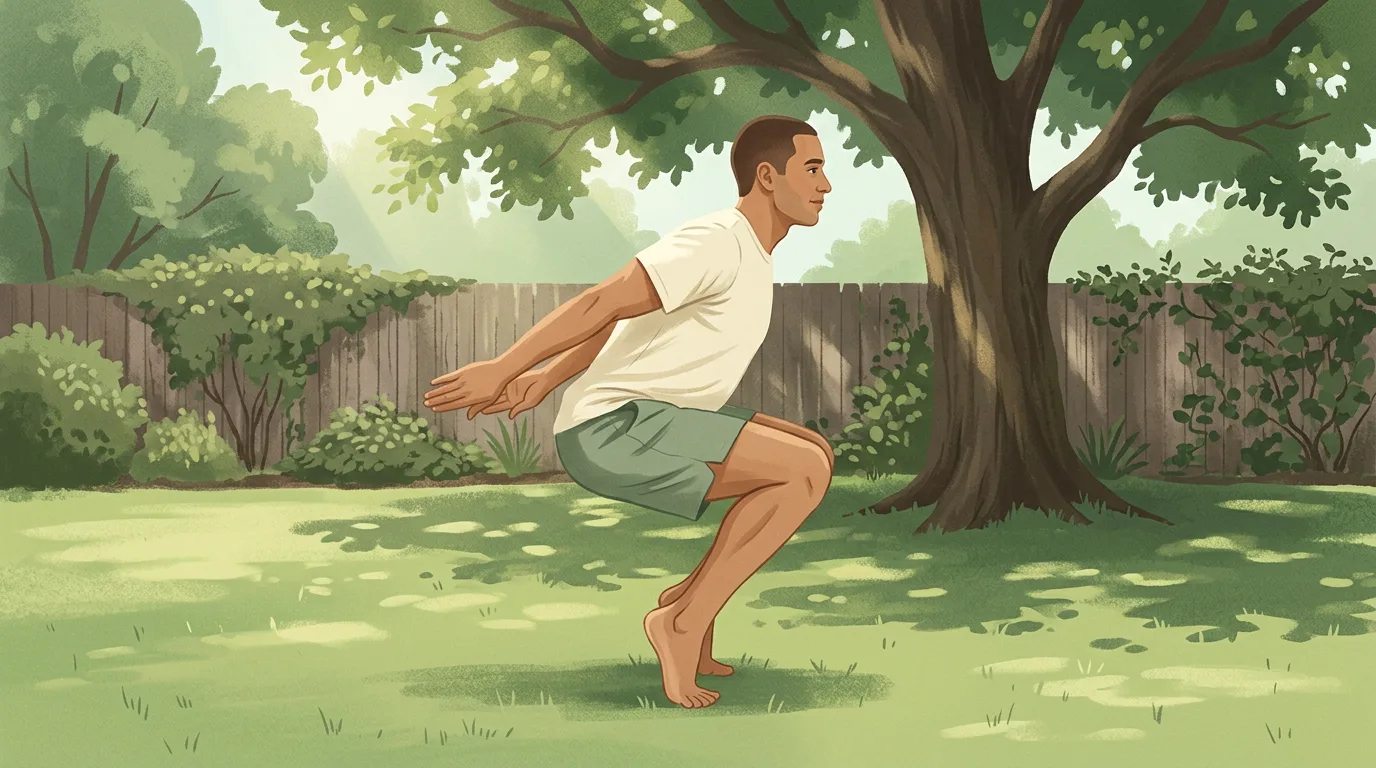
A Hindu squat is a deep bodyweight squat done in a steady rhythm, with your heels rising near the bottom and your arms swinging to keep you balanced. In India it's called the baithak, or bethak, and it's a staple of pehlwani, the traditional wrestling of north India.
A detailed written account comes from the anthropologist Joseph Alter, who studied wrestling schools in north India for his book The Wrestler's Body (University of California Press, 1992). His description of the bethak includes:
- Stance. Feet turned out at about 45 degrees, with the heels only about 15 to 20 cm apart. That's much narrower than a typical gym squat.
- Way down. A slight hop forward onto the balls of the feet, lifting the heels clear of the floor.
- Way up. A small hop back to the starting spot.
- Arms and eyes. The arms stay relaxed and sway with the body for balance. The eyes stay on a spot on the ground about 4 meters ahead, so the head stays still.
- Pace. About 60 to 80 a minute, in sets of 60 to 100.
- Breath. The general exercise rules Alter records say to breathe deeply and steadily, only through the nose, with each exercise done to the rhythm of a single breath.
The volume is the eye-opening part. Alter reports that well-known champions did 2,000 to 3,000 bethaks a day, that average wrestlers often did as many as 1,000, and that even the least a wrestler did was 500 to 800 a day. Many of these men also held jobs, but their lives were built around training. You don't need anything close to that. Wrestlers pair bethaks with dands, a swooping push-up often called the Hindu push-up.
How to Do a Hindu Squat, Step by Step
Most people learn a home version without the hops. Start with this, and add the small hop later if you want the traditional rhythm.
- Set your feet. Stand with your feet about hip width apart or a little narrower, toes turned out slightly. Hold your arms straight out in front of you at shoulder height.
- Sink and swing back. Bend your knees and hips together, and let your arms swing down and back past your hips as you lower.
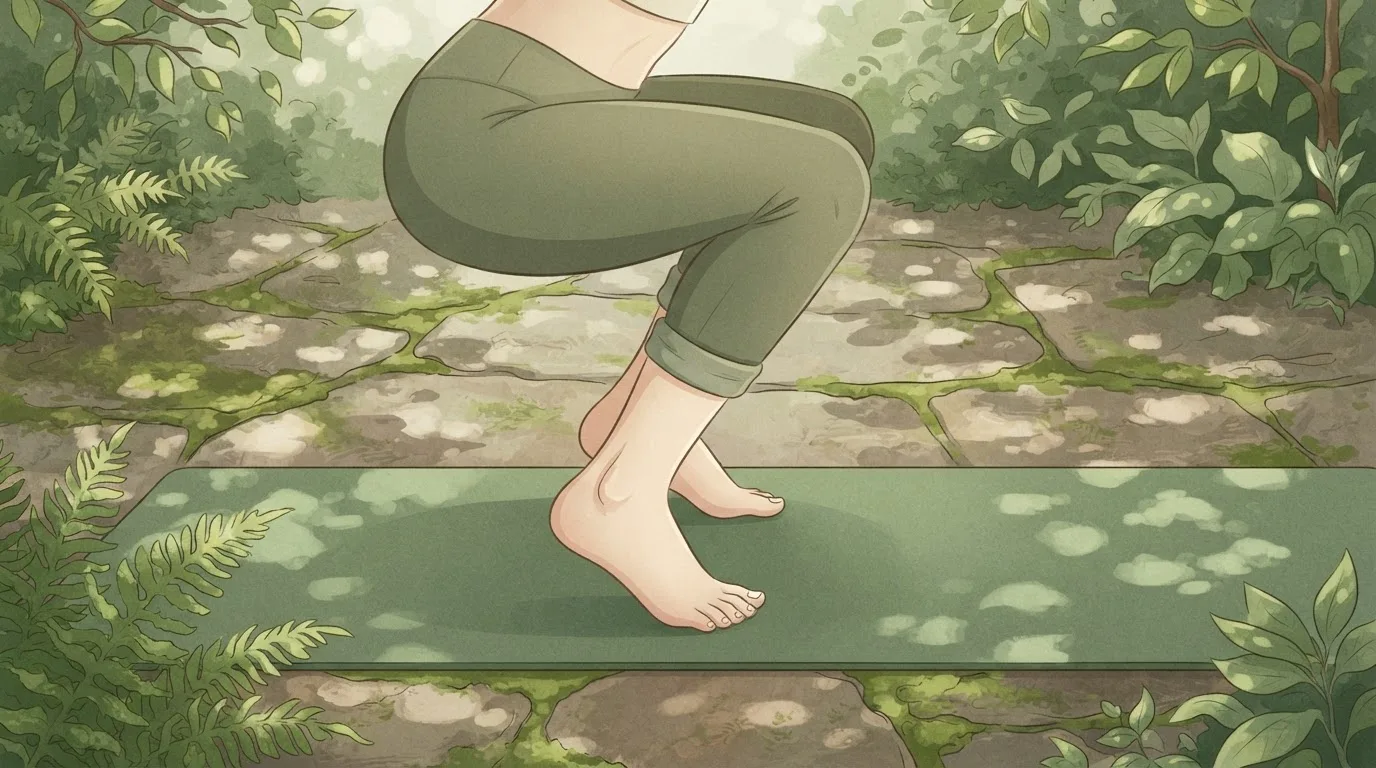
- Let your heels rise. As your knees travel forward over your toes, let your heels come up so you finish on the balls of your feet, thighs at or just below parallel and your chest fairly upright.
- Drive up and swing forward. Push through the balls of your feet to stand, lowering your heels as you rise and swinging your arms forward to shoulder height.
- Keep the rhythm. Go straight into the next rep without stopping at the top or the bottom. Start at about one rep every two seconds and speed up only when the movement feels smooth.
Breathe with the rhythm, one breath per rep. In through the nose as you go down and out as you come up is a common pattern, but either direction works if you keep it steady. Never hold your breath through a set.
An easier version to start with
If balance is the problem, hold the back of a chair or a door frame with one hand and leave the arm swing for later. If depth is the problem, squat only halfway and let your heels rise just a little. Our squat guide covers regular heels-down form if you want to learn that first.
Hindu Squat vs Regular Squat
Both squats work the same main muscles, the quads and glutes. The differences are in where the load goes and how long you're under it.
| Feature | Regular squat | Hindu squat |
|---|---|---|
| Heels | Stay on the floor | Rise near the bottom |
| Knees | Travel a little past the toes | Travel well past the toes |
| Arms | Held still in front | Swing back and forward |
| Stance | About shoulder width | Narrow, heels close together |
| Pace | Controlled, often 2 to 3 seconds down | Fast and continuous, about a second per rep |
| Typical set | 8 to 20 reps, fewer with weights | 25 to 100 reps or a timed block |
| Main training effect | Leg strength and muscle | Leg endurance, calves and conditioning |
For a muscle-by-muscle breakdown of the regular version, see what muscles squats work. The sections below cover only what the Hindu squat changes.
Hindu Squat Benefits: What It Trains
We couldn't find a study that tested the Hindu squat itself. The benefits below come from studies of its parts: heels-up and knees-forward squatting, and long sets of bodyweight squats.
Your calves work on every rep
Rising onto the balls of your feet at the bottom of each rep is a small calf raise done under your body weight. A regular bodyweight squat barely loads the calves, so this is the biggest muscular difference between the two. Expect sore calves after your first few sessions.
Your knees and quads take more of the load
When your heels lift and your knees travel forward, more of the work shifts to the front of the thigh and the knee. Two studies show the direction of that shift, though neither tested Hindu squats. In Fry, Smith and Schilling (2003), seven trained men did parallel barbell squats with and without a barrier stopping their knees from moving past their toes. Letting the knees travel forward raised the load at the knee by about 28% and moved load away from the hips. It was a small study, so treat the exact numbers loosely.
Zwerver, Bredeweg and Hof (2007) had five people do one-leg squats on a board that tilted their heels up. From an angle of 15 degrees, the turning load at the knee rose by about 40%. Raised heels and forward knees are the same ingredients the Hindu squat uses.
Healthy knees can handle deep squatting. A review by Hartmann, Wirth and Klusemann (2013) concluded that regular deep squats, learned with good technique and progressed gradually, don't raise the injury risk to the knee's passive tissues. The review was about squat depth and weight load, not heels-up or high-rep squats, which is one more reason to build up slowly. A knee that already hurts at the front is a different story, as the next section explains.
It builds stamina more than strength
A set of 50 or 100 squats is endurance work. Haramura and colleagues (2017) had 15 young men do 200 continuous bodyweight squats to 90 degrees of knee bend, which took about nine minutes. From minute five on, their oxygen use averaged about 46% of their maximum, and from minute seven their heart rate held at about 71% of maximum, a moderate aerobic effort. That study used regular squats at a steady pace. Hindu squats are usually done much faster, so the effort is likely higher.
Long sets build endurance more than strength. In a study by Schoenfeld and colleagues (2015), trained men who did sets of 25 to 35 reps for 8 weeks grew about as much muscle as men who did 8 to 12 reps. But their squat strength rose 8.8%, against 19.6% for the heavier group, and they improved more on a bench press endurance test. The same logic likely holds for your legs. If you want stronger legs, regular squats with a dumbbell will do more. If you want legs that don't tire on stairs, hikes and long days on your feet, Hindu squats fit the job.
It works around stiff ankles
Because your heels rise, a Hindu squat needs less ankle bend than a deep heels-down squat. That lets people with stiff ankles reach depth, but it works around the stiffness rather than fixing it. Our ankle mobility exercises work on the range itself.
Find out what's really holding you back
FitCraft, our mobile fitness app, pairs you with an AI coach who builds you a personalized plan around your goals, schedule, and fitness level. Every FitCraft program is designed by Domenic Angelino, MPH (Brown University) and NSCA-CSCS, with research published in the Journal of Strength and Conditioning Research and Medicine & Science in Sports & Exercise.
Take the Free Assessment Free • 2 minutes • No credit cardWho Should Go Easy on Hindu Squats?
Hindu squats are fine for most healthy adults who build up gradually. Three groups should start slowly or pick a different squat for now:
- Front-of-knee pain. Pain around or under the kneecap often flares with deep knee bends and forward knee travel, which is exactly what this squat adds. Use a heels-down squat to a box at a comfortable depth instead, and see a clinician if the pain lingers.
- Achilles or calf trouble. Every rep ends on the balls of your feet, which loads the Achilles tendon dozens of times a minute. Keep your heels down until the tendon settles. Rest isn't always required. In a trial of 38 people with Achilles tendinopathy by Silbernagel and colleagues (2007), everyone did the same tendon-strengthening program. Those who kept running and jumping under a pain-monitoring rule did as well as those who stopped both for the first six weeks. The rule capped how much pain was allowed during activity, required it to settle by the next morning and didn't let it build from week to week.
- Shaky balance or very new to exercise. The fast pace and the rise onto your toes demand balance. Hold a chair, keep sets to 10 or 15 and go slowly until the rhythm feels easy.
5 Common Hindu Squat Mistakes
- Going fast too soon. Speed hides sloppy reps. Get 20 smooth reps at a slow rhythm before you speed up.
- Crashing into the bottom. Lower under control and turn around smoothly. Dropping hard onto your calves jars the knees.
- Letting the knees cave in. Keep your knees pointing over your toes as they travel forward.
- Fighting the arm swing. Your arms go back as you sink and forward as you rise. If the timing feels wrong, slow down or hold your arms still for a few sessions.
- Doing hundreds on day one. Your calves and Achilles tendons need time to get used to high reps on the balls of your feet. A first session of 300 squats usually means a week of sore calves.
A 4-Week Hindu Squat Plan
Train three times a week on days that aren't back to back, such as Monday, Wednesday and Friday. Warm up with a minute of marching in place and 10 slow regular squats, and rest about 60 seconds between sets.
| Week | Sets and reps | Pace | Focus |
|---|---|---|---|
| 1 | 3 x 15 | Slow, about 2 seconds a rep | Heels rise a little; hold a chair if needed |
| 2 | 3 x 25 | Moderate | Full heel rise and arm swing |
| 3 | 3 x 40 | Moderate to brisk | Cut rest to 45 seconds |
| 4 | 2 rounds of 2 minutes nonstop | Brisk, about 1 rep a second | Count your reps and try to beat them next time |
Stop a set early if your form slips or a knee or heel starts to hurt. Move on to the next week only when the current one feels comfortable for two sessions in a row. After week 4, you can stretch the timed rounds, add the small hop from the traditional version or pair Hindu squats with push-ups in a circuit. Our beginner calisthenics workout has the other moves to build that circuit.
If you want strength as well as stamina, keep one or two sessions a week of slower, heavier leg work such as goblet squats or split squats. Our guide to squats vs lunges covers that side of your week.

The Bottom Line
The Hindu squat turns a regular squat into a conditioning drill. Your heels rise, your knees travel forward and your arms swing, so your calves and knees do more work, and long rhythmic sets build stamina rather than maximal strength. Learn it slowly, build up over a month, and keep your heels down if your Achilles or knees complain.
Learning the move takes a week. Still doing it three months from now is the hard part, and that's where most home routines fade. In FitCraft, an AI coach demonstrates bodyweight exercises on an interactive 3D model, says your name during the workout and adjusts your plan as you progress, while streaks and leaderboards give you a reason to come back. See how a home workout app with no equipment fits around your day. As one FitCraft user, Matt, put it: "The real win is I actually want to work out now. That's never happened before."
Frequently Asked Questions
What type of squat is best for bad knees?
For most sore knees, a box squat with your heels down is the gentlest place to start. Sit back to a box or chair at a depth that doesn't hurt, keep your shins fairly upright and stand up slowly. In a small barbell study, stopping the knees from moving past the toes cut the load at the knee by about a fifth, though it moved more load to the hips and probably the lower back.
Who should avoid doing squats?
Very few people need to avoid squats entirely. Anyone with a fresh knee or hip injury, recent joint surgery or pain that sharpens during the movement should hold off until a clinician clears them, and most people with sore knees can still squat to a box at a shallower depth. Hindu squats in particular are a poor fit while you have front-of-knee or Achilles pain.
What is dragon squat?
A dragon squat, also called a dragon pistol squat, is an advanced one-leg squat in which the free leg passes behind the working leg and reaches out to the other side as you lower. It takes a lot of single-leg strength, balance and hip and ankle mobility, so it's a skill to build toward after pistol squats rather than a beginner move.
How many Hindu squats should I do a day?
Start with 3 sets of 15 Hindu squats three times a week rather than every day, and build to a few minutes of continuous reps over about a month. Indian wrestlers do hundreds or thousands a day, but their lives are built around training. For most adults, two or three sessions a week of a few minutes each is plenty for conditioning.
Are Hindu squats better than regular squats?
Neither is better, because they train different things. Hindu squats build leg endurance, calf work and conditioning, while regular squats, especially with a dumbbell, build more strength. A week that includes both covers more ground than either one alone.