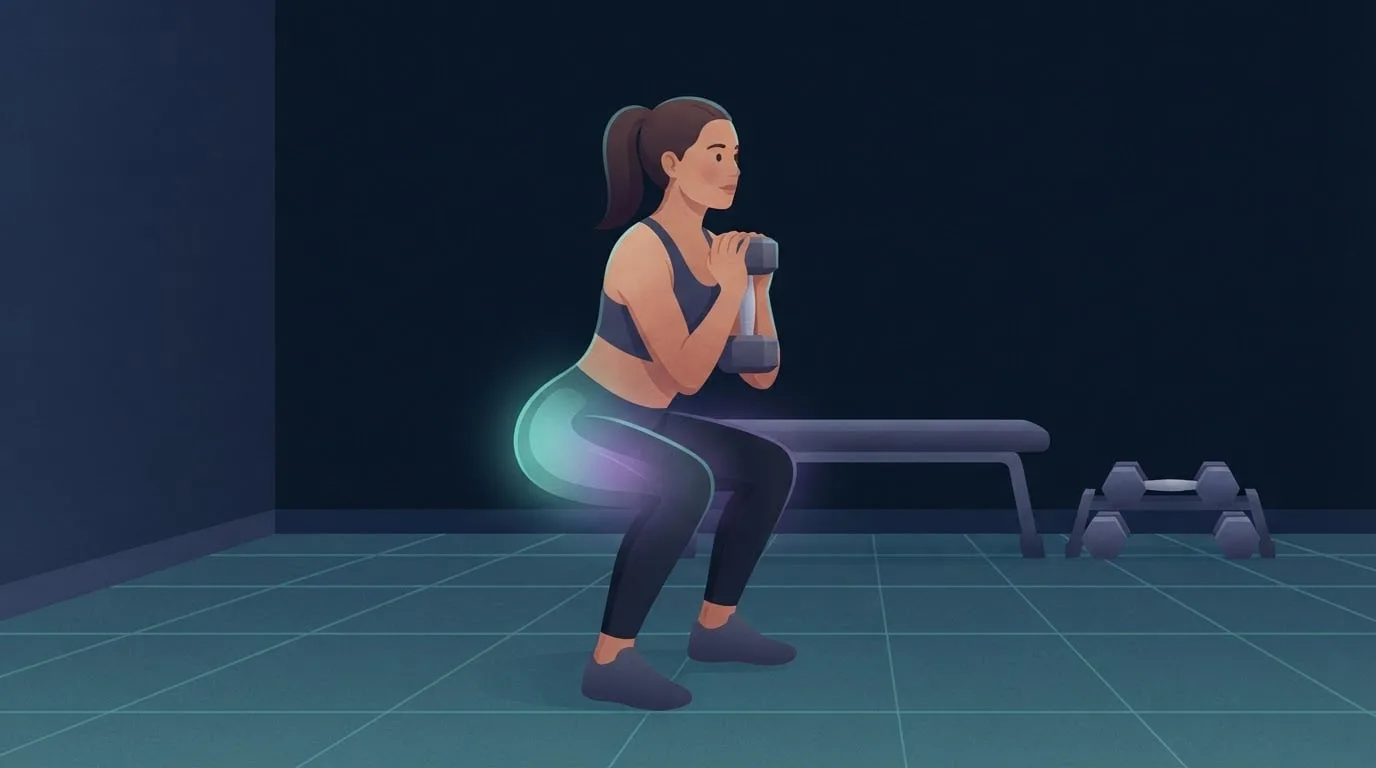
Leg day at home usually comes down to two moves. You squat, you lunge, and somewhere around the third set you start wondering whether one of them is doing more for you than the other. Maybe your dumbbells feel too light for squats now. Maybe lunges make your knees ache, or you wobble so much you're not sure the set counted.
It's frustrating to put in hard sets without knowing whether you picked the right exercise. A lot of the advice online names a winner without showing any data, so people drop lunges because they feel awkward, or drop squats because they've stopped feeling hard.
Squats and lunges are two ways of loading the same leg muscles, and each one covers something the other misses. This guide compares lunges vs squats on muscle activity, glutes, balance and knee load, explains the split squat (the "lunge squat"), and gives you a lunges and squats workout with dumbbells.
Squats vs Lunges at a Glance
| Squat | Lunge | |
|---|---|---|
| Stance | Feet side by side; both legs share the load | Split stance; the front leg does most of the work |
| Main muscles | Quadriceps, glutes and adductors | Quadriceps, glutes and adductors, with more gluteus medius and hamstring work |
| Gluteus maximus activity | 53% of maximum pooled across back squat studies; about 60% at parallel depth | 70% in the split squat; 66 to 67% in lunges |
| Weight you need | Heavier | About half: a split squat at 50% of the back squat load drew similar leg muscle activity |
| Balance demand | Low | High |
| Kneecap load | At 60 to 90 degrees of knee bend, two-leg wall squats generally put more force behind the kneecap than a one-leg squat | Depends on the setup: short steps load it most in deep bends, and a reverse lunge loads it less than a forward lunge |
| Muscle growth | No difference between one-leg and two-leg training across 9 trials | No difference between one-leg and two-leg training across 9 trials |
| Strength carryover | Best for two-leg strength | Best for one-leg strength |
| Best for | Heavier loads, beginners and learning to bend at the hips and knees together | Home training with light dumbbells, glutes, one-leg strength and spotting side-to-side differences |
The row that matters most at home is the weight you need. A pair of dumbbells runs out of challenge for squats long before it does for lunges, because the front leg in a lunge carries most of your body weight plus the dumbbells. The studies behind each row are below.
Do Lunges and Squats Work the Same Muscles?
Yes, mostly. Squats and lunges both work the quadriceps, the gluteus maximus and the adductors of the inner thigh, with the hamstrings and calves helping. The difference is in the mix. A lunge asks the gluteus medius, on the side of your hip, to keep your pelvis level, and it gives the hamstrings more to do. Three studies show the shift:
- Two legs vs one. McCurdy and colleagues (2010) had 11 female college athletes do a 2-leg squat and a modified single-leg squat at the same relative load, 85% of their 3-rep max. The single-leg version drew more gluteus medius and hamstring activity, and the 2-leg squat drew more quadriceps.
- Half the weight, similar activity. DeForest and colleagues (2014) compared a back squat at 85% of the 1-rep max with a split squat and a rear-foot-elevated split squat at half that weight in 9 trained men. Activity in eight front-leg muscles was similar across all three, except one hamstring, the biceps femoris. The rear-foot-elevated version also matched the back squat's peak force.
- Within the lunge family. Mausehund and colleagues (2019) took 11 trained adults to failure on three one-leg exercises at the same relative load. Gluteus maximus and vastus lateralis activity didn't differ between the split squat, the rear-foot-elevated split squat and the single-leg squat. The single-leg squat drew the most gluteus medius, 82% of maximum against 46% in the split squat, and the rear-foot-elevated split squat drew more hamstring than the split squat.
So the muscle list is the same, and the emphasis shifts. Two-leg squats lean on the quads, while one-leg work adds gluteus medius and hamstrings. That's the practical difference behind every "lunges vs squats muscles worked" chart.
Squats vs Lunges for Glutes: Which Builds More?
Lunges and split squats edge out squats for glute activity per rep, though both can grow your glutes. The best summary is a systematic review of 16 EMG studies by Krause Neto and colleagues (2020), which rated gluteus maximus activity above 60% of maximum as very high:
- Split squat: 70% of maximum.
- Lunge: 66% for the traditional lunge and 67% for the in-line lunge.
- Back squat: 53% averaged across studies, and about 60% at parallel depth.
- Step-ups: the highest of all, though that figure came from a single 15-person study.
Treat the ranking as rough. The numbers were pooled from studies that used different loads and methods, and EMG shows how hard a muscle works during a rep, not how much it grows.
How you lunge changes the glute share. Farrokhi and colleagues (2008) recorded 10 adults doing forward lunges with the trunk upright, leaning forward and leaning back. Leaning forward raised the hip extensor demand and the activity of the gluteus maximus and the biceps femoris. Leaning back didn't change the muscle activity. For more glute in a lunge, lean your chest slightly forward over the front thigh, lower until your back knee nearly touches the floor, and push up through the whole front foot.
For growth, hard sets matter more than the exercise label. One-leg and two-leg training showed no detectable difference in muscle growth in the meta-analysis covered in the next section, and squats grow the glutes well when you go deep. Our article on whether squats make your butt bigger covers the depth and stance studies.
One Leg or Two: Strength, Muscle and Balance
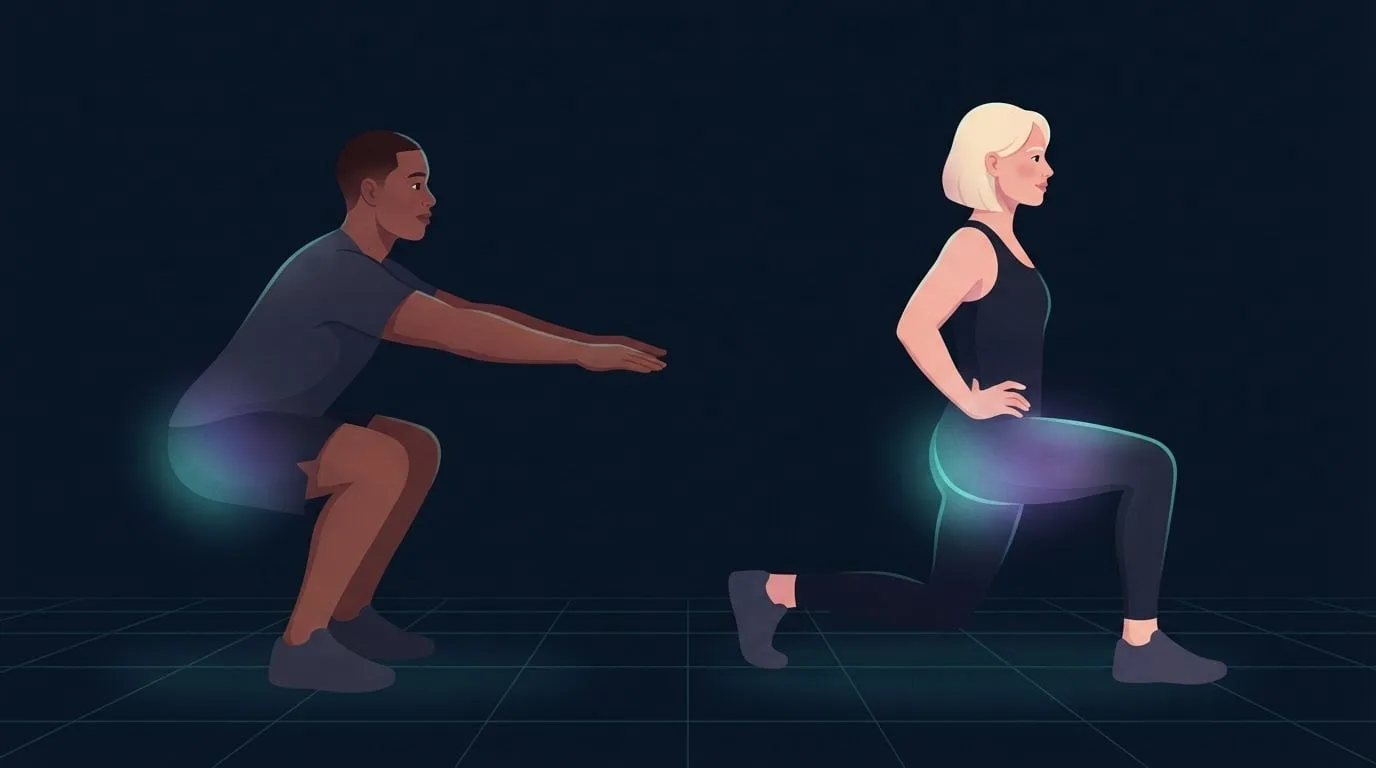
Behind squats vs lunges sits a bigger question, two-leg (bilateral) vs one-leg (unilateral) training, and our single-leg training research review covers it in depth. The short version comes from a 2025 meta-analysis by Kassiano and colleagues. Across 9 trials, one-leg and two-leg training produced no detectable difference in muscle growth, while strength followed the pattern people trained: two-leg training won on two-leg strength tests and one-leg training on one-leg tests.
One-leg work also needs much less weight, which is why lunges suit home training so well. In the DeForest study, a rear-foot-elevated split squat with half the back squat's load matched it for peak force. Part of the reason is the bilateral deficit: your legs working together produce a little less force than the sum of each one working alone. If your heaviest dumbbells have stopped challenging your goblet squats, the same pair turns a split squat into a heavy set for the front leg.
Lunges challenge your balance on every rep, but whether that makes you steadier off the mat is less certain than most articles claim. A 2023 meta-analysis of 28 studies in athletes by Zhang and colleagues found no significant difference in balance gains between one-leg and two-leg training.
Find out what's really holding you back
FitCraft, our mobile fitness app, pairs you with an AI coach who builds you a personalized plan around your goals, schedule, and fitness level. Every FitCraft program is designed by Domenic Angelino, MPH (Brown University) and NSCA-CSCS, with research published in the Journal of Strength and Conditioning Research and Medicine & Science in Sports & Exercise.
Take the Free Assessment Free • 2 minutes • No credit cardSquats vs Lunges for Your Knees
Neither exercise is bad for healthy knees. The load behind your kneecap depends more on how deeply you bend and how you set up than on which exercise you pick. Most of the data come from Rafael Escamilla's lab, which modeled knee forces in adults lifting their 12-rep max:
- Lunge step length. In 18 adults, a short-step lunge put more force behind the kneecap than a long step between 70 and 90 degrees of knee bend, and stepping out and back added force between 10 and 40 degrees. The authors suggested a long step without stepping, which is a long-stance split squat, to keep kneecap stress down (Escamilla 2008).
- Forward vs reverse lunge. In 20 women, Goulette and colleagues (2021) found the forward lunge produced more quadriceps force and more force behind the kneecap than the backward lunge.
- Two legs vs one. Between 60 and 90 degrees of knee bend, two-leg wall squats generally put more force behind the kneecap than a one-leg squat (Escamilla 2009).
- Ligaments. In these studies, ACL force appeared only in the one-leg squat and the short-step lunge, and it stayed small: a peak of 59 newtons in the one-leg squat (Escamilla 2009) and 0 to 50 newtons in the lunge (Escamilla 2010). The authors judged these loads safe for healthy knees.
If the front of your knee is sensitive, start with reverse lunges and long-stance split squats, keep the bend in a range that feels fine, and save short-step forward lunges and walking lunges for later. Our leg day workout guide has a full section on training with cranky knees.
Lunge Squat: Split Squat vs Lunge
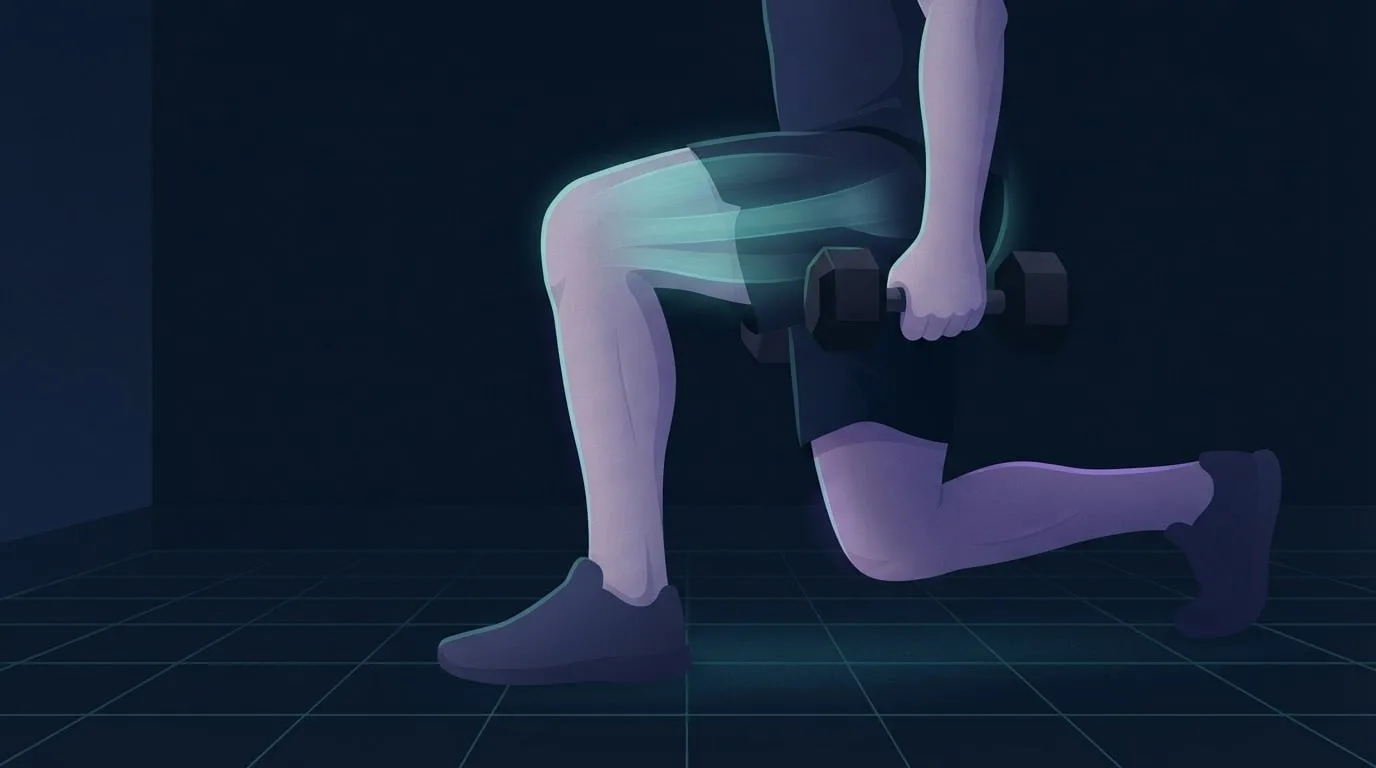
A "lunge squat" usually means the split squat: a stationary lunge where both feet stay planted and you move straight down and up. A lunge adds a step, forward or back, so every rep includes stopping your body and pushing it back to the start. Here's how the family compares:
| Variation | How it works | Best for |
|---|---|---|
| Split squat | Feet stay planted in a split stance; straight down and up | Learning the pattern, and knees that dislike stepping |
| Reverse lunge | Step back, lower, step forward to the start | Glutes, and lighter kneecap loading than a forward lunge |
| Forward lunge | Step forward, lower, push back to the start | Quadriceps and control as you land |
| Walking lunge | Step forward straight into the next rep | Conditioning and coordination |
| Rear-foot-elevated (Bulgarian) split squat | Back foot on a bench or sofa | Loading one leg hard with light dumbbells, with more hamstring work than a split squat |
In the Mausehund study, glute and quad activity were similar across the split squat, the rear-foot-elevated split squat and the single-leg squat, so choose by what you can load well and progress. Start with split squats, add reverse lunges once you're steady, and move to the Bulgarian version when a split squat with your dumbbells stops feeling hard.
Can I Just Do Lunges Instead of Squats?
Yes for building muscle, and often for home training too. With matched effort, one-leg and two-leg training showed no detectable difference in muscle growth in the Kassiano meta-analysis, and lunges and split squats load each leg hard with light dumbbells. The trade-off is specificity. If you want a heavier two-leg squat, for a sport or a fitness test, you need to squat.
Are lunges better than squats, then? For glute activity per rep, one-leg strength and home training with light dumbbells, yes. For two-leg strength, heavier total loads and an easy first leg exercise, squats win. Most people do best with one of each in every leg session.
A Lunges and Squats Workout With Dumbbells
This lunges and squats workout takes about 30 minutes with a pair of dumbbells. Do it twice a week, two or three days apart, and swap the order of the first two exercises each session so both get your freshest sets. Rest 60 to 90 seconds between sets. If the goblet squat is new to you, our goblet squat guide covers the setup.
| Exercise | Sets x reps | How to do it |
|---|---|---|
| 1. Goblet squat | 3 x 8 to 12 | One dumbbell at your chest; sit to parallel or below with your heels down |
| 2. Dumbbell reverse lunge | 3 x 8 to 10 per leg | Lean slightly forward over the front thigh; back knee nearly to the floor |
| 3. Dumbbell split squat | 2 x 10 to 12 per leg | Long stance, straight down and up, three seconds on the way down |
| 4. Squat to reverse lunge | 2 x 6 per leg | Bodyweight: one squat, stand, then step back into a lunge and return; that's one rep |
The last row combines both patterns into one squats and lunges exercise, which makes it a good finisher when your legs are already tired. For bodyweight squat form, our squat exercise guide covers depth and knee position.
End every set with one to three good reps left. When you reach the top of the rep range on every set, move up to heavier dumbbells, or slow the lowering to three seconds if you don't have a heavier pair. When your heaviest dumbbells stop challenging goblet squats, swap the split squat for a rear-foot-elevated split squat, which loads the front leg harder with the same weight. Adding a little each week is progressive overload, and it's what keeps both exercises working.
No dumbbells? Run the same session with bodyweight: squats with a three-second lowering, reverse lunges, split squats with a two-second pause at the bottom, and the combo, adding reps each week.
Lunges or Squats: Which Should You Do?
For most people, both. Here's how to weight the choice by goal:
- Bigger glutes: both, with lunges and split squats done with a slight forward lean and squats taken deep.
- Training at home with light dumbbells: lean on split squats and lunges, which make a light pair feel heavy.
- A heavier two-leg squat, or a sport or test that needs one: squat first, and keep one-leg work as your second exercise.
- Running, field sports or hiking: include one-leg work every week, because strength gains follow the pattern you train.
- Sensitive knees: split squats and reverse lunges in a pain-free range before forward or walking lunges.
- Brand new to training: squats to a chair or box and split squats with one hand on a wall, then add dumbbells.
Knowing the right mix is the easy part. Showing up for leg day twice a week for months is harder, and that's where most leg plans fall apart. In FitCraft, a 3D AI coach demonstrates each exercise in your workout with interactive 3D demos you can zoom in on, your program adapts as you progress, and streaks keep leg day from slipping. If you train with dumbbells at home, a dumbbell workout app can plan the progression for you.
The Bottom Line
Squats vs lunges: do both. They build the same leg muscles about equally well. Squats load both legs and lean on the quads, while lunges and split squats load one leg, add gluteus medius and hamstring work, rate higher for glute activity per rep, and let light dumbbells feel heavy.
Practical rule: pair one squat with one lunge or split squat in each leg session, take sets close to failure, and pick reverse lunges and long-stance split squats if your knees are sensitive.
Your lunges count, and so do your squats. The best leg exercise is the pair you keep doing twice a week while the dumbbells slowly get heavier. As Mike put it: "The streak system got me hooked. I didn't want to break my chain."
Frequently Asked Questions
What are the key differences between squats and lunges?
Squats work both legs at once from a side-by-side stance, while lunges work mostly one leg at a time from a split stance. That means lunges need more balance, draw more gluteus medius and hamstring activity, and need about half the weight to challenge the working leg as much. Squats are easier to learn and load more heavily, and both build the quads and glutes.
Are lunges better than squats?
Lunges are better for one-leg strength, glute activity per rep and training at home with light dumbbells, and squats are better for two-leg strength and heavy loads. For building muscle, a 2025 meta-analysis of 9 trials by Kassiano and colleagues found no difference between one-leg and two-leg training. Most people get the most from doing one of each in every leg session.
Do lunges build muscle mass?
Yes. Lunges and split squats build the quads and glutes as well as two-leg exercises when the sets are hard enough: across 9 trials, one-leg and two-leg training produced no detectable difference in muscle growth (Kassiano 2025). To keep lunges building muscle, end each set one to three reps short of failure and add weight or reps over time.
Which is better for glute growth, Bulgarian split squats or step-ups?
Both work the glutes hard, and no trial has compared the glute growth they produce. In a review of EMG studies, step-ups showed the highest glute activation of any exercise, though that figure came from one 15-person study (Krause Neto 2020), and the rear-foot-elevated split squat matched the split squat and the single-leg squat for gluteus maximus activity (Mausehund 2019). Pick the one you can load and progress steadily, or rotate the two.
Do lunges and step-ups work the same muscles?
Yes. Lunges and step-ups both work the quadriceps most, followed by the gluteus medius and gluteus maximus. In a 2020 study of 20 adults by Muyor and colleagues, the vastus lateralis and vastus medialis were the most active muscles in the forward lunge, the lateral step-up and a single-leg squat, and the single-leg squat drew more activity than the other two in every muscle measured except the rectus femoris.
Are lunges harder than squats?
At the same weight, yes, for most people. A lunge puts most of the load on one leg and adds a balance challenge, so each rep feels harder. In a 2014 study by DeForest and colleagues, a rear-foot-elevated split squat with half the weight of a back squat produced similar leg muscle activity and similar peak force.
What is the mother of all exercises?
There's no official one, but the squat is the exercise coaches most often call the king or mother of all exercises. It trains the biggest muscles of your hips and thighs in a movement you repeat every time you sit down and stand up. Lunges come a close second because they train the same muscles one leg at a time.