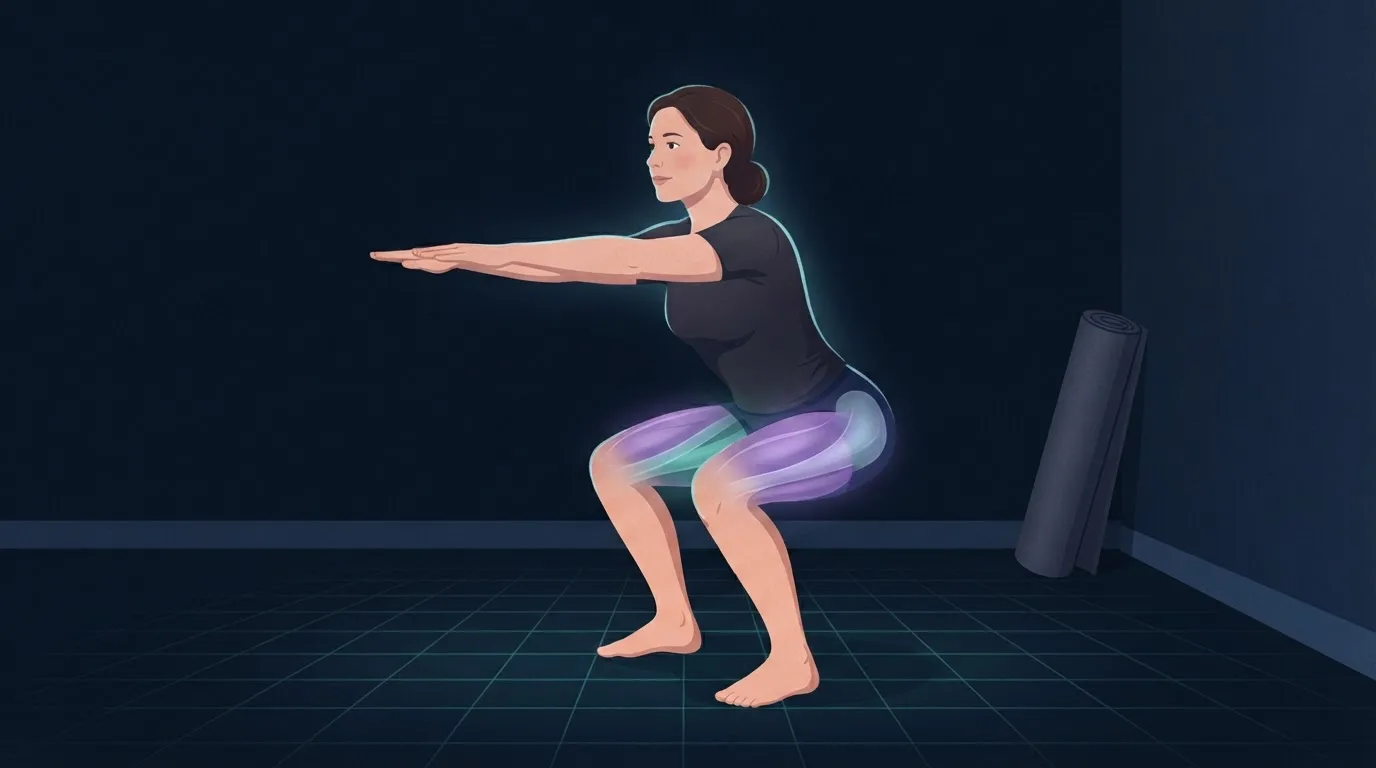
Type "what muscle does squats work" into a search bar and you'll get a long list: quads, glutes, hamstrings, calves, core. It makes the squat sound like it trains your whole lower body evenly. It doesn't. Some of those muscles drive every rep and grow from it, some help out, and some mostly hold you still.
That difference matters when your time is short. If you're getting back into training in your 40s with half an hour and a pair of dumbbells, you want to know which muscles squats cover well and which ones need a second exercise.
Below, every muscle is sorted by its job in the squat, with the training studies that measured what actually grew. You'll also see how depth, stance and four common squats move the work around, where you should feel squats, and what to add for the muscles they miss.
What Do Squats Work? Every Muscle by Its Job
Squats work three groups of muscles. The prime movers produce the force that lowers and lifts you. The synergists help them. The stabilizers hold your spine, pelvis and knees in position so the prime movers can do their job.
| Role | Muscle | Its job in the squat | Grew in squat training studies? |
|---|---|---|---|
| Prime mover | Quadriceps: vastus lateralis, medialis and intermedius | Straighten your knees to stand you up | Yes |
| Prime mover | Gluteus maximus | Drives your hips forward out of the bottom | Yes, more with deeper squats |
| Synergist | Adductors, mainly the adductor magnus | Help your glutes extend the hip from a deep position | Yes, more with deeper squats |
| Synergist | Hamstrings | Assist the hip and steady the knee | No |
| Synergist | Rectus femoris, the fourth quad muscle | Helps straighten the knee while it also bends the hip | No |
| Synergist | Calves: soleus and gastrocnemius | Control how far your shins tip forward | Not measured |
| Stabilizer | Lower back: erector spinae and multifidus | Keep your spine from rounding as you lean | Not measured, but busy under heavy loads |
| Stabilizer | Abs and obliques | Brace your trunk | Not measured, and no more active than in stability-ball exercises |
| Stabilizer | Gluteus medius and minimus | Keep your pelvis level and your knees over your toes | Not measured |
A barbell back squat at the gym uses the same list. Putting weight on your back raises the work for your hips and calves more than for your quads, for reasons the depth section below explains.
The Prime Movers: Your Quads and Glutes
Quadriceps
Your quads are four muscles on the front of your thigh. Three of them, the vastus lateralis, vastus medialis and vastus intermedius, cross only the knee. They stretch as you sink and shorten as you stand, and they're the muscles that burn first in a long set.
The fourth, the rectus femoris, also crosses the hip. As you squat down, your bending knee stretches it while your bending hip slackens it, so its length barely changes. That's a likely reason it gets so little from squats. In the trial by Kubo, Ikebukuro and Yata (2019), 17 young men squatted twice a week for 10 weeks. MRI scans showed their quads grew about 5% whether the squats were full or half depth, yet the rectus femoris didn't change at all.
Fonseca and colleagues (2014) saw the same gap. Two groups of active men trained only squats for 12 weeks, and their whole quadriceps grew by roughly 9% to 12%. The rectus femoris didn't grow in either group, and in one of them the vastus medialis didn't either. Two other groups rotated squats with leg presses, deadlifts and lunges, and they grew all four quad muscles.
Gluteus maximus
Your gluteus maximus extends your hip, which means it drives your hips forward as you stand. It works hardest near the bottom, where your hips are deepest and the muscle is stretched under load. That's why depth decides how much glute a squat trains, and why the full-squat group in the Kubo trial grew about three times as much glute as the half-squat group. Our answer to whether squats make your butt bigger covers the glute research and the best squats for glute growth.
The Helpers: Adductors, Hamstrings and Calves
Adductors
The adductors on your inner thigh are known for pulling your legs together. The largest of them, the adductor magnus, has a part that extends the hip, so in a squat it works alongside your glutes to lift you out of a deep position. In the Kubo trial the adductors grew 6.2% with full squats and 2.7% with half squats. If your inner thighs are sore the day after a session of deep squats, that's the reason.
Hamstrings
Squats are often sold as a hamstring exercise, but they aren't much of one. Like the rectus femoris, the hamstrings cross both the hip and the knee. As you descend they lengthen at the hip and shorten at the knee, so their overall length changes little. They switch on to help extend the hip and to steady the knee, but hamstring volume didn't change with full or half squats in the Kubo trial.
If you want the back of your thighs to grow, add a hip hinge such as a dumbbell Romanian deadlift. Split squats help as well, as the variation section below shows.
Calves
Your soleus and gastrocnemius control how far your shins tip forward and keep your weight balanced over the middle of your foot. Bryanton and colleagues (2012) measured how hard each muscle group worked compared with its own maximum strength while 10 strength-trained women squatted 50% to 90% of their max. Calf effort rose with the weight on the bar but not with depth. In a bodyweight squat your calves work lightly, and calf raises do far more for them.
Knowing what to do is the easy part.
FitCraft, our mobile fitness app, pairs you with an AI coach who builds you a personalized plan around your goals, schedule, and fitness level. Every FitCraft program is designed by Domenic Angelino, MPH (Brown University) and NSCA-CSCS, with research published in the Journal of Strength and Conditioning Research and Medicine & Science in Sports & Exercise.
Take the Free Assessment Free • 2 minutes • No credit cardThe Stabilizers: Lower Back, Abs and Side Hips
Stabilizers don't move you up and down. They stop you from folding forward, tipping over or letting your knees cave while the prime movers work.
- Lower back. The erector spinae and multifidus keep your spine from rounding as your torso leans forward. In a study by Nuzzo and colleagues (2008), nine trained men squatted and deadlifted at 50% to 100% of their max. At 90% and 100%, their long back muscles worked harder in the squat than in any of three stability-ball exercises.
- Abs and obliques. The same study found no difference in ab or oblique activity between those heavy squats and the ball exercises. Squats brace your midsection, but they aren't an ab exercise.
- Side hips. The gluteus medius and minimus keep your pelvis level and your knees pointing over your toes. When they tire, your knees drift inward. One-leg squats ask much more of them than two-leg squats do.
Bodyweight squats ask far less of these muscles than the near-maximal loads in that study. If you squat with your body weight or a light dumbbell, give your core its own few minutes of planks or dead bugs.
How Squat Depth Changes the Muscles Squats Work
Depth changes the work more than anything else you control. In the Bryanton study, quad effort rose as the women squatted deeper but didn't rise with a heavier bar. Calf effort did the opposite, and hip effort rose with both. The authors concluded that the quads can be trained with light loads, but only in deep squats.
That's good news for training at home. A deep bodyweight or light goblet squat still challenges your quads, while your glutes and calves need more load to keep up. The training data point the same way. In the Kubo trial, the full-squat group raised its full-squat max by 31.8%, against 11.3% in the half-squat group. On the half squat, both groups improved, with no clear difference between them. You get strongest at the depth you train, and full depth trained more muscle.
How deep is deep? Aim to get your hip crease below the top of your knee while your heels stay down and your lower back stays flat. Our squat form guide covers the setup one step at a time.
How Stance and Squat Type Shift the Work
The four squats most people do at home work the same list of muscles. What changes is the share each one gets.
Bodyweight squat
The bodyweight squat trains your quads well once you go deep, and gives your glutes, calves and lower back a light workout. Its limit is load. After a few weeks most people can do 20 or 30 in a row, and the set turns into endurance work. Our guide to how many squats a day gives ranges by goal.
Goblet squat
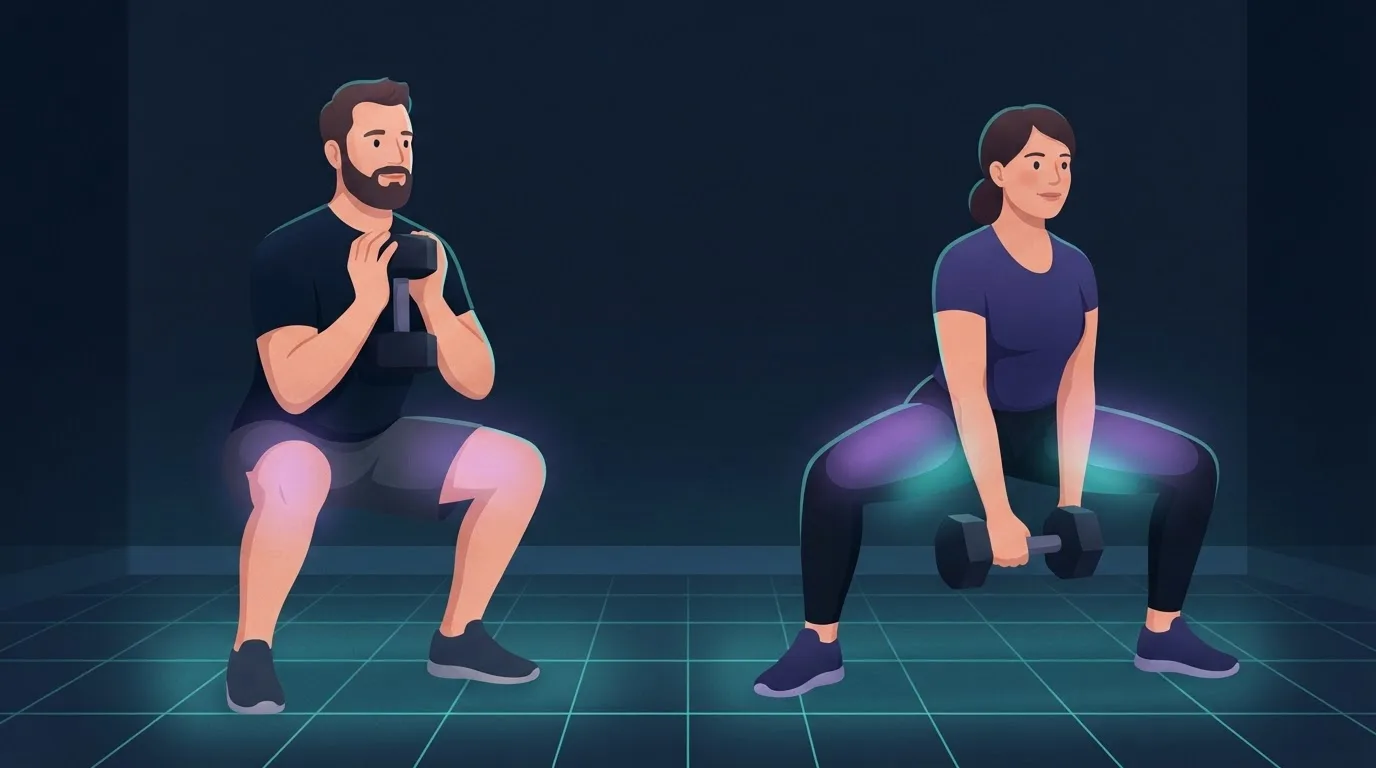
Holding one dumbbell at your chest puts the load in front of you. Few studies have measured muscle activity in the goblet squat, and none we found compares it with a back squat. The closest evidence is the barbell front squat, which also loads the front of the body. Gullett and colleagues (2009) tested 15 trained adults and found the front squat recruited the muscles as much as the back squat, with less compressive force and a smaller turning load at the knee. The weight in front also acts as a counterbalance, which helps many beginners sit deeper with a straighter back. Our goblet squat guide covers the hold and the setup.
Sumo squat
A sumo squat sets your feet wider than your shoulders with your toes turned out. McCaw and Melrose (1999) recorded six leg muscles in nine lifters squatting with narrow, shoulder-width and wide stances. Stance width didn't change the activity of the three quad muscles they measured. It changed only two: the adductor longus on the inner thigh and the gluteus maximus. So a wide stance keeps your quads working just as hard and adds inner-thigh and glute work on top. Our sumo squat guide shows how to set your feet.
Split squat
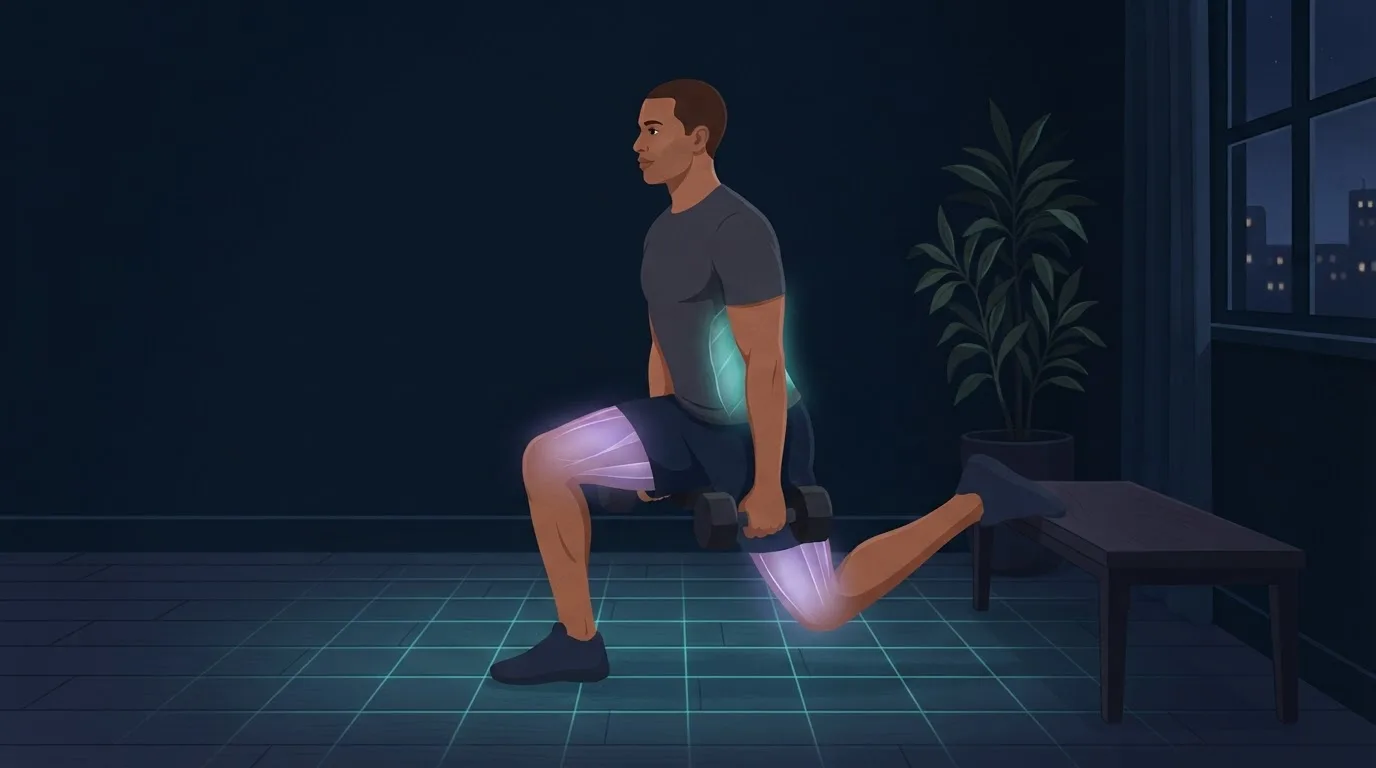
A split squat puts one foot forward and one back, and the Bulgarian version raises the back foot on a bench. Andersen and colleagues (2014) had 15 trained men do regular squats and Bulgarian split squats at the same relative effort. The split squat drew 63% to 77% more activity from the biceps femoris, one of the hamstrings, and 58% to 62% more from the external obliques on the side of the waist. It drew 16% to 21% less from the rectus femoris, and the other quad muscles worked about the same. Our guide to squats vs lunges compares one-leg and two-leg training in more detail.
Where Should I Feel Squats the Most?
You should feel squats most in the front of your thighs and in your glutes, with some work in your inner thighs as you go deeper. That matches the prime movers and helpers above. A burn in your quads during the set and some soreness in your glutes and inner thighs a day or two later are both normal.
Some feelings are a sign to change something:
- Only your quads, never your glutes. You may be stopping above parallel. Sit a little deeper and pause for a second at the bottom.
- Your lower back more than your legs. Your chest may be dropping or your back rounding at the bottom. Stop just above that point and keep your chest up.
- Pain at the front of your knee. Squat to a box set at a depth that feels fine, slow the lowering and keep your knees pointing over your toes. Pain that stays sharp needs a clinician.
Feeling a muscle isn't the same as growing it. Your hamstrings can feel busy during a hard set of squats and still didn't grow in the Kubo trial. Focusing on the muscle you want to train, often called the mind-muscle connection, may help you feel it more, but depth, stance and load decide most of the work.
What Squats Miss and What to Add
Squats cover your quads, glutes and inner thighs well. Three gaps are worth one extra exercise each:
- Hamstrings. A dumbbell Romanian deadlift or a glute bridge once or twice a week. Split squats add some hamstring work too.
- Calves. Standing calf raises, since bodyweight squats barely load them.
- Rectus femoris. Mix in lunges and other leg exercises. In the Fonseca trial, only the groups that rotated exercises grew all four quad muscles.
What This Means for You
If you only have time for one leg exercise, a deep squat is a strong pick. It trains your quads, glutes and inner thighs together and makes your back and trunk work to hold you upright. Go as deep as your form allows, add a dumbbell once 20 reps feel easy, and pair squats with a hinge for your hamstrings.
Knowing which muscles to train is the easy part. Keeping it up for the 10 to 12 weeks these studies ran is harder. Most people start strong, miss a week when work gets busy and never quite get going again. The usual cause is a plan that doesn't fit your life.
In FitCraft, an AI coach demonstrates each exercise on an interactive 3D model that highlights the working muscles, and the exercise tips tell you which muscles to focus on. Programs get harder as you progress, and streaks and XP give you a reason to come back. If you're just starting out, our page on the best workout app for beginners shows what your first day looks like. As one FitCraft user, Tim, put it: "I didn't think an app could replace my trainer. My AI coach proved me wrong."
Frequently Asked Questions
Are squats a full-body exercise?
Not quite. Squats are a lower-body exercise that also makes your trunk work: the quads and glutes do most of the lifting while your back and abs hold you upright. Your chest, shoulders and arms barely work unless you hold a weight, so pair squats with a push and a pull for a full-body session.
Do squats work your abs?
Only a little. In a study of nine trained men, near-maximal squats drew no more ab or oblique activity than stability-ball exercises, though they worked the lower back harder. Bodyweight squats ask even less of your abs, so add planks or dead bugs if a stronger midsection is the goal.
Do squats work hamstrings?
Squats use the hamstrings to steady the knee and help extend the hip, but they barely grow them. In a 10-week MRI trial, hamstring volume didn't change with full or half squats. A Romanian deadlift, a glute bridge or a split squat does more for the back of your thighs.
Do squats increase vertical jump?
Deep squats can. In a 10-week study of young adults, the groups that trained deep front or deep back squats jumped higher in both the squat jump and the countermovement jump, while a quarter-squat group didn't improve. The deep-squat groups also beat the quarter-squat group on the countermovement jump.
What muscle is hardest to grow?
There's no single answer, because it varies from person to person. With squats, the hardest muscles to grow are the hamstrings and the rectus femoris on the front of the thigh, and neither grew in a 10-week MRI trial of full and half squats. Those muscles usually need hinges, lunges or other exercises added to your week.
Will 20 squats a day make a difference?
Twenty bodyweight squats a day is a good habit if your legs get little exercise now, but the set soon gets easy and stops building muscle. To keep progressing, go deeper, add a dumbbell or move to split squats. Our guide to how many squats a day gives daily and weekly ranges by goal.