You bought the roller because someone told you to. It lives under the couch. Every few weeks you drag it out after a hard session, lie on it for ninety seconds while it hurts in a way you're not sure is productive, and put it back.
That's a frustrating loop, and it isn't a discipline problem. Nobody handed you a dose. The gym advice you got was a list of body parts and a vague instruction to roll until it loosens, which is not a thing that happens, so you have no way of knowing whether tonight's two minutes did anything at all.
The research on rolling is much tidier than the folklore around it. There's a duration that works, a pressure that's enough, a small set of regions worth your time, and a shorter list of places to stay away from. That's the whole guide.
How to Use a Foam Roller: The Method That Works on Every Region
One method covers all of it. Change only the body part.
- Set up so the roller is under one muscle, not a joint. Bone on foam is just painful. Muscle belly on foam is the exercise.
- Load it with body weight you can control. Support yourself on your hands or your opposite leg, then let as much weight down as you can hold while your breathing stays quiet.
- Move slowly, about one inch per second. Fast passes are the single most common error. The sensation you're chasing takes several seconds to build.
- Cover the whole length of the muscle. Roll from just above one end to just below the other, then back. Short strokes over one hot spot miss most of the tissue.
- Stay about 90 seconds, then move on. Longer isn't better, and you have other regions to get through.
Pressure is the part people get wrong in both directions. Grabow and colleagues (2018), in the Journal of Strength and Conditioning Research, had 16 adults roll their quadriceps at a moderate force and at a high force, each calibrated to the individual's own pain perception. The high-force condition produced no extra range of motion, and it didn't impair strength or jump performance either. Rolling harder isn't dangerous. It's just pointless. Pick a pressure you can hold for a minute and a half without clenching.
One small addition earns its keep. Bradbury-Squires and colleagues (2015), in the Journal of Athletic Training, had participants roll the quadriceps for 20 or 60 seconds while actively bending and straightening the knee. Knee range improved and muscle activity during a lunge dropped in both conditions. Bending and straightening the joint while the muscle sits on the roller is free, and it beats lying still.
Foam Roller Exercises, Region by Region
Five regions do almost all the work. Two more are worth knowing if you sit a lot or press overhead. Nobody needs all seven in one session.
| Region | Position | Dose | Watch for |
|---|---|---|---|
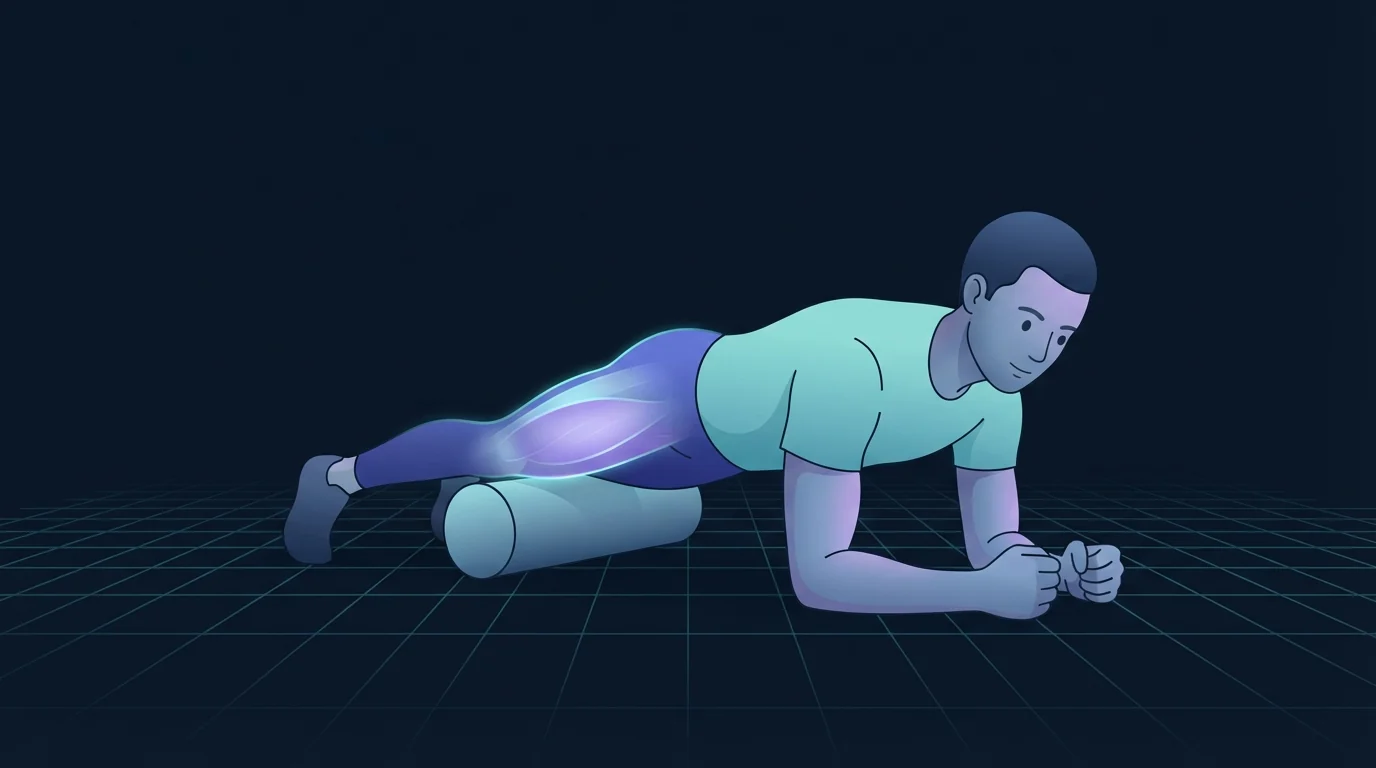
| Quadriceps | Face down, forearms on the floor, roller under the front of the thigh | 90 sec per leg | Stop above the kneecap |
| Hamstrings | Seated, hands behind hips, roller under the back of the thigh | 90 sec per leg | Cross the free ankle over to add weight |
| Glutes | Seated on the roller, one ankle crossed on the opposite knee | 60 to 90 sec per side | Lean into the side you're rolling |
| Calves | Seated, hands behind hips, roller under the calf, hips lifted | 90 sec per leg | Point and flex the foot as you go |
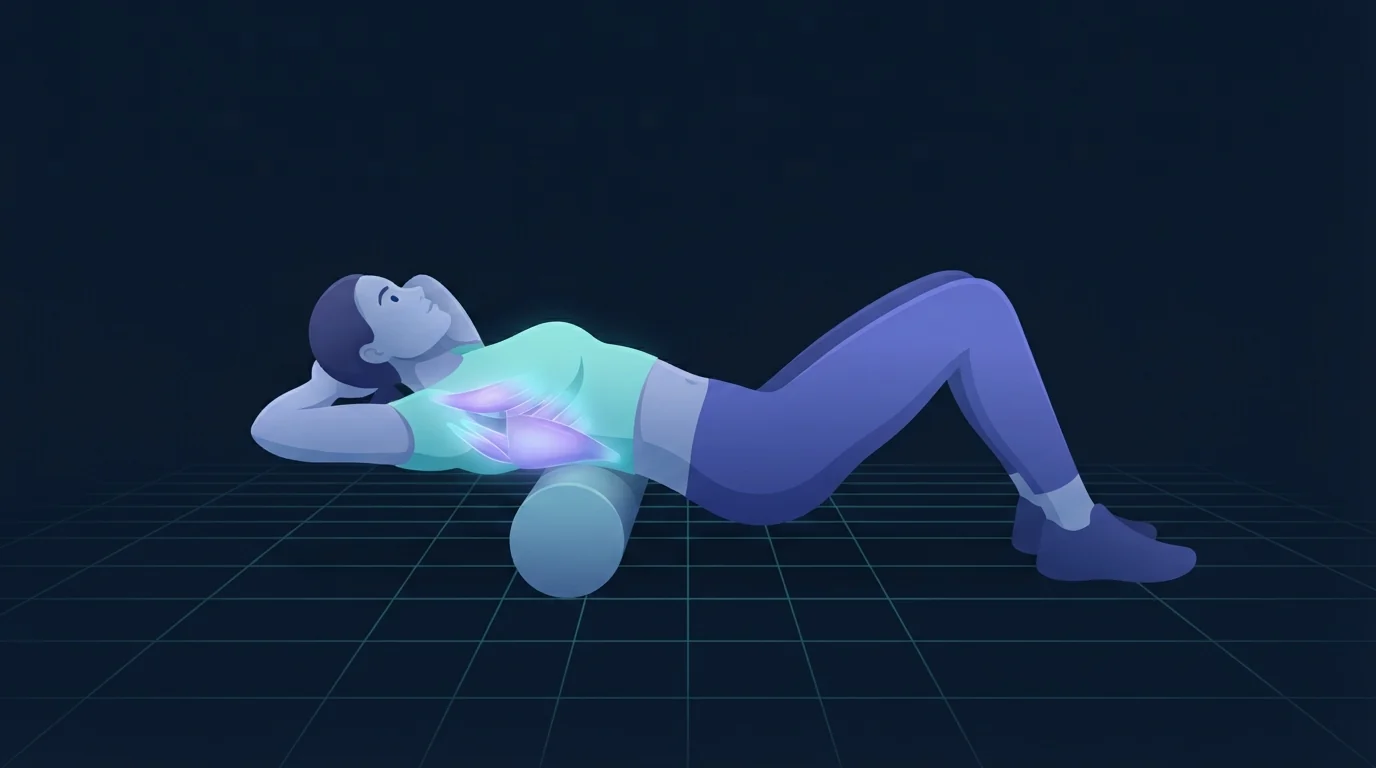
| Upper back | Face up, roller across the back below the shoulder blades, hands behind head | 60 to 90 sec | Stop at the bottom of the ribs |
| Adductors | Face down, one leg out to the side, roller along the inner thigh | 60 sec per leg | Keep the pressure light at first |
| Lats | On your side, arm overhead, roller under the armpit down the ribs | 60 sec per side | Rotate slightly forward and back |
Quadriceps
Lie face down with your forearms on the floor and the roller under the front of one thigh. Shift your weight onto that leg, then travel from just above the kneecap to the top of the thigh and back. If the pressure is too much, leave the other foot on the floor and use it to hold some of your weight. Bend and straighten the knee a few times at the tender third of the thigh before you move on. If the front of your hip is the part that feels short rather than the thigh itself, our guide to tight hip flexors covers the testing and the loading work the roller can't do.
Hamstrings
Sit with the roller under the back of one thigh and your hands planted behind your hips. Lift your hips off the floor and travel from just above the back of the knee to the base of the glute. To add pressure, stack the free ankle on top of the working leg. Hamstrings tolerate more weight than most people expect, which is handy, because this is the region where rolling has the strongest range-of-motion track record.
Glutes
Sit on the roller, cross your right ankle over your left knee, and lean into the right hip. Small movements are enough here. Travel two or three inches back and forth rather than sweeping the whole area, since the working muscle is thick and the useful pressure is concentrated. This is the region most people mean when they say their low back is tight.
Calves
Sit with the roller under one calf, hands behind your hips, and press your hips off the floor. Roll from just above the ankle to just below the back of the knee. Point and flex your foot every few passes. Rotate the leg slightly in and out to catch both heads of the calf. Rolling here feels great and does very little for lasting ankle range, which is a distinction worth holding on to and one I come back to below.
Upper back
Lie face up with the roller across your back just below the shoulder blades, knees bent, feet flat, hands laced behind your head with your elbows open. Lift your hips a couple of inches and travel between the bottom of your ribs and the top of your shoulder blades. You can pause and let your upper back drape backwards over the roller for a few breaths. Keep your ribs from flaring and keep the roller above your waistline.
Adductors and lats
For the inner thigh, lie face down with one leg out to the side, knee bent, and the roller running along the inside of that thigh. Go lighter than you think. For the lats, lie on your side with the bottom arm stretched overhead and the roller under your armpit, then travel a few inches down the side of your ribs while rotating slightly forward and back. Both regions are optional. Both are useful if you sit all day or press overhead.
Find out what's really holding you back
FitCraft, our mobile fitness app, pairs you with an AI coach who builds you a personalized plan around your goals, schedule, and fitness level. Every FitCraft program is designed by Domenic Angelino, MPH (Brown University) and NSCA-CSCS, with research published in the Journal of Strength and Conditioning Research and Medicine & Science in Sports & Exercise.
Take the Free Assessment Free • 2 minutes • No credit card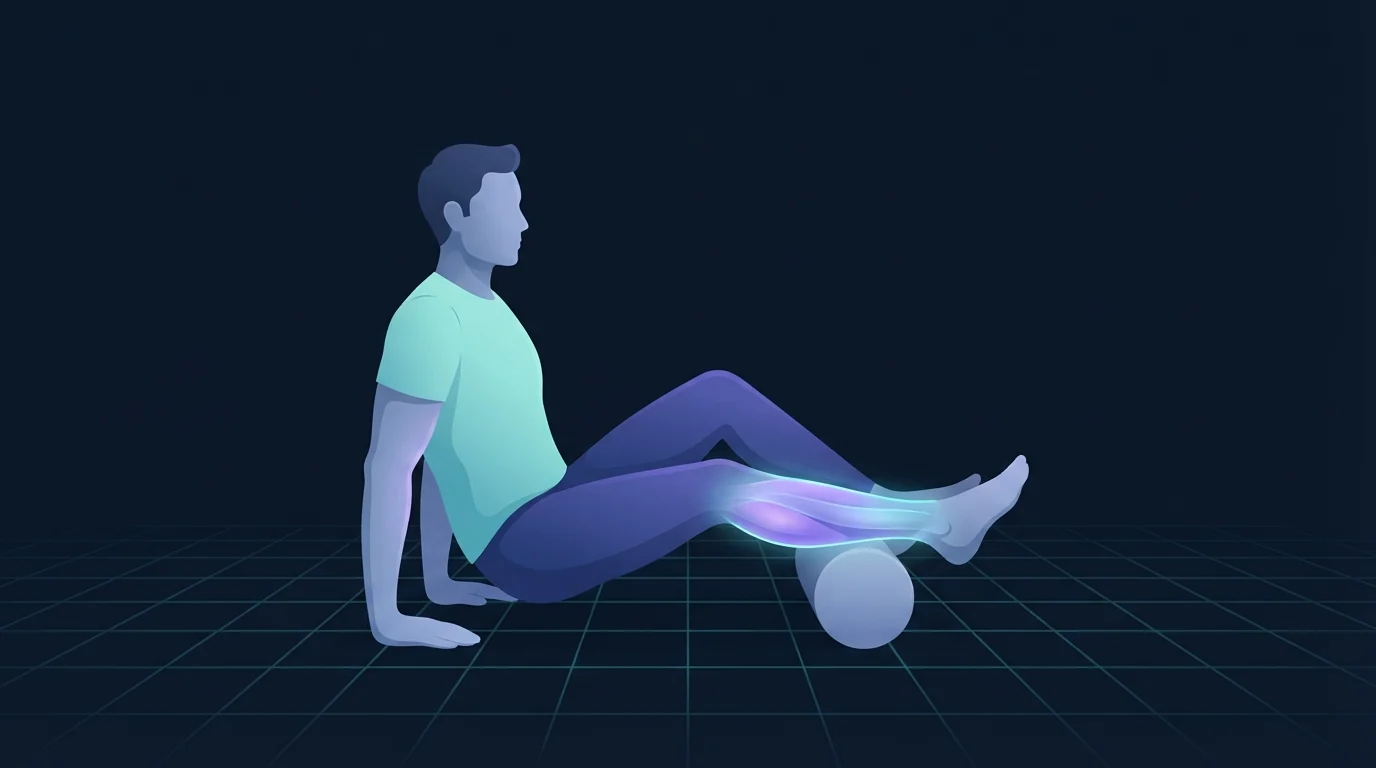
How to Foam Roll Your Legs in Six Minutes
If your legs are the reason you own a roller, run them in this order. Top of the leg downward, both sides.
- Quads, 90 seconds per leg. Bend and straighten the knee at the sorest third.
- Hamstrings, 90 seconds per leg. Stack the free ankle on top once the pressure feels manageable.
- Glutes, 60 seconds per side. Ankle crossed over the opposite knee, small travel.
- Calves, 90 seconds per leg. Point and flex, rotate the leg in and out.
That's six to eight minutes of work and it's a complete session. Doing it on a rest day is fine. Doing it while a show plays is fine. What doesn't work is fifteen seconds per region on your way out of the gym, which is where most people's rolling habit actually lives.
Foam Rolling for Sore Muscles and DOMS
This is the reason most rollers get bought, so it deserves a straight answer. Rolling does reduce soreness, the effect is modest, and it works by changing how much pressure the muscle will tolerate rather than by repairing anything faster. Pearcey and colleagues (2015), in the Journal of Athletic Training, put participants through ten sets of ten back squats and then had them roll for 20 minutes immediately afterwards and again at 24 and 48 hours. The rolling group reported less soreness and held on to more sprint, jump and strength performance than the control group. Our review of the foam rolling research works through the full evidence base, including why the fascia release story that usually comes with it doesn't hold up.
For practice, three things change on a sore day. Drop the pressure, because DOMS makes everything feel sharper and extra force buys nothing anyway. Cover the whole muscle instead of parking on the worst spot. And repeat it, since the Pearcey protocol wasn't one session but three across 48 hours. Rolling sits on top of the things that actually drive recovery rather than replacing them, which our guide on how to recover faster from a workout ranks in order.
Using a Foam Roller on Muscle Knots
A tender spot gets a different technique. Instead of passing over it, park the roller on it, hold for 20 to 30 seconds, and breathe out slowly until the sensation drops by roughly half. Then roll through the area normally a few times. Keep the total under about a minute per spot.
There's a useful trick for spots too painful to press. Aboodarda, Spence and Button (2015), in BMC Musculoskeletal Disorders, found tender spots in the calves of 150 participants and compared heavy rolling of the sore calf, heavy rolling of the opposite calf, light sham rolling, manual massage and no treatment. Pressure pain thresholds rose in the treated calf, and they also rose in the untouched opposite calf. Whatever rolling does, a good part of it happens in the nervous system rather than in the tissue under the roller. So if the left calf is too sore to touch, roll the right one and some of the benefit crosses over.
How Long to Foam Roll, and How Often
Ninety seconds per muscle, most days you want it. That number comes from the study that tested it directly: Nakamura and colleagues (2021), in the Journal of Sports Science and Medicine, randomised 45 adults to 30 seconds, 90 seconds or 300 seconds of calf rolling. Ankle dorsiflexion improved in the 90 and 300 second groups and not in the 30 second group, and the 300 second dose added nothing over 90. Muscle stiffness measured by shear wave elastography didn't change in any group, and neither did strength.
The bigger finding in that study is the one nobody quotes. Every gain was back to baseline within 30 minutes. Rolling buys a short window, so use it. Roll before the session that needs the range, not the night before.
Across the wider literature the acute effect holds up well. Wilke and colleagues (2020), in a multilevel meta-analysis in Sports Medicine, found a single bout of foam rolling acutely increased joint range with a medium effect size of 0.74. Lasting change is a slower story. Konrad and colleagues (2022) pooled 11 studies and 290 participants on foam rolling as a training intervention and found a moderate overall effect on range (0.823), but only in programmes running longer than four weeks. Programmes of four weeks or less produced nothing significant. By muscle group, hamstrings responded moderately, quadriceps a little, and the calves not at all.
That last detail is worth acting on. If your goal is lasting ankle range for squatting or running, rolling the calves isn't the tool, and our ankle mobility exercises guide covers the loading and end-range work that is.
Should You Foam Roll Before or After a Workout
Before, if you're only doing it once. Konrad, Tilp and Nakamura (2021), in Frontiers in Physiology, pooled 13 studies with 304 participants that compared foam rolling against stretching in a warm-up. Rolling produced an average performance change of 2.19 percent against 1.11 percent for stretching, with the advantage clearest when rolling ran longer than 60 seconds per muscle. Rolling gives you range without the temporary strength cost that long static holds can carry, which is exactly what a warm-up wants. Our review of static versus dynamic stretching covers that trade-off in full.
After training, the target changes from range to soreness, and the protocol changes with it: lighter pressure, longer coverage, repeated over the next two days. Most people who roll consistently end up doing 60 seconds per region before and a longer version on the evenings after hard sessions.
Where Not to Put the Roller
Four places, and the reasons are structural rather than superstitious.
- Your lower back. Between the bottom of the ribs and the pelvis there's no bony cage to spread the pressure, so the roller pushes the spine into extension while the muscles brace against it. Roll the glutes and the upper back instead. That's where the relief people are chasing usually comes from.
- Your IT band. This one is stubborn because it's still taught. Falvey and colleagues (2010), in the Scandinavian Journal of Medicine and Science in Sports, measured what actually happens to the iliotibial band during the standard stretches and found mean lengthening of less than 0.5 percent. It's a sheet of connective tissue anchored along the femur, so it doesn't behave like a muscle you can lengthen under a roller. Roll the tensor fasciae latae at the front of the hip and the glutes behind it.
- Your neck. Too many structures, too little muscle to absorb the pressure. Stop at the top of the shoulder blades.
- Directly on joints or bone. Kneecaps, elbows, the back of the knee, the front of the shin. If it feels like bone under foam, it is.
Buying a Foam Roller as a Beginner
Get a smooth medium-density roller about 36 inches long and stop researching. Cheatham and Stull (2018), in the International Journal of Sports Physical Therapy, randomised 36 recreationally active adults to soft, medium or hard density rollers for quadriceps rolling. There was no significant difference between the three for knee range or pressure pain threshold. Every group improved knee flexion by roughly seven to eight degrees within its own session.
So density isn't the variable that decides your result. The long smooth roller covers more of the leg per pass, stays stable under your back, and doesn't hurt enough to talk you out of the habit. The aggressive knobbly ones are fine later if you want them, and they buy nothing you can measure. A no-equipment workout app can drop the rolling sessions into the same week as your training so the habit has somewhere to live instead of depending on you remembering.
The Bottom Line
Ninety seconds per muscle, moderate pressure, slow travel, five regions, and timing that matches what you want: before training for range, after training for soreness. Rolling buys a short window rather than a permanent change, and once you stop expecting the permanent change it becomes a genuinely useful ten minutes.
Mike, 23, said something about his training streak that transfers directly: "The streak system got me hooked. I didn't want to break my chain." A short rolling routine you run four times a week beats the heroic twenty-minute version you run once in February.
Frequently Asked Questions
How do you use a foam roller for sore muscles?
Use lighter pressure than usual and cover the whole muscle rather than hunting for the worst spot. Sixty to ninety seconds per region, repeated immediately after the session and again on each of the next two days, is the pattern Pearcey and colleagues (2015) used when rolling reduced soreness and preserved sprint, jump and strength performance after ten sets of ten back squats. Rolling raises your tolerance for pressure in the muscle. It doesn't speed up tissue repair, so it sits on top of sleep and food rather than replacing them.
How long should you foam roll each muscle?
About 90 seconds per muscle group. Nakamura and colleagues (2021) gave 45 adults either 30, 90 or 300 seconds of calf rolling and only the 90 and 300 second doses increased ankle dorsiflexion, with no extra benefit from the longer version. The gains were back to baseline within 30 minutes, so roll close to the moment you need the range rather than hours before.
Can you use a foam roller on muscle knots?
Yes, and the method is different from normal rolling. Park the roller on the tender spot instead of passing over it, hold 20 to 30 seconds, and breathe out slowly until the sensation drops by roughly half. Aboodarda and colleagues (2015) tested 150 people with tender spots in the calf and found rolling raised pressure pain thresholds not only in the treated calf but in the untouched opposite calf too, which is why a spot too painful to press directly can still be worked from the other leg.
Is foam rolling better before or after a workout?
Before, if you have to pick one. Konrad, Tilp and Nakamura (2021) pooled 13 studies and 304 participants comparing foam rolling against stretching as a warm-up and found rolling produced a small performance gain averaging 2.19 percent against 1.11 percent for stretching, with the advantage clearest past 60 seconds per muscle. Rolling afterwards is for soreness rather than for range, so many people end up doing a short version at both ends.
Which foam roller should a beginner buy?
A smooth medium-density roller about 36 inches long. Cheatham and Stull (2018) randomised 36 adults to soft, medium or hard density rollers and found no significant difference between them for knee range of motion or pressure pain threshold, with every group gaining roughly seven to eight degrees. Density isn't the variable that decides your result, so buy the one you'll actually lie on and skip the aggressive knobbly models until rolling is a habit.
Should you foam roll your lower back or your IT band?
Neither is a good target. The lower back has no rib cage protecting it, so the roller pushes the spine into extension while the muscles brace against it, and rolling the glutes and upper back usually gives the relief people are chasing. The IT band is a sheet of connective tissue anchored along the femur: Falvey and colleagues (2010) measured less than 0.5 percent lengthening under stretch, so pressing on it hurts without changing anything. Roll the tensor fasciae latae at the front of the hip and the glutes behind it instead.