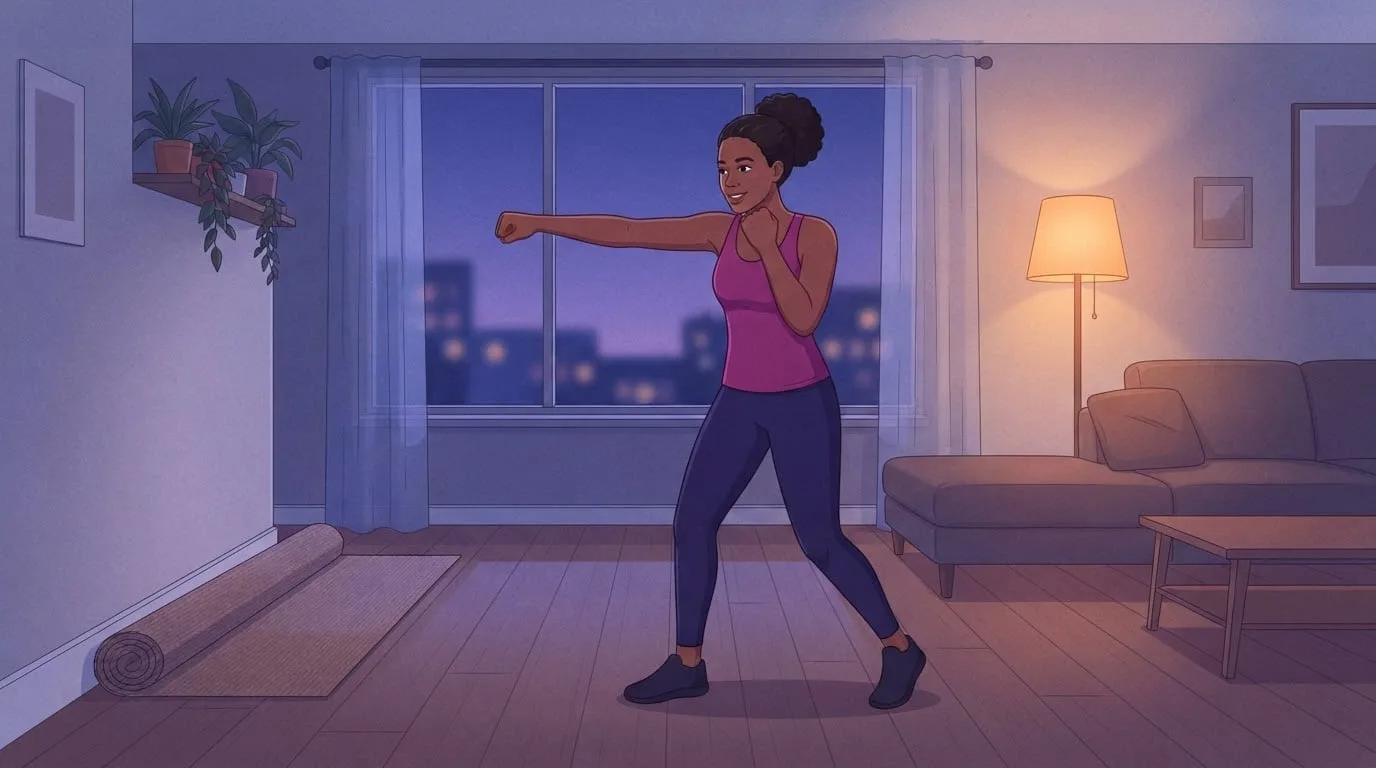
You want cardio you can do at home, but running in place gets dull in about four minutes, jumping bothers your knees or the people downstairs, and you've already quit two workout videos this year. Shadow boxing solves more of that than you'd expect. It's fast, it keeps your brain busy with combinations and footwork, and it needs nothing but floor space.
The catch is that most people try it once, flail their arms for a few minutes and decide it isn't a real workout. That isn't a fitness problem. Without a structure, a shadow boxing exercise turns into random punching, and random punching is hard to push and easy to quit.
This guide gives you the structure. You'll learn what shadow boxing is, the stance and the six basic punches, a 20-minute shadow boxing workout, a 4-week shadow boxing workout plan for beginners, and what the research says about calories, muscle and the benefits of shadow boxing.
What Is Shadow Boxing?
Shadow boxing is boxing practice without an opponent, a bag or pads. You throw punches, move your feet and slip imaginary punches as if someone were in front of you. Boxers use it to warm up and rehearse technique. As a workout, it's timed rounds of combinations and movement, which makes it a full-body cardio session with no equipment. Some people call it air boxing.
How does shadow boxing work as exercise? Your legs drive each punch, your trunk rotates to pass that force to your arms, and your shoulders hold your hands up for the whole round. The faster you punch and move, the harder your heart and lungs have to work. Because one foot is almost always on the floor, it's also low impact, which is why it appears in our guide to low impact cardio at home.
One name causes confusion. Chinese shadow boxing is an old English name for tai chi, the slow, flowing martial art. It's a different practice with different benefits, mainly balance, and our review of the tai chi balance research covers it.
The 20-Minute Shadow Boxing Workout
Set a round timer for 2 minutes of work and 45 seconds of rest. Each round has one focus, so you're never wondering what to throw next. Stay on your toes, keep your hands up and breathe out with every punch.
| Round | Focus | What to throw |
|---|---|---|
| Warm-up (3 min) | Raise your heart rate | March, step touches, arm circles, then light bouncing with slow jabs |
| 1 | Straight punches | Jab, then jab-cross (1-2), stepping forward and back |
| 2 | Add the hook | 1-2-3: jab, cross, lead hook. Reset your guard after each combo |
| 3 | Hooks and uppercuts | 3-4 (both hooks), then 5-6 (both uppercuts), alternating every 30 seconds |
| 4 | Defense | Slip left, slip right, roll under, then answer with 1-2 |
| 5 | Speed intervals | 20 seconds of fast 1-2s as quickly as you can, 10 seconds of easy bouncing, 4 times |
| 6 | Freestyle | Mix everything: combos, pivots and slips, moving around the room |
| Cool-down (2 min) | Bring it down | Slow walking, shoulder rolls and a chest stretch in a doorway |
That's about 20 minutes in total. To make it harder, add rounds before you add speed: work up to 8 rounds, then lengthen them to 3 minutes, which is the length of a professional boxing round. Round 5 is the hardest part of the session. If you're new to exercise or have a heart condition, keep it at a steady, comfortable pace for the first few weeks.
How to Shadow Box: Stance, Guard and the 6 Punches
Good form makes shadow boxing safer for your joints and harder for your heart, because the power comes from your legs and hips instead of your arms alone.
The stance
If you're right-handed, stand with your left foot forward and your right foot back, about shoulder-width apart, with your feet staggered rather than lined up one behind the other. This is the orthodox stance. Left-handers reverse it, which is called southpaw. Bend your knees slightly, lift your back heel a little and keep your weight even between both feet.
The guard
Bring both fists up to your cheekbones, elbows tucked in close to your ribs, chin slightly down. After every punch, your hand comes straight back to this spot. Dropping your hands between punches is the most common habit to break, and it's also what makes your shoulders work, so the guard is part of the workout.

The 6 punches
Boxing coaches number the punches so they can call combinations quickly. The numbers below are the most common system, though some gyms swap 5 and 6.
- Jab (1): a quick, straight punch with your lead hand. Step forward slightly as you throw it and snap it straight back.
- Cross (2): a straight punch with your rear hand. Pivot on the ball of your back foot and turn your rear hip forward, so the power comes from the floor.
- Lead hook (3): a short, curved punch with your lead hand, elbow bent to about 90 degrees and level with your fist. Turn your lead foot and hip in the direction of the punch.
- Rear hook (4): the same curved punch with your rear hand, with a pivot on the back foot.
- Lead uppercut (5): dip your lead shoulder slightly, bend your knees, then drive the fist up in a short arc, palm facing you.
- Rear uppercut (6): the same upward punch from the rear hand, driven by the back leg and hip.
Never fully lock your elbow at the end of a punch. Stop just short of straight. With no bag to absorb the force, a snapped elbow takes all of it. If you want to add more leg work, the side step and punch pattern on our Step-N-Punch page pairs a lateral step with each punch.
Footwork and Defense: What Makes It Shadow Boxing
Punching in one spot is only half of shadow boxing. Footwork and defense keep your legs working and your heart rate up between combinations.
- Step and drag: to move forward, step with your lead foot and let the rear foot follow the same distance. To move back, step with the rear foot first. Never cross your feet.
- Pivot: turn on the ball of your lead foot, swinging your rear foot around to change your angle by a quarter turn.
- Slip: rotate your trunk and bend slightly at the knees so your head moves a few inches to one side of an imaginary straight punch.
- Roll: bend your knees and dip under an imaginary hook in a U shape, coming up on the other side with your guard intact.
- Stay light: a small, constant bounce on the balls of your feet keeps you ready to move. Flat feet make the whole round feel slower.
Find out what's really holding you back
FitCraft, our mobile fitness app, pairs you with an AI coach who builds you a personalized plan around your goals, schedule, and fitness level. Every FitCraft program is designed by Domenic Angelino, MPH (Brown University) and NSCA-CSCS, with research published in the Journal of Strength and Conditioning Research and Medicine & Science in Sports & Exercise.
Take the Free Assessment Free • 2 minutes • No credit cardShadow Boxing Workout for Beginners: A 4-Week Plan
A shadow boxing workout for beginners starts shorter and slower than the full routine. Do this plan three days a week on non-consecutive days. Walk or stretch on the days between.
| Week | Rounds | Work / rest | Focus |
|---|---|---|---|
| 1 | 4 | 1 min / 1 min | Stance, guard, jab and cross only |
| 2 | 5 | 90 sec / 1 min | Add hooks and the step and drag |
| 3 | 6 | 2 min / 1 min | Add uppercuts, slips and rolls |
| 4 | 6 | 2 min / 45 sec | The full 20-minute workout, round 5 at a moderate pace |
Film one round on your phone at the end of week 2. Most beginners are surprised by how often their hands drop and how flat their feet are. Fix one thing at a time.
Three sessions a week for a month is the part most people never reach. If you'd rather follow a plan than build every session yourself, a home workout app with no equipment needed can take that job. FitCraft's cardio, strength, mobility and yoga workouts use your body weight or dumbbells, an AI coach demonstrates each exercise on an interactive 3D model you can pinch and zoom, and streaks and calendar rewards keep the weeks adding up.
Is Shadow Boxing a Good Workout? What the Research Shows
Yes, if you keep moving and keep the punch rate up. No trial has tested pure shadow boxing as a workout, but studies of boxing drills and boxing-style intervals point the same way.
Punch rate decides the intensity
Arseneau, Mekary and Léger (2011), in the Journal of Strength and Conditioning Research, measured oxygen uptake and heart rate in nine amateur boxers. Punching a bag at 60, 120 and 180 punches a minute used about 40, 49 and 62 percent of their peak oxygen uptake, at about 68, 75 and 83 percent of maximum heart rate. Sparring reached about 70 percent of peak oxygen uptake and 86 percent of maximum heart rate. Shadow boxing works the same way: a lazy pace is light exercise, while fast combinations with constant footwork are hard cardio.
Boxing-style intervals at home improved fitness
The closest trial to a home shadow boxing workout comes from Areeudomwong, Juntiya and Buttagat (2026), in the Journal of Education and Health Promotion. They randomized 58 sedentary young adults to 6 weeks of home-based Thai-boxing intervals, eight 60-second high-intensity bouts with 60 seconds of active recovery, or to a control program of health education with strengthening and moderate exercise. The boxing group improved VO2 max, resting blood pressure, resting heart rate, grip strength and trunk endurance more than the control group, and lost more fat mass. Muscle mass didn't differ between groups.
Older studies agree. In Ouergui and colleagues (2014), in the Muscles, Ligaments and Tendons Journal, 15 people who trained in kickboxing three times a week for 5 weeks improved upper-body power, aerobic power, speed and agility, while their body composition didn't change. A control group of 15 was tested alongside them. And in a small pilot by Cheema and colleagues (2015), in BMC Sports Science, Medicine and Rehabilitation, adults with abdominal obesity who did 12 weeks of boxing intervals improved body fat percentage, systolic blood pressure and VO2 max, while a brisk walking group didn't. Only 12 people took part, so treat it as a hint, not proof.
How Many Calories Does Shadow Boxing Burn?
Shadow boxing has no entry of its own in the 2024 Adult Compendium of Physical Activities (Herrmann and colleagues, Journal of Sport and Health Science), the standard reference for the energy cost of exercise. Its nearest neighbors give a range. General punching bag work is listed at 5.8 METs, bag work at 60, 120 and 180 punches a minute at 7.0, 8.5 and 10.8 METs, and a simulated boxing round at 9.3. A MET is a multiple of your resting energy use.
Without a bag to hit, a steady shadow boxing workout probably sits around 5 to 8 METs. Here's what that range means for calories. These numbers are our estimate, not a measured value:
| Body weight | 20 minutes | 30 minutes |
|---|---|---|
| 125 lb (57 kg) | 100-160 calories | 150-240 calories |
| 155 lb (70 kg) | 120-195 calories | 185-295 calories |
| 185 lb (84 kg) | 145-235 calories | 220-355 calories |
Shadow boxing for weight loss
Shadow boxing for weight loss works the way any cardio does: it adds to your daily energy use, and weight loss follows only if you eat less than you burn over weeks. For a 155-pound person, two or three 30-minute sessions a week add up to roughly 350 to 900 calories, a useful slice of a deficit but not the whole of it. Strength training protects your muscle while you lose fat, and the trials above found clearer changes in fitness than in body weight. Pair shadow boxing with strength work and a modest, steady calorie deficit.
Benefits of Shadow Boxing
- Cardio fitness: boxing-style intervals raised VO2 max in the home trial above, and punch rate lets you dial the effort from easy to hard.
- Coordination and footwork: combinations, pivots and slips train your hands, feet and eyes to work together in a way that steady cardio doesn't.
- Shoulder and core endurance: holding a guard for 2 minutes and rotating through every punch tires the shoulders and the muscles around your trunk.
- Low impact: with one foot nearly always down, it's kind to the knees and quiet enough for an apartment.
- Stress relief: a 2023 scoping review by Bozdarov and colleagues, in the American Journal of Lifestyle Medicine, found 16 studies and reports of non-contact boxing improving symptoms of anxiety, depression and other mental health conditions. The authors call the evidence preliminary, but many people simply find punching the air a good way to let off steam.
- No equipment and no learning curve to start: you can do your first round tonight.
What about the benefits of shadow boxing every day? Easy rounds every day are fine for most people. Keep the hard interval rounds to two or three days a week, so your shoulders and elbows get time to recover.
Does Shadow Boxing Build Muscle?
Not much. Muscle grows when sets are hard enough to bring the muscle close to failure, and a punch thrown at empty air weighs almost nothing. In the home Thai-boxing trial, muscle mass didn't change more than in the control group, even as fitness improved. Shadow boxing builds the endurance of your shoulders, arms and core, and it can make lean arms look more defined as you lose fat, but it won't add much size.
If you want more muscle, add push-ups, squats, lunges and rows two or three times a week, or put strength sets between your rounds. Our article on whether HIIT builds muscle explains why intervals of any kind fall short of lifting for growth. Avoid holding dumbbells while you punch. The weight pulls hardest on the shoulder and elbow at the end of each punch, where the joint is most exposed, and it slows the punch down.
Turning Shadow Boxing Into a HIIT Workout
Round 5 of the routine is already an interval: 20 seconds as fast as you can, 10 seconds easy. To make the whole session high-intensity interval training, run 6 to 10 rounds of 30 seconds of all-out straight punches with 30 to 60 seconds of easy footwork between them. Our HIIT workout at home guide explains work-to-rest ratios, how often to do HIIT and who should skip it. Twice a week is plenty of HIIT for most people, with easier shadow boxing on other days if you like.
Common Shadow Boxing Mistakes
- Locking the elbows. Snapping each punch to full lockout strains the elbow. Stop just short of straight.
- Dropping the hands. Bring every punch straight back to your cheekbone.
- Punching with only the arms. Turn the hips and pivot the feet. That's where the power and the calorie burn come from.
- Holding your breath. Breathe out sharply with each punch, often with a short "tss" sound.
- Standing flat-footed. Stay light on the balls of your feet and keep moving between combos.
- Going all-out from round one. Speed comes last. Rounds of clean, steady punching build the base for hard rounds later.
The Bottom Line
A shadow boxing workout is real cardio when you give it structure: a stance and guard, the six punches, timed rounds and a punch rate that keeps your heart rate up. Start with the 4-week plan, build to the 20-minute workout and add strength work for muscle. The research on boxing-style intervals is small but consistent: better aerobic fitness, lower resting blood pressure and some fat loss.
You don't need a gym, a bag or a partner. You need a clear patch of floor, a timer and a few rounds a week for long enough to see the change.
Frequently Asked Questions
What is shadow boxing?
Shadow boxing is boxing practice without an opponent or a bag: you throw punches, move your feet and defend against an imaginary opponent. Boxers use it to rehearse technique, and as a workout it's a no-equipment cardio session done in timed rounds.
Is shadow boxing a good workout?
Yes, shadow boxing is a good cardio and coordination workout if you keep moving and keep the punch rate up. In a 6-week trial, home-based Thai-boxing intervals improved VO2 max, resting blood pressure and body fat in sedentary young adults compared with a control group. It builds endurance more than strength.
Does shadow boxing build muscle?
Not much. Shadow boxing trains the endurance of your shoulders, arms and core, but punching the air puts too little load on the muscles to build much size. Pair it with push-ups, squats and other strength work two or three times a week if you want more muscle.
Can you lose weight shadow boxing?
Shadow boxing can help you lose weight as part of a calorie deficit. A 30-minute session likely burns about 180 to 300 calories for a 155-pound person, based on Compendium values for similar boxing exercise. Diet, strength training and total weekly activity matter more than any single workout.
Is it OK to shadow box every day?
Easy shadow boxing every day is fine for most people, since it has no impact on the legs beyond light footwork. Keep hard interval rounds to two or three days a week, and take a day off if your shoulders or elbows ache.
Do you need equipment for shadow boxing?
No. You need about two meters of clear floor, supportive shoes and a timer. A mirror helps you check your guard. Skip hand weights: holding a dumbbell while punching adds strain to the shoulder and elbow at the end of each punch.
What is Chinese shadow boxing?
Chinese shadow boxing is an old English name for tai chi, the slow, flowing Chinese martial art. It isn't the same as boxing-style shadow boxing. Tai chi is mainly a balance and mobility practice, while boxing shadow work is a faster cardio workout.