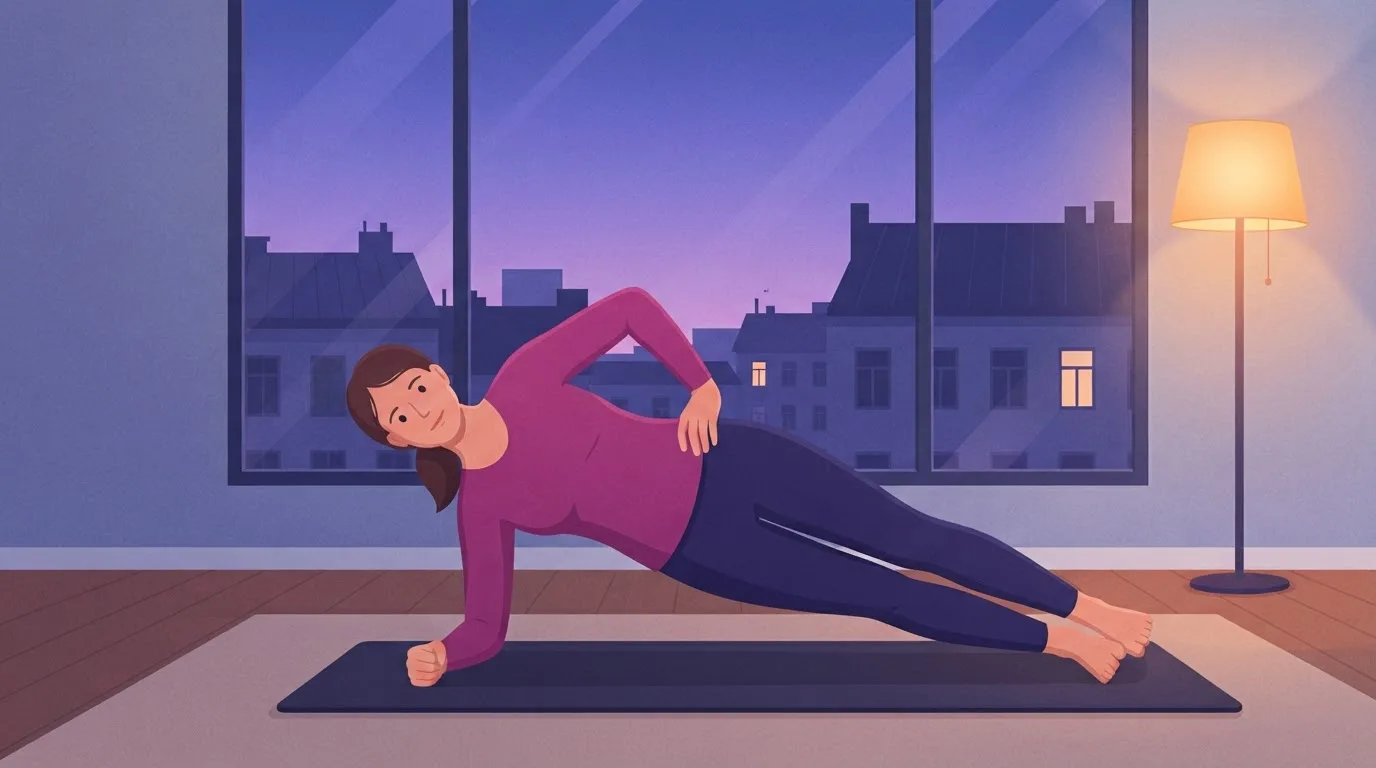
You can hold a side plank for 30 seconds, maybe 45 on a good day. Then you hit a wall. Holding longer just feels like waiting, and the videos you find jump straight to people balancing on one hand with a leg in the air.
It's easy to decide your core isn't strong enough for the next step. Usually nobody showed you the steps in between. Side plank variations aren't a random list of tricks. Each one changes one of three things: how long a lever your body makes, how much of you touches the floor, and whether your hips or arms move. Change one at a time and the hard versions stop looking out of reach.
Below are 10 side plank variations ranked from the modified side plank on your knees to the star and Copenhagen planks, what each one changes and who it suits, the EMG studies behind the ranking, and a simple rule for when to move up.
10 Side Plank Variations, Ranked From Easiest to Hardest
Find your rung in the table, then read the notes for that move. The order follows how much each version asks of the side of your trunk and hip, based on the three dials and the EMG data further down. In every version, keep your elbow or hand directly under your shoulder and push the floor away.
| # | Variation | What it changes | Who it suits |
|---|---|---|---|
| 1 | Knee side plank | Shortest lever: you pivot on your knee | Beginners, and anyone whose hips sag on the full version |
| 2 | Staggered-feet side plank | Full lever on a wider base, top foot in front | Your first straight-leg side plank |
| 3 | Forearm side plank, feet stacked | Full lever on a narrow base | The standard version for most people |
| 4 | Straight-arm side plank | Support moves to the hand | Sore elbows, or getting ready for rungs 8 and 9 |
| 5 | Side plank raise | Adds hip movement: lower and lift | A 30-second hold feels easy |
| 6 | Side plank with knee drive | Adds leg movement and a briefly smaller base | More hip and trunk control without equipment |
| 7 | Side plank leg lift | Top leg lifts, so the bottom hip works harder | Hip strength, runners and walkers |
| 8 | Side plank reach-through | Adds a twist under your body | Strong side planks, sports that turn |
| 9 | Star side plank | Hand support with the top arm and leg lifted | The hardest floor-only version |
| 10 | Copenhagen plank | Top leg on a bench, bottom leg off the floor | Inner thigh strength, sports with cutting or kicking |
1. Knee side plank (the modified side plank)
Lie on your side with your elbow under your shoulder and your knees bent so your feet sit behind you. Lift your hips until your body is straight from your knees to your head. Your knee becomes the pivot point, so less of your body hangs between your elbow and the floor and the side of your trunk has less weight to hold up. Domenic's side plank exercise guide uses this as the easier version of the full move. Move up when you can hold two 30-second sets per side without your hips dropping.
2. Staggered-feet side plank
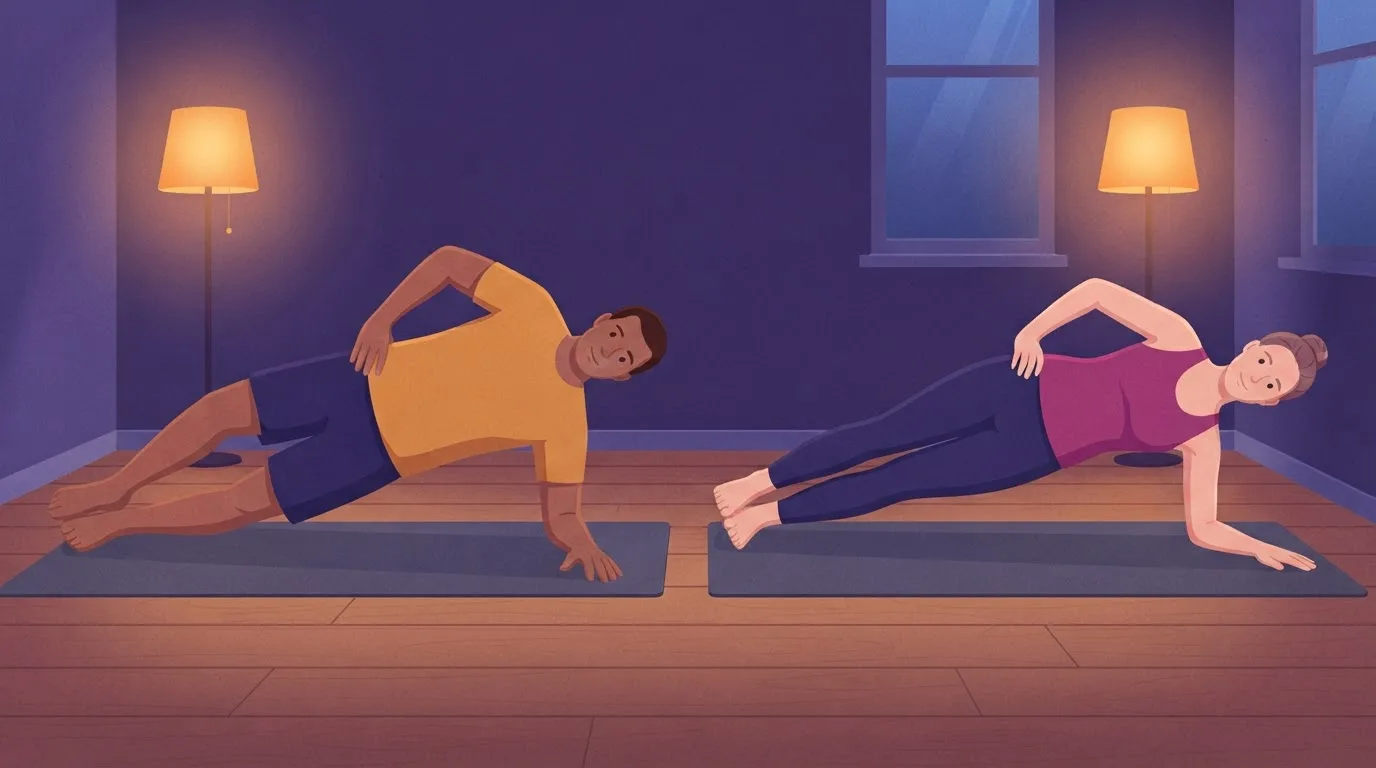
Straighten your legs and set your top foot on the floor just in front of your bottom foot. You now carry your whole body length, but with your feet spread front to back you're much harder to tip over, which makes this the easiest straight-leg version. If you wobble in a stacked side plank, this is the fix.
3. Forearm side plank, feet stacked
Rest your top foot on your bottom foot. Your base shrinks to the edge of one foot and one forearm, so your obliques and the hip underneath have to stop you rolling forward or back as well as sagging. This is the standard side plank, the one the FitCraft app rates Advanced. Build to 30 to 45 clean seconds per side before you add movement.
4. Straight-arm side plank
Push up onto your hand, with your wrist under your shoulder and your fingers spread. Your body sits at a steeper angle, which takes a little load off your trunk and puts more of the job on your shoulder and wrist. It ranks above the forearm version because of that shoulder and wrist demand, not because your obliques work harder. Use it when the forearm version irritates your elbow, or as a stepping stone to the reach-through and the star, which both start from the hand. Skip it if your wrist complains.
5. Side plank raise (hip dips)
From a forearm side plank, lower your hips toward the floor and lift them back to a straight line. Your obliques now move your trunk through a short range instead of only holding it still. Two seconds down and two seconds up works well. The side plank raise guide has Domenic's form cues. Move on when 2 sets of 12 slow reps per side feel controlled.
6. Side plank with knee drive
Hold a forearm side plank with straight legs, then draw your top knee toward your chest and return it, without letting your hips turn. Each time the leg moves, your bottom foot and forearm carry you alone, and your trunk has to resist a twist. Go slowly, because speed hides the hard part.
7. Side plank leg lift
Hold a side plank and lift your straight top leg a foot or two, then lower it under control. This is the version for hip strength. In an EMG study of 24 healthy adults by Boren and colleagues (2011), a side plank with the top leg lifted reached 103 percent of a maximal contraction in the gluteus medius with the dominant leg underneath, and 89 percent with it on top. Those were the two highest scores of the 18 rehabilitation exercises they tested, so the hip underneath works as hard as the leg in the air. Do it from your bottom knee if the straight-leg version is too much.
8. Side plank reach-through
From a side plank on your hand or forearm, thread your top arm under your chest as your upper body turns toward the floor, then open back up and reach toward the ceiling, with your hips staying high. You're adding a twist on top of the side brace, and the FitCraft app rates it Expert. The reach-through guide breaks the turn into steps. Start with 2 sets of 6 slow reps per side.
9. Star side plank
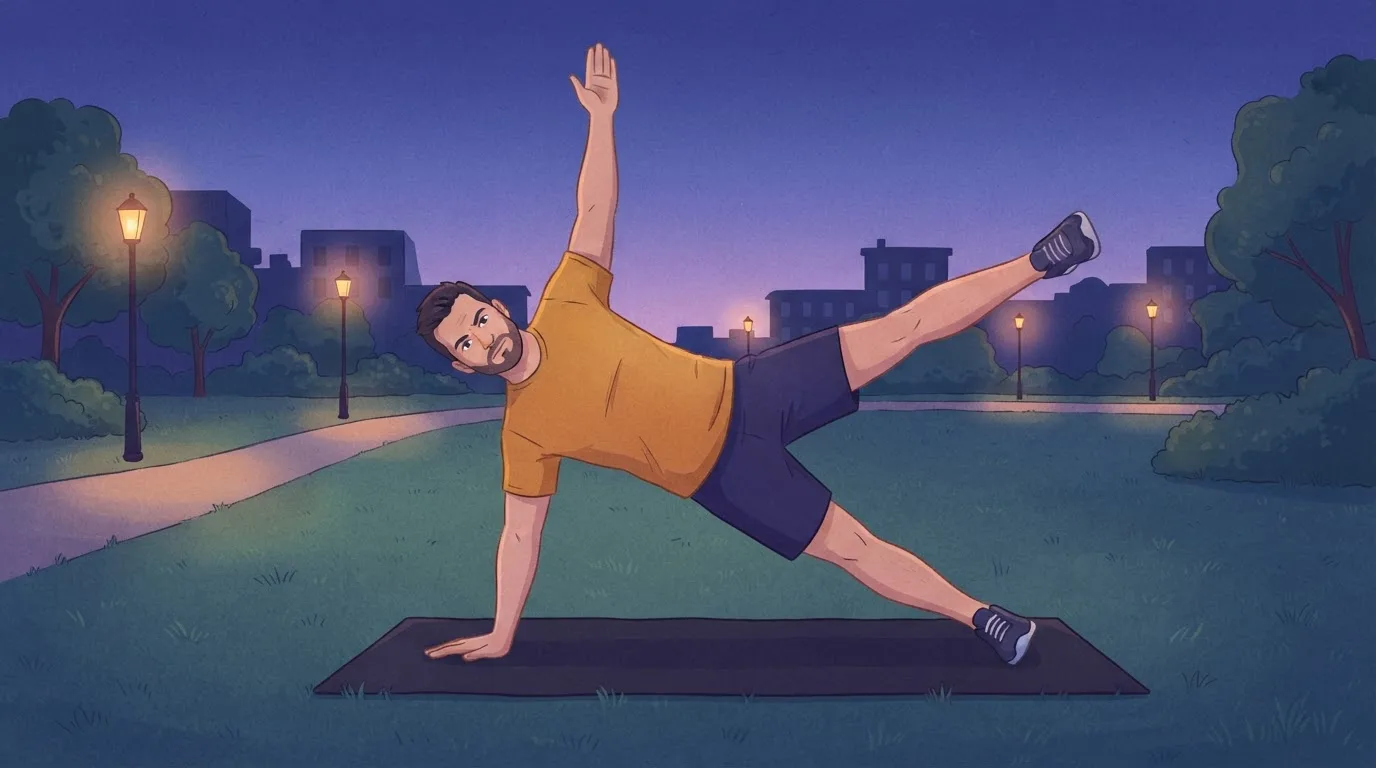
From a straight-arm side plank, raise your top arm straight up and lift your top leg toward it, so you balance on one hand and the edge of one foot. It stacks the hand support, the leg lift and the smallest base on this list. Hold for 10 to 20 seconds per side, and bend your bottom knee to the floor if your hips won't stay up.
10. Copenhagen plank
Lie on your side next to a bench, a sturdy chair or the edge of a couch. Rest your top leg on it, at the knee to begin with, prop yourself up on your forearm and lift your hips so your bottom leg comes off the floor under the bench. The inner thigh of your top leg now holds much of your weight. Serner and colleagues (2014) measured the adductor longus in 40 elite male soccer players during eight hip adduction exercises, and they grouped the Copenhagen exercise with an elastic-band adduction as the high-intensity choices. Moving the support from your knee to your ankle lengthens the lever and makes it much harder. Our Copenhagen plank research review covers the trials and the full progression, so this list stops at the short-lever hold: 2 to 3 sets of 15 to 20 seconds per side.
What Makes a Side Plank Harder: Lever, Base and Movement
Every rung above turns one of three dials. Knowing which dial you're turning tells you what your next step should be.
Lever length: knees, feet or hand
The farther your support sits from your hips, the harder your body weight pulls your trunk toward the floor. Going from your knees to your feet is the biggest jump on the list. Escamilla and colleagues (2016) recorded 18 men and women aged 23 to 45 through 10 core exercises. External oblique activity was significantly higher in the side plank on the toes than on the knees, and the lumbar paraspinals, the muscles along your lower back, worked harder in the three side-lying exercises than in any of the others.
Base of support: stacked, staggered or one leg
A narrower base doesn't make you heavier, but it does make you easier to tip. Your trunk has to stop you rolling forward or back as well as sagging. Garcia-Vaquero and colleagues (2012) tested front, back and side bridges in 29 healthy volunteers, with and without one leg lifted. Taking away a point of support raised trunk activity, mostly in the obliques, because the body now had to resist a twist as well, and the internal oblique gained the most. That's why the leg lift and the star sit above the stacked hold.
Movement: hips, legs and arms
Adding motion turns a hold into something your trunk has to control. Youdas and colleagues (2014) measured 25 healthy adults during four side-bridge exercises. A rotational side bridge, which rolls in and out of the side plank, produced the most external oblique activity, about 63 percent of a maximal contraction, against about 37 percent in the version the authors called trunk-elevated side support. Gluteus medius activity stayed above 69 percent in three of the four exercises. The muscles on the side touching the floor almost always worked harder than those on top, so give both sides the same number of sets.
A free upgrade: breathe out hard
El Melhat and colleagues (2025) tested 30 healthy young men in three side bridge positions. A forceful exhale raised activity in the rectus abdominis and the external oblique compared with relaxed breathing, while changing the angle of the top hip made little difference to either muscle. Breathe out firmly through pursed lips as you settle into each hold, and keep breathing rather than holding your breath.
Find out what's really holding you back
FitCraft, our mobile fitness app, pairs you with an AI coach who builds you a personalized plan around your goals, schedule, and fitness level. Every FitCraft program is designed by Domenic Angelino, MPH (Brown University) and NSCA-CSCS, with research published in the Journal of Strength and Conditioning Research and Medicine & Science in Sports & Exercise.
Take the Free Assessment Free • 2 minutes • No credit cardMuscles Worked in Side Plank Variations
A side plank trains the muscles that keep your trunk from bending sideways. That job is shared by five groups, and each variation leans on some more than others.
| Muscle | Its job in a side plank | Variations that load it most |
|---|---|---|
| Obliques, external and internal | Hold your ribs and pelvis in line against gravity | Straight-leg holds, the raise, the knee drive and the reach-through |
| Quadratus lumborum | Holds your trunk level from the side, between the lowest rib and the pelvis | Any straight-leg hold |
| Gluteus medius | Holds the bottom hip up and lifts the top leg | The leg lift and the star |
| Lumbar erector spinae | Keeps your lower back straight | Side-lying holds in general |
| Adductors (inner thigh) | Press the top leg into the bench | The Copenhagen plank |
The quadratus lumborum is hard to reach with most floor exercises. McGill, Juker and Kropf (1996) placed fine-wire electrodes in the quadratus lumborum of four young adults during a long list of everyday and training tasks. A side support on one elbow and both feet brought it to 54 percent of its maximum, more than the other muscles they measured in that position, and the authors recommended the horizontal side support for training it.
For the hip, the side bridge stands out among bodyweight moves. Ekstrom and colleagues (2007) recorded surface EMG in 30 adults across nine rehabilitation exercises. They concluded the side bridge could be used to strengthen both the gluteus medius and the external oblique, while most of the other exercises looked better suited to endurance work.
Your lower back works too. Calatayud and colleagues (2017) compared eight plank variants in 20 university students. The stable and suspended side planks produced the highest lumbar erector spinae activity of the set, while the front planks led for the abdominals. So side planks don't replace front planks. They train a different direction.
What Is a Side Plank for Beginners?
A side plank for beginners is the knee side plank, a modified side plank where your bent knees rest on the floor instead of your feet. It shortens the lever enough that most people can hold a straight line on the first try. Here's how to set it up:
- Lie on your side with your elbow directly under your shoulder and your forearm pointing forward.
- Bend your knees so your feet sit behind you, in line with your back.
- Brace your stomach as if someone were about to poke it, and squeeze your glutes.
- Lift your hips until your knees, hips and head make one line, pushing the floor away with your forearm.
- Breathe out steadily, hold, then lower and switch sides.
Start with 3 holds of 10 to 20 seconds per side, with 20 to 30 seconds of rest between them, two or three times a week. End each hold when your hips start to sink, not when it becomes unbearable. If even the knee version strains your shoulder, rest your forearm on the seat of a couch instead, which takes some of your weight off your arm.
How to Progress Between Side Plank Variations
You progress by turning one dial at a time. These rules keep each jump small enough that your form holds:
- Use a clean-hold test. Move up a rung when you can do 2 holds of 30 seconds per side, or 2 sets of 10 to 12 slow reps for the moving versions, with your hips level and your breathing steady.
- Change one thing. Lengthen the lever, narrow the base or add movement, but never two at once. Going straight from your knees to stacked feet changes both the lever and the base, which is why the staggered version sits between them.
- Train your weaker side first. Then match the other side to it, instead of letting the stronger side set the target.
- Step back when you need to. If your hips sag within 15 seconds on a new rung, go back one step for another week, or do the new version from your knees.
- Keep the dose small. Two or three side plank variations, 2 to 3 sets each, two or three times a week, is plenty for most people.
| Stage | Rungs | Typical dose per side | Move up when |
|---|---|---|---|
| Foundation | 1 and 2 | 3 holds of 10 to 30 sec | 2 clean holds of 30 sec |
| Standard | 3 and 4 | 3 holds of 20 to 45 sec | 2 clean holds of 45 sec |
| Moving | 5 to 7 | 2 to 3 sets of 8 to 12 slow reps | 2 controlled sets of 12 |
| Advanced | 8 to 10 | 2 to 3 sets of 6 to 10 reps, or 10 to 20 sec holds | Stay here and rotate versions |
Most people in their 30s and 40s get what they need from the Standard and Moving stages. The star and the long-lever Copenhagen are worth chasing if you enjoy a challenge or play a sport, but you don't need them for a strong trunk.
Side Plank Alternatives for Sore Shoulders and Wrists
Most people looking for a side plank alternative have a shoulder, elbow or wrist that doesn't like the floor. You can train the same side-of-the-trunk job without it:
- Incline side plank. Rest your forearm on a couch seat, a bench or a sturdy table, with your feet on the floor. The higher your support, the easier it gets.
- Suitcase carry. Hold one dumbbell or a loaded bag at your side and walk for 20 to 40 seconds without leaning. The obliques and quadratus lumborum on the other side keep you upright.
- Standing side bend. Hold a dumbbell in one hand, lean slowly toward it and come back up, 10 to 12 times per side. It trains your obliques through a range rather than as a hold.
- Side-lying leg raise. If the hip is what you're after, lie on your side and lift your straight top leg. It trains the gluteus medius with no weight on your arm.
For core drills that don't involve side planks at all, our guide to core stability exercises sorts them by the job each one trains.
Two Side Plank Workouts: Beginner and Advanced
Add one of these to the end of a strength session, or do it on its own on a rest day. Rest about 30 seconds between sides and between sets.
Beginner side plank workout (about 8 minutes)
| Exercise | Sets | Per side |
|---|---|---|
| Knee side plank | 3 | 15 to 20 sec hold |
| Staggered-feet side plank | 2 | 15 to 20 sec hold |
| Knee side plank with a top-leg lift | 2 | 8 slow lifts |
Advanced side plank workout (about 12 minutes)
| Exercise | Sets | Per side |
|---|---|---|
| Forearm side plank, feet stacked | 2 | 30 to 45 sec hold |
| Side plank raise | 2 | 12 slow reps |
| Side plank reach-through | 2 | 8 reps |
| Star side plank | 2 | 10 to 15 sec hold |
| Copenhagen plank, short lever | 2 | 15 to 20 sec hold |
If you'd rather not track rungs and sets yourself, an AI personal trainer app can carry the plan for you. FitCraft has the side plank, the side plank raise and the side plank reach-through as exercises with interactive 3D demos you can zoom in on, and the AI coach Domenic designed says your name while you train. Your workouts adjust as you progress, and streaks help keep short core sessions from slipping.
The Bottom Line
Side plank variations all train the same job, keeping your trunk from bending sideways, and each one turns a single dial: a longer lever, a smaller base or added movement. Start where you can hold a straight line for 30 seconds, change one thing at a time, and move up when two clean sets feel steady. The knee side plank counts, and so does every rung after it.
Working out consistently is hard, but it doesn't have to be. As Katie put it, "I've tried everything. This is the first time I've stuck with something past two weeks." Pick your rung and do your first set today.
Frequently Asked Questions
What is a Copenhagen plank?
A Copenhagen plank is a side plank with your top leg resting on a bench, chair or couch and your bottom leg lifted off the floor, so the inner thigh of the top leg holds much of your weight. Start with the support under your knee, the short-lever version, and move it toward your ankle only when 20-second holds feel steady. It is best known from groin injury research in soccer players.
What are some alternatives to side plank hip dips?
Side plank hip dips are the same move as the side plank raise. If they bother your shoulder, do them from your knees or with your forearm on a couch seat. For the same oblique work standing up, try a suitcase carry or slow standing side bends with one dumbbell, and for the hip side, a side-lying leg raise.
Do side planks get rid of love handles?
No exercise burns fat from one spot, so side planks won't shrink love handles on their own. They strengthen the obliques and the deep muscles at the side of your waist, which sit underneath that fat. Losing the fat itself comes from your overall eating and activity over weeks and months.
How often should you do side plank variations?
Two or three times a week is enough for most people. Pick two or three side plank variations from your level and do 2 to 3 sets of each per side. Side planks recover quickly, so they fit at the end of a strength session or on a rest day.
What are the five best plank exercises?
No official top five exists, but a balanced set is the front plank, the side plank on each side, a moving side plank such as the side plank raise, a front plank with one leg lifted, and the Copenhagen plank for the inner thighs. Together they train your trunk against bending forward, sideways and twisting.