Maybe you heard about it on a podcast, or a friend swears the morning breathing rounds changed their energy. The claims are big: a stronger immune system, less stress, more energy, better workouts. The technique itself looks simple enough to try tonight.
It's also easy to get wrong in a way that matters. The same breathing that makes a long breath hold feel effortless can make you black out without warning, and people have drowned doing similar breathing before swimming underwater. Most of the popular claims rest on a handful of small trials, and some of them have never been tested at all.
This guide gives you the whole picture. You'll learn what the Wim Hof breathing technique is, the safety rules that come before anything else, the step-by-step method, what happens in your body during each round, what the studies actually found, and how it compares with box breathing and slower breathing practices.
What Is the Wim Hof Breathing Method?
The Wim Hof breathing method is a breathing exercise named after Dutch extreme athlete Wim Hof. A round has three parts: a set of 30 to 40 deep, fast breaths, a breath hold after breathing out, and a short recovery breath held for about 15 seconds. Most people do three or four rounds, which takes 10 to 15 minutes.
Researchers call the core pattern cyclic hyperventilation with breath retention. The breathing is one part of the broader Wim Hof Method, which also includes gradual cold exposure (cold showers and ice baths) and a commitment or mindset practice. A 2024 systematic review by Almahayni and Hammond found only nine published papers, covering eight trials, that tested either the full method or the breathing alone. That's a small evidence base for a practice with millions of followers.
This guide is independent. It describes the technique and the published research, and it isn't affiliated with or endorsed by Wim Hof or his company.
Wim Hof Breathing Safety: Never in Water, Never Driving, Never Standing
Read this before your first round. Wim Hof breathing can make you faint without any warning sign.
- Never practise in or near water. Not in a bath, pool, lake, the sea or the shower, and never right before swimming or holding your breath underwater. Fainting in water can mean drowning.
- Never practise while driving, cycling or operating anything.
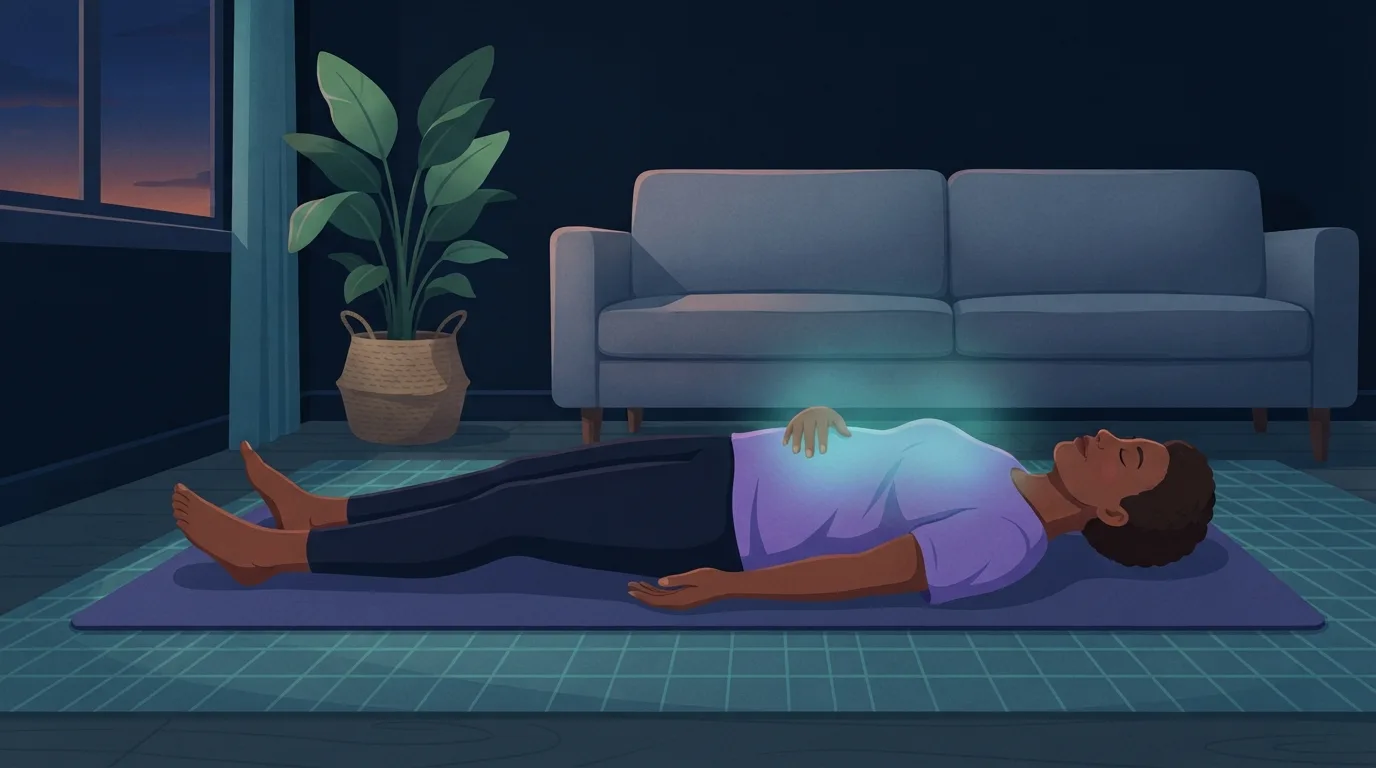
- Never practise standing or walking. Sit with your back supported or lie down on a bed, couch or mat.
- Stop if you feel chest pain, strong dizziness, confusion or hand cramps that don't ease, and breathe normally.
The danger comes from how your body decides when to breathe. The urge to take a breath is driven mostly by rising carbon dioxide, not by falling oxygen. Fast, deep breathing blows off carbon dioxide, so when you then hold your breath, oxygen keeps falling while the carbon dioxide alarm stays quiet. The hold feels easy right up to the point where oxygen is too low for your brain.
The numbers are striking. In Citherlet and colleagues (2021), oxygen saturation in amateur runners fell to an average of 60% (plus or minus 12%) at the end of Wim Hof breath holds. Normal is 95 to 100%. In the 2014 PNAS trial described below, one trained participant's saturation dipped to about 50% for around 10 seconds in each round. On land, sitting down, that usually ends with a gasp and a light head. In water it can end in a blackout under the surface.
This isn't hypothetical. A review of drowning cases in New York State by Boyd and colleagues (2015), published by the CDC, identified 16 cases linked to dangerous underwater breath-holding, including deliberate hyperventilation before going under, and four of them were fatal. The authors explain the mechanism in the same terms: hyperventilation lowers the body's carbon dioxide stores and delays the signal to surface for air.
Who should skip it or talk to a doctor first
- People with epilepsy. Deliberate hyperventilation is a known seizure trigger. A review by Salvati and Beenhakker (2019) notes that it triggers seizures in the vast majority of people with absence epilepsy, which is why neurologists use it during EEG testing.
- Pregnant women. Repeated drops in blood oxygen haven't been studied in pregnancy.
- People with heart disease, an arrhythmia or high blood pressure. The technique produces a sharp rise in adrenaline.
- Anyone with a history of fainting, panic attacks or a lung condition. The tingling and light-headedness of fast breathing can feel like the start of a panic attack.
How to Do the Wim Hof Breathing Method: Step by Step
Here's how to do Wim Hof breathing in a way that keeps the risk low. Plan for 10 to 15 minutes, ideally on an empty stomach, because forceful breathing on a full stomach is uncomfortable.
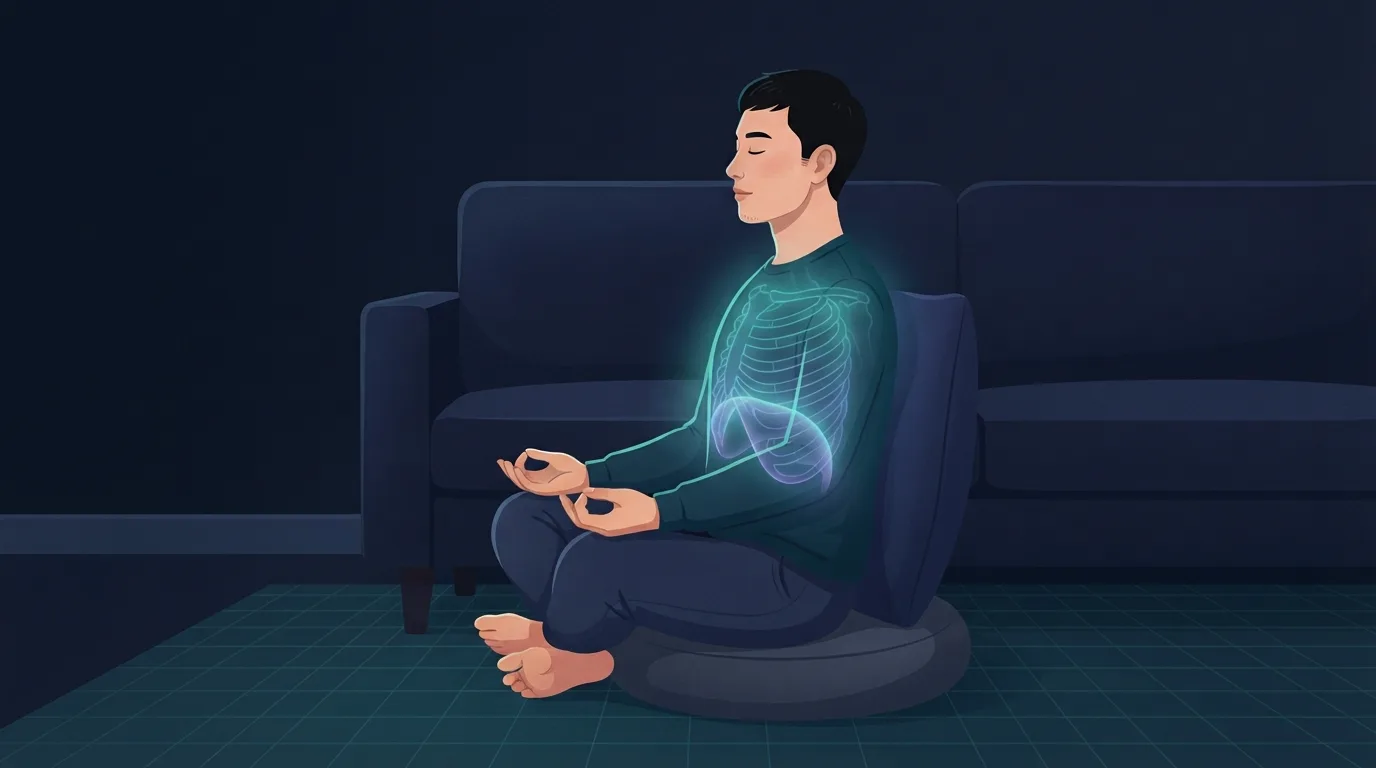
- Get into a safe position. Lie on your back on a mat, bed or couch, or sit with your back supported. Loosen anything tight around your waist or chest.
- Take 30 to 40 deep breaths. Breathe in fully through your nose or mouth, letting your belly rise first and then your chest. Let each breath go without pushing, then breathe in again straight away. Keep a steady, fairly quick rhythm. Beginners should start with 30.
- Breathe out and hold. After the last breath, breathe out normally without forcing every last bit of air, and hold with your lungs mostly empty. Relax your shoulders and let your body go still.
- Breathe in at the first strong urge. Take one full breath in and hold it for about 15 seconds, then let it go. This is the recovery breath.
- Repeat for three or four rounds. Start each round with the deep breathing again.
- Finish slowly. Breathe normally for a minute or two before you sit up, and get up slowly. Don't stand straight away, drive or get into water.
The breath hold isn't a contest. Pushing for a longer time each round is how people end up fainting. Hold until the urge to breathe is clear, then breathe. A guided recording with a voice that counts the breaths and times the holds makes the first few sessions easier; just make sure you're lying down when you use one.
Want a shorter version to start with? In a Stanford study described below, people did three rounds of 30 breaths, each followed by a 15-second hold on empty lungs, in five minutes a day. That's a reasonable first week before you try longer holds.
What Happens in Your Body During Each Round
Each round pushes your blood chemistry in two directions, one after the other.
During the fast breathing
You breathe out carbon dioxide faster than your body makes it. In the Citherlet study, exhaled carbon dioxide at the end of the breathing phase fell to about 19 mmHg, roughly half the usual level. With less carbon dioxide, your blood becomes more alkaline. Researchers measured a blood pH as high as 7.75 in some trained participants, well above the normal range of about 7.35 to 7.45. This is what causes the tingling in your fingers and lips, the light head, and sometimes cramping hands: alkaline blood makes nerves more excitable, and low carbon dioxide narrows the blood vessels in the brain.
During the breath hold
Oxygen in your blood falls steadily, often to 50 to 60% saturation by the end of a long hold, while carbon dioxide climbs back from its low starting point. That's why the hold feels calm. It's also why it's risky anywhere you can't safely fall.
The adrenaline surge
The striking finding in the research is what happens to adrenaline. In the PNAS trial, trained participants' plasma epinephrine peaked at 2.08 nmol/L on average, with some reaching 5.3 nmol/L, while the untrained group's levels stayed low. That surge is the most likely reason people feel alert and energized afterwards, and it's the mechanism behind the immune findings below. Within a few minutes of normal breathing, carbon dioxide and pH return to normal.
Find out what's really holding you back
FitCraft, our mobile fitness app, pairs you with an AI coach who builds you a personalized plan around your goals, schedule, and fitness level. Every FitCraft program is designed by Domenic Angelino, MPH (Brown University) and NSCA-CSCS, with research published in the Journal of Strength and Conditioning Research and Medicine & Science in Sports & Exercise.
Take the Free Assessment Free • 2 minutes • No credit cardDoes the Wim Hof Method Actually Work? What the Studies Show
It depends on what you want it to do. Here are the main trials, what each one tested and what it found.
| Study | Who and what | What it found |
|---|---|---|
| Kox 2014, PNAS | 24 healthy young men; 12 trained for 10 days in breathing, cold and meditation, then all received a bacterial toxin | Adrenaline up, three inflammatory proteins about half as high, peak flu-like symptoms 56% lower |
| Zwaag 2022 | 88 healthy men across two studies; breathing, cold training, both or neither | Breathing alone reduced inflammation; cold alone didn't; the combination worked best |
| Buijze 2019 | 24 people with axial spondyloarthritis, 8 weeks, open label | No safety problems; one inflammation marker and disease activity improved, C-reactive protein didn't |
| Blades 2024 | 84 women with high depressive symptoms, 3 weeks of daily practice | Equal improvement to slow breathing; neither beat the other |
| Balban 2023 | 108 adults, 5 minutes a day for a month | Mood improved, but a slow exhale-focused technique did better |
| Citherlet 2021 | 15 amateur runners, one session before sprinting | No change in sprint power or fatigue |
The endotoxin trial: what Kox 2014 showed
The study that made the method famous is Kox and colleagues (2014) in PNAS. Twelve healthy young men were trained for 10 days by Wim Hof and instructors he had certified, starting with four days of cold exposure and breathing practice in Poland. Twelve similar men weren't trained. Then everyone received an injection of a purified bacterial toxin, a standard lab model that produces flu-like symptoms for a few hours.
The trained men practised the breathing during the experiment. Compared with the untrained group, their levels of three inflammatory proteins (TNF-alpha, IL-6 and IL-8) were 51 to 57% lower, their anti-inflammatory IL-10 was 194% higher, and their peak flu-like symptoms were 56% lower.
What the trial didn't show matters just as much. It tested healthy young men only. It bundled breathing with cold and meditation, so it couldn't say which part mattered. It wasn't blinded, so the participants knew they'd been trained. And a calmer response to an injected toxin isn't the same as catching fewer colds: no trial has tested whether the method prevents real infections.
Breathing or cold: which part does the work?
The same Dutch research group answered part of that question. In Zwaag and colleagues (2022), 40 healthy men learned the breathing exercises in a short or long course, taught either by the method's creator or by an independent trainer. Adrenaline rose the same way regardless of who taught it or for how long. In a second study, 48 men were assigned to cold training, the breathing exercise, both, or neither, and then received the same toxin. Cold training alone didn't change the inflammatory response, the breathing did, and adding cold made the breathing effect stronger.
That makes the breathing, not the ice, the main active ingredient for this particular effect. If cold exposure is what interests you, our review of cold plunge recovery research covers what cold water does after training, and our look at ice bath benefits goes through the cold side of the 2014 trial.
Inflammatory disease
One small trial has tested the full method in people with an inflammatory condition. In Buijze and colleagues (2019), 24 people with axial spondyloarthritis, an inflammatory arthritis of the spine, did eight weeks of breathing, cold exposure and meditation on top of their usual care. The program raised no safety concerns. One blood marker of inflammation, the erythrocyte sedimentation rate, fell from a median of 16 to 9 mm/hr, and a disease activity score also improved, but C-reactive protein didn't change. The authors called it a proof of concept that needs larger trials, not a treatment.
Stress, anxiety and depression
This is where the evidence is most sobering. Blades and colleagues (2024) randomized 84 women with high stress and depressive symptoms to three weeks of daily 15-minute sessions of either the Wim Hof breathing plus cold showers, or slow-paced breathing plus warm showers. Both groups improved by similar amounts: about a 24% drop in depressive symptoms, 27% in anxiety and 20% in perceived stress, and the gains held at three months. The Wim Hof group didn't do better on any of those outcomes. It did show less rumination after stressful days, a small finding the authors said needs replication, and all six people who dropped out were in the Wim Hof group.
A Stanford trial by Balban and colleagues (2023) pointed the same way. It compared 5 minutes a day of three breathing patterns with mindfulness meditation for a month in 108 adults. One pattern was a 30-breath, 15-second-hold cycle very similar to Wim Hof breathing, and it did raise positive mood. But cyclic sighing, a slow technique with a double inhale and a long exhale, produced the biggest improvement in mood and the only drop in breathing rate that beat meditation.
Exercise performance
Athletes sometimes use the technique before training or competition. The only controlled test so far, by Citherlet and colleagues (2021), had 15 amateur runners do a single session of Wim Hof breathing, plain hyperventilation or normal breathing before a repeated-sprint test. Despite the big shifts in oxygen and carbon dioxide, none of the conditions changed peak power, average power or fatigue. The review by Almahayni and Hammond also found the exercise findings mixed.
What it hasn't been shown to do
No published trial has shown that Wim Hof breathing prevents colds or other infections, cures an autoimmune disease, burns fat, or improves endurance. The trials so far are small, short and mostly in young, healthy men, and several involved trainers linked to the method. If you enjoy it and practise it safely, there's no reason to stop. Just keep the claims in proportion to the evidence.
Wim Hof Breathing vs Box Breathing and Slow Breathing
Different breathing techniques push your nervous system in different directions, so the right one depends on what you need in the moment.
| Technique | The pattern | What it does | Best moment |
|---|---|---|---|
| Wim Hof breathing | 30 to 40 fast, deep breaths, then a hold on empty lungs | Lowers carbon dioxide, raises adrenaline, feels energizing | Morning, lying or seated, away from water |
| Box breathing | Inhale, hold, exhale, hold, equal counts | Steadies breathing and attention | Before a stressful task |
| Cyclic sighing | Two inhales through the nose, one long exhale | Slows breathing, calms the body | Stressful moments, before bed |
| Slow diaphragmatic breathing | About 6 slow belly breaths a minute | Slows breathing, calms the body | Daily stress practice, before bed |
The slow techniques have the larger and longer research record for stress. Our review of diaphragmatic breathing research covers the trials behind slow breathing, and if you're more interested in how to breathe during a workout than before one, our piece on nasal breathing during exercise looks at what breathing through your nose changes at different intensities.
What Time of Day Should I Do Wim Hof Breathing?
Morning suits it best for most people. The adrenaline surge leaves you alert, which is useful at the start of the day and unhelpful at the end of it. Many practitioners do their rounds soon after waking, before breakfast, lying in bed or on a mat.
Should you do Wim Hof before bed? For most people, no. A practice that raises adrenaline works against falling asleep. At bedtime, a slow, exhale-focused technique is the better tool: in the Balban trial, cyclic sighing was the pattern that calmed breathing the most.
Before a workout, there's no proven benefit, since the sprint study found none. If you do it anyway, finish a few minutes before you start training so your breathing and blood chemistry settle first. Never do it right before swimming.
What Happens If You Do Wim Hof Breathing Every Day?
The trials used daily practice for 10 days to 8 weeks, and none reported serious harm linked to the practice among people doing it on land under study conditions. Nobody has studied what years of daily practice do. A sensible routine is one session of three or four rounds a day, done in the same safe spot, at the same time, with holds that end at the first strong urge to breathe.
That last part, the same time every day, is where most new habits fall apart, whether it's breathing, stretching or lifting. If what you really want is a daily routine you'll still be doing in two months, our comparison of the best fitness apps for consistency looks at the tools built for exactly that. In FitCraft, 3D AI coaches lead yoga, mobility, strength and cardio sessions, demonstrate every move, and say your name as you train, while a streak makes showing up tomorrow feel like it matters.
The Bottom Line
The Wim Hof breathing method is 30 to 40 deep breaths, an empty-lung hold and a 15-second recovery breath, repeated three or four times. It reliably raises adrenaline, and in two lab trials it blunted the body's inflammatory response to an injected toxin. It hasn't beaten slow breathing for stress or depression, it hasn't improved athletic performance, and no trial shows it prevents illness.
Treat it as an energizing morning practice, not a cure. Do it lying down or seated, keep the holds comfortable, and never do it in or near water, while driving or while standing.
Frequently Asked Questions
Should you do Wim Hof before bed?
It's not a good choice for most people. The fast breathing and breath holds raise adrenaline, which is the opposite of what you want before sleep. If you want a breathing exercise at bedtime, a slow pattern with long exhales, such as cyclic sighing or diaphragmatic breathing, calms the body instead.
What breathing method do navy seals use?
The technique most commonly linked to Navy SEALs is box breathing: inhale, hold, exhale and hold again for equal counts, often four seconds each. It's a steadying technique for staying calm under pressure, and it works very differently from Wim Hof breathing, which uses fast, deep breaths and long holds on empty lungs to raise arousal.
How long can you hold your breath during Wim Hof breathing?
Much longer than usual, often one to three minutes, because the fast breathing lowers carbon dioxide, the main trigger of the urge to breathe. In Kox and colleagues' 2014 trial, trained men held for about two to three minutes per round. That long, easy hold is also why the method is dangerous in water: oxygen can fall to fainting levels before you feel the need to breathe.
Why do my hands tingle during Wim Hof breathing?
Tingling in the hands, feet and lips comes from breathing off carbon dioxide faster than your body makes it. Your blood becomes more alkaline, which changes how nerves fire and can cause pins and needles or cramping fingers. It passes within minutes of normal breathing; if cramping is strong or doesn't ease, stop and breathe slowly.
Is Wim Hof breathing the same as hyperventilation?
It's a controlled, deliberate form of it. Researchers describe the technique as cyclic hyperventilation followed by breath retention: a set of deep, fast breaths that lowers carbon dioxide, then a hold on empty lungs that lowers oxygen. Unlike a panic attack, you choose when it starts and stops.
Can Wim Hof breathing make you pass out?
Yes. In one study, blood oxygen saturation fell to about 60% at the end of the breath holds, far below the normal 95 to 100%. That's why you should only do it sitting or lying down on a stable surface, never in or near water, never while driving and never while standing.