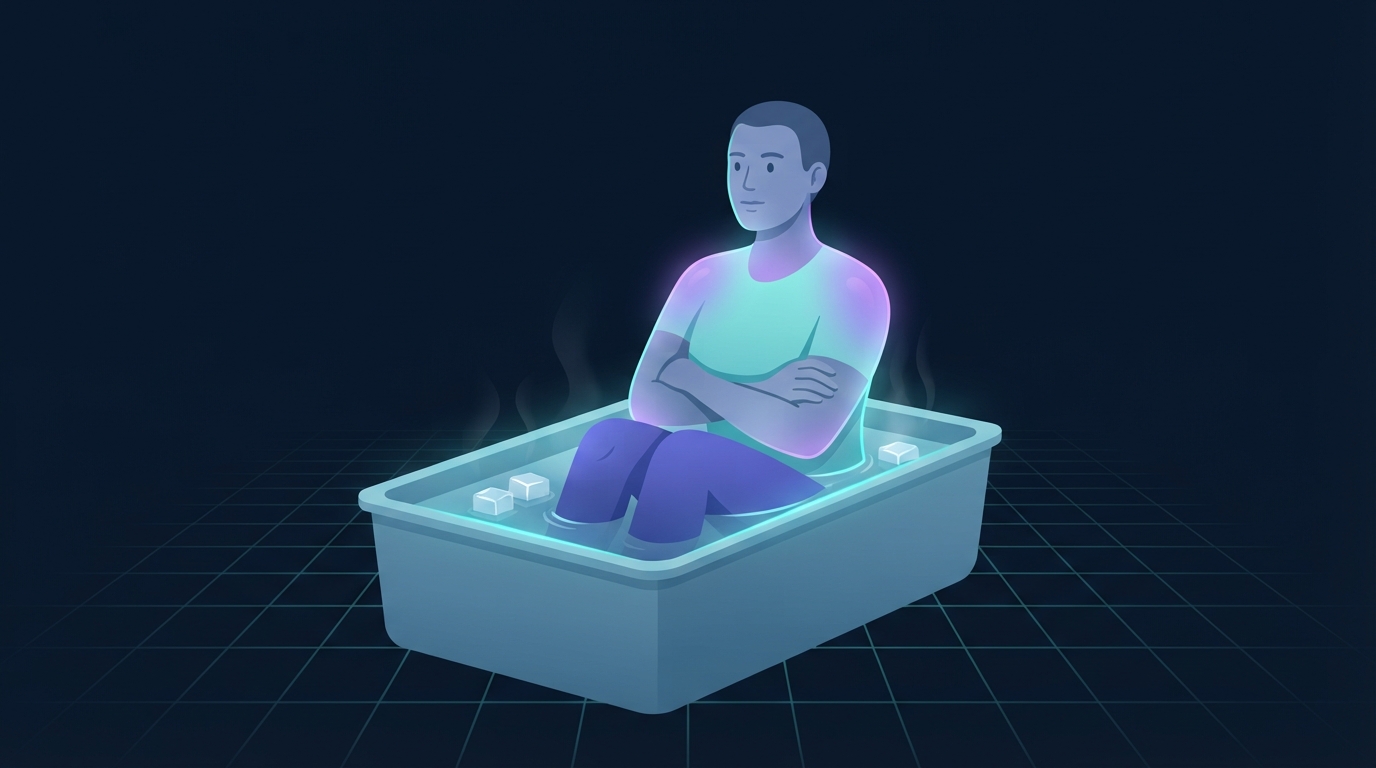
Ice baths have four separate evidence bases pretending to be one. There is a mature sports-recovery literature on soreness and performance. There is a small, newer literature on mood and brain function. There is a mechanistic literature on cold, catecholamines and immune signaling. And there is a metabolic literature on brown fat that almost nobody quotes accurately. The claims get blended together in a single sentence, usually by someone selling a tub.
This page covers the three that are not about soreness. The recovery question already has a home: our review of cold plunge recovery works through the dose-finding meta-analyses and the timing conflict with muscle growth in full, and this page does not repeat that work. What follows is the physiology of the first two minutes, the mood evidence, the immune evidence, the brown fat evidence, the honest dose ranges for each, and the safety picture that cold content routinely skips.
One framing note before the studies. Almost every benefit attributed to cold is really attributed to a stress response, and stress responses are dose-dependent and adaptation-dependent. That is why an intervention can be genuinely useful for mood, useless for fat loss and dangerous in the wrong body, all at once.
What an Ice Bath Does in the First Two Minutes
The most important physiology in an ice bath happens before you settle in. Tipton, Collier, Massey, Corbett and Harper (2017) in Experimental Physiology wrote the reference review across the whole field of cold water immersion, treating it as both a hazard and a treatment. The opening event is the cold shock response.
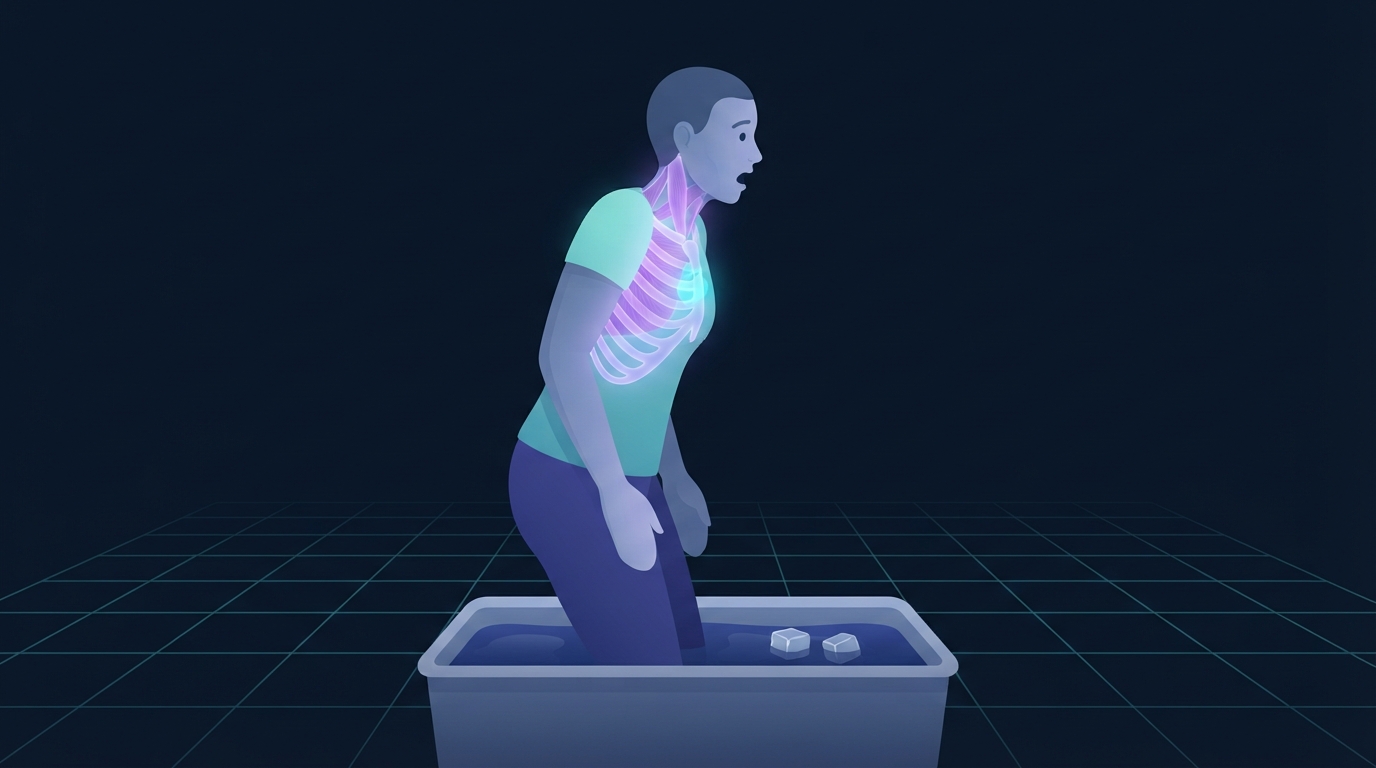
Skin thermoreceptors fire the moment cold water hits a large surface area. The result is an involuntary gasp, then uncontrollable hyperventilation that can run several times resting ventilation, a sharp rise in heart rate, peripheral vasoconstriction and a spike in blood pressure. The response peaks within about 30 seconds and settles over the next two to three minutes. In open water this is the mechanism behind most sudden cold-water drownings, because a gasp underwater is unsurvivable and hyperventilation drops the breath-hold time to a few seconds.
Two other hazards in Tipton's review matter for home tubs. Autonomic conflict, the simultaneous sympathetic drive from cold shock and parasympathetic drive from the diving response when the face is submerged, can produce arrhythmias in susceptible people. And afterdrop, the continued fall in core temperature after you get out as cold peripheral blood returns to the core, is why the shivering often gets worse five minutes after the bath, not during it.
The practical translation is simple and it is the opposite of the usual advice. The last ten minutes of an ice bath are not the hard part. The first thirty seconds are, and controlling your breathing through them is the skill that makes the rest of the exposure safe.
The Research: What Studies Show
Sramek 2000: The Numbers Behind the Post-Plunge High
Sramek, Simeckova, Jansky, Savlikova and Vybiral (2000) ran the study that most cold-exposure claims trace back to, usually without attribution. Participants sat in head-out immersion for one hour at three temperatures on separate occasions: 32, 20 and 14 degrees Celsius.
- At 32 degrees (thermoneutral): heart rate fell 15%, systolic and diastolic blood pressure fell 11 to 12%, metabolic rate did not change. This is what immersion alone does, with no cold stimulus at all.
- At 20 degrees (cool): metabolic rate rose 93%, rectal temperature fell, heart rate and blood pressure still dropped.
- At 14 degrees (cold): metabolic rate rose 350%, heart rate rose 5%, blood pressure rose 7 to 8%, noradrenaline rose 530%, dopamine rose 250%, and adrenaline did not change.
Three things are worth pulling out of that table. First, the catecholamine surge is real and it is large, which explains the sharpened, wired, unusually alert feeling that follows a plunge. Second, adrenaline stayed flat while noradrenaline went up more than fivefold, so the response is a noradrenergic one rather than a generic adrenaline dump. Third, the direction of the blood pressure effect flips with temperature. Warm immersion lowers blood pressure. Cold immersion raises it. That single fact is most of the safety section further down.
Yankouskaya 2023: Mood and Brain Networks After Five Minutes
Yankouskaya, Williamson, Stacey, Totman and Massey (2023) in Biology ran the first functional MRI study of cold water immersion and affect. Thirty-three healthy adults with no cold-water swimming experience, aged 20 to 45, took a 5-minute head-out bath at 20 degrees Celsius. Brain connectivity and self-reported emotional state were measured before and after.
Afterwards participants rated themselves more active, alert, attentive, proud and inspired, and less distressed and nervous. The ratio of positive to negative affect moved from 1.75 before to 3.00 after, which sits at the threshold researchers associate with flourishing rather than merely adequate wellbeing. On the scans, the gain in positive feeling tracked increased coupling between the medial prefrontal cortex and both the anterior insula and the dorsolateral prefrontal cortex, and decreased coupling between the medial prefrontal cortex and the anterior cingulate. The drop in negative feeling did not map cleanly onto any connectivity change.
Keep the scope honest. This is 33 people, one session, no control immersion at a neutral temperature, and an outcome measured minutes afterward. It is a strong mechanistic hint that the mood lift is a genuine brain-state change rather than pure expectation, and it is not evidence that regular ice baths treat any mood disorder.
Buijze 2016: The Trial With 3,018 People
The largest randomized trial in the entire cold literature did not use a tub. Buijze, Sierevelt, van der Heijden, Dijkgraaf and Frings-Dresen (2016) in PLoS One randomized 3,018 Dutch adults aged 18 to 65 to finish their normal shower with 30, 60 or 90 seconds of cold water, or to shower as usual, for 30 consecutive days, then followed everyone to 90 days.
The cold groups recorded 29% fewer days of self-reported sickness absence from work than controls (incident rate ratio 0.71, p = 0.003). The detail that rarely travels with that statistic: the number of illness days did not differ between groups. People in the cold groups got sick about as often. They called in sick less. That is a meaningful outcome, and it is a different outcome from a stronger immune system.
Dose did not matter either. Thirty seconds produced the same result as ninety, which argues against the escalating-duration culture that has grown up around cold exposure. And 79% of the intervention participants completed the full 30-day protocol, which is a genuinely high adherence rate for a daily unpleasant habit.
Kox 2014: Cold, Breathing and the Inflammatory Response
Kox, van Eijk, Zwaag and colleagues (2014) in PNAS ran the study that put cold exposure into immunology journals. Twelve healthy men trained for 10 days in a package of meditation, cyclic hyperventilation with breath retention, and immersion in ice cold water. Twelve untrained men served as controls. Everyone then received an intravenous dose of E. coli endotoxin, a standard experimental model of systemic inflammation.
The trained group released far more epinephrine during the challenge, produced more of the anti-inflammatory mediator interleukin-10, mounted a much smaller pro-inflammatory cytokine response, and reported fewer flu-like symptoms. Against the historical database of more than 100 previous endotoxemia subjects, their response was remarkably blunted.
Two caveats decide how much weight this carries. The intervention bundled cold with a specific breathing protocol, and later work from the same group suggested the breathing was doing much of the work, so the trial cannot isolate cold. And a blunted inflammatory response to injected endotoxin is not the same thing as better defense against real pathogens. It is a demonstration that a voluntary behavior can reach a system long assumed to be involuntary, which is remarkable on its own terms.
van der Lans 2013 and Yoneshiro 2013: What the Brown Fat Trials Actually Did
Brown adipose tissue burns energy to make heat instead of storing it, and its discovery in adult humans is why cold exposure became a metabolism story. Two 2013 trials in the Journal of Clinical Investigation are the ones everyone cites, and almost nobody describes their protocols.
van der Lans and colleagues (2013) exposed 17 healthy adults to 15 to 16 degrees Celsius for 6 hours a day for 10 consecutive days. Brown fat activity and volume increased, and non-shivering thermogenesis rose in parallel. Muscle mitochondrial uncoupling did not contribute meaningfully, and abdominal white fat did not brown.
Yoneshiro and colleagues (2013) exposed subjects to 17 degrees for 2 hours a day for 6 weeks. Brown fat activity rose, cold-induced energy expenditure rose with it, and body fat mass fell, with the two changes inversely correlated.
Now read the protocols again. Sixty hours of mild cold in the first study. Eighty-four hours in the second. Both used cool air in the 15 to 17 degree range, which is roughly a chilly room, not water near freezing. Neither used an ice bath. Brown fat recruitment is a slow adaptation to sustained mild cold, and a 5-minute daily plunge is not a smaller version of that stimulus. It is a different stimulus.
This is also why the ice bath fat-loss claim collapses. Yes, metabolic rate rises 350% while you sit in 14-degree water. Over 10 minutes, on a resting baseline, that is a modest number of calories, and the shivering and appetite response afterward can offset it. If fat loss is the goal, the levers are an energy deficit and resistance training. Our review of what actually raises metabolic rate ranks the options honestly.
Cold Plunge Recovery, Muscle Growth and Contrast Water Therapy, in Three Paragraphs
Recovery. Cold water immersion reliably reduces delayed onset muscle soreness and speeds short-term functional recovery after hard or muscle-damaging sessions, with the pooled protocol evidence landing on roughly 10 to 15 minutes at 5 to 15 degrees Celsius. That literature is mature and it has its own page: see cold plunge recovery and what the research shows for the network meta-analysis, the dose rankings and the caveats.
Muscle growth. The same anti-inflammatory response that dulls soreness also suppresses satellite cell recruitment and anabolic signaling when cold is applied immediately after lifting, which blunts long-term strength and hypertrophy gains. If you lift for size, timing is the whole answer, and our review of ice baths and muscle growth works through the trials that established it.
Contrast water therapy. Alternating hot and cold immersion cuts soreness and preserves strength against sitting still, without producing the sustained vasoconstriction behind the hypertrophy tradeoff. It is a reasonable substitute for lifters. The protocols and the pooled numbers are in our contrast water therapy review.
Get an evidence-based plan built for you
FitCraft, our mobile fitness app, pairs you with an AI coach who builds you a personalized plan around your goals, schedule, and fitness level. Every FitCraft program is designed by Domenic Angelino, MPH (Brown University) and NSCA-CSCS, with research published in the Journal of Strength and Conditioning Research and Medicine & Science in Sports & Exercise.
Take the Free Assessment Free • 2 minutes • No credit cardHow Cold, How Long, and How Often
The single most useful thing to understand about cold dosing is that the studied protocols differ by outcome, and they differ a lot. Lining them up side by side makes the "colder and longer is better" instinct look silly.
- Mood and alertness: 5 minutes at 20 degrees Celsius. That is the Yankouskaya protocol, and it is mild by plunge-culture standards.
- Post-exercise soreness and performance: 10 to 15 minutes at 5 to 15 degrees, from the sports-recovery pooled data covered on the cold plunge page.
- Sickness absence: 30 seconds of cold at the end of a normal shower, daily. Ninety seconds performed no better in Buijze 2016.
- Brown fat and non-shivering thermogenesis: hours per day at 15 to 17 degrees over weeks. Not achievable with a plunge.
- Immune signaling: the Kox protocol was ice water combined with a breathing practice, over 10 days of training, and the cold component cannot be isolated.
Frequency has almost no direct trial evidence outside the daily-shower studies. Most wellbeing protocols in the pooled literature run a few sessions a week. If you lift, keep the plunge off lifting days or at least several hours away from the session. And note the one variable that shows up in every honest review: adherence. A protocol you dread will not survive three weeks, which makes enjoyment a legitimate selection criterion rather than a soft one. That is the same logic behind our roundup of the best fitness apps for consistency: the intervention you repeat beats the optimal one you abandon.
Common Misconceptions
Misconception: "Colder is better"
There is no dose-response curve in the human data that keeps rewarding colder water. The mood trial used 20 degrees. The soreness meta-analyses rank 11 to 15 degree protocols at or above 5 to 10 degree protocols depending on the outcome. What does keep rising as the water gets colder is the cold shock response, the hypothermia risk and the difficulty of staying in long enough to matter.
Misconception: "An ice bath boosts your immune system"
The strongest study, Buijze 2016, found fewer sick days claimed but no fewer illness days experienced. The most striking study, Kox 2014, blunted an inflammatory response to injected endotoxin in 12 men using a bundle of cold plus breathing. Neither result supports the claim that a plunge makes you catch fewer infections. Regular moderate exercise has a considerably stronger immune evidence base than cold exposure does.
Misconception: "Ice baths spike testosterone"
This claim circulates constantly and it has no solid human trial behind it. What Sramek 2000 measured was noradrenaline and dopamine, not sex hormones, and the catecholamine surge is the source of nearly every subjective effect people attribute to an ice bath. Esperland, de Weerd and Mercer (2022) reviewed 104 studies of voluntary cold water exposure in the International Journal of Circumpolar Health and concluded that some effects look beneficial but that small samples, single-gender cohorts and wildly varying protocols keep the field in debate. Hormone claims sit well outside what that evidence supports.
Misconception: "An ice bath and a cold shower are the same thing"
They are not, and the difference runs both ways. Immersion cools far more tissue far more evenly and drives a much larger catecholamine and metabolic response, which is why the recovery literature uses it. But the single biggest randomized health trial used showers, and 30 seconds was enough. Our post on whether cold showers are actually good for you covers that side in detail. For heat as the mirror-image stimulus, the epidemiology on sauna use and cardiovascular outcomes is considerably stronger than anything on the cold side.
Safety: The Part Cold Content Skips
Cold water immersion has a real risk profile, and Tipton's review exists partly because of it. The following are not hypothetical.
- Cold shock. The gasp and hyperventilation in the first 30 seconds is the reason to enter slowly, feet first, with a hand on the rim, and never alone.
- Blood pressure. Sramek 2000 measured a 7 to 8% rise during cold immersion. For most people that is trivial. For uncontrolled hypertension or known cardiac disease it is not.
- Arrhythmia. Face submersion during cold shock creates simultaneous sympathetic and parasympathetic drive, which can trigger arrhythmias in susceptible people, including those with long QT syndrome.
- Afterdrop and hypothermia. Core temperature keeps falling after you exit. Rewarm actively, dry off, add layers, and do not drive or lift immediately after a long cold exposure.
- Cold urticaria and Raynaud's phenomenon. Both are absolute reasons to avoid whole-body cold exposure without medical guidance.
- Alcohol. It impairs shivering and judgment and is present in a large share of cold-water fatalities.
What the Research Suggests Going Forward
Three gaps define the field right now, and none of them are exotic.
First, the wellbeing literature is small and skewed. Cain and colleagues (2025) in PLOS ONE pooled 11 studies and 3,177 participants on cold water immersion for general health, and reported improvements in sleep quality and quality of life alongside a null result for mood and an acute rise in inflammation immediately after exposure. Our cold plunge page covers that analysis in full. The samples are mostly male, the protocols vary wildly, and the follow-up windows are short.
Second, nobody has run the trial that would settle the mood question: a properly controlled comparison of cold immersion against thermoneutral immersion, in the same people, over weeks rather than minutes. Sramek 2000 showed that immersion alone at 32 degrees changes heart rate and blood pressure substantially, so warm immersion is not an inert control, which makes the design harder and the need for it greater.
Third, the dose question for health outcomes is wide open. The recovery side has a network meta-analysis ranking six protocols. The mood, sleep and immune side has single trials at single doses. Until someone maps the temperature-by-duration grid for non-recovery outcomes the way it has been mapped for soreness, anyone prescribing a specific plunge protocol for mood or immunity is extrapolating.
The defensible summary for someone standing in front of a cold tub: expect a reliable short-term lift in alertness and mood, expect real soreness relief if you time it away from lifting, expect nothing for fat loss, and treat the immune and hormone claims as unproven. Then decide whether you like it, because enjoying it is the variable most likely to determine whether you are still doing it in three months.
References
- Sramek P, Simeckova M, Jansky L, Savlikova J, Vybiral S. "Human physiological responses to immersion into water of different temperatures." Eur J Appl Physiol. 2000;81(5):436-442. doi:10.1007/s004210050065
- Tipton MJ, Collier N, Massey H, Corbett J, Harper M. "Cold water immersion: kill or cure?" Exp Physiol. 2017;102(11):1335-1355. doi:10.1113/EP086283
- Yankouskaya A, Williamson R, Stacey C, Totman JJ, Massey H. "Short-Term Head-Out Whole-Body Cold-Water Immersion Facilitates Positive Affect and Increases Interaction between Large-Scale Brain Networks." Biology (Basel). 2023;12(2):211. doi:10.3390/biology12020211
- Buijze GA, Sierevelt IN, van der Heijden BC, Dijkgraaf MG, Frings-Dresen MH. "The Effect of Cold Showering on Health and Work: A Randomized Controlled Trial." PLoS One. 2016;11(9):e0161749. doi:10.1371/journal.pone.0161749
- Kox M, van Eijk LT, Zwaag J, van den Wildenberg J, Sweep FC, van der Hoeven JG, Pickkers P. "Voluntary activation of the sympathetic nervous system and attenuation of the innate immune response in humans." Proc Natl Acad Sci U S A. 2014;111(20):7379-7384. doi:10.1073/pnas.1322174111
- van der Lans AA, Hoeks J, Brans B, et al. "Cold acclimation recruits human brown fat and increases nonshivering thermogenesis." J Clin Invest. 2013;123(8):3395-3403. doi:10.1172/JCI68993
- Yoneshiro T, Aita S, Matsushita M, et al. "Recruited brown adipose tissue as an antiobesity agent in humans." J Clin Invest. 2013;123(8):3404-3408. doi:10.1172/JCI67803
- Esperland D, de Weerd L, Mercer JB. "Health effects of voluntary exposure to cold water: a continuing subject of debate." Int J Circumpolar Health. 2022;81(1):2111789. doi:10.1080/22423982.2022.2111789
- Cain T, Brinsley J, Bennett H, Nelson M, Maher C, Singh B. "Effects of cold-water immersion on health and wellbeing: A systematic review and meta-analysis." PLOS ONE. 2025;20(1):e0317615. doi:10.1371/journal.pone.0317615
Frequently Asked Questions
What are the benefits of an ice bath?
The ice bath benefits with the clearest human data are an immediate lift in alertness and positive mood, a large short-term catecholamine and metabolic response, and reduced muscle soreness after hard training. Sramek and colleagues (2000) measured a 530% rise in noradrenaline, a 250% rise in dopamine and a 350% rise in metabolic rate during one hour of head-out immersion at 14 degrees Celsius. Yankouskaya and colleagues (2023) scanned 33 adults after a 5-minute bath at 20 degrees and found the ratio of positive to negative affect rose from 1.75 to 3.00. Claims about fat loss, immune strengthening and testosterone are far weaker.
Is an ice bath better than a cold shower?
They are different stimuli and they have different evidence bases. A shower cools skin unevenly and briefly, while immersion holds the whole body at a fixed temperature and drives a much larger drop in tissue temperature and a much larger catecholamine response. The recovery and soreness literature is almost entirely on full immersion. The single largest health trial, Buijze 2016 with 3,018 participants, used cold showers rather than baths. If you want the recovery effect, immerse. If you want a low-cost daily habit with one large randomized trial behind it, a cold shower is a defensible starting point.
Do ice baths burn fat?
Not in any amount that changes body composition on its own. Cold does raise energy expenditure sharply while you are in the water, and repeated mild cold exposure recruits brown adipose tissue. But van der Lans 2013 used 15 to 16 degrees Celsius air for 6 hours a day across 10 days, and Yoneshiro 2013 used 17 degrees for 2 hours a day across 6 weeks. Those are long mild exposures, not 5-minute ice baths, and the body-fat change in Yoneshiro was small. An ice bath is a poor fat-loss tool compared with a calorie deficit and resistance training.
Do ice baths boost your immune system?
The honest answer is that cold changes immune signaling but the clinical evidence is thin. Buijze and colleagues (2016) randomized 3,018 adults to routine cold showering and found 29% less self-reported sickness absence from work, with no reduction in the number of illness days, which suggests people worked through illness rather than got sick less often. Kox and colleagues (2014) showed in PNAS that cold exposure combined with breathing techniques raised epinephrine and blunted the inflammatory response to injected bacterial endotoxin, a mechanistic finding in 12 trained volunteers rather than proof of fewer infections.
How cold and how long should an ice bath be?
Match the dose to the goal. For post-exercise soreness and performance recovery, the pooled protocol evidence points to 10 to 15 minutes at 5 to 15 degrees Celsius, which our cold plunge recovery review breaks down by outcome. For mood and alertness, the trial that measured brain and affect changes used just 5 minutes at 20 degrees. For metabolic adaptation, the trials used hours of mild cold rather than minutes of extreme cold. Colder and longer is not automatically better.
Is contrast water therapy better than an ice bath?
For lifters chasing muscle growth, often yes. Contrast water therapy alternates hot and cold immersion, which cuts soreness and preserves strength recovery against sitting still while avoiding the sustained vasoconstriction that drives the post-lift hypertrophy tradeoff. For pure soreness reduction and creatine kinase clearance after high-intensity work, cold water immersion on its own has the larger and better-replicated effect. Pick contrast during muscle-building blocks and straight cold on competition or hard interval days.
Who should not take an ice bath?
Anyone with cardiovascular disease, uncontrolled hypertension, a history of arrhythmia or cardiac events, long QT syndrome, cold urticaria or Raynaud's phenomenon, or who takes beta-blockers or other cardiovascular medication should get medical clearance first. Tipton and colleagues (2017) document the cold shock response, an involuntary gasp followed by uncontrollable hyperventilation, tachycardia and a blood pressure spike, which peaks in the first 30 seconds of immersion and is the mechanism behind most cold-water deaths. Never take an ice bath alone, never enter head-first, and never combine one with alcohol.