Citrulline malate is the strange case in the pre-workout aisle. It is one of the very few ingredients in a typical scoop that has a real meta-analytic base underneath it, and it is also one of the ingredients most people take at the wrong dose in the wrong window and never notice a thing. The effect is small. The effect is also real, replicated, and predictable in a specific slice of training. Almost everything else in a pre-workout blend is caffeine (which works) plus a wall of underdosed proprietary ingredients (which mostly do not).
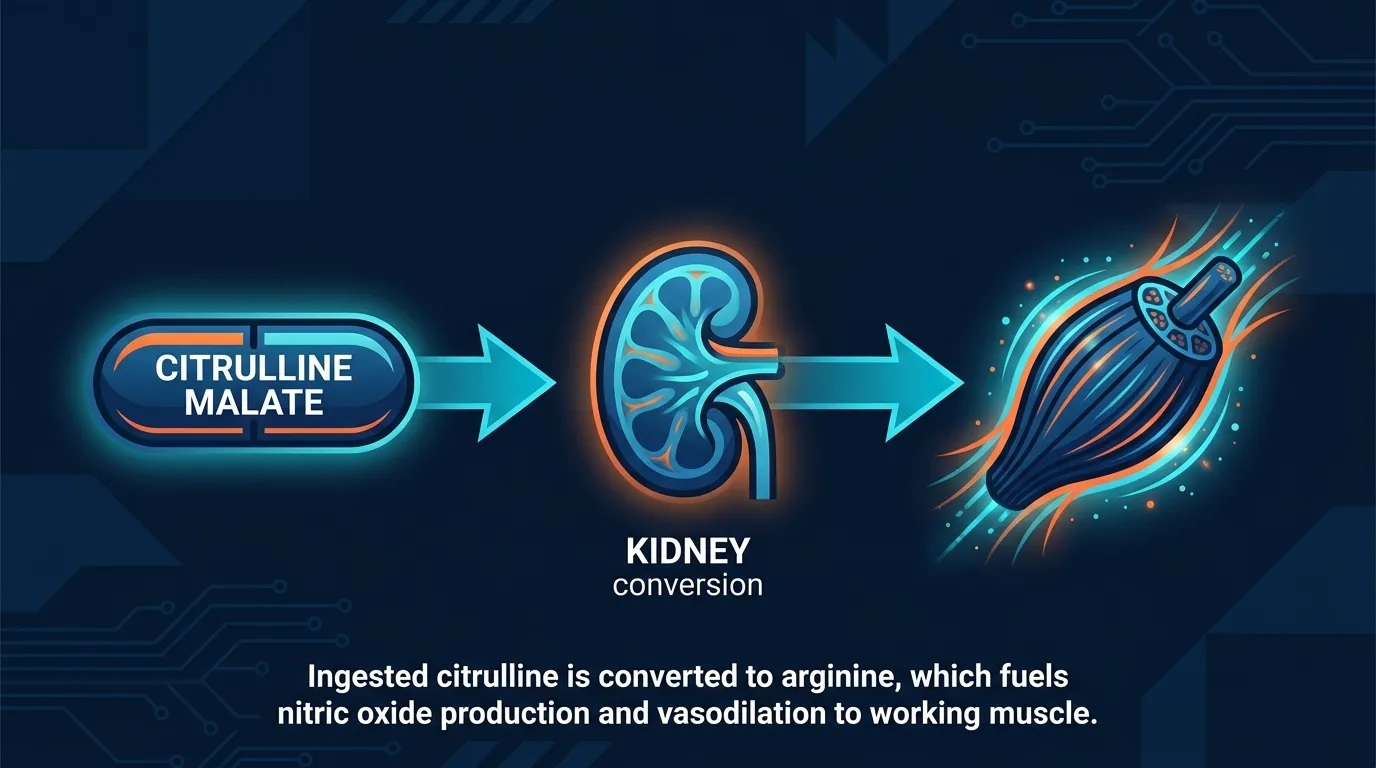
The mechanism is unusually indirect. Citrulline is a non-protein amino acid the body makes as a byproduct of the urea cycle. Supplemental L-arginine, which would seem like the more direct nitric oxide precursor, is a poor supplement in practice because a lot of it gets destroyed by intestinal arginase before it ever reaches circulation. Citrulline, by contrast, is absorbed intact, transported to the kidney, and converted there to arginine, which raises plasma arginine more reliably than arginine tablets do. That arginine feeds nitric oxide synthase, which relaxes vascular smooth muscle, which improves blood flow to working tissue. The malate half of the compound is a Krebs cycle intermediate. Whether it actually contributes to the ergogenic effect on top of the L-citrulline itself is still contested.
The short version, if you skip the rest: 8 grams of citrulline malate, taken 40 to 60 minutes before a session, on days you plan to do 3 or more sets close to failure in the 8-to-15 rep range. Expect roughly 3 extra reps on your last set, on average, and possibly noticeably less soreness the next two days. Do not expect a bigger 1-rep max, faster endurance times, or a life-changing pump. And do not expect much from a pre-workout scoop that lists "citrulline malate" in a proprietary blend without a number, because the effective dose is 8 grams and most blends carry a fraction of that.
The Research: What Studies Show
Pérez-Guisado 2010: The Foundational Trial
The paper that put citrulline malate on the pre-workout map is Pérez-Guisado and Jakeman (2010), published in the Journal of Strength and Conditioning Research. Forty-one trained men each did two sessions of 8 sets of flat barbell bench press to failure at 80 percent of their 1-rep max, one session preceded by 8 g of citrulline malate and one preceded by placebo, in randomized crossover order.
The reps-per-set advantage over placebo grew across the session. It was small on the early sets and reached 52.9 percent more reps on the final (eighth) set, where 100 percent of participants responded (every subject did more reps on citrulline malate than on placebo). Muscle soreness measured on a 0-to-10 scale was roughly 40 percent lower at both 24 and 48 hours post-session, with more than 90 percent of participants reporting less soreness on citrulline malate than on placebo. The soreness finding has not been reproduced with the same magnitude in every follow-up trial, but the reps-extension finding has held up in the meta-analytic pooling that came later.
That single study is small (n=41) and the effect size looks improbably large on face, but its design was tight: within-subject crossover, standardized loading, tight protocol control. It set the dose (8 g), the timing (40 to 60 minutes pre-exercise), and the outcome (reps close to failure on multi-set, high-intensity resistance work) that essentially every subsequent trial has echoed.
Trexler 2019: The First Systematic Meta-Analysis
By the late 2010s the literature had enough independent trials to run a formal synthesis. Trexler, Persky, Ryan, Schwartz, Stoner, and Smith-Ryan (2019), publishing in Sports Medicine, screened the human ergogenic literature and pooled 12 studies (13 independent samples) covering 198 participants across resistance and high-intensity performance measures.
The pooled standardized mean difference (Hedges' g) came out to 0.20, with a 95 percent confidence interval of 0.01 to 0.39 and a p-value of 0.036. In plain terms: statistically significant, but small. That effect size is right around the boundary between "detectable in a well-powered study" and "irrelevant to a recreational lifter." The Trexler pool was heterogeneous, mixing different exercise modalities, dose forms (L-citrulline versus citrulline malate), and outcomes, which likely diluted the signal. It nonetheless confirmed the direction of the Pérez-Guisado finding without depending on it.
The Trexler paper is also the honest one on interpretation. The authors note that a 0.20 effect size may matter to competitive athletes chasing marginal gains but is likely below the noise floor for most recreational trainees. That framing is closer to reality than the marketing that surrounds most pre-workout ingredients.
Vårvik 2021: The Rep-Specific Meta-Analysis
The tightest and most useful synthesis for a lifter's actual question is Vårvik, Bjørnsen, and Gonzalez (2021), publishing in the International Journal of Sport Nutrition and Exercise Metabolism. Rather than pool everything, they restricted inclusion to double-blind, placebo-controlled trials measuring repetitions to failure during upper- or lower-body resistance exercise. That gave them 8 trials covering 137 participants: 101 strength-trained men, 26 women, and a small group of untrained men.
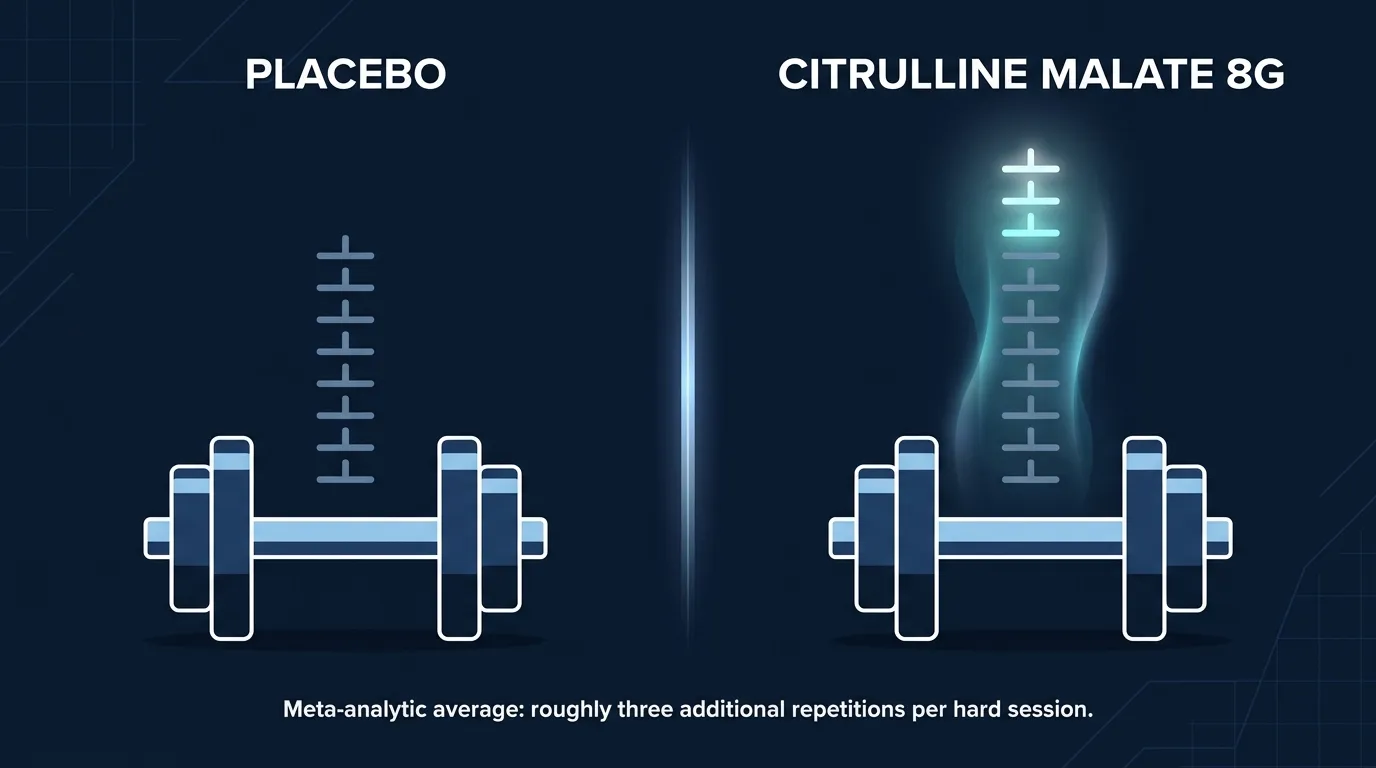
The pooled result: 8 g of citrulline malate taken 40 to 60 minutes pre-exercise added, on average, about 3 additional repetitions to failure across the session, or a 6.4 percent increase in total reps compared with placebo. That effect is larger than the Trexler pool suggests because Vårvik measured the outcome (reps close to failure) where the mechanism should show up cleanest, in a standardized dose window, using the specific compound (citrulline malate, not plain L-citrulline). It is the closest thing the field has to a clean estimate of "how much does this do for a lifter, on the outcome a lifter cares about."
The number to hold in your head: 3 extra reps. Not per set. Roughly, across a hard session of multiple sets to failure. That is not a life-changing swing. It is also not zero, and over months of training it compounds into meaningfully more accumulated volume, which is one of the more reliable drivers of hypertrophy over time.
Harnden 2023: The Endurance Question
Endurance is a different story. Harnden, Agu, and Gascoyne (2023), publishing in the Journal of the International Society of Sports Nutrition, screened the endurance-specific literature and pooled 9 trials covering 158 participants. The outcomes were time-to-exhaustion and time-to-completion at endurance intensities.
The pooled effect was essentially zero. Time-to-exhaustion produced a standardized mean difference of 0.03; time-to-completion, minus 0.07. Both confidence intervals crossed zero comfortably. The authors concluded that the current evidence does not support citrulline supplementation as a meaningful endurance aid. They flagged the usual caveats (small female sample, mostly single-dose acute protocols, limited long-distance data), but the direction is clear: whatever citrulline malate is doing for a lifter's rep-out set, it is not doing for a cyclist's 40-km time trial.
Gonzalez 2023: The L-Citrulline Test
One of the underappreciated wrinkles in this literature is that most positive trials used citrulline malate, and most negative trials used plain L-citrulline. Gonzalez, Yang, Mangine, Pinzone, Ghigiarelli, and Sell (2023), publishing in the Journal of Functional Morphology and Kinesiology, gave 18 recreationally resistance-trained participants (11 men, 7 women) an 8 g dose of plain L-citrulline before an acute resistance session and measured isometric force, ballistic bench press velocity and power, repetitions and volume during strength-endurance sets, and near-infrared spectroscopy measures of muscle oxygenation.
Result: nothing significant on any outcome. Force did not rise. Bench press power did not rise. Reps did not rise. Muscle oxygenation did not shift. That is one small study and it does not overturn Vårvik, but it is a real datapoint suggesting the malate half of citrulline malate may not be inert. The head-to-head trials that would definitively answer "malate versus no malate at matched L-citrulline dose" are still thin on the ground. Until they get run, using the citrulline malate form matches the compound most positive trials actually studied.
How Citrulline Malate Actually Works
The clearest way to understand the mechanism is to compare it with plain L-arginine, which was the original nitric-oxide-precursor supplement and which turned out to be a disappointment. When you swallow L-arginine, a significant fraction is destroyed by intestinal arginase before it ever gets to the bloodstream. Plasma arginine rises less than the label dose would suggest, and it rises with a lot of individual variability. That is why L-arginine supplements consistently underperform in ergogenic trials despite being the "logical" nitric oxide precursor on paper.
Citrulline is different. It is absorbed intact, taken up by the kidney, and converted to L-arginine inside the body, downstream of intestinal arginase. The result is that a gram of oral citrulline raises plasma arginine more than a gram of oral arginine does. That arginine then feeds endothelial nitric oxide synthase, which produces nitric oxide, which relaxes vascular smooth muscle and improves blood flow to working tissue. Improved blood flow means faster delivery of oxygen and substrate to the muscle and faster clearance of metabolic byproducts, which is the plausible mechanism for the extra reps on set 8 in the Pérez-Guisado trial.
The role of the malate portion is less clean. Malate is a Krebs cycle intermediate, and one hypothesis is that it accelerates ATP resynthesis via oxidative phosphorylation. That hypothesis has been floated more than it has been tested. What is testable is whether trials using citrulline malate produce different results than trials using plain L-citrulline at matched L-citrulline dose, and here the evidence is suggestive rather than conclusive: the positive resistance-training literature is dominated by malate-form studies, and several plain L-citrulline trials in the same dose range have come up empty. That pattern is consistent with malate contributing something. It is also consistent with study heterogeneity, publication bias, or coincidence. Take it seriously enough to use the malate form until better data lands.
The duration signature also matters. Because the mechanism is a plasma arginine rise driving nitric oxide production, the effect is acute. Plasma citrulline peaks about 60 minutes after oral ingestion of an 8 g dose and returns near baseline within about 4 to 8 hours. Unlike creatine or beta-alanine, there is no chronic tissue accumulation to build. You take it before training. It works or does not work in that session. Then it clears.
Why This Matters for Your Fitness
If your training is heavy on moderate-rep resistance work close to failure (rep-out sets in the 8 to 15 zone, drop sets, giant sets, back-to-back sets with short rest), citrulline malate is one of the few pre-workout ingredients with a specific evidence base for exactly what you are doing. The effect is small (3 extra reps on average across a session, per the Vårvik meta-analysis), which is small in the moment and meaningful over months of accumulated volume.
If your training is heavy on maximal strength work at 90+ percent of 1-rep max, low-rep singles and doubles, or short-duration explosive work, the ergogenic case is weaker. The Trexler meta-analysis pooled some of that data and found a small overall benefit, but the mechanism (vasodilation-driven blood flow to working tissue over multiple reps) does not fit a single max effort. Nothing in the citrulline literature moves a 1-rep max meaningfully.
If your training is primarily endurance (running, cycling, rowing at aerobic intensities), the Harnden meta-analysis says the evidence does not currently support citrulline as ergogenic. The mechanism should in principle help, and a handful of individual studies have shown improvements in tests like time-to-exhaustion at fixed workload, but the pooled effect is essentially zero and confidence intervals cross into "the placebo did slightly better." Save the money for something with a better endurance evidence base like beetroot juice, or spend it on caffeine, which has by far the strongest endurance evidence of any legal supplement.
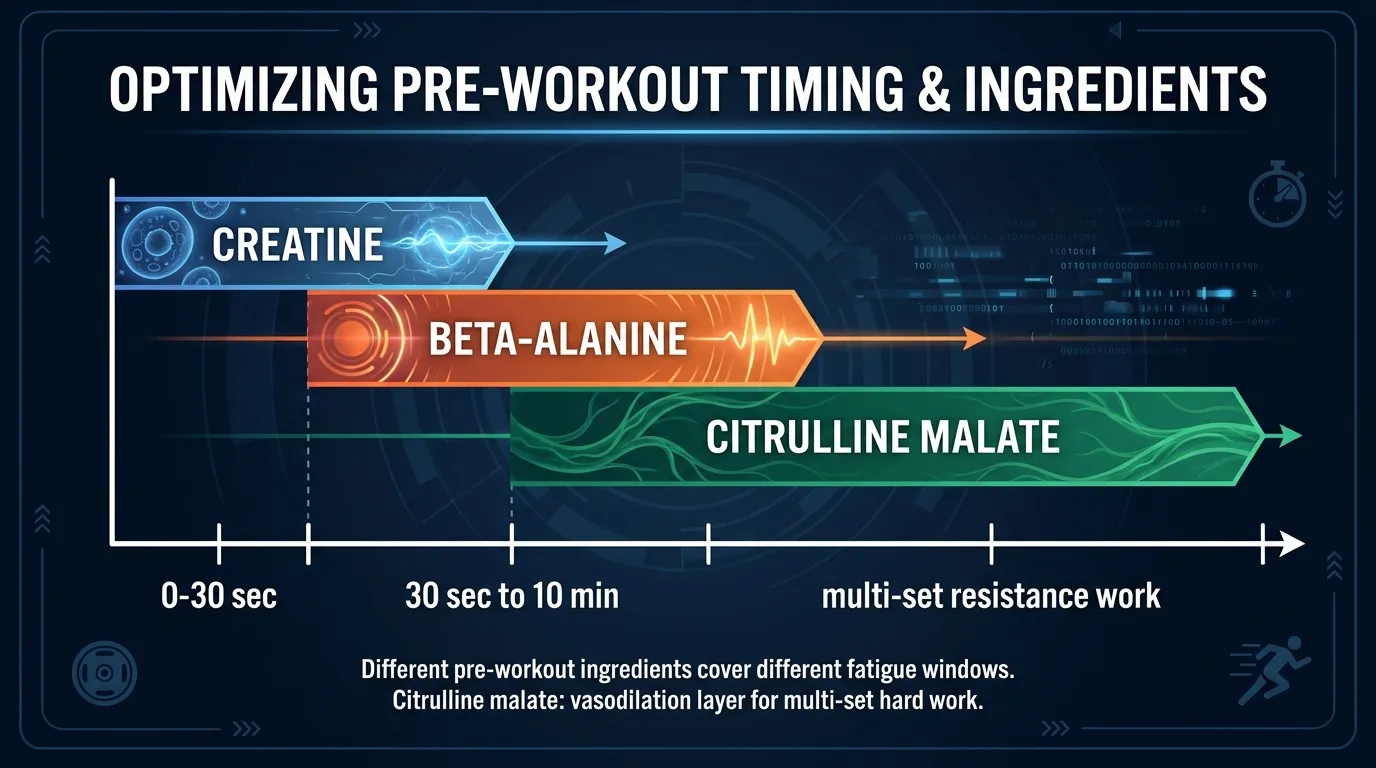
Citrulline malate stacks well with the other three ISSN-endorsed ergogenic aids, and the stacking case is stronger than for most supplement combinations. Creatine, caffeine, beta-alanine, and citrulline malate all target different fatigue mechanisms in different exercise windows. Creatine handles the 0-to-30-second window via phosphocreatine. Beta-alanine handles 30 seconds to 10 minutes via carnosine buffering. Caffeine works on central nervous system perception of effort. Citrulline malate adds a vasodilation layer on top of any of them without redundant mechanism. There is no reason to pick one over the others if your training uses all three energy systems.
What citrulline malate will not fix is inconsistent training. The trials that show benefit ran subjects through prescribed protocols with prescribed doses on prescribed days. If you take a pre-workout scoop on the two sessions you make it to per week when you meant to train four, no supplement closes that gap. The biggest predictor of results over months is whether you keep stringing sessions together, and that is a behavior problem, not a chemistry problem.
Get an evidence-based plan built for you
FitCraft, our mobile fitness app, pairs you with an AI coach who builds you a personalized plan around your goals, schedule, and fitness level. Every FitCraft program is designed by Domenic Angelino, MPH (Brown University) and NSCA-CSCS, with research published in the Journal of Strength and Conditioning Research and Medicine & Science in Sports & Exercise.
Take the Free Assessment Free • 2 minutes • No credit cardHow to Use Citrulline Malate in Practice
The protocol from the positive literature, translated into a workable routine:
- Dose: 8 grams of citrulline malate. That is the dose in Pérez-Guisado (2010) and the dose pooled in the Vårvik (2021) meta-analysis. Lower doses (3 to 6 g) show inconsistent effects across trials, likely because plasma arginine does not rise high enough to change vasodilation meaningfully. Higher doses (10+ g) do not appear to add proportional benefit and start to cause gastrointestinal complaints in a nontrivial fraction of users.
- Timing: 40 to 60 minutes before training. Plasma citrulline peaks around the 1-hour mark after oral ingestion. Taking it 5 minutes pre-workout misses the peak. Taking it 2 hours pre-workout misses it on the other end.
- Form: the malate salt, not plain L-citrulline. The positive resistance-training literature is dominated by studies of citrulline malate. Plain L-citrulline trials at matched L-citrulline dose have been inconsistent, including the null Gonzalez (2023) trial. The head-to-head data is thin, so until it improves, matching the form used in the trials that showed benefit is the safest choice.
- Take it on training days, not rest days. No accumulation benefit exists to justify daily dosing. Save the doses (and the money) for the sessions where you actually want the effect.
- Use it on hard sessions, not easy ones. The mechanism should shine on rep-out sets, drop sets, sets with short rest, high-volume hypertrophy work. It does nothing meaningful for a warm-up, an easy zone 2 ride, or a mobility session. Do not waste the dose.
- Do not expect anything on a single serving. Some people notice a subjective pump. Some people notice they can eke out one more rep. Many people notice nothing on any single session and only see the effect in retrospect over weeks of consistent use, and even then it is subtle. The literature says the average benefit is roughly 6 percent extra reps, not "a new PR every workout."
- If you use a pre-workout blend, check the citrulline malate line item. Many commercial blends list "citrulline malate" at 1 to 4 g per scoop, well below the effective dose. If the blend uses a proprietary formula that does not disclose the number, assume it is underdosed. Consider dosing bulk citrulline malate powder separately, on top of or instead of your usual pre-workout.
- Do not stack with L-arginine. The whole reason citrulline works better than arginine is that arginine gets destroyed in the gut. Adding L-arginine on top does nothing useful and adds cost.
Individual Variation: Who Responds Most
Training Modality
The cleanest signal in the meta-analytic data is on multi-set resistance work in the 8-to-15 rep range close to failure. Bodybuilding-style volume protocols, drop sets, hypertrophy blocks with short rest intervals, kettlebell complexes, and dumbbell circuits all fit the window. Powerlifters training 1-to-3-rep singles at 90 percent-plus, endurance runners on steady zone 2 miles, and yoga sessions are outside the window where the ergogenic effect has been demonstrated.
Training Status
The Vårvik pool included 101 trained men, 26 women, and untrained men. Effect sizes were reasonably consistent across those subgroups. The 2019 Trexler pool did not find that training status meaningfully moderated the outcome. Practically, both trained and untrained lifters seem to respond, though the trained-lifter data is far larger and more precise.
Sex and Age
Most of the citrulline malate ergogenic trials to date have been run in young to middle-aged trained men. The female sample is small (26 women in the Vårvik pool), and older-adult data specifically for citrulline malate is thin. Basic pharmacokinetics do not vary meaningfully by sex or age, and there is no signal in the existing data of a differential ergogenic response, but the confidence interval is wider for those subgroups. If you are outside the modal study demographic, treat the average effect estimate as a rough guide, not a precise prediction.
Diet
Endogenous citrulline production and dietary sources (watermelon is the highest, along with small amounts in various nuts and legumes) do not meaningfully move plasma citrulline compared with an 8 g supplemental dose. Vegans, vegetarians, and omnivores all start from roughly the same baseline in the context of this dose. Watermelon specifically has been studied as a whole-food alternative, but the citrulline content per serving is low enough that hitting an ergogenic dose from watermelon alone would require several liters of juice.
Common Misconceptions
Misconception 1: "Citrulline gives you a pump the way caffeine gives you a stim."
Sometimes. Not always. The mechanism is vasodilation, which should mechanically produce a bigger pump, but the subjective pump varies enormously across trials and individuals. Objective muscle-oxygenation measures have been inconsistent, including the null result in Gonzalez (2023). If you notice a bigger pump on citrulline malate, great; if you do not, the ergogenic case still rests on the extra reps and the possible soreness reduction, not on the pump itself.
Misconception 2: "L-citrulline and citrulline malate are basically the same."
They are related, and the L-citrulline half is doing most of the mechanism. Whether the malate portion adds anything on top is genuinely open, but the pattern in the literature is that positive resistance-training trials mostly used the malate form and several plain L-citrulline trials at matched dose have come up empty. Until better head-to-head data lands, match the form used in the trials that showed the effect.
Misconception 3: "More citrulline means more benefit."
Not beyond 8 g. The dose-response is not linear. Doubling to 15 or 20 g does not double the plasma arginine peak or the ergogenic effect. It does reliably produce gastrointestinal side effects (bloating, loose stools) in a fraction of users. The 8 g dose is where the trials landed the effect, and there is no research-backed reason to go higher.
Misconception 4: "Citrulline works acutely like caffeine, so timing does not matter much."
Timing matters, just in a different way than caffeine. Plasma L-citrulline peaks about 60 minutes after ingestion of an 8 g dose. Taking it 5 minutes before you lift is too late; the peak arrives after your best sets are already done. Taking it 3 hours before is too early. The 40-to-60 minute window is where the positive trials placed the dose, and it is where you should put it too.
Misconception 5: "Citrulline in a pre-workout blend is the same as bulk citrulline malate."
Only if the blend actually contains 8 g per scoop, which most do not. Many commercial pre-workouts list 1 to 4 g of citrulline malate per scoop, or bury it in a proprietary blend that does not disclose the specific amount. At 1 g, the ingredient is essentially decorative on the label. If you want the ergogenic effect, either buy a pre-workout that discloses 8 g of citrulline malate per scoop, or dose bulk citrulline malate separately.
What the Research Suggests Going Forward
The citrulline malate literature is in reasonable shape for a supplement, though not as tight as the beta-alanine or creatine literature. The direction of the resistance-training effect (small but real, concentrated on reps close to failure at 8 g pre-workout) is consistent across two meta-analyses covering 20 trials and roughly 335 participants. The endurance direction (essentially null pooled effect) is also consistent. The mechanism (plasma arginine and nitric oxide production) is well characterized. Safety at the recommended dose is well established.
What is still open:
- Whether the malate portion is genuinely ergogenic on top of L-citrulline alone. Head-to-head, dose-matched trials of citrulline malate versus plain L-citrulline are the study the field most needs, and there are only a handful of them.
- Whether chronic daily dosing (weeks of 8 g/day) produces different outcomes than acute pre-workout dosing. Almost all positive trials used single-dose pre-exercise protocols, so the chronic loading question is largely unstudied.
- Whether the soreness-reduction finding in Pérez-Guisado (2010) is reproducible at the same magnitude, or whether the original 40 percent reduction was an inflated estimate that has quietly regressed toward zero in follow-up work.
- Whether the female and older-adult subgroups respond similarly to the young-trained-male majority in the existing data. Underrepresented populations mean wider confidence intervals for those groups specifically.
- Whether the ergogenic effect on rep-count actually translates to more hypertrophy over months of loading. The extra reps clearly happen. Whether they compound into meaningfully more muscle at the end of a hypertrophy block is a longer trial that has not been run cleanly.
The bottom line for someone deciding whether to try it: citrulline malate is one of the few pre-workout ingredients that has any meta-analytic evidence base at all. The effect is small (roughly 3 extra reps per session, per Vårvik) and specific to hard, multi-set resistance work close to failure. It costs relatively little to try, is well tolerated at the effective dose, and is one of the safer bets on the shelf. If you race intervals, run easy miles, chase a 1-rep max, or train inconsistently, it is not the right tool. If you run hard hypertrophy sessions with sets in the 8-to-15 rep range and want a small evidence-backed edge on accumulated volume over months, an 8 g dose 40 to 60 minutes before training is a defensible use.
And if the training itself is inconsistent, no pre-workout closes that gap. Consistency beats every ergogenic supplement ever tested, and it costs nothing.
References
- Pérez-Guisado J, Jakeman PM. "Citrulline malate enhances athletic anaerobic performance and relieves muscle soreness." J Strength Cond Res. 2010;24(5):1215-1222. doi:10.1519/JSC.0b013e3181cb28e0
- Trexler ET, Persky AM, Ryan ED, Schwartz TA, Stoner L, Smith-Ryan AE. "Acute Effects of Citrulline Supplementation on High-Intensity Strength and Power Performance: A Systematic Review and Meta-Analysis." Sports Med. 2019;49(5):707-718. doi:10.1007/s40279-019-01091-z
- Vårvik FT, Bjørnsen T, Gonzalez AM. "Acute Effect of Citrulline Malate on Repetition Performance During Strength Training: A Systematic Review and Meta-Analysis." Int J Sport Nutr Exerc Metab. 2021;31(4):350-358. doi:10.1123/ijsnem.2020-0295
- Harnden CS, Agu J, Gascoyne T. "Effects of citrulline on endurance performance in young healthy adults: a systematic review and meta-analysis." J Int Soc Sports Nutr. 2023;20(1):2209056. doi:10.1080/15502783.2023.2209056
- Gonzalez AM, Yang Y, Mangine GT, Pinzone AG, Ghigiarelli JJ, Sell KM. "Acute Effect of L-Citrulline Supplementation on Resistance Exercise Performance and Muscle Oxygenation in Recreationally Resistance Trained Men and Women." J Funct Morphol Kinesiol. 2023;8(3):88. doi:10.3390/jfmk8030088
Frequently Asked Questions
Does citrulline malate actually improve exercise performance?
Yes, but modestly and mostly for one thing. Vårvik and colleagues (2021, International Journal of Sport Nutrition and Exercise Metabolism) pooled 8 double-blind trials covering 137 participants and found that 8 g of citrulline malate taken 40 to 60 minutes before training added about 3 extra repetitions to failure, roughly a 6.4 percent increase. Trexler and colleagues (2019, Sports Medicine) pooled 12 studies covering 198 participants and reported a small overall benefit for high-intensity strength and power outcomes (standardized mean difference 0.20, p=0.036). Endurance-only synthesis by Harnden and colleagues (2023) found no significant benefit. The clean summary: modest help for rep-extension on hard sets, minimal help for endurance or a 1-rep max.
How much citrulline malate should I take, and when?
The dose that shows up in every ergogenic trial is 8 grams of citrulline malate (roughly 4.5 g of L-citrulline paired with 3.5 g of malate) taken 40 to 60 minutes before training. That is the protocol Pérez-Guisado and Jakeman used in the 2010 foundational study and the dose the 2021 Vårvik meta-analysis pooled. Lower doses (3 to 6 g) show inconsistent effects, likely because plasma L-citrulline does not rise high enough to meaningfully feed arginine and nitric oxide production. Timing matters here in a way it does not for creatine or beta-alanine: citrulline malate is an acute, pre-workout supplement, not a chronic loader.
What is the difference between L-citrulline and citrulline malate?
Citrulline malate is L-citrulline bonded to malic acid (a Krebs cycle intermediate) in roughly a 1.11:1 or 2:1 ratio depending on the manufacturer. An 8 g citrulline malate dose delivers about 4 to 6 g of L-citrulline plus 2 to 4 g of malate. Whether the malate portion does anything ergogenic on top of L-citrulline alone is genuinely unsettled. Most positive resistance-training trials used the malate form; several plain L-citrulline trials, including Gonzalez and colleagues (2023, Journal of Functional Morphology and Kinesiology), failed to show a benefit at 8 g. Until head-to-head data is stronger, using the malate form at 8 g is the evidence-backed default.
Does citrulline malate reduce muscle soreness?
The original Pérez-Guisado and Jakeman (2010) trial reported roughly 40 percent lower delayed-onset muscle soreness at 24 and 48 hours after a heavy bench-press session, with more than 90 percent of participants responding on that outcome. The finding has not been reproduced with the same magnitude in every follow-up study. Real, but treat the size of the soreness effect as an upper bound rather than a guarantee.
Does citrulline actually give you a bigger pump?
Citrulline raises plasma L-arginine more effectively than L-arginine supplements do (because arginine gets destroyed in the gut before absorption), and that arginine feeds nitric oxide synthase, which drives vasodilation. So the mechanism for a pump is real. The subjective pump is highly variable across trials, and objective muscle-oxygenation measures have been inconsistent. Gonzalez and colleagues (2023) found no significant change in muscle oxygenation after 8 g of L-citrulline during resistance work. Some people notice a bigger pump on it, some do not. If a pump matters to you, try it and judge for yourself; the ergogenic case rests on the extra reps and the soreness data, not the pump.