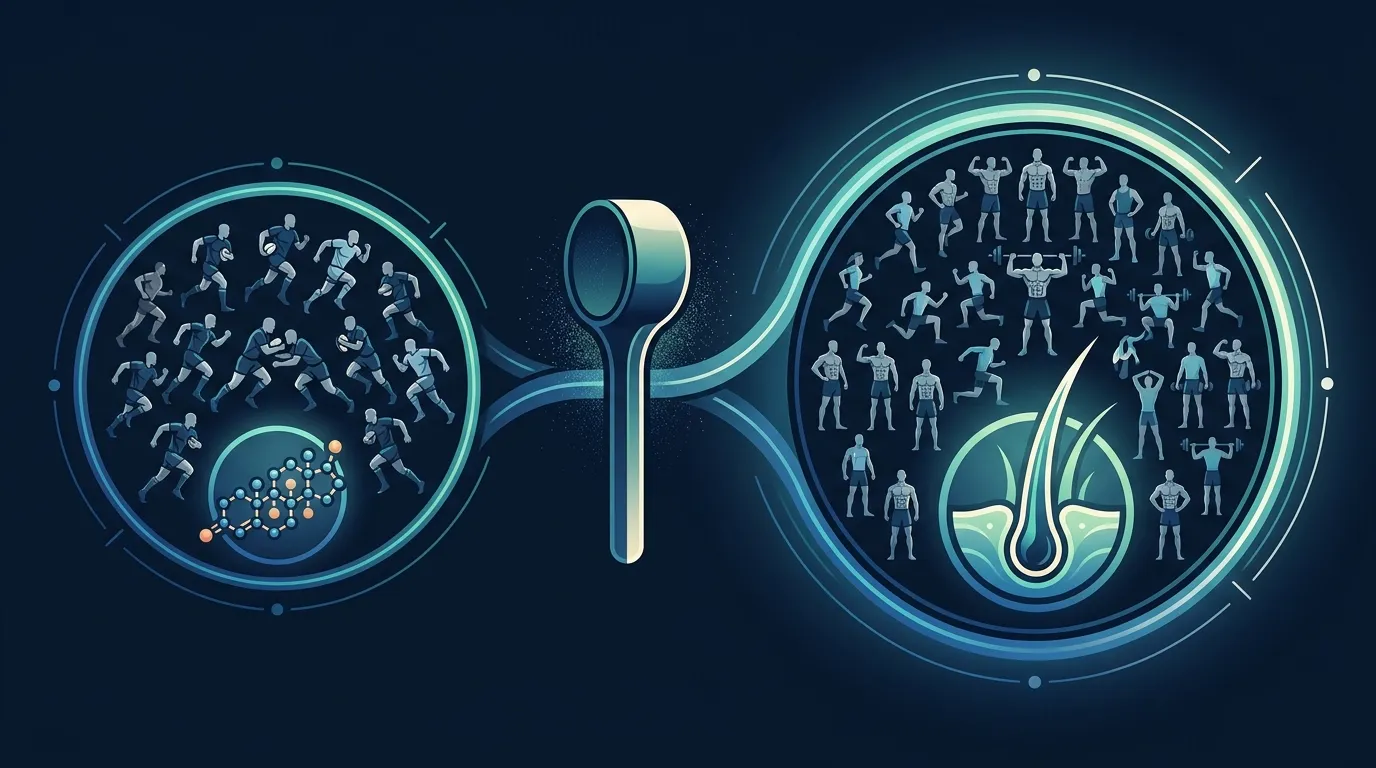
Almost every conversation about creatine eventually reaches the same worry. Someone posts on r/Fitness or r/xxfitness asking whether creatine causes hair loss. A dozen replies say yes, one guy says his hairline receded, three replies point at "the rugby study," and a physician chimes in to say the evidence is weak. Meanwhile the industry keeps selling monohydrate by the ton and researchers keep publishing that it's one of the most-studied and safest ergogenic aids in sports nutrition.
The disconnect is real. It's also solvable. The claim has one primary source, that source has one specific limitation (it never measured hair), and the follow-up work has been consistent. Now, in 2025, we finally have the direct study everyone was waiting for. Let's walk through it.
This is part of our broader creatine coverage. If you want the bigger picture, see creatine loading vs maintenance, creatine's brain benefits, and the practical do I need creatine question. This page focuses narrowly on the hair-loss claim.
What does the research on creatine and hair loss actually show?
van der Merwe 2009: The Study That Started It
The whole story traces back to a single trial. van der Merwe, Brooks, and Myburgh (2009), published in the Clinical Journal of Sport Medicine, gave 20 college-aged male rugby players a 3-week creatine or placebo protocol: 25 grams per day for 7 days (loading), then 5 grams per day for 14 days (maintenance). The researchers measured serum androgens at baseline, at the end of loading, and at the end of maintenance.
In the creatine group, DHT rose about 56 percent after loading and remained about 40 percent above baseline after maintenance. The DHT to testosterone ratio rose about 36 percent after loading and about 22 percent at the end of maintenance. Testosterone itself did not change significantly. The absolute DHT values stayed within the standard clinical reference range at every time point.
Here is the critical detail almost every social media summary misses. The study did not measure hair. Not hair count. Not hair density. Not scalp DHT (only serum DHT). Not anagen or telogen rates. Not follicular sensitivity. Nothing about hair.
The reasoning chain went like this. DHT drives androgenetic alopecia in genetically susceptible people. The rugby study found a DHT signal. So maybe creatine drives hair loss. That reasoning is not unreasonable as a hypothesis. It's a bad summary of what the paper found.
The Fifteen Years That Followed: No Replication
The rugby study was small, and small studies with novel findings often fail to replicate. Between 2009 and 2024, numerous creatine trials measured testosterone, free testosterone, or DHT as secondary outcomes. Most found no change. A few found small transient changes in the opposite direction. None replicated the 2009 magnitude of DHT increase, and none measured actual hair-loss outcomes.
The 2017 International Society of Sports Nutrition (ISSN) position stand on creatine (Kreider et al.) reviewed over 500 primary studies and concluded that creatine supplementation does not negatively affect testosterone, free testosterone, or hair. Across the safety review, the position stand identifies no evidence that short-term or long-term creatine monohydrate use causes hair loss or baldness. The position stand is the most-cited reference document in the field and represents the consensus of 13 leading exercise-science researchers.
Four years later, Antonio and colleagues (2021) in the Journal of the International Society of Sports Nutrition published a review specifically targeting the most persistent creatine myths. Hair loss made the shortlist. Their read: the 2009 rugby paper is one small study that never measured hair, subsequent work has not replicated it, and the claim should not drive supplementation decisions.
Lak 2025: The First Direct Hair Follicle Study
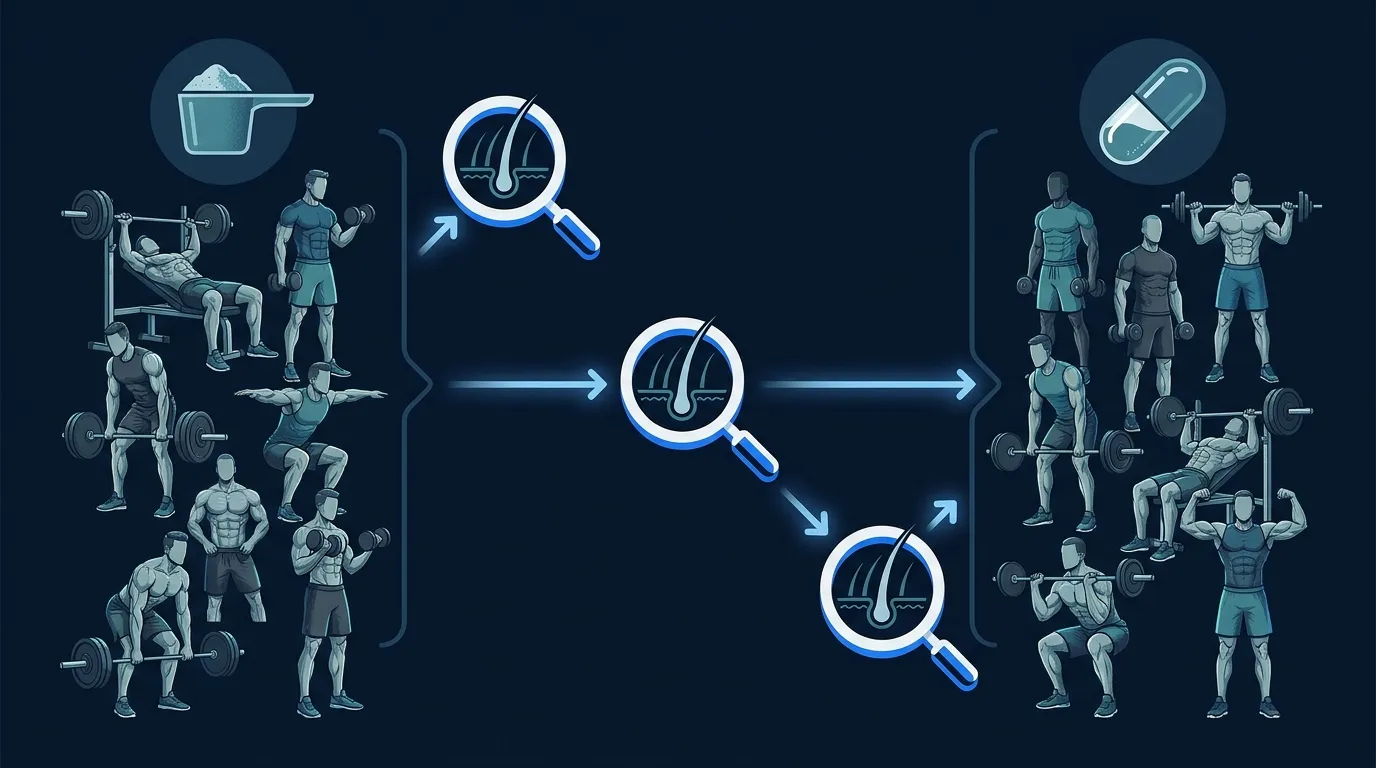
What was still missing was a study that actually looked at hair. In April 2025, Lak, Forbes, Ashtary-Larky, and colleagues published a 12-week randomized, double-blind, placebo-controlled trial in the Journal of the International Society of Sports Nutrition. This is the first trial designed specifically to answer the hair question.
Design: 38 resistance-trained males completed the study (19 per group; the trial enrolled 45). The creatine group took 5 grams per day of creatine monohydrate. The placebo group took 5 grams per day of maltodextrin. Both groups maintained their habitual diets and trained at least 3 times per week. The 5 g/day dose matches the standard evidence-based maintenance dose and matches how most people actually take creatine.
Measurements at baseline, week 6, and week 12 included:
- Serum total testosterone, free testosterone, and DHT
- DHT to testosterone ratio
- Direct scalp measurements via trichoscopy: hair count, hair density, follicular unit density
- Terminal and vellus hair percentages
- Anagen (growth phase) and telogen (rest phase) hair rates
- Cumulative hair thickness
Results: no statistically significant differences between the creatine and placebo groups on any hormone measure or any hair measure. DHT did not rise. The DHT to testosterone ratio did not rise. Hair count did not fall. Hair density did not fall. The anagen to telogen ratio did not shift toward telogen (which would indicate accelerated shedding). Terminal hair percentage did not decrease. Vellus hair percentage did not increase.
The authors concluded that their findings provide "strong evidence against the claim that creatine contributes to hair loss." Given the study directly measured what the field had been arguing about for 15 years, that conclusion carries weight.
Why This Matters for Your Fitness
Creatine is the most-studied ergogenic aid in sports nutrition. It reliably improves strength, power output, and lean mass adaptations from resistance training. It has cognitive benefits in some populations (see our creatine and brain function deep-dive). It is cheap, tastes like nothing, and has one of the cleanest long-term safety profiles of any supplement.
The hair-loss worry has caused a meaningful fraction of would-be users to skip it entirely. If you have a family history of male pattern baldness and you have been avoiding creatine, the direct evidence in front of you now is: 12 weeks of the standard dose in resistance-trained men produced no measurable hair-follicle change and no DHT change. That doesn't mean the question is closed forever. It does mean the burden of evidence has shifted decisively.
For the FitCraft user base, who train mostly with dumbbells, resistance bands, and bodyweight, the practical implication is the same as it is for any resistance training: creatine works on any modality because the underlying phosphocreatine energy system is the same across squats, push-ups, and band rows. If you had been holding off on creatine because of the hair worry, that specific reason has weak evidentiary support.
None of this means everyone should take creatine. Plenty of people train and progress just fine without it. The point of a research review is to help you make the choice on accurate information. Creatine causing hair loss is not a well-supported claim.
How the DHT to Hair Loss Chain Actually Works
To understand why a DHT signal in serum does not automatically translate to hair loss, it helps to know how androgenetic alopecia (male pattern baldness) actually works.
Androgenetic alopecia is a genetically determined condition. It affects hair follicles that inherit sensitivity to DHT. DHT binds to androgen receptors on the follicle, and in susceptible follicles, this binding progressively miniaturizes the follicle across successive hair cycles. Terminal (thick, pigmented) hairs are replaced by vellus (thin, colorless) hairs, and eventually by no hair at all. The follicles that miniaturize are on the top and front of the scalp. Follicles at the back and sides are genetically insensitive to DHT and don't miniaturize regardless of hormone levels.
Two things follow. First, hair loss requires genetic susceptibility. Circulating DHT is present in all men to varying degrees, and most men do not lose hair despite lifelong DHT exposure. Second, the concentration of DHT that matters for hair is the local scalp concentration, not the serum concentration. Studies of finasteride (which reduces serum DHT by roughly 70 percent) show that local scalp DHT reduction is what correlates with hair regrowth, and even large serum shifts don't reliably predict follicle-level effects.
The 2009 rugby study measured serum DHT and did not measure scalp DHT or hair follicles. The 2025 Lak trial measured both serum hormones and hair follicles directly and found no signal on either. The chain from "5 grams per day of creatine" to "your hair falls out" has multiple links that would need to be true, and current evidence does not support any of them.
Get an evidence-based plan built for you
FitCraft, our mobile fitness app, pairs you with an AI coach who builds you a personalized plan around your goals, schedule, and fitness level. Every FitCraft program is designed by Domenic Angelino, MPH (Brown University) and NSCA-CSCS, with research published in the Journal of Strength and Conditioning Research and Medicine & Science in Sports & Exercise.
Take the Free Assessment Free • 2 minutes • No credit cardCommon Misconceptions
Misconception: "The rugby study proved creatine causes hair loss"
It did not. The van der Merwe 2009 study measured serum DHT and the DHT to testosterone ratio. Both rose in the creatine group. Neither hair count nor any hair-related endpoint was measured. The inference that a DHT rise means hair loss is a hypothesis, not a finding. The hypothesis has been tested directly for the first time by Lak et al. (2025), and the hypothesis was not supported.
Misconception: "Creatine mimics steroids because it raises DHT"
Anabolic steroids are synthetic androgens that directly bind androgen receptors, drive muscle protein synthesis through a hormonal pathway, and produce large systemic hormonal effects. Creatine is a nitrogen-containing organic acid that increases muscle phosphocreatine stores and improves phosphagen-system energy availability. The mechanism has nothing to do with androgen receptor binding. Even the 2009 DHT finding, which has not consistently replicated, is a modest shift within normal reference ranges, not a steroid-like effect. The Antonio 2021 review addresses this comparison directly and rejects it.
Misconception: "Even if the average person is fine, guys with a family history should avoid it"
This is the most reasonable-sounding version of the concern. The Lak 2025 trial did not stratify by family history of male pattern baldness. Neither did the 2009 rugby study. So we don't have a randomized trial specifically enrolling androgenetic-alopecia-susceptible men. That's a real gap. What we do have: 12 weeks of direct hair-follicle measurement in resistance-trained men found no signal at all. Zero signal in a general resistance-trained population is not proof of safety in every subgroup, but it's the strongest evidence available. The precautionary "avoid it if you have a family history" recommendation rests on a mechanism that has not been demonstrated in humans.
Misconception: "You should cycle creatine to protect your hair"
Cycling is a bodybuilding-culture holdover from steroid protocols. It has no basis in creatine research generally, and no basis in the hair-loss literature specifically. The 2025 Lak trial ran 12 weeks of continuous daily dosing and found no hair change. Cycling makes no evidence-based sense as a hair-protective strategy.
What the Research Suggests Going Forward
The current state of evidence is straightforward. One small 2009 study reported a serum DHT signal in a group that did not have hair measured. Fifteen years of subsequent work did not replicate the hormonal signal consistently. The first study to measure hair follicles directly, published in 2025, found no effect on hair or on DHT.
What would move the needle further? A larger randomized trial specifically enrolling men with confirmed androgenetic alopecia risk factors (family history, genetic testing, or early Norwood-scale progression) would close the last remaining gap. That trial does not exist yet. If it appears and shows an effect, the picture will need updating. Based on how the field usually resolves these questions, and based on how consistent the negative findings have been, that appears unlikely. But science is empirical, so the correct posture is to hold the current answer with reasonable confidence and stay open to revising it if new data arrives.
For practical purposes today, the evidence supports the standard ISSN recommendation: 3 to 5 grams per day of creatine monohydrate is safe and effective. Hair loss is not a well-supported reason to skip it. If you want the broader picture on how creatine fits with resistance training and daily dosing, see our loading vs maintenance breakdown and the resistance band training guide for how the ergogenic benefits transfer to bands, dumbbells, and bodyweight work.

References
- van der Merwe J, Brooks NE, Myburgh KH. "Three weeks of creatine monohydrate supplementation affects dihydrotestosterone to testosterone ratio in college-aged rugby players." Clinical Journal of Sport Medicine 19.5 (2009): 399-404. doi:10.1097/JSM.0b013e3181b8b52f.
- Lak M, Forbes SC, Ashtary-Larky D, et al. "Does creatine cause hair loss? A 12-week randomized controlled trial." Journal of the International Society of Sports Nutrition 22.1 (2025): 2495229. doi:10.1080/15502783.2025.2495229.
- Kreider RB, Kalman DS, Antonio J, et al. "International Society of Sports Nutrition position stand: safety and efficacy of creatine supplementation in exercise, sport, and medicine." Journal of the International Society of Sports Nutrition 14 (2017): 18. doi:10.1186/s12970-017-0173-z.
- Antonio J, Candow DG, Forbes SC, et al. "Common questions and misconceptions about creatine supplementation: what does the scientific evidence really show?" Journal of the International Society of Sports Nutrition 18.1 (2021): 13. doi:10.1186/s12970-021-00412-w.
Frequently Asked Questions
Does creatine cause hair loss?
The best available evidence says no. Lak et al. (2025) ran the first 12-week randomized trial with direct hair follicle measurements (n=38, 5 g/day) and found no difference in hair count, density, growth-phase ratios, or DHT between creatine and placebo groups. The 2009 rugby study that started the worry never measured hair.
What did the 2009 van der Merwe rugby study actually find?
DHT rose about 40 percent above baseline after 21 days of creatine dosing in 20 college-aged rugby players, and the DHT to testosterone ratio rose about 22 percent by the end of maintenance. Absolute values stayed within the normal reference range. Hair was not measured.
Does the ISSN position stand address creatine and hair loss?
Yes. The 2017 ISSN position stand concluded there is no compelling scientific evidence that creatine supplementation causes hair loss or baldness. The 2021 Antonio et al. misconception review restated the same conclusion.
Should men with a family history of male pattern baldness avoid creatine?
Current evidence does not support avoiding creatine on this basis. The 2025 Lak trial found no hair effect at 12 weeks in resistance-trained men, and no randomized trial has shown that creatine accelerates androgenetic alopecia. If you're still concerned given a strong family history, talk to a dermatologist.
Does creatine raise DHT levels in the body?
One 2009 study of 20 rugby players reported an increase. The 2025 Lak trial of 38 men measured serum DHT and the DHT to testosterone ratio at baseline, week 6, and week 12 and found no significant change. Other trials measuring androgens during creatine supplementation have generally found no consistent effect.
Is a lower creatine dose safer for hair?
The only direct hair follicle trial used 5 g/day and found no adverse effect. There is no evidence a specific dose is riskier for hair. If you want the simplest evidence-aligned protocol, 3 to 5 grams per day of creatine monohydrate is the ISSN-recommended standard.
Does FitCraft account for creatine or supplementation in its programs?
FitCraft builds your training plan around your goals, schedule, and equipment. Supplementation is a personal choice and isn't required by any FitCraft program. If you take creatine, the performance benefit compounds cleanly with the progressive resistance work in the app. If you don't, the programs still deliver strength and hypertrophy adaptations. Take the free FitCraft assessment to get a plan built around your training reality.