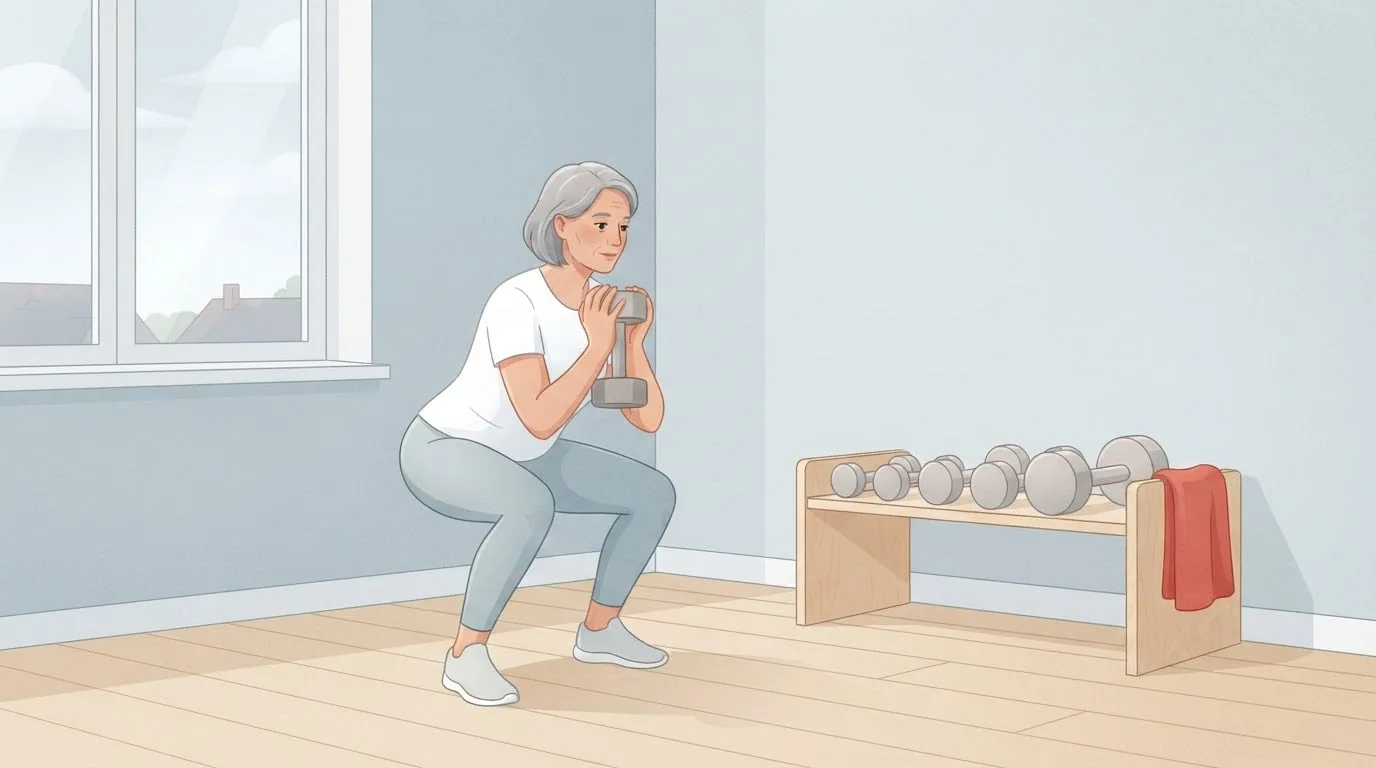
Pyramid sets are one of the oldest set schemes in strength training. Thomas DeLorme's progressive resistance exercise, described in the late 1940s (DeLorme and Watkins, 1948), climbed through three sets of 10 reps to a 10-repetition maximum, the heaviest weight you can lift 10 times. A modern pyramid workout looks much the same: 12 reps with a light pair of dumbbells, 10 with the next pair up and 8 with a heavier pair.
If you train at home with a few pairs of dumbbells, pyramids feel natural, because moving up or down a pair is easier than fine-tuning one weight. You may also have read that pyramids shock your muscles into growing, or that a reverse pyramid is the secret to getting strong. The trials tell a calmer story. Against straight sets, with the same weight on every set, pyramids come out about even for strength and muscle, in trained men and in women in their late 60s.
This review explains the pyramid training technique and its types, walks through the long-term trials and the short studies on how pyramids feel next to drop sets, covers when a pyramid helps and finishes with a dumbbell pyramid workout and the common myths.
What Is the Pyramid Training Technique?
Pyramid training is a way to organize the sets of one exercise so the weight changes from set to set and the reps change in the opposite direction. A 2026 review of resistance training methods describes it as progressive increases or decreases in load across sets, with the number of reps moving the other way (Rios and colleagues, 2026). Each step of the pyramid is a full set with a normal rest after it.
That rest is what separates a pyramid from a drop set, where you strip weight off and keep going without resting, and from a cluster set, which breaks one set into small chunks with short pauses. Our cluster sets research review covers how that method compares with straight sets.
Types of Pyramid Sets
Coaches and researchers use different names for the same few patterns, which makes the research hard to search. This table maps them.
| Type | Other names | How the weight moves | Dumbbell example |
|---|---|---|---|
| Ascending pyramid | Standard pyramid, crescent pyramid, DeLorme method | Light to heavy, reps fall | 12, 10 and 8 reps |
| Descending pyramid | Reverse pyramid (RPT), decrescent pyramid, Oxford technique | Heavy to light, reps rise | 8, 10 and 12 reps after a warm-up set |
| Full pyramid | Triangle or double pyramid | Up, then back down | 12, 10, 8, 10 and 12 reps |
| Rep pyramid | Ladder | Same load, reps climb and then fall | 2, 4, 6, 8, 6, 4 and 2 push-ups |
Some research versions keep the reps the same and change only the load. The DeLorme and Oxford methods both used three sets of 10, and one 2021 study's descending pyramid kept 10 reps per set while the weight fell.
Ascending pyramid
The ascending pyramid is the one most trials tested. In the studies of older women it was 3 sets of 12, 10 and 8 reps, each a repetition maximum at a heavier load than the set before (Ribeiro and colleagues, 2017). The lighter first sets double as practice for the movement. The trade-off is that your heaviest set comes last, when you're most tired.
Descending or reverse pyramid
A reverse pyramid puts the heaviest set first, after a warm-up, then lightens the load so you can keep the reps up as fatigue builds. The older Oxford technique works the same way: it starts at your 10-repetition maximum and takes weight off each set (Fish and colleagues, 2003).
Full, wide and narrow pyramids
A full or triangle pyramid climbs and then comes back down, which adds sets and time. Pyramids also differ in how far the reps spread. A narrow pyramid such as 12, 10 and 8 reps stays in a moderate range, while a wide one such as 15, 10 and 5 reaches both lighter and heavier loads (Dos Santos and colleagues, 2018).
Rep pyramids for bodyweight training
With no weights to change, a pyramid climbs and falls in reps instead: 2, 4, 6, 8, 6, 4 and 2 push-ups with a short rest at each step, or the same pattern with squats or pull-ups. Runners use the word too. A running pyramid means intervals that get longer and then shorter, and our interval running workout guide includes one.
The Research: What Studies Show
Trials that compare pyramid sets with straight sets are small and few, but they point the same way. Here are the main ones, starting with the long-term results.
Angleri 2017 and 2022: the crescent pyramid in trained men
Angleri and colleagues (2017) trained 32 well-trained men on the leg press and leg extension for 12 weeks. Each man trained one leg with straight sets, 3 to 5 sets of 6 to 12 reps at 75 percent of his one-rep max, and the other leg with either a crescent pyramid of 6 to 15 reps at 65 to 85 percent or drop sets. Total training volume was matched between the legs. Thigh muscle cross-sectional area grew 7.5 percent on the pyramid leg and 7.6 percent on the straight-set leg, and leg press strength rose 25.9 percent with both. The drop-set side of the same trial is covered in our drop sets research review.
A follow-up analysis looked at each man on his own (Angleri and colleagues, 2022). Individual muscle growth was similar with every protocol. Leg press strength told a slightly different story: of the 15 men who trained one leg with the pyramid and the other with straight sets, 4 gained more with the pyramid, 1 gained more with straight sets and 10 gained about the same. The authors suggested that some people respond more to a protocol that reaches heavier loads.
Ribeiro 2016 and 2017: women in their late 60s
Ribeiro's team ran a crossover trial in 25 women with an average age of 67.6. Each woman did 8 weeks of straight sets, 3 sets at one weight for 8 to 12 repetition maximum, and 8 weeks of an ascending pyramid of 12, 10 and 8 repetition maximum, in random order with a 12-week break between them. Strength rose by similar amounts with both: chest press 12.4 percent with straight sets and 11.5 percent with the pyramid, knee extension 12.5 and 11.8 percent. Skeletal muscle mass rose 3.6 and 2.4 percent, with no significant difference between systems, and testosterone and IGF-1 didn't change with either.
A second paper from the same trial looked at health markers (Ribeiro and colleagues, 2016). Both systems improved muscle quality, triglycerides, LDL cholesterol and C-reactive protein, a marker of inflammation, with no difference between them. LDL cholesterol fell 23.3 percent with straight sets and 21.0 percent with the pyramid.
Dos Santos 2018 and 2020: narrow and wide pyramids
The 2018 Dos Santos trial compared two ascending pyramids in 39 women averaging 67.8 years: a narrow one of 12, 10 and 8 reps and a wide one of 15, 10 and 5. They did 8 whole-body exercises 3 times a week for 8 weeks. Skeletal muscle mass rose 4.7 percent with the narrow pyramid and 8.4 percent with the wide one, and total strength rose 11.3 and 13.8 percent. Both groups improved significantly, and the differences between them weren't statistically significant.
A larger trial added a control group: 59 women averaging 67.3 years did the same two pyramids or no training for 8 weeks, resting 60 to 120 seconds between sets (dos Santos and colleagues, 2020). Both pyramids lowered LDL cholesterol, by 10.9 and 8.3 percent, raised HDL cholesterol by about 10 percent and cut C-reactive protein by 15 to 17 percent, while the same markers got slightly worse in the control group. The two rep zones did about equally well.
Fish 2003: light to heavy against heavy to light
One of the few long-term tests of ascending against descending loading comes from rehabilitation research. Fish and colleagues randomized 50 adults to the DeLorme or the Oxford method: three sets of 10 knee extensions, 3 times a week for 9 weeks, with the 10-repetition maximum retested every week and the weights adjusted. Both groups got stronger by similar amounts, with no significant difference between methods or between men and women. The authors concluded that the two methods improve strength with equivalent efficacy.
What a review of 15 studies concluded
Cardozo and Destro (2023) reviewed 15 studies that compared pyramid and traditional training: 6 on how a single session responds and 9 long-term trials. Pyramids weren't clearly better for acute responses, strength or muscle growth, and the authors suggested choosing them for periodization, motivation or preference. Most of the evidence covers 8 to 12 reps at 67 to 85 percent of one-rep max. A 2023 meta-analysis of advanced training methods in trained people, which included the crescent pyramid trial, also found no extra muscle growth from advanced methods as a group (Fonseca and colleagues, 2023).
Pyramid Sets vs Straight Sets vs Drop Sets
The long-term results tie, but the sessions don't feel the same. Three short studies measured how pyramids compare within a single workout.
Enes and colleagues (2023) had 24 trained men do the same total volume of squats, leg presses and knee extensions as drop sets, a descending pyramid and straight sets. Average effort ratings for each set, on a 10-point scale, were 8.8 for drop sets, 8.0 for the pyramid and 7.5 for straight sets. On a pleasure scale where positive numbers mean a set felt good, drop sets averaged minus 1.4, the pyramid 0.4 and straight sets 1.3.
Costa and colleagues (2021) tested 18 trained young men on the bench press and leg press. Their descending pyramid kept 10 reps per set while the load fell from a 10- to a 12- to a 15-repetition maximum. Thirty minutes later, jump height was 1.9 percent lower after the pyramid and 6.7 percent lower after drop sets, and only drop sets reduced bench press force and power.
In 12 trained young men, a crescent pyramid on the leg extension, 10 reps at 75 percent of one-rep max, then 8 at 80 and 6 at 85, lowered muscle oxygen about as much as 3 sets of 10 at 75 percent, while drop sets lowered it more (Angleri and colleagues, 2020). Volume wasn't matched, though, because the drop sets moved about twice as much total weight. Muscle activation was similar in all three.
| Straight sets | Ascending pyramid | Descending pyramid | Drop set | |
|---|---|---|---|---|
| Weight across sets | The same | Rises | Falls | Falls within one set |
| Rest | Full rest | Full rest | Full rest | None between drops |
| Set effort and pleasure (Enes 2023) | 7.5 and 1.3 | Not measured | 8.0 and 0.4 | 8.8 and minus 1.4 |
| Long-term muscle and strength | The reference | About equal (Angleri 2017, Ribeiro 2017) | About equal for strength (Fish 2003) | About equal (Angleri 2017) |
| Best use | Simple to track | Built-in warm-up | Heaviest set while fresh | Saving time on a last set |
If the clock is your main limit, pyramids won't help much, because every set keeps its full rest. Supersets and rest-pause sets pack more work into less time, as our reviews of supersets and rest-pause training explain.
When Does Pyramid Training Help?
Because the long-term results tie, a pyramid helps when it fits how you train. It earns its place in these situations:
- You like a warm-up built into your working sets. An ascending pyramid lets you practice the movement with lighter dumbbells before the heaviest set.
- You want your heaviest set while you're fresh. A reverse pyramid puts it first, after a warm-up, and the lighter sets that follow keep your reps up.
- You own a few fixed pairs of dumbbells. Moving one pair up or down per set is easier than finding one perfect weight.
- Straight sets have gone stale. Pyramids gave the same results as straight sets in the trials, and the review authors suggested choosing one for motivation or preference.
- You respond well to heavier loads. In the 2022 individual analysis, 4 of 15 men gained more leg press strength with the pyramid, which reaches heavier weights than straight sets do.
It won't help when you're short on time, since a full pyramid adds sets and every set keeps its rest. It also won't help if your lighter sets are easy. If the first set of an ascending pyramid ends with plenty of reps left, it's a warm-up, and you're doing fewer hard sets than the people in the trials did.
Is pyramid training good for beginners?
Yes, as long as the steps between weights are small. The 12, 10 and 8 pyramid worked in the trials of women in their late 60s, and the lighter opening set gives you a rehearsal before the heaviest one. If an exercise is brand new to you, learn it with straight sets for a few weeks before you start pyramiding it.
How long should you rest between pyramid sets?
Rest about 2 minutes between the heavier steps. In 20 young women doing a five-step crescent pyramid on the leg press, 3 minutes of rest allowed more total weight lifted than 1 minute, 12,820 kg against 10,367 kg, and 2 minutes did about as well as 3, while effort ratings stayed the same (Kassiano and colleagues, 2020). The trials in older women used 60 to 120 seconds of rest in whole-body sessions.
Get an evidence-based plan built for you
FitCraft, our mobile fitness app, pairs you with an AI coach who builds you a personalized plan around your goals, schedule, and fitness level. Every FitCraft program is designed by Domenic Angelino, MPH (Brown University) and NSCA-CSCS, with research published in the Journal of Strength and Conditioning Research and Medicine & Science in Sports & Exercise.
Take the Free Assessment Free • 2 minutes • No credit cardA Dumbbell Pyramid Workout You Can Do at Home
This pyramid workout example uses dumbbells and your body weight. It mixes ascending and descending pyramids so you can feel both, and it takes about 40 minutes. Do it 2 or 3 times a week with a day off between sessions, for 8 to 12 weeks, the length of the trials.
| Exercise | Pyramid | Reps per set | Rest |
|---|---|---|---|
| Goblet squat | Ascending | 12, 10, 8 | 90 s |
| Dumbbell floor press or bench press | Descending | 1 warm-up set, then 8, 10, 12 | 90 to 120 s |
| One-arm dumbbell row | Ascending | 12, 10, 8 each side | 60 to 90 s |
| Dumbbell Romanian deadlift | Ascending | 12, 10, 8 | 90 s |
| Seated dumbbell shoulder press | Descending | 1 warm-up set, then 8, 10, 12 | 90 s |
| Push-up rep pyramid | Rep pyramid | 2, 4, 6, 8, 6, 4, 2 | 20 to 30 s between steps |
How to choose your dumbbells
Pick the weight for the heaviest set first: the heaviest pair you can lift for the target reps with one or two good reps left. For an ascending pyramid, start one or two dumbbell sizes lighter and move up a size each set. For a reverse pyramid, warm up with a lighter pair, do the heavy set, then drop one size for each set that follows. If you own only one pair, turn the exercise into a rep pyramid.
How to progress
When your heaviest set reaches its target reps with a rep or two to spare, move every step of that pyramid up one dumbbell size next session. Write the weights down, because a pyramid gives you three numbers to remember instead of one.
Pyramid squats and pull-up pyramids
For a bodyweight squat pyramid, do 5, 10, 15, 10 and 5 squats with 30 seconds of rest between steps. For a pull-up pyramid, if you have a bar, do 1, 2, 3, 4, 3, 2 and 1 pull-ups with a short rest at each step. No bar? The push-up pyramid in the table does the same job for your upper body.
If you'd rather not plan the weights and rests yourself, a dumbbell workout app can carry that structure. FitCraft's AI coaches build you a personalized plan around your goals, schedule and fitness level, demonstrate each exercise in interactive 3D and adapt your workouts as you progress.
Common Misconceptions
Misconception 1: "Pyramids build more muscle than straight sets"
The trials don't show it. The crescent pyramid leg in the 2017 trial grew 7.5 percent against 7.6 percent for straight sets, and muscle mass in the older women rose 2.4 percent with the pyramid against 3.6 percent with straight sets, a difference too small to be significant. The 2023 review of 15 studies reached the same conclusion. A pyramid rearranges the work. When the total work was matched, as in the 2017 trial, the gains matched too.
Misconception 2: "Reverse pyramid training is the proven way to get strong"
A reverse pyramid puts your heaviest set first, which makes sense when that top set is your priority. The 9-week trial of heavy-to-light against light-to-heavy loading found equal strength gains (Fish 2003), and we found no long-term trial showing that a reverse pyramid builds more strength than an ascending one or than straight sets. Use it if you like hitting your heavy set fresh.
Misconception 3: "The light sets are just a warm-up"
In the older-women trials, every step was a repetition maximum: the 12-rep set used the heaviest weight the women could lift 12 times. That made each set a hard working set. If your first set stops with five or more reps left, count it as a warm-up, and know that your pyramid holds fewer hard sets than the ones that matched straight sets.
What the Research Suggests Going Forward
The evidence points one way. In trained men, in women in their late 60s and in a 9-week comparison of light-to-heavy and heavy-to-light loading, pyramids matched straight sets for strength and muscle. In single sessions, a descending pyramid felt harder and a little less pleasant than straight sets, and far less punishing than drop sets.
The research has real limits. The trials are small, usually 25 to 60 people, and short, at 8 to 12 weeks. Most used gym machines such as the leg press and leg extension, the trial in trained men worked only the legs, and none tested a home dumbbell routine. Most of the evidence covers 8 to 12 reps at moderate to heavy loads, and no long-term trial has tested a modern reverse pyramid against straight sets.
So choose the pyramid that suits you. Keep every step a hard set, rest about 2 minutes between the heavy ones and move up a dumbbell size when the top set gets easy. If straight sets keep you training, they work just as well.

References
- Angleri V, Ugrinowitsch C, Libardi CA. "Crescent pyramid and drop-set systems do not promote greater strength gains, muscle hypertrophy, and changes on muscle architecture compared with traditional resistance training in well-trained men." European Journal of Applied Physiology 117.2 (2017): 359-369. doi:10.1007/s00421-016-3529-1
- Angleri V, Ugrinowitsch C, Libardi CA. "Individual muscle adaptations in different resistance training systems in well-trained men." International Journal of Sports Medicine 43.1 (2022): 55-60. doi:10.1055/a-1493-3121
- Ribeiro AS, Schoenfeld BJ, Fleck SJ, Pina FLC, Nascimento MA, Cyrino ES. "Effects of traditional and pyramidal resistance training systems on muscular strength, muscle mass, and hormonal responses in older women: a randomized crossover trial." Journal of Strength and Conditioning Research 31.7 (2017): 1888-1896. doi:10.1519/JSC.0000000000001653
- Ribeiro AS, Schoenfeld BJ, Souza MF, Tomeleri CM, Venturini D, Barbosa DS, Cyrino ES. "Traditional and pyramidal resistance training systems improve muscle quality and metabolic biomarkers in older women: a randomized crossover study." Experimental Gerontology 79 (2016): 8-15. doi:10.1016/j.exger.2016.03.007
- Dos Santos L, Ribeiro AS, Cavalcante EF, Nabuco HC, Antunes M, Schoenfeld BJ, Cyrino ES. "Effects of modified pyramid system on muscular strength and hypertrophy in older women." International Journal of Sports Medicine 39.8 (2018): 613-618. doi:10.1055/a-0634-6454
- Dos Santos L, Ribeiro AS, Nunes JP, Tomeleri CM, Nabuco HCG, Nascimento MA, et al. "Effects of pyramid resistance-training system with different repetition zones on cardiovascular risk factors in older women: a randomized controlled trial." International Journal of Environmental Research and Public Health 17.17 (2020): 6115. doi:10.3390/ijerph17176115
- Fish DE, Krabak BJ, Johnson-Greene D, DeLateur BJ. "Optimal resistance training: comparison of DeLorme with Oxford techniques." American Journal of Physical Medicine & Rehabilitation 82.12 (2003): 903-909. doi:10.1097/01.PHM.0000098505.57264.DB
- DeLorme TL, Watkins AL. "Technics of progressive resistance exercise." Archives of Physical Medicine 29.5 (1948): 263-273. PubMed: 18860422
- Enes A, Oneda G, Leonel DF, Ramos RA, Kvas-Cabral VC, Bernardo MF, Escalante G, Souza-Junior TP. "Drop-set resistance training versus pyramidal and traditional sets elicits greater psychophysiological responses in men." Perceptual and Motor Skills 130.4 (2023): 1624-1643. doi:10.1177/00315125231176729
- Costa BDV, Ferreira MEC, Gantois P, Kassiano W, Paes ST, de Lima-Júnior D, Cyrino ES, Fortes LS. "Acute effect of drop-set, traditional, and pyramidal systems in resistance training on neuromuscular performance in trained adults." Journal of Strength and Conditioning Research 35.4 (2021): 991-996. doi:10.1519/JSC.0000000000003150
- Angleri V, de Oliveira R, Biazon TMPC, Damas F, Borghi-Silva A, Barroso R, Libardi CA. "Effects of drop-set and pyramidal resistance training systems on microvascular oxygenation: a near-infrared spectroscopy approach." International Journal of Exercise Science 13.2 (2020): 1549-1562. PMC7745902
- Kassiano W, Medeiros AI, de Vasconcelos Costa BD, Andrade AD, Moura Simim MA, de Sousa Fortes L, Cyrino ES, de Oliveira Assumpção C. "Does rest interval between sets affect resistance training volume, density, and rating of perceived exertion when adopting the crescent pyramid system in young women?" Journal of Sports Medicine and Physical Fitness 60.7 (2020): 992-998. doi:10.23736/S0022-4707.20.10612-1
- Cardozo DC, Destro DS. "Pyramidal resistance training: a brief review of acute responses and long-term adaptations." Journal of Bodywork and Movement Therapies 35 (2023): 21-27. doi:10.1016/j.jbmt.2023.04.070
- Fonseca PAB, Ide BN, Oranchuk DJ, Marocolo M, Simim MAM, Roberts MD, Mota GR. "Comparison of traditional and advanced resistance training paradigms on muscle hypertrophy in trained individuals: a systematic review and meta-analysis." Translational Sports Medicine 2023 (2023): 9507977. doi:10.1155/2023/9507977
- Rios MJ, Ferreira FA, Chapman DW, Fernandes RJ, Reis VM. "Methods and systems of resistance training: a narrative review based on contemporary recommendations." Sports 14.8 (2026): 348. doi:10.3390/sports14080348
Frequently Asked Questions
What is a pyramid set?
A pyramid set is a group of sets on one exercise in which the weight changes every set and the reps move the other way, such as 12, 10 and 8 reps with three dumbbells that get heavier. Each step is a full set with a rest after it. Going from light to heavy is an ascending pyramid, and going from heavy to light is a reverse or descending pyramid.
Is pyramid training better than straight sets?
Pyramid training builds about as much muscle and strength as straight sets, so neither one is better. In a 12-week trial in trained men and an 8-week crossover trial in women in their late 60s, the two produced similar gains. A 2023 review of 15 studies found no clear advantage for pyramids, so pick the method you'll stick with.
Is reverse pyramid training better for strength?
There's no good evidence that reverse pyramid training builds more strength. In a 9-week trial of 50 adults, starting heavy and taking weight off each set built strength as well as working up to the heaviest set. A reverse pyramid does let you lift your heaviest set while you're fresh, which some lifters prefer.
Is pyramid training good for people over 60?
Pyramid training is one of the better-studied set schemes for older adults. In trials of women averaging about 67 years, 8 weeks of ascending pyramids such as 12, 10 and 8 reps raised strength by roughly 9 to 14 percent and improved muscle mass, cholesterol and an inflammation marker as much as straight sets did. Check with your doctor first if you have a heart condition or joint problems.
What is the 6-12-25 rule?
The 6-12-25 rule is a giant set for one muscle group: 6 heavy reps of one exercise, 12 reps of a second and 25 light reps of a third, with about 10 seconds between them. It works like a descending pyramid spread across three exercises. We found no controlled trial of it, so treat it as a way to add variety rather than a proven upgrade.