Drop sets have a reputation as a bodybuilder shortcut, a "muscle confusion" trick, a way to force growth by doing more than the body wants to do. That reputation predates the research. What the research actually shows is more useful and more mundane.
When you match total volume and total effort, drop sets and traditional straight sets build about the same amount of muscle and about the same strength. The real payoff is on the clock. A drop-set session gets you to the same growth stimulus in roughly half the time. That is a big deal for anyone training three or four times a week around a full life. It is not a hypertrophy hack. It is a time-efficiency tool.
This piece walks through what a drop set actually is, the four main studies and two meta-analyses that pin down the effect, when the evidence says to use them, and how to actually run them with dumbbells, resistance bands, or bodyweight at home.
What a Drop Set Actually Is
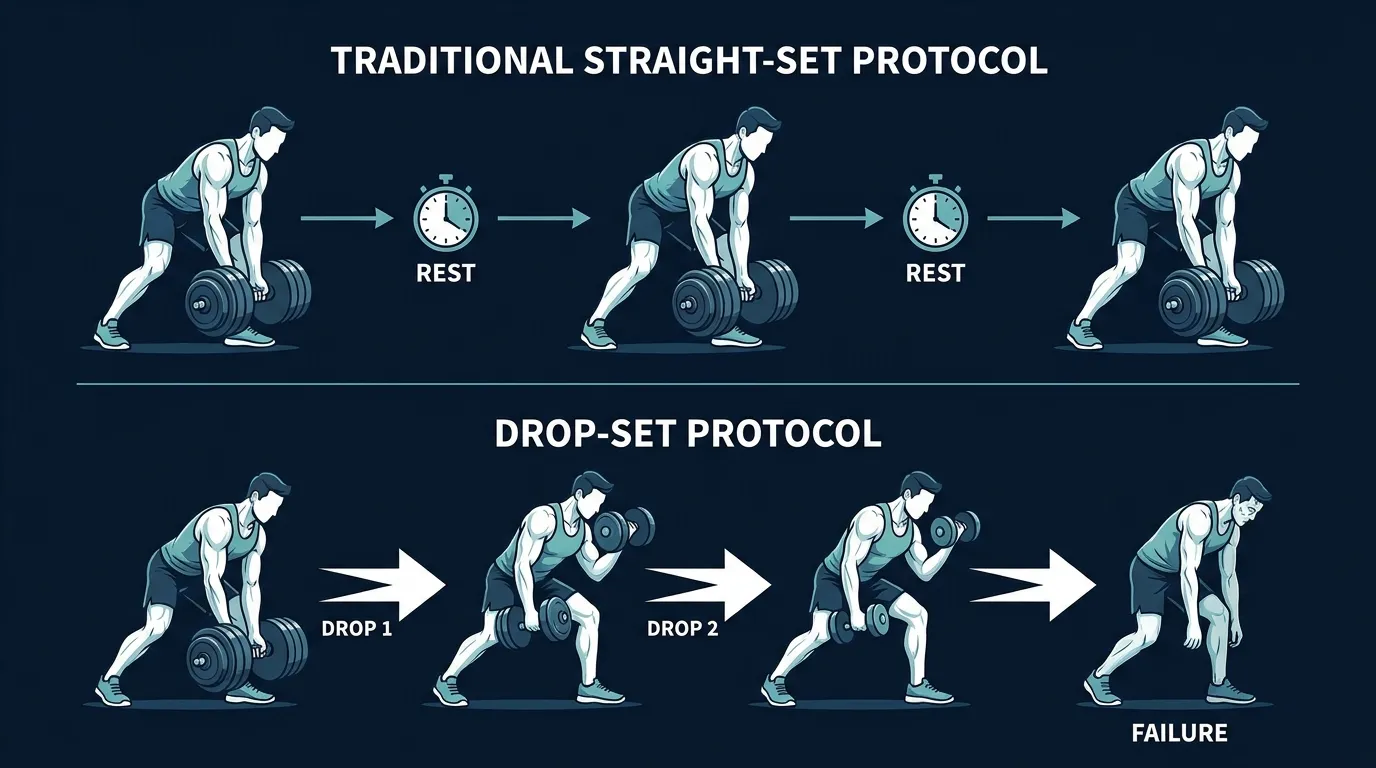
A drop set is a resistance training set where you take reps to failure (or close to it) at one load, immediately reduce the load, and keep going. No full rest between the drops. That whole cascade counts as one set.
The canonical version looks like this. You dumbbell-press 25s for 10 reps to failure. Without racking, you grab the 20s and squeeze out 5 more. Maybe you go one more drop to the 15s and get 4 more. Total working reps in that one set: 19. Total time: under a minute. Compare that to three straight sets of 10 with two-minute rests: 30 reps, six or seven minutes of clock time.
Common terminology varies. A single drop is often called a "double-drop set". Two drops make a "triple-drop". Some coaches program a "descending pyramid" where the load reduction is planned and larger (20% or 30% cuts). Others use "running the rack" on dumbbell exercises: start heavy, go to failure, immediately step down one dumbbell increment, repeat until you can't rep the lightest pair. All of these are drop-set variants and all get analyzed together in the meta-analytic literature.
The mechanism is intuitive. When you hit failure at a given load, most of the high-threshold motor units are already recruited. Reducing the load lets you keep repping while those fibers stay engaged. You get more mechanical tension time on the fibers that matter for growth, without needing to add another full rest and another full set to the workout.
The Research: What Studies Show
Havers et al. (2026): The Full-Picture Meta-Analysis
The most recent and largest synthesis is Havers, Micke, Geisler, and Held (2026) in Sports Medicine Open. They pooled 12 studies with 274 participants and separated acute physiological responses from chronic training adaptations. Both matter for judging whether drop sets are a useful tool.
On the acute side, the picture is what you'd expect from a technique built around fatigue accumulation:
- Rating of perceived exertion: SMD 1.62 (95% CI 0.33 to 2.91) favoring drop sets. That's a large effect. Drop sets feel much harder.
- Blood lactate: SMD 0.67 (95% CI 0.20 to 1.14) favoring drop sets. Significant metabolic stress increase.
- Heart rate: SMD 0.45 (95% CI −0.12 to 1.02). Trend toward higher, not statistically significant.
Chronic adaptations across 16 comparisons told a different story:
- Muscle hypertrophy: SMD 0.04 (95% CI −0.29 to 0.36). Trivial. No meaningful difference.
- Muscular strength: SMD −0.04 (95% CI −0.34 to 0.26). Trivial. No meaningful difference.
- Muscular endurance: SMD 0.53 (95% CI −0.20 to 1.26). Trend toward drop sets, not statistically significant.
The authors' plainspoken conclusion: drop sets are "a time-efficient alternative" that produces "comparable long-term gains in muscle hypertrophy and strength" at roughly half to one-third the training duration. The acute cost is real. The chronic payoff is a tie with less time in the gym.
Sødal et al. (2023): The Hypertrophy-Focused Meta-Analysis
Two years earlier, Sødal, Kristiansen, Larsen, and van den Tillaar (2023) ran a narrower meta-analysis in Sports Medicine Open, focused specifically on hypertrophy. Six studies met inclusion, five contributed to quantitative synthesis, pooling 142 participants (114 men, 28 women, mean age 19 to 27).
Both training approaches produced significant pre-post muscle growth:
- Drop sets: within-group SMD 0.555 (95% CI 0.357 to 0.921, p<0.0001).
- Traditional sets: within-group SMD 0.437 (95% CI 0.266 to 0.608, p<0.0001).
- Between-group difference: SMD 0.155 (95% CI −0.199 to 0.509, p=0.392). Not significant.
Same story as Havers three years later: comparable hypertrophy, drop sets require roughly half to one-third the training time. The consistency across two independent syntheses is worth noting. The hypertrophy conclusion is stable.
Fink et al. (2018): The 6-Week Trial That Started the Conversation
The trial that put drop sets on the modern hypertrophy map was Fink, Schoenfeld, Kikuchi, and Nakazato (2018) in the Journal of Sports Medicine and Physical Fitness. Sixteen young men trained triceps pushdowns for 6 weeks, split into two equal groups (n=8 each). One group did a single drop set per session. The other did three conventional sets.
The headline: MRI-measured triceps cross-sectional area increased 10.0 ± 3.7% in the drop-set group vs. 5.1 ± 2.1% in the conventional group. That's roughly double the hypertrophy in less total training time. Strength gains, measured as 12RM, went the other way. Both groups improved, but the conventional group showed slightly larger 12RM strength gains.
This trial gets cited a lot for the "drop sets grow more muscle" claim. Two things to hold in mind. First, N was small (8 per group), so precision was limited. Second, and more importantly, the drop-set group's single-set volume was not directly matched to the conventional group's three-set volume. Once later meta-analyses like Havers (2026) and Sødal (2023) pooled volume-matched and volume-unmatched trials together, the between-group hypertrophy difference washed out to trivial. Fink et al. is real evidence that drop sets work. It is not evidence that they beat straight sets when the comparison is fair.
Ozaki et al. (2018): The Time-on-Task Comparison
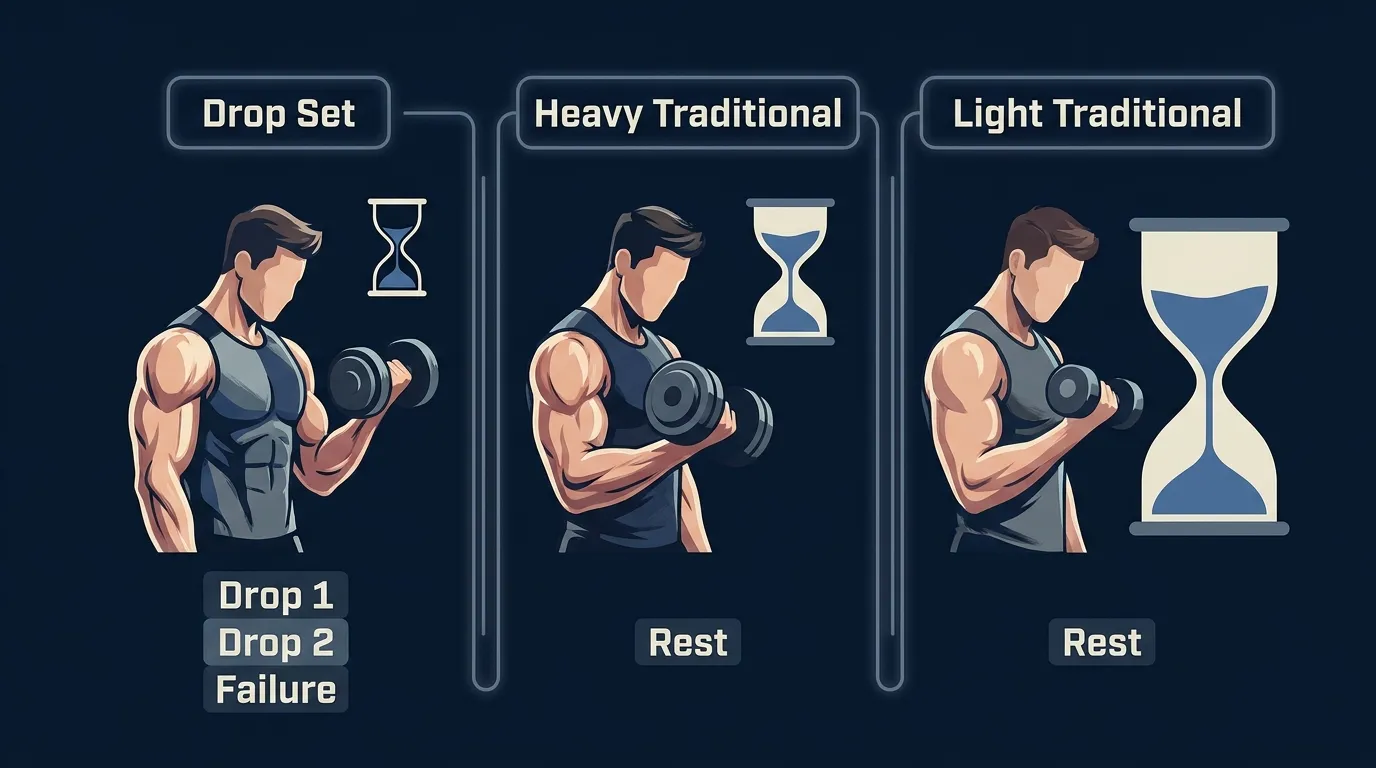
The clearest quantification of drop sets' time advantage comes from Ozaki, Kubota, Natsume et al. (2018) in the Journal of Sports Sciences. Nine untrained men trained elbow flexion with a within-subject design (each arm assigned to a different condition) over 8 weeks, 2 to 3 sessions per week. Three conditions:
- Heavy-load traditional: 80% 1RM, 3 sets, 3-minute rests.
- Light-load traditional: 30% 1RM, 4 sets, 90-second rests.
- Single-set drop: one heavy set at 80% 1RM, then 4 drops at 65%, 50%, 40%, and 30% with no rest.
MRI-measured elbow flexor cross-sectional area increased similarly in all three conditions. Isometric strength and 1RM increased only in the heavy-load and drop-set groups. The interesting number: session time. The drop-set protocol averaged 2.1 minutes. The heavy-load traditional averaged 6.8 minutes. The light-load traditional averaged 11.6 minutes.
Same hypertrophy outcome. Roughly one-third to one-fifth the session time. That is the practical case for drop sets in one number.
Angleri et al. (2017): The Volume-Matched Trial in Trained Men
The cleanest volume-matched comparison in trained lifters is Angleri, Ugrinowitsch, and Libardi (2017) in the European Journal of Applied Physiology. Thirty-two well-trained men trained the leg press and leg extension for 12 weeks with total training volume equated across three conditions: traditional (TRAD), crescent pyramid (CP), and drop set (DS).
Every outcome came out approximately equal:
- Cross-sectional area gains: TRAD 7.6%, CP 7.5%, DS 7.8%.
- Leg press strength: similar ~25% increase across all groups.
- Leg extension strength: similar 16 to 17% increase.
- Muscle architecture (pennation angle, fascicle length): similar across all three (PA ~10.6%, FL ~8.9%).
The authors' clean read: when total training volume is equated, specialized set-configuration systems (drop sets, crescent pyramids) offer no advantage over traditional straight sets in trained men. This is the same conclusion the meta-analyses reached later. Set structure is not the lever. Volume, load, and effort are.
Why This Matters for Your Training
The plain-English translation of two meta-analyses and three good trials: drop sets and straight sets grow the same amount of muscle when effort is equated. Drop sets do it in less time. That's it. No magic.
That's still useful. If you have three 20-minute windows a week to lift, and a traditional program needs 40 minutes to hit adequate volume, drop sets close the gap. If you're a busy parent, a shift worker, or anyone whose training budget is time-bounded, this matters. The trade is that each drop set is genuinely uncomfortable. Havers 2026 pegged RPE at SMD 1.62 higher than traditional sets. That's a large effect. You are working harder per minute. You are just working fewer total minutes.
For maximal 1RM strength, straight sets are still the primary tool. Fink 2018 showed a small strength edge for the conventional group. Havers 2026 pooled 12 studies and found the two are a tie for strength (SMD −0.04), but neither meta-analysis suggests drop sets are the better option here. The specificity principle wins. If you want to press heavy, you have to press heavy. Drop sets end with lighter loads, so they naturally spend less time in the maximum-strength adaptation zone.
The population who benefits most is the intermediate lifter with limited time. A beginner still needs to learn form under moderate fatigue and doesn't need advanced techniques to grow. A serious powerlifter needs specificity to heavy loads. The person in between (someone lifting 3 to 5 years, training 3 to 4 days a week for size and general fitness, with 30 to 45 minutes per session) is who the time-efficiency case fits best.
How to Actually Use Drop Sets
Three practical rules, then the loading patterns.
Rule 1: Use them on isolation and accessory lifts, not on your main compound lifts. Drop sets after failure on a barbell squat or bench are technically possible but riskier. Form breaks down as fatigue accumulates. Save the technique for machines, dumbbells, cable work, band work, and bodyweight exercises where a form breakdown on the last few reps of a drop is low-consequence.
Rule 2: One or two drop sets per muscle group per session, not every set. Drop sets are metabolically expensive. Havers 2026 pinned lactate SMD at 0.67 higher than traditional training. If every set is a drop, systemic recovery gets thrashed and total weekly volume drops. Use drop sets as your last set on the last exercise for that muscle group. Everything before it should be normal straight sets.
Rule 3: Load reduction should be 20 to 30 percent per drop. Too small a drop and you fail almost immediately on the next drop. Too big and you're doing a very light warm-up set instead of a fatiguing continuation. Dumbbell increments (25 to 20 to 15) usually land in the right range. Resistance band swaps between adjacent bands work well. On bodyweight, the "drop" is a movement modification (diamond push-up to standard push-up to knee push-up).
The most common loading pattern is the single-drop set: take a working set to failure at a target load, immediately reduce load 20 to 30%, continue to failure again. That's what Fink 2018 and most of the volume-matched trials used. It's the simplest way to test whether drop sets fit your training.
For more aggressive fatigue accumulation, the triple-drop set adds two more drops. Failure at load 1, drop, failure at load 2, drop, failure at load 3. This is closer to what bodybuilders call "running the rack" on dumbbell exercises. Higher time savings, higher recovery cost. If you use it, put it at the end of the workout, not in the middle.
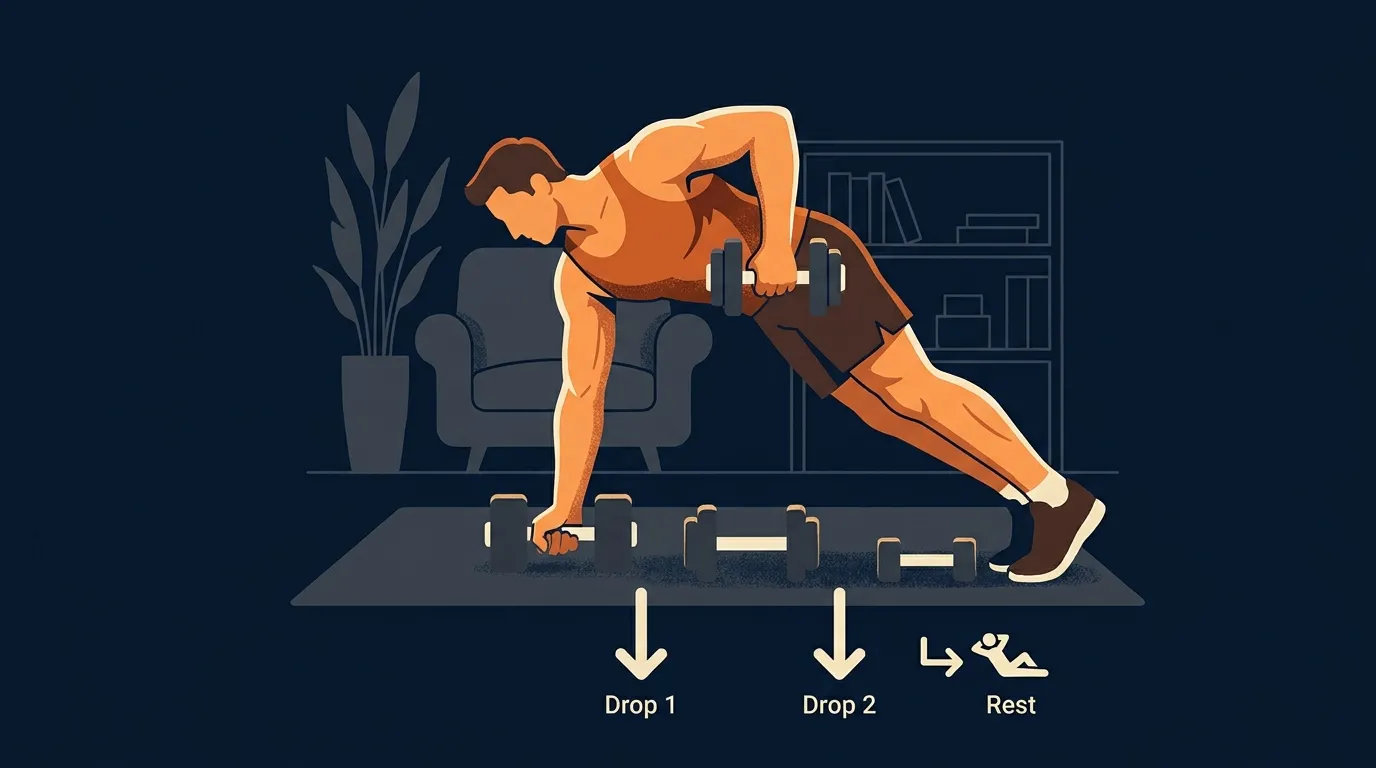
At home with fixed loads, the bodyweight-drop pattern works: a hard variation to failure, then step down to an easier variation and continue. Push-up example: 8 diamond push-ups to failure, immediately to standard push-ups for 6, immediately to knee push-ups for 8. One set, three "loads", 22 total reps. Total time: under 90 seconds. This is the honest home-training case for drop sets. When you can't add weight and you don't have time for more sets, you can still keep adding effective volume.
For related evidence on the surrounding questions, our pieces on training to failure vs reps in reserve, cluster sets, light-weights hypertrophy, and rest periods for muscle growth cover the same territory from different angles. And if a time-efficient plan matters to you generally, our quick workouts guide pulls the practical structure together.
Get an evidence-based plan built for you
FitCraft, our mobile fitness app, pairs you with an AI coach who builds you a personalized plan around your goals, schedule, and fitness level. Every FitCraft program is designed by Domenic Angelino, MPH (Brown University) and NSCA-CSCS, with research published in the Journal of Strength and Conditioning Research and Medicine & Science in Sports & Exercise.
Take the Free Assessment Free • 2 minutes • No credit cardCommon Misconceptions
"Drop Sets Grow More Muscle Than Straight Sets"
They don't, once you match effort and volume. The Havers et al. (2026) meta-analysis of 12 studies found a trivial hypertrophy effect (SMD 0.04, 95% CI −0.29 to 0.36). Sødal et al. (2023) reached the same conclusion in an independent synthesis. Angleri et al. (2017) ran a 12-week volume-matched trial in trained men and found identical CSA gains (7.6% to 7.8% across drop set, traditional, and pyramid conditions). Fink et al. (2018) is the trial most cited for the "drop sets grow twice the muscle" claim, but its volume was not directly matched between groups, and it pooled with the rest of the literature in the 2023 and 2026 meta-analyses. The between-group hypertrophy edge disappeared.
"Drop Sets Are Only for Advanced Bodybuilders"
Not really. The mechanism (fatigue the muscle at a higher load, drop the load to keep repping) is accessible to any lifter who understands their working weights. Sødal 2023's sample was 19 to 27 years old and predominantly untrained or recreationally trained. Ozaki 2018 used untrained men. Beginners can use drop sets safely on isolation and accessory work. What is true is that beginners get plenty of growth from basic progressive overload on straight sets and don't need the technique to make progress. Advanced lifters use it more because their marginal returns on straight-set volume have narrowed.
"Drop Sets Are the Fastest Way to Get Stronger"
No. Drop sets end with lighter loads and higher fatigue. They spend less time in the neuromuscular adaptation zone that drives maximal strength. Havers 2026 found strength adaptations were a tie (SMD −0.04), which is a statistical way of saying drop sets don't hurt strength when structured well but also don't help it. For 1RM strength, heavier loading, longer rests, and lower reps per set are still the primary tools. Drop sets are a hypertrophy and time-efficiency technique. They are not a strength peaking technique.
"You Have to Take Every Drop to Failure"
Not necessarily. Most protocols in the meta-analytic literature do take the initial working set to failure or near failure, but the subsequent drops can stop when bar speed collapses or form breaks down rather than at absolute failure. Especially on bodyweight and dumbbell exercises where a "grinding" bad rep at fatigue accumulates without adding growth stimulus, stopping a drop 1 to 2 reps short of failure is fine. What matters is that the total set puts the target muscle under enough mechanical tension time to drive adaptation, not that every drop is a maximal effort.
What the Research Suggests Going Forward
The drop-set literature has landed in an unusually clean place. Two independent meta-analyses (Sødal 2023, Havers 2026) agree on the hypertrophy conclusion. Three volume-matched or volume-comparable trials (Fink 2018, Ozaki 2018, Angleri 2017) agree drop sets produce growth comparable to traditional training in less time. The strength conclusion is a tie, with a mild lean toward traditional heavy sets in one trial. The time-efficiency conclusion is a clear drop-set win, with roughly half to one-third the session duration.
Use drop sets when time is the binding constraint. Program them on isolation and accessory work, once or twice per muscle group per session, as the last set of that exercise. Expect the sets to feel meaningfully harder than a straight set. Expect the growth outcome over 8 to 12 weeks to look like a straight-set program. Do not expect a hypertrophy shortcut. Do not expect improved 1RM strength beyond what heavy straight sets provide.
The honest limits worth naming. Most drop-set trials pool populations that are young (mean age often under 30) and predominantly male. Response in older adults, in women, and in highly trained populations is under-studied. The chronic adherence question (do lifters keep programming drop sets over 6 or 12 months of self-directed training?) has not been formally tested. Sample sizes across individual trials remain small (Fink 2018 had 8 per group, Ozaki 2018 had 9 total, Angleri 2017 had 32). The 2026 Havers meta-analysis pooled 274 participants total across all 12 studies. That is enough for stable effect-size estimates on hypertrophy and strength but limited for subgroup analyses by age, sex, or training experience.
Practical bottom line. If you have limited training time and want to keep hypertrophy progress moving, drop sets are one of the best-supported time-efficiency tools in the research. If you are chasing maximal strength, keep the drop sets out of the main lifts and stick with heavy straight sets. If you are just curious whether the technique earns its reputation as a "muscle hack", the honest answer is: the technique works about as well as straight sets, in less time, and calling it a hack overstates what the data actually shows.
References
- Havers T, Micke F, Geisler S, Held S. "Acute and Chronic Effects of Drop-Set Training: A Meta-Analysis and Systematic Review." Sports Medicine - Open. 2026;12:38. doi:10.1186/s40798-026-01012-1 · PMC13043944
- Sødal LK, Kristiansen E, Larsen S, van den Tillaar R. "Effects of Drop Sets on Skeletal Muscle Hypertrophy: A Systematic Review and Meta-analysis." Sports Medicine - Open. 2023;9:66. doi:10.1186/s40798-023-00620-5 · PMC10390395
- Fink J, Schoenfeld BJ, Kikuchi N, Nakazato K. "Effects of drop set resistance training on acute stress indicators and long-term muscle hypertrophy and strength." Journal of Sports Medicine and Physical Fitness. 2018;58(5):597-605. doi:10.23736/S0022-4707.17.06838-4 · PubMed: 28474868
- Ozaki H, Kubota A, Natsume T, et al. "Effects of drop sets with resistance training on increases in muscle CSA, strength, and endurance: a pilot study." Journal of Sports Sciences. 2018;36(6):691-696. doi:10.1080/02640414.2017.1331042 · PubMed: 28532248
- Angleri V, Ugrinowitsch C, Libardi CA. "Crescent pyramid and drop-set systems do not promote greater strength gains, muscle hypertrophy, and changes on muscle architecture compared with traditional resistance training in well-trained men." European Journal of Applied Physiology. 2017;117(2):359-369. doi:10.1007/s00421-016-3529-1 · PubMed: 28130627
Frequently Asked Questions
What is a drop set?
A drop set is a resistance training technique where you take a working set to or near failure, immediately reduce the load, and continue repping without a full rest. A typical setup: press a weight for 10 reps to failure, drop the load 20 to 30 percent, and squeeze out 4 to 6 more reps. That whole sequence counts as one set. The idea is to keep muscle fibers under tension past the point straight sets would stop, without needing to add another full set. Loading options like dumbbells, resistance bands, and bodyweight variations (harder push-up to easier push-up) all work.
Do drop sets build more muscle than traditional sets?
When training volume and effort are equalized, no. The 2026 meta-analysis by Havers et al. in Sports Medicine Open pooled 12 studies and 274 participants and found a trivial effect for hypertrophy (SMD 0.04, 95% CI −0.29 to 0.36). Sødal et al.'s 2023 meta-analysis in the same journal reached the same conclusion across 6 studies (between-group SMD 0.155, 95% CI −0.199 to 0.509, p=0.392). What drop sets deliver is equivalent growth in substantially less training time: roughly half to one-third of a traditional protocol's session length.
Are drop sets better for strength?
No. Havers et al. (2026) pooled 12 trials and found a trivial strength effect (SMD −0.04, 95% CI −0.34 to 0.26). Traditional heavy-load sets tend to build maximal strength at least as well as drop sets, and sometimes better. Fink et al. (2018) found the traditional group in their 6-week trial gained slightly more strength than the drop-set group even though the drop-set group gained roughly twice the arm size. If maximal 1RM strength is the primary goal, drop sets are not the main tool. If muscle size or time efficiency is the goal, they hold up.
How much time do drop sets save?
A lot. Ozaki et al.'s 2018 pilot in the Journal of Sports Sciences reported that a single drop-set protocol took 2.1 minutes per session on average, compared to 6.8 minutes for a traditional heavy-load protocol and 11.6 minutes for a light-load protocol. Sødal et al.'s 2023 meta-analysis and the 2026 Havers review both noted drop sets required roughly half to one-third of the training duration of equivalent traditional protocols. The trade-off is real physiological cost: acute perceived exertion (SMD 1.62) and blood lactate (SMD 0.67) are significantly higher with drop sets, per Havers 2026.
Can you do drop sets at home with bodyweight or dumbbells?
Yes. Drop sets are a load-reduction principle, not an equipment requirement. Any exercise where you can smoothly reduce effort mid-set works. With dumbbells: start with heavier pair, hit failure, immediately switch to a lighter pair and continue. With resistance bands: switch to a lighter band. With bodyweight: drop from a harder variation to an easier one (diamond push-ups to wide push-ups to knee push-ups). The mechanical principle (fatigue the fibers, reduce load, keep the set going) is the same at every equipment tier. Program 1 to 2 drop sets per muscle group per session, once or twice a week, on isolation or accessory lifts.