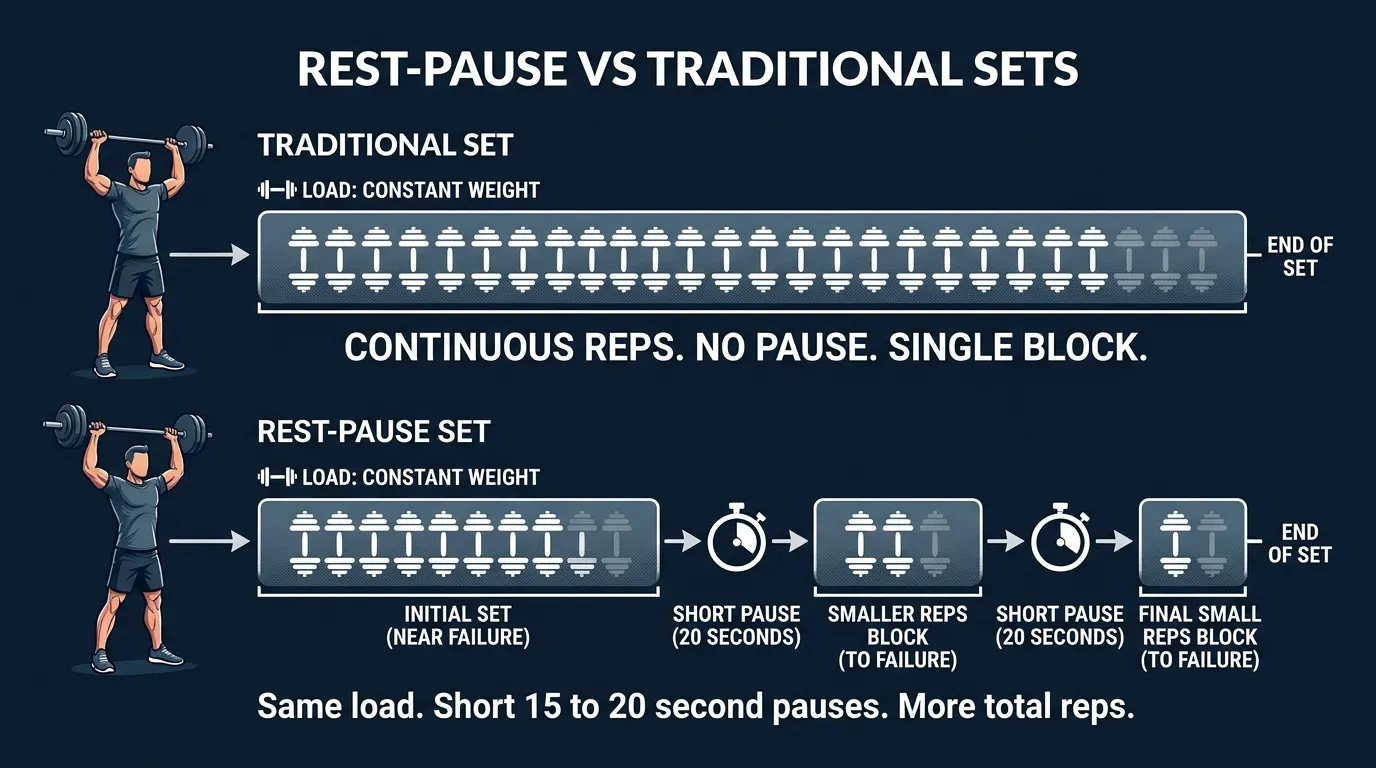
Straight sets are the honest default. You pick a load, do 8 or 10 reps, rest, do another set. The problem is that once your last rep is really hard, the set is over. Rest-pause tries to squeeze a little more work out of that same load with a short in-set rest, then a second (usually smaller) set to failure. Then, sometimes, a third.
The physiology is straightforward. Phosphocreatine drops fast during hard work, and 15 to 20 seconds is enough for a partial rebound. Not full recovery. Just enough that you can hit a few more clean reps at the same load. That's the entire mechanism. The interesting question is what it buys you when you actually train that way for weeks.
This piece walks through what rest-pause really is (in the research, not in Instagram captions), the four best-designed trials on the method, where it wins and where it draws with traditional sets, and how to actually use it when your equipment is a pair of dumbbells and your kitchen floor.
What Rest-Pause Actually Is
The rest-pause structure that shows up in the research looks like this. You do one working set to failure or one rep short of failure at 75 to 85% of your 1-rep max. You rack the load, sit or stand still for 15 to 20 seconds, then unrack and do another set at the same load to failure. That second set is shorter (maybe 2 to 4 reps). You rest another 15 to 20 seconds, then do one more failure set (usually 1 to 3 reps). All of it counts as one rest-pause "set".
The whole block takes 40 to 60 seconds of work spread across roughly a minute of rest. Total reps at the load are typically 30 to 60% higher than a single straight set at the same load. That extra volume is the whole point.
A few naming conventions are worth pinning down, because the literature and coaches use overlapping terms:
- Rest-pause: failure at the start, short rest, more reps to failure at the same load. Repeat two or three cycles. Load stays constant. See our rest-pause glossary entry for the short definition.
- Cluster set: rest inserted between rep groups before reaching failure, aimed at preserving bar speed on later reps. Load stays constant. Overlaps with rest-pause in structure but differs in intent (see our cluster sets research write-up for the full picture).
- Drop set: failure at one load, immediately reduce load, keep going to failure at the lower load. Load drops with each mini-set.
- Myo-reps: a specific rest-pause variant with a 3-to-5 second inter-rep rest and 5-to-10 second inter-mini-set rest, more common in coaching content than in peer-reviewed research.
The research on rest-pause almost always uses the classic Prestes 2019 or Enes 2021 style: failure, short rest, more reps at the same load, repeat two or three cycles. That's the version this piece is about.
The Research: What Studies Show
Marshall et al. (2012): The Acute Fatigue Baseline
The clearest look at what rest-pause actually does to a working muscle in a single session comes from Marshall, Robbins, Wrightson, and Siegler (2012) in the Journal of Science and Medicine in Sport. Fourteen resistance-trained men performed three volume-load-matched protocols: five sets of four reps with three-minute rests (traditional heavy), five sets of four reps with 20-second rests (a cluster-like short-rest protocol), and a rest-pause protocol starting with a set to failure at 80% of 1RM, then continuing at the same load with 20-second inter-set rests until total volume matched the other two conditions.
The rest-pause protocol produced the greatest reductions in maximal force output and rate of force development after the session. Both short-rest protocols produced more post-session fatigue than the traditional heavy protocol. That's not surprising, but it's important. Rest-pause and cluster structure are not the same, even at similar load-and-rest arithmetic. Rest-pause pushes to failure. Cluster structure typically doesn't. The failure component drives the extra fatigue.
The takeaway from Marshall (2012): rest-pause is genuinely a hard set. Coaches sometimes describe it as "extending" a set gently. It's not. The neuromuscular cost is real, and the recovery demand between rest-pause sets and between rest-pause sessions is higher than for a straight set at the same load. This matters when you're deciding how often to use it (see the programming section below).
Korak et al. (2017 and 2018): The Volume Case
Two randomized trials from Korak and colleagues nailed down what rest-pause does to total lifting volume. The Korak et al. (2017) trial in the European Journal of Applied Physiology compared rest-pause bench press training to traditional four-sets protocols in resistance-trained men. The Korak et al. (2018) trial in the same journal ran the same comparison on the back squat in trained women.
Both trials found the same pattern. Rest-pause allowed significantly more total repetitions at the same relative load than the traditional protocol, and pectoral (2017) and lower-body (2018) muscle activation measured via surface EMG was similar or slightly higher across the working sets in the rest-pause condition. The clean version of the finding: rest-pause is doing exactly what it's supposed to. More reps at the same load, with muscle activation preserved into the extended reps.
The lifter isn't magically stronger. The load hasn't changed. What's changed is that fatigue gets a small reset between the mini-sets, so the lifter can express more of their strength at that load. And volume, at a given intensity, is the primary driver of long-term adaptation.
Prestes et al. (2019): The 6-Week Adaptation Trial
The first well-designed chronic trial on rest-pause was Prestes, Tibana, and colleagues (2019) in the Journal of Strength and Conditioning Research. Eighteen resistance-trained men (mean age 30) trained for 6 weeks. The traditional group performed 3 sets of 6 reps at 80% of 1RM with 2-minute rests. The rest-pause group performed one set to failure at 80% of 1RM, rested 20 seconds, more reps to failure, rested 20 seconds, and finished with a third set to failure at the same load. Same target load, same relative intensity, same session frequency. Different set structure.
Over 6 weeks, both groups gained strength on bench press, leg press, and biceps curl. No between-group differences in strength (p>0.05 on all three lifts). But two outcomes did differ:
- Thigh muscle thickness: rest-pause 11%, traditional 1% (p<0.05).
- Leg press muscular endurance (reps at 60% 1RM): rest-pause 27%, traditional 8% (p<0.05).
The hypertrophy and endurance advantages were driven by the extra volume rest-pause let the trained group accumulate at the target load. Total repetitions per session were higher for the rest-pause group. Time per session was actually lower, because 20 seconds of rest is much less than 2 minutes. So a shorter session moved more total load, and over 6 weeks that turned into a growth advantage on the thigh (though not on upper-body thickness in this trial).
One caveat worth naming. This trial did not equate total training volume between the two groups. That was the design intent. Rest-pause was allowed to do what it does, and volume was allowed to be higher. The trial answers "what if you use rest-pause instead of traditional sets at the same load?" not "what if you match total volume and just change the set structure?" Enes (2021) is the trial that asked that second question.
Enes et al. (2021): The Volume-Equated 8-Week Trial
The cleanest test of rest-pause as a set-structure effect (rather than a volume-accumulation effect) is Enes, Alves, Schoenfeld, and colleagues (2021) in Applied Physiology, Nutrition, and Metabolism. Twenty-eight resistance-trained males were randomized to rest-pause (n=10), drop-set (n=9), or traditional (n=9) training for 8 weeks, twice weekly. Total training volume was equated across the three groups, so any differences reflect the set structure itself, not extra volume.
The strength result: rest-pause produced significantly greater 1RM back squat gains than traditional (p=0.001). Drop-set and traditional were similar. So on a heavy multi-joint lift in trained lifters, rest-pause produced a strength edge even when total volume was equated.
The hypertrophy result: no between-group differences in muscle thickness. Rest-pause, drop-set, and traditional all produced similar growth in the proximal and middle thigh regions (distal thigh did not change in any group).
Read together with Prestes (2019), a coherent picture emerges. When total volume is allowed to drift up (as it usually does with rest-pause, because it lets you do more reps at the same load), you can get more hypertrophy than a straight-set control. When total volume is equated, hypertrophy differences disappear. Strength differences on multi-joint lifts can persist even at equated volume, at least in trained males on the back squat.
Tsartsapakis et al. (2026): The Meta-Analytic Summary
The most recent synthesis is Tsartsapakis, Zafeiroudi, and Kouthouris (2026) in the Journal of Functional Morphology and Kinesiology. The review examined advanced resistance training systems including rest-pause, drop sets, cluster sets, and pre-exhaustion, with 24 studies identified and 20 included in the meta-analysis. Four of those studies specifically compared rest-pause to traditional training.
Across the pooled hypertrophy analysis, rest-pause was the only advanced method with a significant positive coefficient, meaning the pooled effect leaned toward more hypertrophy with rest-pause than traditional sets. The authors were careful about the size of the effect: it was small, and the number of rest-pause trials in trained adults is limited. The strength results across advanced systems were more mixed, with rest-pause showing a moderate positive effect but not consistently superior across all studies.
The honest read of the meta-analysis is that the current evidence base modestly favors rest-pause for hypertrophy, but the effect is small and the trials are few. Anyone claiming rest-pause is a hypertrophy revolution is running past what four small trials can support.
Why This Matters for Your Training
Three practical use cases fall out of the research.
Time-efficient sessions. Rest-pause moves more work per minute than straight sets. Prestes (2019) had rest-pause groups finishing sessions faster than the traditional groups. If you have 30 minutes for a workout and want to move maximum quality volume in that window, rest-pause is one of the highest-yield structures. This is the "same result in less time" case, and it's well-supported.
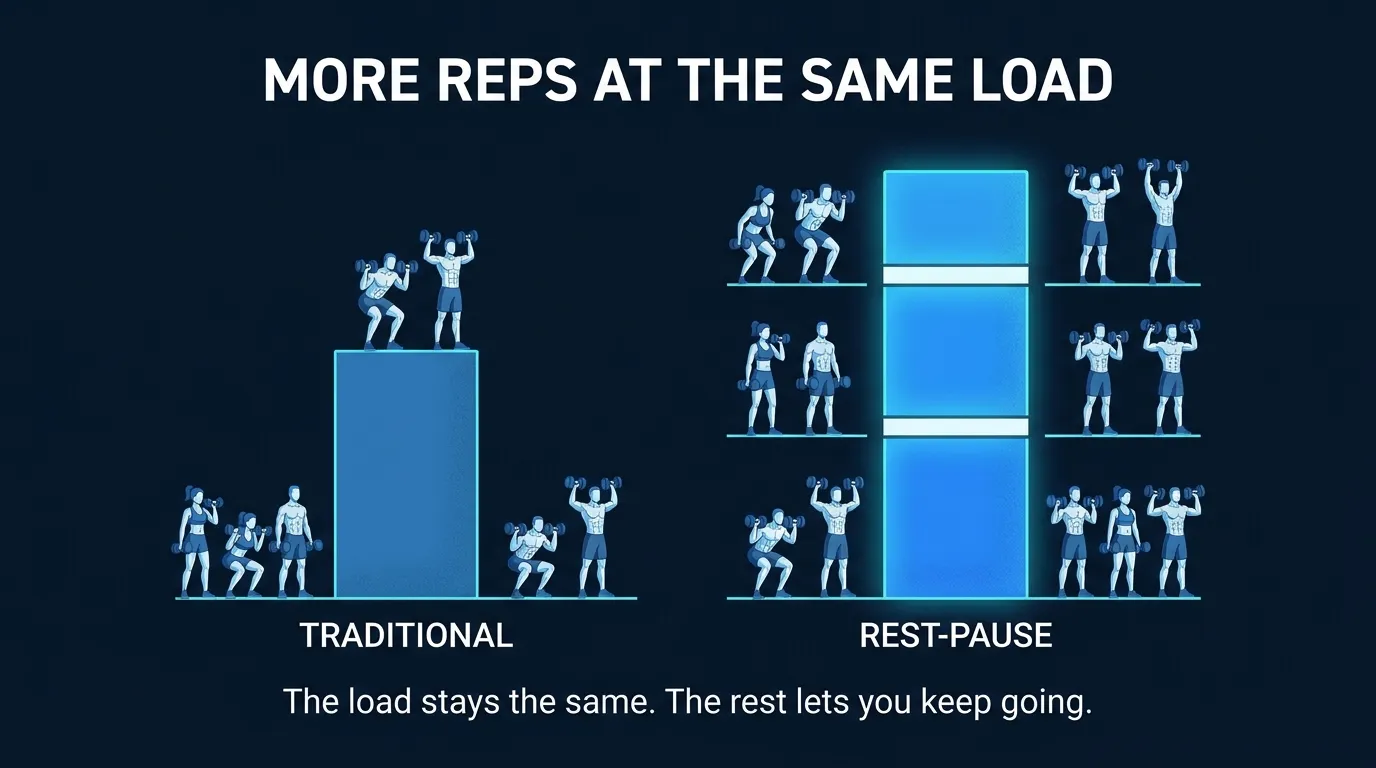
Home training with fixed loads. If you own one pair of dumbbells and can't easily add weight, rest-pause is one of the few ways to keep applying progressive overload without changing the load. You get more total reps at the load you already have. This overlaps with the case for cluster sets in fixed-load home training, but rest-pause is more aggressive: it takes the mini-sets to failure, so the total effort is higher. If you're building volume tolerance and can recover from harder sessions, rest-pause squeezes more out of a fixed load than a cluster.
Trained lifters looking for a small strength edge on multi-joint lifts. Enes (2021) is the only clean signal here (28 males, back squat, 8 weeks, volume-equated). The effect was real (p=0.001) but the trial is small and the population is narrow. It would be an overreach to say every trained lifter should switch to rest-pause on every heavy compound. But it's a fair tool to periodize in for a short strength block on one or two big lifts.
Where rest-pause doesn't buy you much: beginners still learning the movement, and hypertrophy programs where total volume is already dialed in. If you're already doing 15 to 20 hard sets per muscle group per week and hitting each set close to failure, adding rest-pause structure won't produce more growth. It just changes how you distribute the fatigue.
Get an evidence-based plan built for you
FitCraft, our mobile fitness app, pairs you with an AI coach who builds you a personalized plan around your goals, schedule, and fitness level. Every FitCraft program is designed by Domenic Angelino, MPH (Brown University) and NSCA-CSCS, with research published in the Journal of Strength and Conditioning Research and Medicine & Science in Sports & Exercise.
Take the Free Assessment Free • 2 minutes • No credit cardHow to Actually Use Rest-Pause
The Prestes 2019 protocol is a good default. One set to failure at 75 to 85% of 1RM, rest 15 to 20 seconds, more reps at the same load to failure, rest 15 to 20 seconds, one more short set to failure. Total time under load: usually 45 to 70 seconds. Count the whole block as one working set.
Do it for 2 or 3 working sets per exercise. Don't do it for 5. The neuromuscular cost Marshall (2012) documented is real, and stacking rest-pause on every set of every exercise turns a session into an accumulated-fatigue mess. One or two exercises per session, with 2 to 3 rest-pause working sets each, is the ceiling for most trained people.
The exercises to prioritize:
- Multi-joint lifts you can safely take to failure with clean form: dumbbell squats, split squats, goblet squats, floor press, dumbbell bench press, single-leg deadlifts, weighted lunges.
- Bodyweight exercises where the failure point is reasonable to reach: push-up variations, pull-ups (if you can hit failure at 8 to 12 reps), inverted rows, single-leg glute bridges.
- Isolation work on a fixed load: dumbbell curls, tricep extensions, lateral raises, hamstring curls (band or bench).
Skip rest-pause on exercises where form breakdown at failure is dangerous or unhelpful. Barbell squats, deadlifts, and overhead pressing at heavy loads are usually not good rest-pause candidates. The exception is if you have a spotter or safety pins and are comfortable failing safely.
How often per week is where most people get this wrong. Rest-pause is a hard training stimulus. If you're doing it on 2 to 3 exercises across 3 to 4 sessions per week, that's plenty. Doing it every set every session is a fast route to accumulated fatigue and stalled recovery. The general pattern in the research: rest-pause worked well at 2 to 3 sessions per week, with 2 to 3 rest-pause sets per session on 1 to 2 exercises.
Progression is the same as with any training method. Track your total reps per rest-pause block. When you can complete more reps at the same load across the block for two consecutive sessions, add a small load increase or add a rep target. For adjacent research on how training frequency and proximity to failure interact with methods like rest-pause, our other write-ups walk through the trade-offs.
Common Misconceptions
"Rest-Pause Builds Way More Muscle Than Straight Sets"
The evidence is more measured than the marketing. Prestes (2019) found a real thigh hypertrophy advantage (11% vs 1%) in a trial that let volume drift up. Enes (2021) equated volume and found similar hypertrophy across rest-pause, drop-set, and traditional. Tsartsapakis (2026) found a small pooled hypertrophy edge for rest-pause across four trials, but noted the effect was small and the evidence base is thin. The honest translation is that rest-pause can produce a bit more hypertrophy when it lets you do more total work, and the differences shrink when total work is matched.
"Rest-Pause Is the Same as a Cluster Set"
No. Cluster sets typically stop each rep group short of failure to preserve bar speed and mechanical output on later reps. Rest-pause pushes to failure and rests briefly to squeeze out more reps at the same load. Marshall (2012) directly compared them in a volume-load-matched design and found rest-pause produced greater neuromuscular fatigue than a short-rest cluster configuration. Same rest arithmetic, very different training stimulus. If your goal is bar speed, use clusters. If your goal is total volume at a heavy load, use rest-pause.
"Rest-Pause Is Only for Advanced Lifters"
Partly true. The research is almost entirely in resistance-trained populations, which limits how strongly we can generalize to beginners. The mechanism (partial phosphocreatine recovery in a short rest window) works the same regardless of training age, but three things bias against beginners using rest-pause aggressively. First, beginners are still learning form, and taking every set to failure amplifies the risk of form breakdown. Second, beginners can drive progress with straight sets at moderate proximity to failure, so the extra stress rest-pause adds isn't necessary. Third, recovery capacity is often lower in the first few months of training. A reasonable rule: hold rest-pause off until you have 6 to 12 months of consistent training and can hit reps in reserve targets reliably on your key lifts.
"You Should Rest-Pause Every Set of Every Session"
No. Marshall (2012) documented that rest-pause produces greater post-session fatigue than a straight-set protocol at the same volume-load. Enes (2021) and Prestes (2019) both used rest-pause selectively (on the primary lift, in a small number of working sets), not universally. Stacking rest-pause on every set turns a training week into an unrecoverable fatigue accumulation, which is neither more effective nor healthier. The right dose is 1 to 2 exercises per session, 2 to 3 rest-pause working sets each, 2 to 3 sessions per week.
What the Research Suggests Going Forward
The rest-pause literature is small but reasonably consistent about what the method does. Marshall (2012) established the acute cost. Rest-pause is a genuinely hard set, harder than a short-rest cluster configuration with matched volume-load. Korak (2017, 2018) established the volume mechanism. Rest-pause lets you accumulate significantly more reps at a given load in a given session. Prestes (2019) and Enes (2021) mapped the chronic outcomes. More hypertrophy when volume drifts up, similar hypertrophy when volume is equated, sometimes a small strength edge on heavy multi-joint lifts in trained lifters. Tsartsapakis (2026) pulled the pooled trials together and found a small but significant hypertrophy signal, with the honest caveat that the trial base is thin.
The honest limits worth naming. Most trials are 6 to 8 weeks long. The chronic story past 12 weeks is not well studied. Sample sizes are almost all under 30 per group. Populations are almost all young resistance-trained men. Older adults, women, and beginners are underrepresented. And the "volume drifts up" trials genuinely can't isolate the set-structure effect from the volume effect. Enes (2021) is the best volume-equated trial we have, and it's still 28 participants on one lift for 8 weeks.
Practical takeaway. If straight sets are working and your progress is steady, keep going. If you want to move more quality volume in a shorter session, rest-pause is well-supported. If you're stuck at a fixed home load and can't easily add weight, rest-pause is one of the most effective ways to keep progressing. If you're a trained lifter looking for a small strength edge on a heavy multi-joint lift, an 8-week rest-pause block on that lift is a reasonable experiment. In all cases, don't stack the method universally, and don't expect it to produce results that outrun what volume, load, and effort would predict on their own.
References
- Marshall PWM, Robbins DA, Wrightson AW, Siegler JC. "Acute neuromuscular and fatigue responses to the rest-pause method." Journal of Science and Medicine in Sport. 2012;15(2):153-158. doi:10.1016/j.jsams.2011.08.003 · PubMed: 21940213
- Korak JA, Paquette MR, Brooks J, Fuller DK, Coons JM. "Effect of rest-pause vs. traditional bench press training on muscle strength, electromyography, and lifting volume in randomized trial protocols." European Journal of Applied Physiology. 2017;117(9):1891-1896. doi:10.1007/s00421-017-3661-6 · PubMed: 28702807
- Korak JA, Bruininks BD, Paquette MR. "Effect of a rest-pause vs. traditional squat on electromyography and lifting volume in trained women." European Journal of Applied Physiology. 2018;118(6):1309-1316. doi:10.1007/s00421-018-3863-6 · PubMed: 29644392
- Prestes J, Tibana RA, de Araujo Sousa E, da Cunha Nascimento D, de Oliveira Rocha P, Camarco NF, Frade de Sousa NM, Willardson JM. "Strength and Muscular Adaptations After 6 Weeks of Rest-Pause vs. Traditional Multiple-Sets Resistance Training in Trained Subjects." Journal of Strength and Conditioning Research. 2019;33(7S):S113-S121. doi:10.1519/JSC.0000000000001923 · PubMed: 28617715
- Enes A, Alves RC, Schoenfeld BJ, Oneda G, Perin SC, Trindade TB, Prestes J, Souza-Junior TP. "Rest-pause and drop-set training elicit similar strength and hypertrophy adaptations compared with traditional sets in resistance-trained males." Applied Physiology, Nutrition, and Metabolism. 2021;46(11):1417-1424. doi:10.1139/apnm-2021-0278 · PubMed: 34260860
- Tsartsapakis I, Zafeiroudi A, Kouthouris C. "Effects of Advanced Resistance Training Systems on Muscle Hypertrophy and Strength in Recreationally Trained Adults: A Systematic Review and Meta-Analysis." Journal of Functional Morphology and Kinesiology. 2026;11(1):80. doi:10.3390/jfmk11010080 · PMC12922048
Frequently Asked Questions
What is rest-pause training?
Rest-pause is a resistance training method where you take a set to failure or close to it, rest briefly (typically 15 to 20 seconds), then squeeze out extra reps at the same load. You repeat the short-rest-plus-reps cycle two or three times inside what counts as one set. The point is to accumulate more total reps at a heavy load than you could manage in one straight set, using very short rests to let phosphocreatine partially resynthesize. Prestes and colleagues' 2019 protocol is representative: one set of 6 reps at 80% of 1RM, 20 seconds rest, more reps at the same load to failure, 20 seconds rest, one more failure set.
Does rest-pause build more muscle than traditional sets?
Sometimes a bit, sometimes not. Prestes et al. (2019) found 11% thigh muscle thickness gains in the rest-pause group versus 1% in the traditional group over 6 weeks in trained men. But Enes et al. (2021), in a tighter 8-week trial in resistance-trained males that equated total volume across groups, found similar hypertrophy in rest-pause, drop-set, and traditional conditions. Tsartsapakis and colleagues' 2026 meta-analysis in the Journal of Functional Morphology and Kinesiology noted rest-pause was the only advanced method with a significant positive coefficient for hypertrophy across the included trials, but the effect was small and the number of rest-pause trials in trained adults is limited. The honest read: rest-pause can match or slightly beat traditional sets for hypertrophy when volume drifts up, and it matches traditional sets when volume is equated.
Does rest-pause increase strength more than traditional sets?
The strongest signal comes from Enes et al. (2021), where rest-pause produced significantly greater 1RM squat gains than traditional training over 8 weeks (p=0.001) in resistance-trained males. But Prestes et al. (2019) found no strength differences on bench press, leg press, or biceps curl across 6 weeks. The pattern that fits the evidence: rest-pause can produce a small strength edge in trained lifters at heavier loads on multi-joint lifts, but on many lifts and populations it draws with traditional sets. The consistent finding across every rest-pause study is that you get more total reps per session at the same load. Whether that extra volume compounds into meaningfully more strength depends on the exercise, the population, and how well total training stress is managed.
How is rest-pause different from a cluster set or a drop set?
All three redistribute rest or load inside a working set, but the goal differs. Cluster sets typically stop each rep group short of failure to preserve bar speed and mechanical output. Rest-pause pushes to or near failure, then rests 15 to 20 seconds and squeezes out extra reps at the same load, so the goal is total volume at a heavy load, not speed preservation. Drop sets keep pushing to failure while reducing the load between mini-sets, so the load drops with each block instead of staying constant. Marshall et al. (2012) documented that rest-pause produces greater neuromuscular fatigue than a cluster configuration with the same rest and volume-load, which fits the three methods being distinct tools rather than interchangeable variants.
Can you do rest-pause at home with dumbbells or bodyweight?
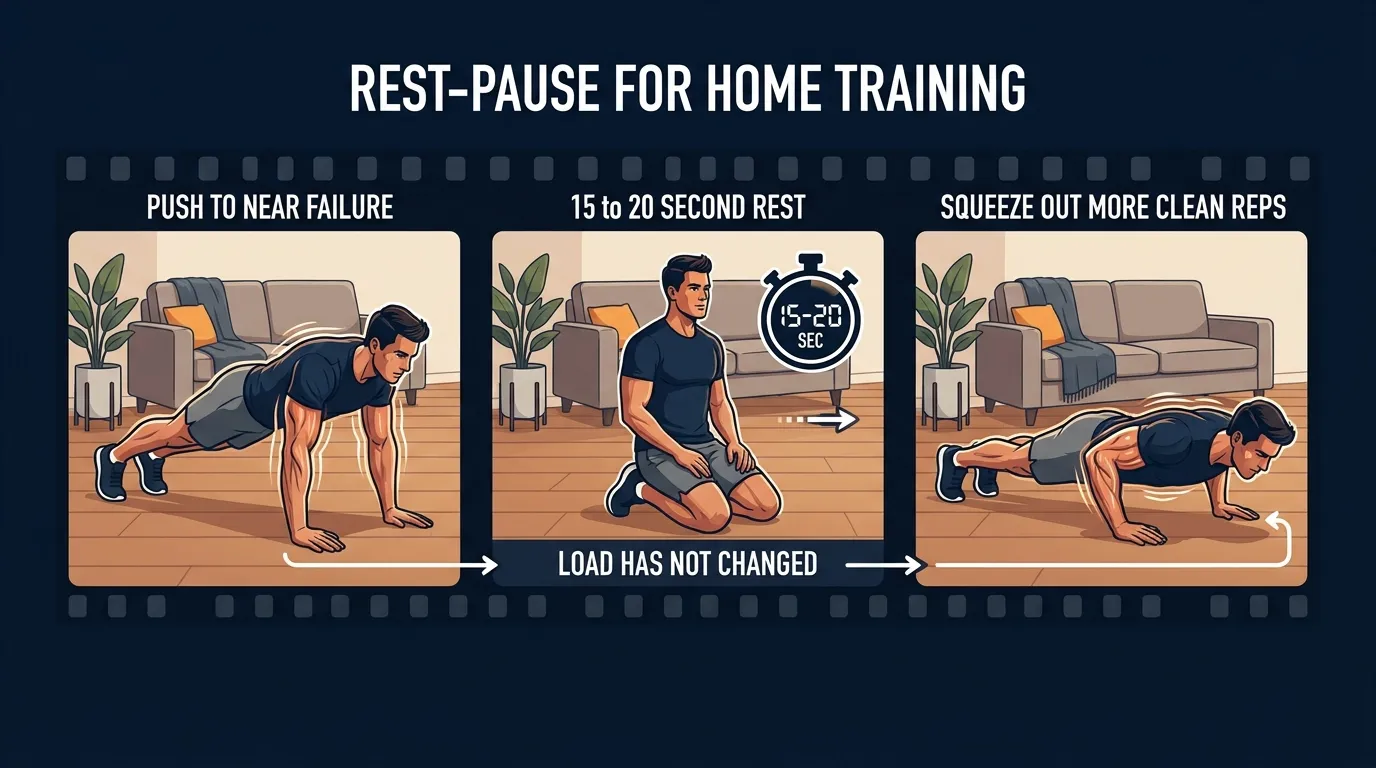
Yes, and this is where rest-pause is genuinely useful. When your loading options are fixed (one pair of dumbbells, or bodyweight) and you can't easily add resistance, rest-pause lets you accumulate more total reps at whatever load you already have. A representative home application: pick a push-up variation where you'd hit failure at 8 to 10 reps. Push to near failure, rest 15 to 20 seconds, then do as many more as you can with clean form. Rest 15 to 20 seconds again, do one more short set to failure. You've now done 15 to 18 quality reps at the same load, versus the 8 to 10 you'd get in one straight set. The same setup works for pull-ups, dumbbell squats, split squats, and single-leg deadlifts.