Home rowing machines used to sit in the corner of the room and gather laundry. Concept2, Hydrow and a handful of magnetic-resistance brands changed that; indoor rowing is now one of the fastest-adopted cardio modalities in the home fitness market. The question this article answers is the one the marketing skips: what do the actual studies show?
The short answer is that rowing's headline claim (full-body cardio in one machine) is one of the better-supported claims in home fitness. The stroke uses most of the body's large muscle groups, the aerobic system is loaded harder than in most seated cardio, and joint impact is meaningfully lower than running. What is oversold is the muscle-building story. What is undersold is the technique cost. This piece walks through both.
What the Rowing Stroke Actually Does
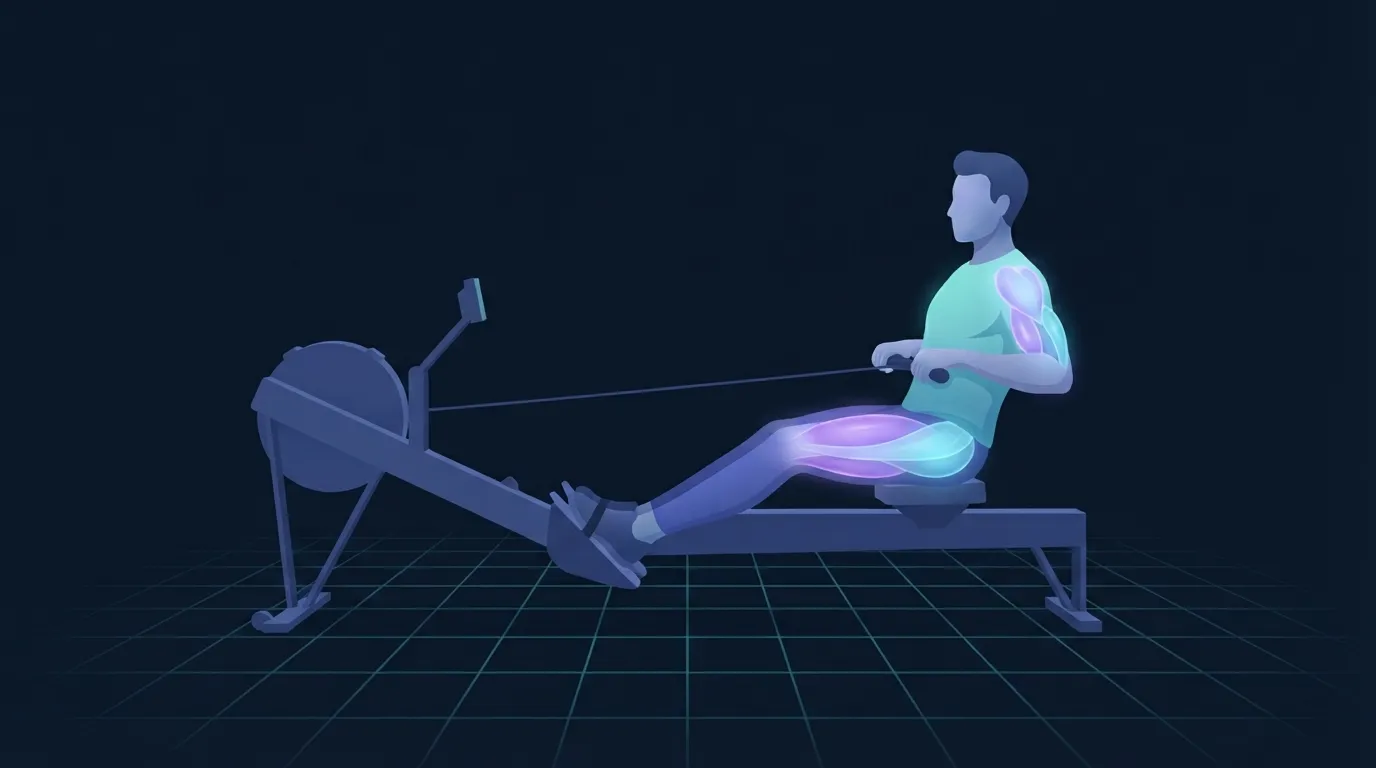
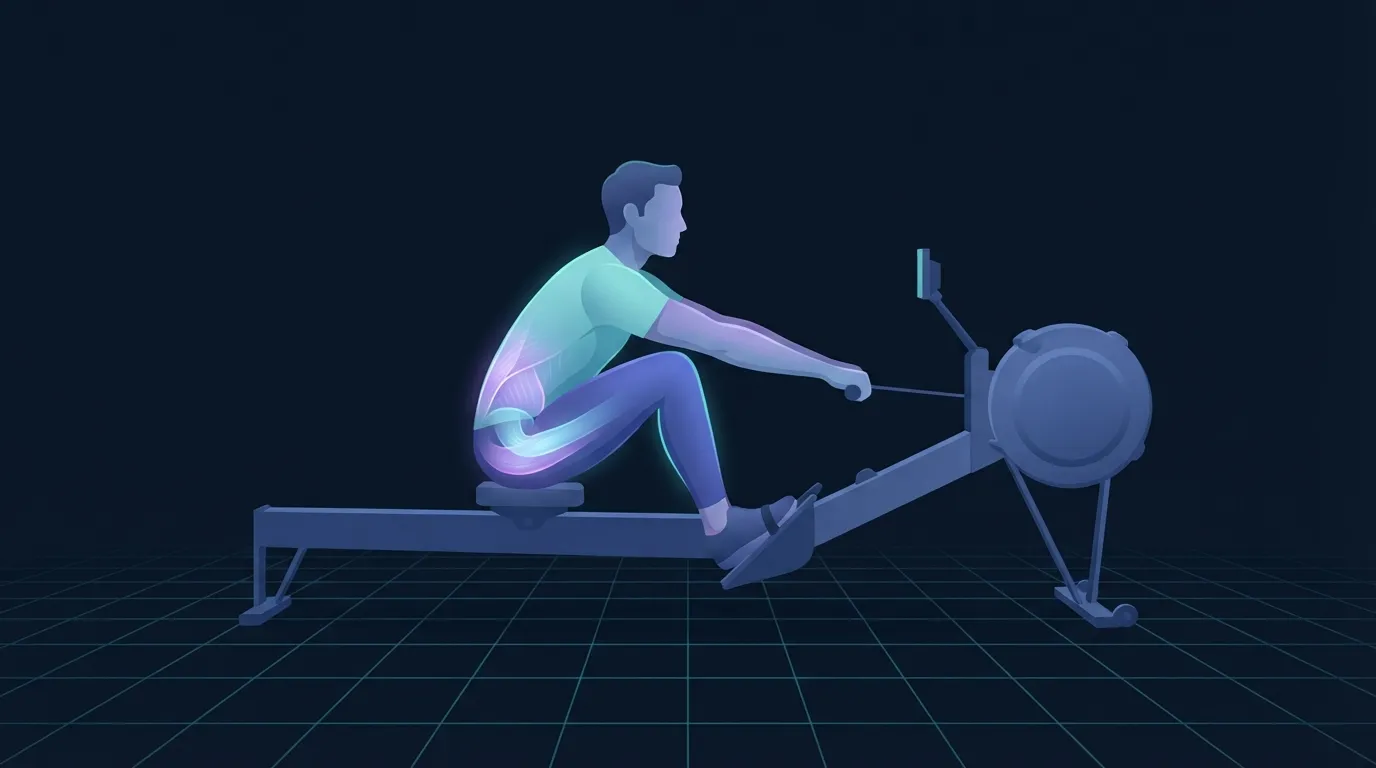
A rowing stroke has four phases: the catch (compressed at the front of the slide, shins vertical), the drive (legs push, then hips open, then arms pull), the finish (handle to the lower ribs, torso slightly reclined), and the recovery (arms out, hips over, knees bend, back to the catch). Each phase loads different muscle groups. For the EMG studies behind each of those phases, and the muscles the stroke leaves untrained, see our guide to what muscles rowing works.
- Legs: quadriceps, glutes, hamstrings, and calves drive the initial extension. On a well-rowed stroke, the legs produce the majority of the total force.
- Back and core: erectors, lats, rhomboids and abdominals transfer force from the legs through the trunk to the handle. This is the piece that goes wrong first when technique breaks down.
- Arms: biceps, brachialis and rear deltoids finish the pull. The arms are the last movers, not the primary ones. Rowers who lead with the arms plateau fast.
- Grip and forearms: holding the handle across long steady sessions is a real dose of grip endurance, especially over 20 to 30 minutes.
Hagerman's 1984 review in Sports Medicine characterized rowing as one of the few sports demanding both high aerobic capacity and high anaerobic capacity, powered by an unusually balanced pattern of muscle recruitment. The paper covered on-water rowing, but the indoor ergometer replicates the stroke closely enough that the physiology broadly transfers. Modern biomechanics work has continued to describe the same sequence.
The Nine-of-Ten Claim
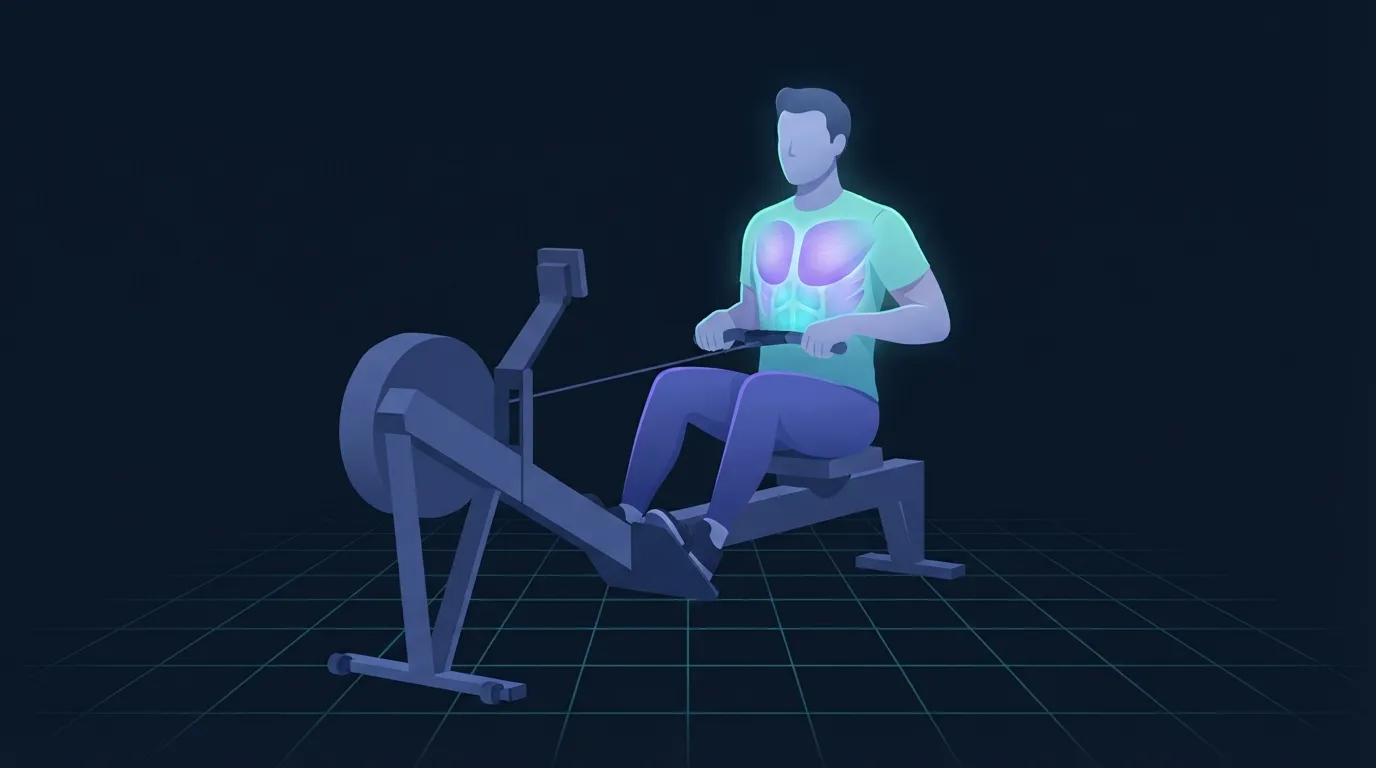
The often-repeated "rowing uses nine of the ten major muscle groups" figure is descriptive, not from a single indexed study. It counts quadriceps, hamstrings, glutes, calves, back extensors, lats, abdominals, biceps and rear deltoids as recruited in the stroke, with the chest doing comparatively little. That is a fair reading of what the movement asks for, and it is the reason rowing sits in a different bucket from most seated cardio. A stationary bike works legs. An arm bike works arms. Rowing works both, then the whole trunk, in one motion.
Aerobic Capacity: Where Rowing Really Shines
Because the stroke recruits so much muscle at once, the cardiovascular load per unit of perceived effort is higher than most home cardio. That is why competitive oarsmen record some of the highest VO2 max values on record in sport, only cross-country skiers and long-distance cyclists comparable.
Volianitis, Yoshiga and Secher (2020) in the European Journal of Applied Physiology reviewed the modern physiology of rowing and its health applications. Their summary of the training and adaptation literature makes three points that carry to the home rower. Cardiac output scales with recruited muscle mass, so the near-whole-body stroke produces higher stroke volumes and higher aerobic loads at a given RPE. The aerobic and anaerobic contributions are close to balanced in a hard rowing test, unusual among endurance sports. And rowing training produces the standard aerobic adaptations (higher mitochondrial density, better substrate handling, lower resting heart rate) at rates comparable to running or cycling at matched effort.
The elite-level evidence backs the "aerobic capacity is the master variable" reading. Ingham, Whyte, Jones and Nevill (2002) in the same journal analysed determinants of 2,000-metre ergometer performance in elite rowers and found peak oxygen uptake was the strongest single physiological predictor, ahead of peak power output and body composition. That is a specific statement about elite performance, not a claim that a recreational rower should chase VO2 max at any cost, but it does tell you what the training is really building.
The dose-response for the recreational rower is more modest. Three sessions a week of 20 to 45 minutes at conversational or somewhat-hard effort will produce measurable resting heart rate and perceived-exertion improvements inside 4 to 8 weeks, in line with what the general cardio literature reports across modalities. If you want the base-building blueprint on the machine, our zone 2 cardio at home walkthrough covers how to keep pace easy enough to build the aerobic base without turning every session into an interval workout.
Calories, METs and What the Ergometer Screen Is Doing
The 2011 Compendium of Physical Activities, by Ainsworth and colleagues in Medicine and Science in Sports and Exercise, is the reference sports scientists use for the metabolic cost of specific activities. Rowing appears in it at several intensities:
- Light rowing (about 4.8 METs): low resistance, less than 50 W effort. A recovery-day pace.
- Moderate rowing (about 7.0 METs): 50 to 100 W, a somewhat-hard pace you could hold for 30 to 45 minutes.
- Vigorous rowing (about 8.5 to 12.0 METs): 100 to 200 W and above, competitive-training paces.
A MET is roughly one kilocalorie per kilogram of body weight per hour. For a 70-kilogram adult, that puts 30 minutes of moderate rowing at 7 METs at about 245 kilocalories, and 30 minutes of vigorous rowing at 12 METs at about 420 kilocalories. Scaling to your own weight is straightforward: multiply your body weight in kilograms by the MET value by the hours rowed.
The on-board calorie counter on any rowing machine is a model of these numbers, not a direct measurement. Concept2's screen, for instance, computes calories from measured power output on the flywheel plus an assumed body weight (default 175 lb). If you weigh more than that, the screen underestimates burn. If you weigh less, it overestimates. Treat any calorie readout as a rough training log, not a nutrition truth.
For weight management, this puts rowing near the top of home-cardio efficiency per minute. Three 30-minute moderate sessions a week is roughly 700 to 900 kilocalories of exercise, on top of the resting-metabolic-rate benefit of the lean-mass work rowing does at the margins. It will not out-lift a lifting program for body composition, but it stacks well with one.
Low Impact, But Not No-Skill
Rowing has no airborne phase. Your feet stay on the footplates and your body slides on wheels; the joints of the ankle, knee and hip mostly see compressive load from your own drive at a rate you control. That makes rowing an easier modality on the knees and hips than running, and it is one of the reasons rehabilitation programs use the ergometer for cross-training when running is contraindicated. Hagerman's review (1984) noted rowing's suitability in that role.
The joint that pays the technique cost is the lumbar spine. High-force pulls with a rounded back at the finish, or aggressive reach at the catch, load the intervertebral discs in a shape they do not like. This is the main injury pattern in indoor rowing, and it accounts for most of the "rowing hurt my back" complaints. It is not intrinsic to the machine; it is intrinsic to bad technique at high load. Three cues correct most of it:
- Legs first. The drive starts with the legs pressing the footplates. The back and arms only move after the legs have most of the way through their range. Leading with the back is what produces the round-back finish.
- Neutral spine at the catch. Reaching for the flywheel by curving the lower back is the second failure mode. Keep the pelvis rocked slightly forward and the spine tall at the front of the stroke.
- Handle to the ribs, not the neck. The finish pulls the handle to the lower rib cage with elbows past the ribs. Pulling to the chin or throat is upper-back and neck load with no benefit.
Get an evidence-based plan built for you
FitCraft, our mobile fitness app, pairs you with an AI coach who builds you a personalized plan around your goals, schedule, and fitness level. Every FitCraft program is designed by Domenic Angelino, MPH (Brown University) and NSCA-CSCS, with research published in the Journal of Strength and Conditioning Research and Medicine & Science in Sports & Exercise.
Take the Free Assessment Free • 2 minutes • No credit cardDoes Rowing Build Muscle?
Yes, but modestly, and only in the muscles the stroke actually loads at meaningful intensity. Rowing is submaximal by design. A single pull is a small fraction of the force a heavy row, a deadlift or a squat would produce. Hypertrophy responds to load and time-under-tension in ranges rowing rarely reaches, which is why competitive rowers still lift. That said, three areas do get a hypertrophy dose:
- Posterior chain endurance: the erectors, glutes and hamstrings work every stroke. Beginners often report low-back soreness in the first week or two; that is the erectors accepting a real training load for the first time.
- Upper-back and lat endurance: the pull to the ribs works the lats, rhomboids and mid-traps in a low-load, high-rep pattern. Not enough to build a visibly wider back on its own, but enough to preserve pulling capacity if you cannot get to weights.
- Grip and forearms: long steady sessions build endurance grip, which carries into pulling work.
What rowing will not do is replace resistance training for visible muscle gain, especially in the chest, quads at high load, or the anterior deltoids. For body composition, the strongest combination is two to three lifting sessions a week plus two to three rowing sessions.
Rowing and Fat Loss
The calorie throughput described above is the primary mechanism, and it is a real one. What rowing adds on top of a cycling or walking program is the trunk and pull-side work, which supports lean mass retention when combined with adequate protein and resistance training. It does not selectively burn fat off any body region. Rowing on top of a modest caloric deficit is a reasonable, joint-friendly way to add training volume for a fat loss phase.
Rowing for Older Adults and Rehab
The seated, low-impact, self-paced nature of the rowing stroke makes it a common recommendation for older adults, deconditioned beginners, and people rehabilitating lower-limb injuries. The load is dose-responsive: at low resistance and low stroke rate, the machine produces a very gentle training stimulus. That is a useful property in a population where the gap between "no exercise" and "safe amount of exercise" is often small.
Volianitis and colleagues (2020) note in their review that rowing training generates the same aerobic health adaptations as running or cycling, without the impact costs. For readers over 50 who are choosing between low-impact cardio options, rowing sits alongside walking, elliptical work and stationary cycling as a defensible pick. If you are shopping for an app to guide that combination, our roundup of the best fitness apps for people over 50 compares the leading options on programming style, coaching depth, and adaptation to older adults.
How Beginners Should Program Rowing
A defensible starter block for a new rower:
| Week | Sessions | Duration | Effort | Stroke rate |
|---|---|---|---|---|
| 1 | 3 | 10 min | Conversational | 18-20 spm |
| 2 | 3 | 15 min | Conversational | 18-22 spm |
| 3 | 3 | 20 min | Conversational to easy | 20-22 spm |
| 4 | 3-4 | 25 min | Easy, mostly zone 2 | 20-24 spm |
| 5 | 3-4 | 30 min | Steady zone 2 | 20-24 spm |
| 6+ | 3-4 | 30-45 min | Zone 2, with 1 harder session | 22-26 spm |
The first month is about technique, not fitness. Sessions end when technique breaks, not when the clock runs out. Once 30 minutes at conversational pace feels easy, add either duration (up to 45 to 60 minutes) or one short interval session per week (for example, 6 rounds of 500 metres hard with 90 seconds easy between).
Beginners fatigue in the grip and lower back first, not the lungs, so short sessions with clean technique beat long sessions that turn into round-back grinds. If you prefer a home cardio option that does not need a rower, our best cardio app for home without running guide covers the alternatives.
What Rowing Does Not Do
Three claims come up in rowing marketing that the evidence does not support at the magnitudes claimed:
- "Rowing gives you the body of a rower." Elite rowers are large, lean and strong because they lift heavy weights, eat a lot of protein, and row 15 to 20 hours a week. The rowing does not produce their bodies alone. A recreational rowing habit at 90 to 180 minutes a week produces fitness, not that physique.
- "Rowing burns twice as many calories as [other cardio]." Rowing burns more calories than seated cycling at the same perceived effort because more muscle is recruited, but the difference is closer to 15 to 25 percent than to double, per the MET tables. Effort held honestly, not modality, is what closes the gap.
- "Rowing is a full-body workout that replaces the gym." It is a real full-body cardio, but it is not a substitute for progressive resistance training if muscle and strength gains are the goal. Stack, do not swap.
Sex Differences and What Scales
Rowing physiology scales predictably with body size and lean mass. Yoshiga and Higuchi (2003) in Scandinavian Journal of Medicine and Science in Sports analysed 2,000-metre ergometer performance in male and female rowers across a range of body sizes and reported that once you accounted for lean mass, male and female rowers scaled aerobic performance the same way. The practical implication is that rowing rewards the same training in both sexes: aerobic base, technique, and enough grip and back endurance to hold form under fatigue. Programming does not need to differ.
Choosing a Rowing Machine
Air resistance (Concept2), magnetic resistance (Hydrow, most connected rowers), water resistance, and hydraulic-piston rowers are the four common categories. Air rowers respond dynamically (harder pull produces more resistance) and are the training standard. Magnetic rowers give a smoother, quieter pull and integrate with subscription content. Water rowers give the closest feel to on-water rowing and are the quietest at low stroke rates. Hydraulic-piston rowers are compact and inexpensive; they feel less like rowing and are best treated as a light home cardio option, not a training tool.
For most home rowers, either an air rower or a magnetic rower will produce the same fitness result. The choice is mostly ergonomic and about how you enjoy training: dynamic resistance vs. programmed classes.
What the Research Suggests Going Forward
What the literature clearly supports:
- The stroke recruits most of the major muscle groups and produces a higher cardiovascular load per unit of effort than smaller-mass cardio.
- Moderate rowing runs about 7 METs; vigorous rowing about 12 METs (Ainsworth et al., 2011).
- Aerobic capacity is the strongest predictor of rowing performance at every level tested (Ingham et al., 2002).
- Rowing training produces the standard aerobic adaptations at rates comparable to running or cycling, with lower joint impact (Volianitis et al., 2020).
- Male and female rowers scale performance similarly with body size and lean mass, so programming does not need to differ (Yoshiga and Higuchi, 2003).
What is still less resolved:
- Whether the connected-rower subscription content (class-style programming with live pacing) produces better long-term adherence than self-programmed rowing has not been rigorously studied.
- The dose-response of rowing for older adults and clinical populations is described but not as extensively trialled as running or cycling.
- The optimal intensity distribution for recreational rowers (a polarized model, a threshold model, or a pyramidal one) is inferred from other endurance sports and not directly established in rowing at the amateur level.
For most readers, the useful takeaway is simpler than the research map: three sessions of 20 to 45 minutes a week, at a pace you could talk through, with clean technique and a couple of short interval sessions layered in later, will produce the cardiovascular and body-composition changes the machine actually can produce. The machine is the tool. The pattern is what does the work.
References
- Hagerman FC. "Applied physiology of rowing." Sports Med. 1984;1(4):303-326. doi:10.2165/00007256-198401040-00005
- Volianitis S, Yoshiga CC, Secher NH. "The physiology of rowing with perspective on training and health." Eur J Appl Physiol. 2020;120(9):1943-1963. doi:10.1007/s00421-020-04429-y
- Ingham SA, Whyte GP, Jones K, Nevill AM. "Determinants of 2,000 m rowing ergometer performance in elite rowers." Eur J Appl Physiol. 2002;88(3):243-246. doi:10.1007/s00421-002-0699-9
- Ainsworth BE, Haskell WL, Herrmann SD, et al. "2011 Compendium of Physical Activities: a second update of codes and MET values." Med Sci Sports Exerc. 2011;43(8):1575-1581. doi:10.1249/MSS.0b013e31821ece12
- Yoshiga CC, Higuchi M. "Rowing performance of female and male rowers." Scand J Med Sci Sports. 2003;13(5):317-321. doi:10.1034/j.1600-0838.2003.00321.x
Frequently Asked Questions
What muscles does a rowing machine work?
Rowing works roughly nine of the ten major muscle groups in a single stroke. The drive is legs first (quadriceps, glutes, calves), then the back and core (erectors, lats, rhomboids, abdominals), and finally the arms (biceps, rear deltoids). Hagerman's 1984 Sports Medicine review of rowing physiology described the stroke as an unusually balanced full-body movement, and later biomechanics work has replicated that finding on the indoor ergometer. That balance is why rowing is one of the few cardio modalities that also delivers a real dose of posterior-chain and grip work.
How many calories does a rowing machine burn?
A moderate-effort session of indoor rowing runs about 7 METs, per the 2011 Compendium of Physical Activities from Ainsworth and colleagues in Medicine and Science in Sports and Exercise. For a 70-kilogram adult, that works out to roughly 245 kilocalories in 30 minutes. Vigorous rowing at competitive-training intensity climbs to about 12 METs, or roughly 420 kilocalories in 30 minutes at the same body weight. Actual burn scales with your body mass, technique efficiency, and how honestly you hold pace, and every ergometer's on-board calorie readout is a rough model of those variables, not a measurement.
Is a rowing machine good cardio?
Rowing is one of the most cardiovascularly demanding modalities per minute available in a home. Elite oarsmen sustain some of the highest VO2 max values recorded in sport, and the physiology review by Volianitis, Yoshiga and Secher (2020) in the European Journal of Applied Physiology attributes this to the near-whole-body muscle recruitment of the stroke, which raises cardiac output more than smaller-mass cardio like cycling. Recreational rowing is easy to scale down and still trains the same aerobic system.
Is a rowing machine low impact?
Yes. There is no airborne phase and no repeated ground contact, so the joints of the ankle, knee and hip see mostly compressive load from your own drive, at a rate you control. That is a very different mechanical stress from running. Hagerman's 1984 review noted rowing's suitability as a training modality for athletes rehabilitating lower-limb injuries, and modern practice continues to use the ergometer for cross-training in that role. Technique matters for the lumbar spine (round-back finishes at high force are the main injury mechanism), but the joint-loading profile is genuinely gentler than running for most people.
How long should a beginner row on a rowing machine?
Start with 10 to 15 minutes of steady, easy-paced rowing (a conversational effort), three days a week, and add 2 to 3 minutes per session per week until you can hold 30 minutes comfortably. The stroke rate for that easy pace is typically 18 to 22 strokes per minute. Beginners fatigue in the grip and the low back first, not the lungs, so shorter sessions with clean technique beat longer sessions with a rounded back. Once 30 minutes at conversational pace is easy, the next progression is either duration (up to 45 to 60 minutes) or brief intervals a couple of days a week.
Can rowing build muscle?
Rowing builds real work capacity and modest hypertrophy in the posterior chain and grip, but it is not a substitute for resistance training if muscle gain is the primary goal. The stroke is submaximal by design; each pull is a small fraction of the force a heavy row or a deadlift would produce, and hypertrophy responds to load and time-under-tension in ranges rowing does not reach. What rowing does very well is build the aerobic base that supports higher training volume, and the grip and upper-back endurance that carry into pulling work. For visible muscle gain, pair rowing with two to three strength sessions per week.
How often should you use a rowing machine to see results?
For general cardiovascular fitness and weight management, three sessions of 20 to 45 minutes per week is a durable dose, in line with the 150 minutes of moderate aerobic activity per week the World Health Organization recommends. Measurable improvements in resting heart rate and perceived exertion at a given pace typically appear within 4 to 8 weeks. Ingham and colleagues (2002) reported that even in elite rowers, the strongest determinant of 2,000-metre ergometer performance was aerobic capacity, meaning the sessions that build the base do the heavy lifting for improvement at every level.