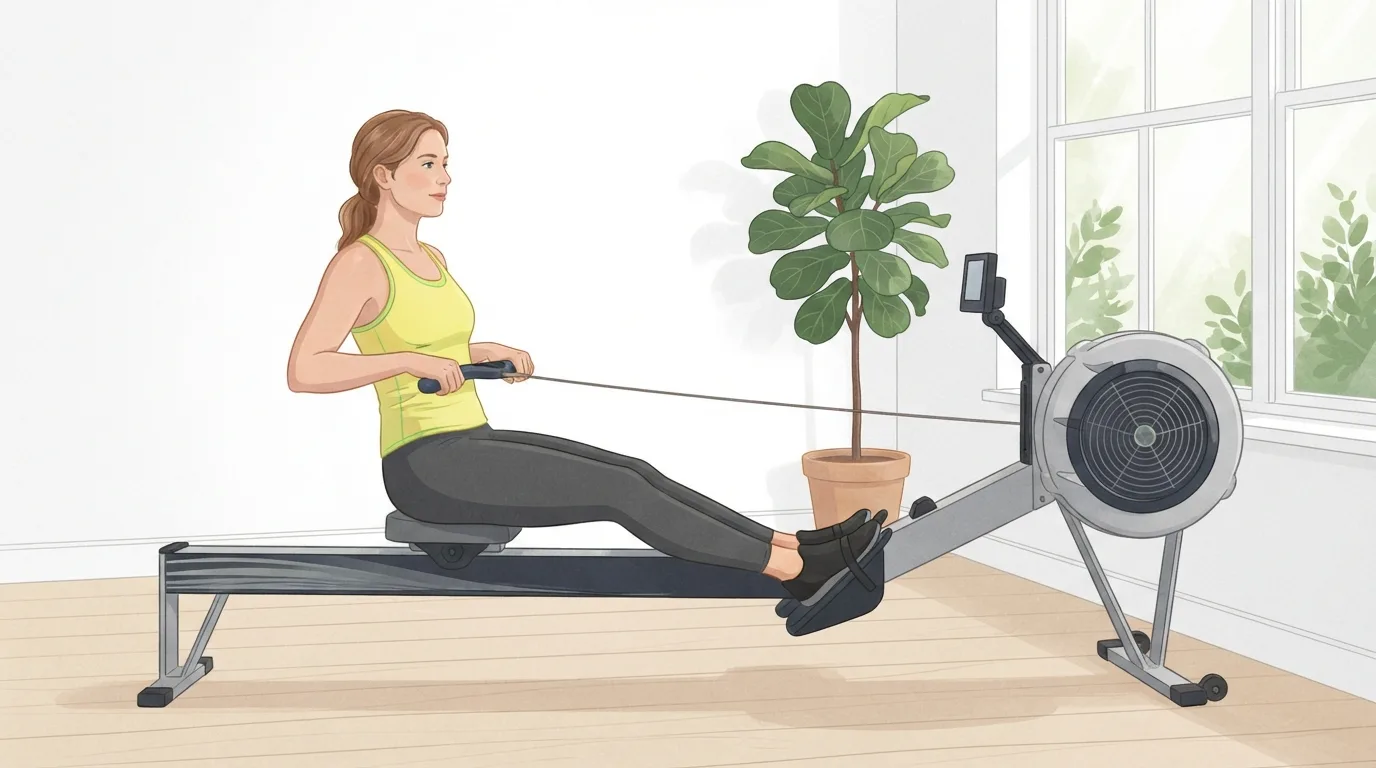
You finish a 20-minute row and your thighs are burning, your lower back has noticed, and your forearms are tired from gripping the handle. Then you look it up and get a different answer from every site: rowing works 80 percent of your muscles, or 86 percent, or 16 named muscles, or simply "your whole body."
Those numbers don't tell you what you actually want to know. Which muscles are doing the work in each part of the stroke? Which ones get shortchanged when your form slips at minute 15? And which ones does rowing hardly touch at all? That last question matters if a rower is your main piece of equipment, because a muscle the stroke never loads won't get stronger by rowing more.
This guide answers all three with the electromyography (EMG) studies that put sensors on rowers' muscles mid-stroke. Then it gives you a short beginner session and the dumbbell and bodyweight moves that round rowing out. If you want the evidence on what rowing does for your heart, lungs and calorie burn, our review of rowing machine benefits research covers that side. This page stays on the muscles.
What Muscles Does a Rowing Machine Work?
A rowing machine works most of the large muscles below your neck, but not equally and not all at once. The stroke is a chain. Your legs push, your hips open and your arms pull, and each link hands its force to the next one. The table shows each group's job and when it works hardest.
| Muscle group | Its job in the stroke | When it works hardest |
|---|---|---|
| Quadriceps | Straighten the knees and push the seat back | Early drive |
| Glutes and hamstrings | Open the hips; the hamstrings also add power to the leg push | Middle of the drive |
| Calves | Press through the footplate, then help draw you forward | Drive, then late recovery |
| Lower back (erector spinae) | Hold the spine firm while the hips swing back | Middle and late drive |
| Lats, rhomboids and middle trapezius | Pull the handle in and draw the shoulder blades together | Late drive |
| Biceps, brachialis and forearms | Bend the elbows and hold the handle | Late drive; grip works all stroke |
| Rear deltoids | Draw the elbows back past your sides | Late drive and finish |
| Abdominals and obliques | Brace the trunk, slow the lean-back, bring you forward again | Finish and recovery |
| Triceps and front shoulders | Push the hands away from your body | Early recovery, at very light load |
The phase-by-phase description from Concept2's guide to the muscles used in rowing matches this order. The surprise for most beginners is that the arms come last and do the least. You feel the stroke in your arms first because your grip tires early, not because your arms are driving it.
The Muscles Worked in Each Phase of the Rowing Stroke
Coaches split the stroke into four positions: the catch, the drive, the finish and the recovery. Here's what's working in each, and what the sensor studies found.
The catch: coiled and ready
At the catch you sit at the front of the slide with your shins close to vertical, your arms straight and your torso tipped slightly forward from the hips. Very little is producing force yet. Your abdominals and hip flexors have just pulled you up the slide, your shins and calves have bent your ankles, and your hands have set the grip. The catch is about position: a long, firm back and loaded legs, so the next push starts from your feet.
The drive: legs, then hips, then arms
The drive is the working half of the stroke. Your quadriceps start it by straightening the knees, and the hamstrings aren't just along for the ride. Guével and colleagues (2011) recorded five thigh muscles in nine experienced rowers on the water and concluded that the hamstrings help produce power during the leg drive rather than only steadying the knee.
As your legs near straight, the glutes and hamstrings open the hips and your torso swings back past upright. Your lower back muscles fire hard here, but mostly to hold the spine still while the pelvis does the moving. Pollock and colleagues (2009) wired up the trunks of nine national-team women during a 2,000-meter race simulation. During peak force the spinal and pelvic extensors switched on together, with very little competing activity from the abdominals, and most of the backward swing came from the pelvis rather than the spine. Only after the handle passes your knees do the lats, rhomboids, rear deltoids and biceps take over and draw it in to your lower ribs.
Rowing harder doesn't reshuffle that order. Turpin and colleagues (2011) recorded 23 muscles in eight untrained people and seven experienced rowers at 60, 90 and 120 percent of their 2,000-meter race power. Activity rose with power in 22 of the 23 muscles, but each muscle's burst kept its shape and timing, shifting by only about 4 percent of the stroke on average. A companion study by the same team (Turpin 2011, Journal of Electromyography and Kinesiology) found that beginners and experienced rowers used the same three muscle groupings in the same sequence. Pulling harder works the same muscles more. It doesn't recruit new ones.
The finish: lean back and brace
At the finish your legs are straight, your torso leans back a little and the handle touches your lower ribs with your elbows drawn past your sides. Now your abdominals earn their keep. In the Pollock study, trunk flexor activity rose toward the end of the drive, which the authors read as the abdominals braking the lean-back. Your lats, mid-back and rear shoulders hold the handle in, and your glutes and quadriceps stay switched on to keep you still on the seat.
The recovery: lighter, but not a rest
The recovery runs the drive in reverse: arms away, body forward from the hips, then knees bend and the seat rolls up the slide. It's light work, but it isn't nothing. Shaharudin and colleagues (2014) recorded eight muscles in nine untrained men during six minutes of hard rowing. On a standard fixed rower, the hamstrings and the rectus femoris, the quadriceps muscle that also flexes the hip, switched on in the second half of the recovery, getting ready for the next drive. Your triceps and front shoulders push the handle away and your abdominals tip you into the next catch. This is the only part of the stroke where your pushing muscles do anything, and the load is close to zero.
Is Rowing Really 60% Legs, 20% Core and 20% Arms?
The most repeated rowing figure says the stroke is 60 percent legs, 20 percent core and 20 percent arms. It's a good coaching cue, because it puts the legs first and the arms last, which is the right order. As a measurement it's too generous to the legs and too stingy to the trunk.
The rowing biomechanist Valery Kleshnev measured how much power each body segment contributes, combining handle force with footstretcher force and boat speed. In his 2000 paper "Power in Rowing", presented at the International Symposium on Biomechanics in Sports, the legs produced 45.2 percent of total rowing power, the trunk 32.2 percent and the arms 22.6 percent. That was measured in boats, and individual rowers vary with style, so treat it as a rough guide on a machine. The order holds, though, and the trunk's share is clearly bigger than the cue suggests.
So the measured version is closer to 45/32/23 than 60/20/20. Two things follow from that. First, your hips and lower back carry about a third of the work, which is why form there matters so much. Second, the arms' share is real but spread across a short pull at a light load, so rowing tires your grip long before it builds your biceps.
Which muscles does rowing work the most?
Your quadriceps and glutes produce the most power, because they move the most mass through the longest range. Your lower back muscles work for the longest stretch, holding the spine firm through the whole drive. Your grip works the entire session without a break. If you're sore in one place after your first few rows, it's usually the lower back or the forearms, because those are the parts least used to holding on for 20 minutes.
Find out what's really holding you back
FitCraft, our mobile fitness app, pairs you with an AI coach who builds you a personalized plan around your goals, schedule, and fitness level. Every FitCraft program is designed by Domenic Angelino, MPH (Brown University) and NSCA-CSCS, with research published in the Journal of Strength and Conditioning Research and Medicine & Science in Sports & Exercise.
Take the Free Assessment Free • 2 minutes • No credit cardFive Form Faults That Move the Work to the Wrong Muscles
Form decides which muscles do the rowing. The same 20 minutes can load your legs and hips the way the table above describes, or quietly hand the job to your lower back and forearms. These are the five faults that do it most often.
1. Shooting the slide
Your knees straighten and the seat flies back, but the handle barely moves. The leg push is spent before it reaches the handle, so your back and arms then haul the handle in on their own. The fix is to feel the handle move the moment your feet push. Keep your arms long and your shoulders set, as if you're hanging from the handle, until your legs are mostly straight.
2. Rounding the lower back at the catch
Reaching for extra length by curling the lower back puts the stroke's biggest force through a bent spine. In the Pollock study, the segments between the third lumbar vertebra and the sacrum moved the most of any part of the spine, which the authors flagged as a likely spot for soft-tissue injury. Long sessions make it worse. Holt and colleagues (2003) tracked 13 elite oarsmen through an hour of ergometer rowing and found marked increases in spinal motion as the hour went on. Willwacher and colleagues (2021) saw the same pattern in the upper back of ten men with rowing and CrossFit experience during an all-out 2,000 meters on a rowing machine, with thoracic curvature rising as the back muscles fatigued. Tip forward from the hips instead, stop the slide when your shins are vertical, and end the session when you can feel your back starting to round.
3. Pulling early with the arms
Bending your elbows as the drive starts makes your biceps and forearms do work your legs should be doing. It also cuts the stroke short and tires your grip in minutes. Keep your arms straight until the handle passes your knees, then pull to the lower ribs. If the handle ends up near your chest or chin, your shoulders are shrugging and your upper trapezius is taking over.
4. Letting the back do the legs' job
Yamashita and colleagues (2023) compared 10 university rowers who had lower back pain with 12 who didn't during a maximal 500-meter piece. The rowers with pain showed significantly more activity in the upper and lower erector spinae and the lats. The study can't say whether the extra back work caused the pain or came from it, but it's a good reason to let your legs and hips take their full share. If your back keeps aching after you row, our guide to the best exercises for lower back pain has a gentle four-week plan to run alongside a shorter rowing schedule.
5. Setting the damper too high
A high damper makes each stroke feel heavy and slow, and many beginners assume heavier means better. It doesn't. Concept2's damper guidance explains that the damper changes how the stroke feels rather than setting the resistance, which comes from how hard you drive. It recommends starting at 3 to 5 and warns that a high setting can tire your muscles before you get the full cardio benefit. In practice your back and arms give out long before your heart and lungs get the workout.
What Muscles Does Rowing Not Work?
Rowing is one movement repeated hundreds of times a session, straight forward and back, with both legs moving together. That's why it's such good cardio, and it's also why it leaves gaps. These are the muscles and qualities the rowing stroke trains least.
- Chest, front shoulders and triceps. The only push in the stroke is the recovery, when you move an empty handle away from your body. None of your pushing muscles works against real load.
- Overhead strength. Your hands never rise above your shoulders, so the muscles that press and stabilize overhead stay idle.
- Single-leg strength and the side hip muscles. Both legs push together, straight ahead, from a seat. There's no balance demand and almost no work for the gluteus medius, which steadies your pelvis when you stand on one leg.
- Twisting and resisting twisting. Your torso only moves forward and back, so the obliques' rotation and anti-rotation work gets little practice.
- Heavy load. Every stroke is far below the force of a hard strength set. That's why rowing builds endurance much better than it builds size, as our rowing research review explains in its section on muscle.
None of that is a flaw in rowing. It's the price of a movement simple enough to repeat a thousand times. It just means a rower can't be your whole program if you want balanced strength.
Dumbbell and Bodyweight Exercises That Fill the Gaps
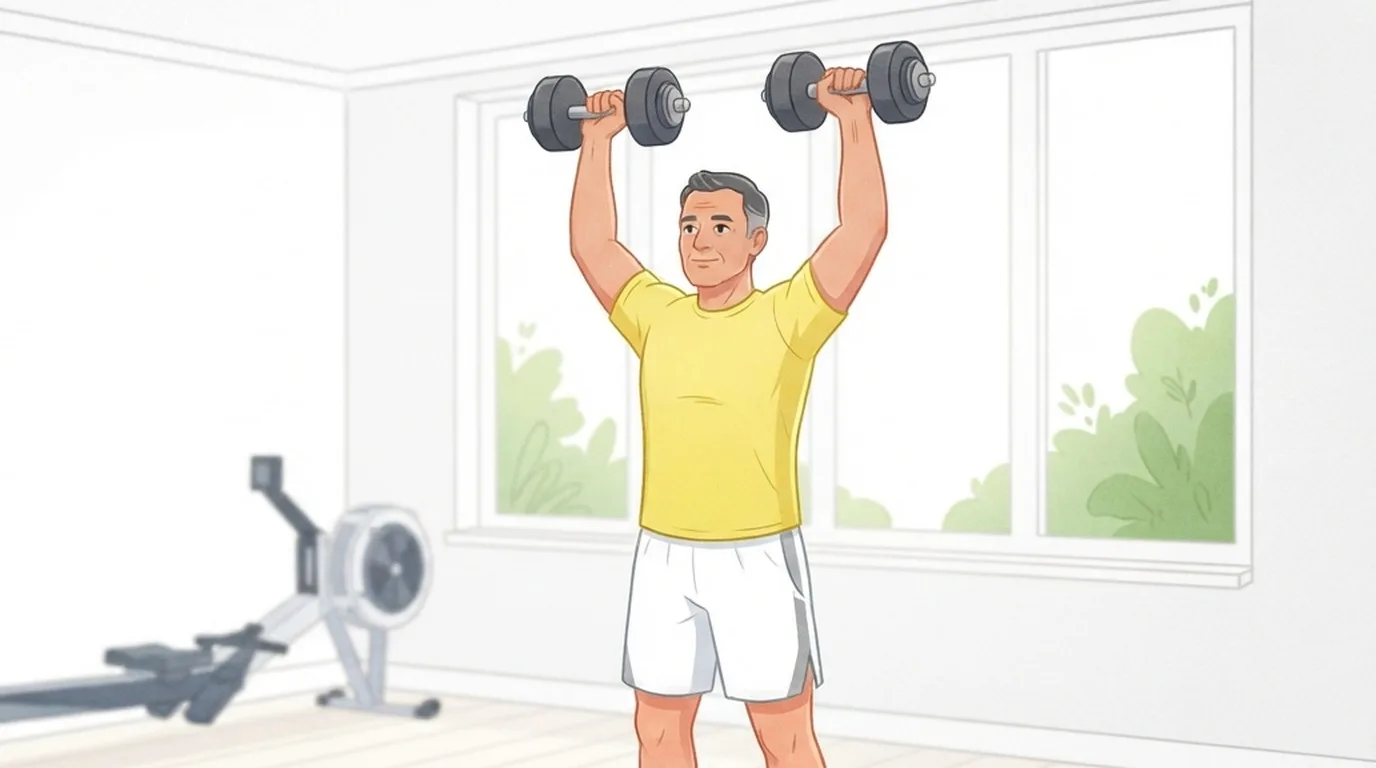
You don't need a gym to cover what rowing misses. A pair of dumbbells and some floor space handle all of it. Pick one exercise from each row of the table.
| The gap | Exercise | Why it fits |
|---|---|---|
| Chest and triceps | Push-ups or a dumbbell chest press | A pushing motion, the mirror image of the row |
| Front shoulders and overhead strength | Dumbbell shoulder press | Loads the arms above the head, a position rowing never reaches |
| Single-leg strength | Split squats | One leg at a time, with a balance demand the seat removes |
| Side hip muscles | Side lunges | Moves you sideways, the plane rowing ignores |
| Side-to-side core | Side planks | Trains the obliques to resist bending and twisting |
Run them as a circuit twice a week: 8 to 12 push-ups, 8 to 12 shoulder presses, 8 to 10 split squats per leg, 8 side lunges per side and a 20- to 30-second side plank per side. Rest a minute and repeat for three rounds. It takes about 20 minutes. Do it on days you don't row, or straight after a short, easy row.
This is also the kind of training FitCraft programs are built from. Its strength work uses only dumbbells and bodyweight, and an AI coach demonstrates each exercise on an interactive 3D model you can pinch and zoom to see the form from any angle. Our dumbbell workout app page shows how those programs progress as you get stronger, which is the part most people skip when they train alone.
Rowing Machine Workout for Beginners: A 25-Minute First Session
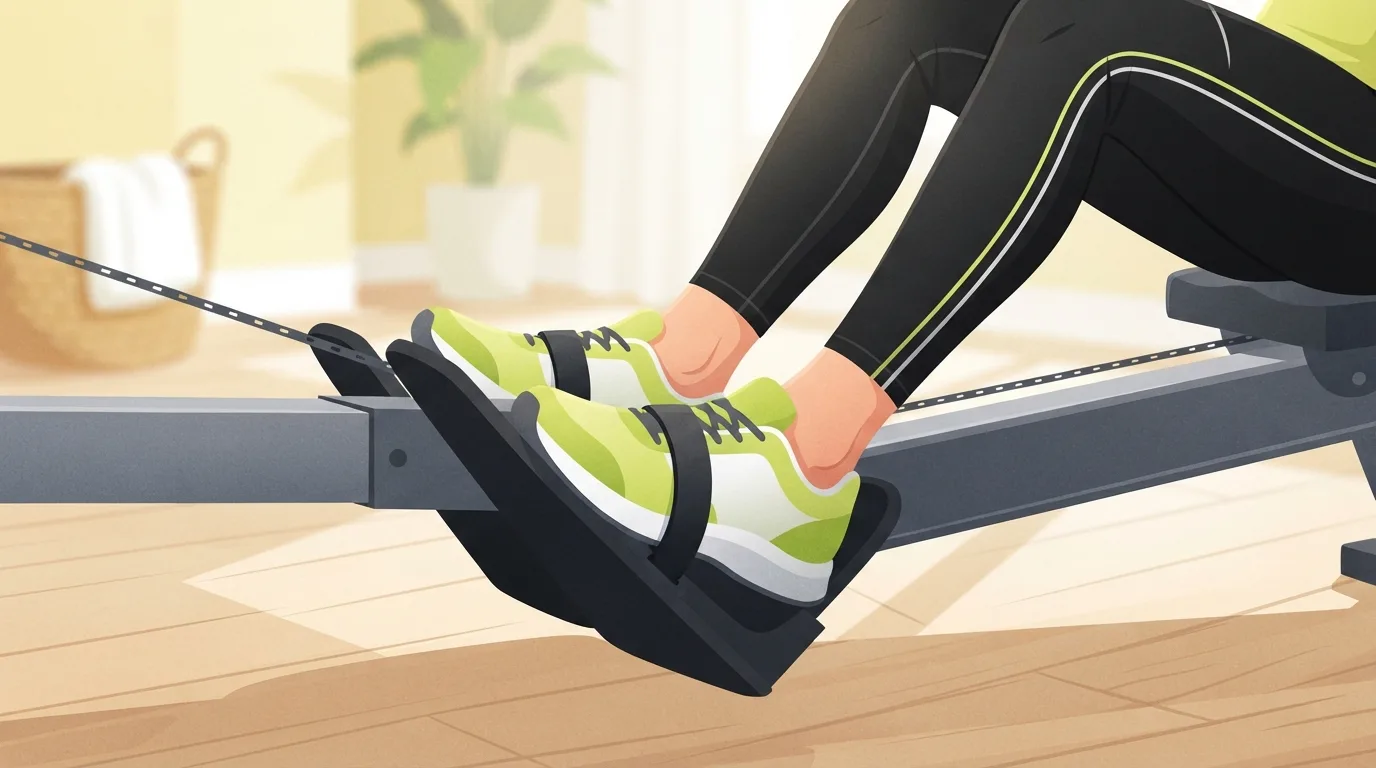
Your first sessions are for learning the order of the stroke, not for exhausting yourself. Set the damper between 3 and 5, strap your feet so the strap crosses the widest part of your foot, and use the effort scale below, where 1 is sitting still and 10 is an all-out sprint.
| Block | Time | What to do | Effort (1-10) |
|---|---|---|---|
| Easy warm-up | 5 min | Relaxed full strokes at about 18 to 20 strokes a minute | 2-3 |
| Build-up drill | 4 min | 1 min arms only, 1 min arms and body swing, 1 min half slide, 1 min full stroke | 3 |
| Steady pieces | 3 x 4 min, 1 min easy between | Full strokes at 20 to 22 a minute: push hard with the legs, come forward slowly | 5 (you can speak in short sentences) |
| Cool-down | 2 min | Very easy strokes, then stand and stretch your hips and hamstrings | 2 |
The build-up drill teaches the order of the stroke one link at a time, which is the quickest way to stop shooting the slide. During the steady pieces, aim for a recovery that takes about twice as long as the drive. A slow return keeps your stroke rate down and gives your legs time to load for the next push.
Do this session two or three times a week, adding a minute to each steady piece every week. If you have the energy, finish with two rounds of the circuit above. Once 20 minutes of steady rowing feels comfortable, the six-week progression in our rowing research review takes you to 30 to 45 minutes.
The Bottom Line
Rowing works your legs first, then your hips, lower back and core, then your arms. Measured power puts the legs at about 45 percent, the trunk at about a third and the arms at under a quarter. It leaves your pushing muscles, your overhead strength, your single-leg balance and your rotational core mostly untrained.
Row two or three times a week with your legs leading and your back long, then spend 20 minutes twice a week on push-ups, presses, split squats and side planks. That combination trains nearly everything, and none of it needs more than a rower and a pair of dumbbells.
Frequently Asked Questions
Can you build muscle by rowing?
Some, mostly in the legs, upper back and grip, and mostly if you're new to training. Each stroke uses only a fraction of the force of a hard strength set, so rowing builds endurance far better than size. For visible muscle, add two short dumbbell or bodyweight strength sessions a week.
Is 20 minutes of rowing enough?
Yes, if it's hard enough and you do it often enough. Twenty minutes of hard rowing on four days gives you 80 vigorous minutes, which meets the World Health Organization target of 75 to 150 vigorous minutes a week. At an easy pace you'd need about 30 minutes on five days to reach its 150 moderate minutes.
Does rowing work your abs?
Yes, but mostly as brakes and braces. In elite rowers the trunk flexors switched on late in the drive to slow the lean-back, and the abdominals pull the torso forward during the recovery. Rowing barely trains the obliques' side-to-side and anti-rotation work, so side planks are a useful addition.
Will I lose belly fat by rowing?
Rowing can help you lose fat, belly fat included, because it burns a lot of energy per minute. No exercise removes fat from one spot, though, so belly fat comes off with your overall fat as your weekly energy balance tips. Regular rowing, strength training and a modest calorie deficit together do the job.
What burns more fat, walking or rowing?
Rowing burns more per minute. The 2024 Adult Compendium of Physical Activities lists moderate indoor rowing under 100 watts at 5.0 METs and harder rowing at 100 to 149 watts at 7.5 METs, against 3.8 METs for walking at 2.8 to 3.4 mph. Walking is easier to do for longer and every day, so the better fat burner is the one you'll do more of.
How much rowing is equal to 10,000 steps?
For a 150-pound person, 10,000 ordinary walking steps burn roughly 380 to 420 calories. On the 2024 Compendium values, that's about 45 to 50 minutes of rowing at 100 to 149 watts, or roughly 70 minutes at an easy pace under 100 watts. Heavier people burn more in both, so the time match stays about the same.
What are the downsides of rowing?
The main ones are lower back strain when your form breaks down late in a long session, sore hands and blisters while your grip toughens, and the muscles the stroke skips: the chest, front shoulders, triceps and single-leg hip strength. A low damper setting, shorter sessions while you learn and two strength sessions a week handle all three.