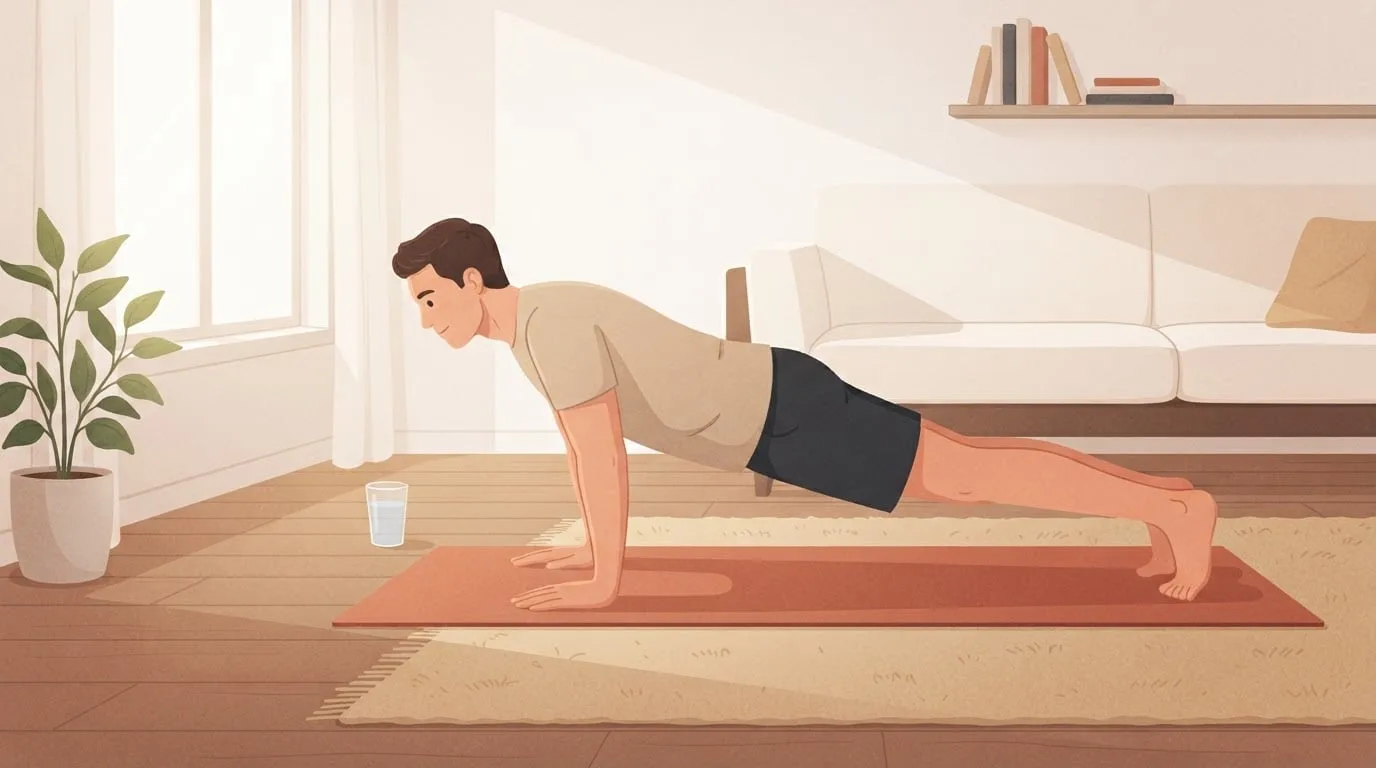
You've probably seen the videos. Someone does 100 pushups a day for 30 days, then posts a before-and-after that looks like a different person. The 100 pushup challenge is simple, needs no equipment and fits in a few minutes, which is why it keeps coming back. It's also easy to quit by day nine, when your elbows ache and the novelty has worn off.
So what actually changes? It depends mostly on one number: how many clean push-ups you can do in a row today. For someone who can do 15, a daily 100 is a big training dose. For someone who can do 60, it's a warm-up. The research on rep ranges, training frequency and recovery explains both outcomes, even though no study has tested the challenge itself.
Below you'll find what happens at 30 days, 90 days and a year, whether it's ok to do push-ups every day, how many calories 100 push-ups burn, the risks, and a plan that gets you through the month. If muscle is your main goal, our companion piece on whether push ups build muscle covers the growth evidence in depth.
Will 100 Pushups a Day Make a Difference?
Yes, if 100 is real work for you, and much less if it isn't. Your body adapts to what challenges it. One hundred push-ups is 10 sets of 10 for a beginner and two easy sets for someone who trains, and those two people get very different results from the same number.
| Your best set today | What 100 a day means | What usually changes in a month |
|---|---|---|
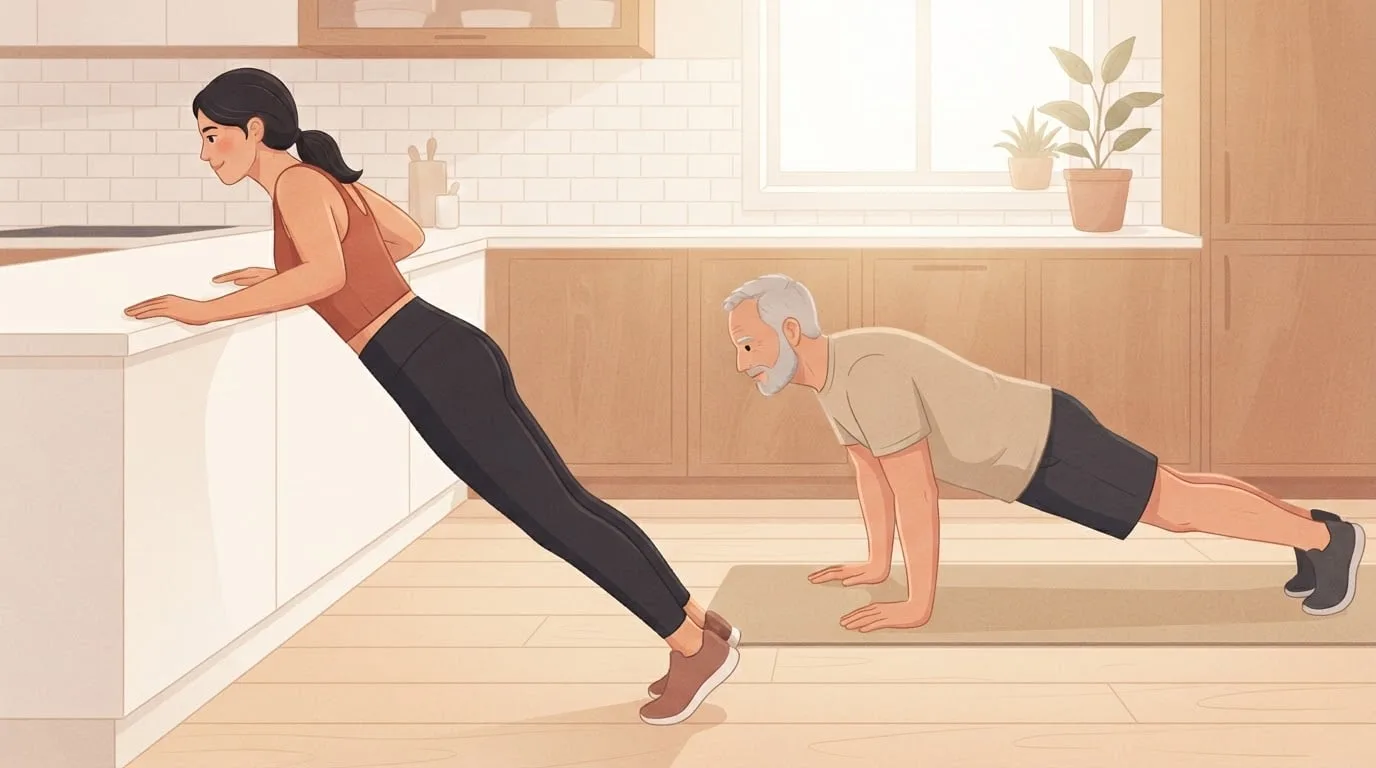
| Fewer than 10 floor push-ups | 10 to 20 short sets, best done on a counter or sturdy bench | Reps climb fast on the easier version, and many people earn their first full sets on the floor |
| 10 to 25 | 5 to 10 sets spread through the day | The biggest payoff: a higher max, more endurance, and some new muscle if the last sets are hard |
| 25 to 50 | 3 or 4 sets | Better endurance, with small size changes unless the final set ends close to failure |
| More than 50 | 2 sets | Very little, because at this level 100 is maintenance rather than training |
Those bands are coaching rules of thumb, not cut-offs from a study. The idea behind them is simple: a set that ends far from your limit asks little of the muscle, whatever the daily total says. Our push-up norms by age and sex show where your current number sits.
What Will Happen If I Do 100 Pushups a Day for 30 Days?
Week 1: sore, then less sore
If push-ups are new to you, the first two or three days bring soreness in the chest, the front of the shoulders and the backs of the arms. It fades fast, even though the workload stays the same. That's the repeated bout effect: one session of unfamiliar work protects the muscle against damage from the sessions that follow, through changes in the nerves, the muscle's stiffness and the muscle cells themselves, as McHugh (2003) reviewed.
The early work goes into repair rather than growth. Damas and colleagues (2016) took muscle biopsies from 10 young men across 10 weeks of training. In week 1, muscle protein building was at its highest, but so was muscle damage, and that early building wasn't linked to later growth. From week 3 on, once the damage had settled, protein building tracked closely with growth. The muscle fibers were measurably bigger at week 10.
Weeks 2 to 4: more reps per set
This is the part people notice. The sets you need to reach 100 get fewer and bigger. Much of that is your nervous system getting better at the movement, the same learning effect behind greasing the groove, plus better endurance in the muscles themselves.
High-rep training is especially good at endurance. In Campos and colleagues (2002), 32 untrained men trained for 8 weeks with low, medium or high reps. The high-rep group, at 20 to 28 reps per set, gained the most in reps at 60% of their max and the most in aerobic power. It gained the least strength and showed no significant fiber growth, while the low- and medium-rep groups grew all three main fiber types. For most people, a daily 100 sits at that high-rep end.
Day 30: what you can expect to see
Expect a higher max, push-ups that feel smooth instead of shaky, and a firmer chest and arms. Real new muscle shows up mostly in beginners, and mostly in people whose last set each day was hard. Many online "after" photos owe a lot to a pump, better lighting and a flexed pose. The fair comparison is your best set on day 1 against day 30, tested the same way.
What Happens If I Do 100 Push-Ups a Day for 90 Days?
By month three, most people who started in the 10 to 30 range can finish 100 in three to five sets. That's when the challenge changes its job. Each set now ends well short of failure, so the daily 100 keeps your endurance and your habit, but it stops adding much strength or size. A 2026 meta-analysis of 67 studies and 2,058 people found that training more often keeps adding a little strength, with shrinking returns, while it adds little size once weekly volume is matched (Pelland and colleagues, 2026).
To keep improving, change the push-up rather than the number. Raise your feet, lower yourself more slowly or bring your hands closer, and aim for 100 hard reps a day instead of 100 easy ones. Our push-up progression guide puts every variation in order from easiest to hardest.
100 pushups a day for a year
A year of the challenge adds up to 36,500 push-ups. Most of the gain comes in the first two or three months. After that the daily 100 works as a maintenance dose, and a generous one. In Bickel and colleagues (2011), young adults trained 3 days a week for 16 weeks, then cut their weekly training to one-ninth of that dose for 32 weeks, and they kept their muscle size. Keeping what you've built takes far less work than building it did.
So for a year-long streak, the things to watch are sore tendons and a front-heavy shoulder, which the next sections cover.
Is It Ok to Do Push Ups Every Day?
Yes, it's ok to do push ups every day for most healthy adults, as long as most days stay below your limit and your joints feel normal the next morning. Recovery depends on how hard each session was. An easy daily dose recovers overnight, and a daily all-out effort doesn't.
The frequency trials back that up. Saric and colleagues (2019) gave 27 trained men an identical weekly workload, done either in 3 sessions or across 6. After 6 weeks, upper-body strength had risen 4% with 3 sessions and 6% with 6, triceps thickness had risen 14% and 11%, and none of the gaps between groups were significant. A meta-analysis of 25 studies landed in the same place for muscle growth: at equal weekly volume, the number of days you split it across makes no meaningful difference (Schoenfeld, Grgic and Krieger, 2019).
So the number of days is fine. The catch is that some of your recovery runs on clocks longer than 24 hours.
Muscles and tendons recover at different speeds
After a hard session, muscle protein building rises quickly and fades within about a day and a half. Earlier work from the same lab had found it 50% above normal 4 hours after heavy arm training and 109% above at 24 hours. MacDougall and colleagues (1995) then measured it at about 36 hours and found it back within 14% of normal. A daily easy session fits inside that cycle without trouble.
Tendons are slower. After loading, collagen production in a tendon peaks around 24 hours and stays raised for about 3 days, while collagen breakdown peaks earlier (Magnusson, Langberg and Kjaer, 2010). Repeated loading without enough recovery is how tendinopathy starts: pain during activity and tenderness when you press on the spot. With push-ups it tends to show up at the back of the elbow or the front of the shoulder, often in week two or three, after the muscle soreness has already gone.
Is 100 pushups a day too much?
For some people, yes. It's too much if you can't yet do about 10 clean floor push-ups in a row, because 100 on the floor then means dozens of grinding sets with sagging hips. It's too much on any day your elbow, wrist or shoulder still hurts from yesterday. And it's too much in any week your best set keeps dropping instead of rising.
None of those mean you should quit. Do the day's 100 on a kitchen counter or a bench, cut the total to 50, or take a full rest day every fourth day, which is how our 30 day workout challenge runs its 100 push-ups a day option. Joint pain that lasts more than a day or two, or comes back every session, is a reason to stop and have it checked.
Knowing what to do is the easy part.
FitCraft, our mobile fitness app, pairs you with an AI coach who builds you a personalized plan around your goals, schedule, and fitness level. Every FitCraft program is designed by Domenic Angelino, MPH (Brown University) and NSCA-CSCS, with research published in the Journal of Strength and Conditioning Research and Medicine & Science in Sports & Exercise.
Take the Free Assessment Free • 2 minutes • No credit cardHow Many Calories Do 100 Push Ups Burn?
Doing 100 push-ups burns about 30 to 50 calories for most adults. The 2024 Adult Compendium of Physical Activities rates vigorous calisthenics such as push-ups, sit-ups and pull-ups at 7.5 METs, and one MET is roughly one calorie per kilogram of body weight per hour. At 2 to 3 seconds per rep, 100 push-ups take about 4 minutes of actual pushing.
| Body weight | Calories for 100 push-ups | Push-ups to burn 100 calories |
|---|---|---|
| 130 lb (59 kg) | About 30 | About 340 |
| 160 lb (73 kg) | About 37 | About 275 |
| 190 lb (86 kg) | About 43 | About 230 |
| 220 lb (100 kg) | About 50 | About 200 |
That's our arithmetic from the Compendium value, assuming 4 minutes of hard work. It counts your total burn, about an eighth of which you'd have burned sitting still, and it leaves out the rest between sets, which adds only a little.
Will doing 100 pushups a day help lose weight?
Not much on its own. At 37 calories a day, a 160-pound person burns about 1,100 calories over 30 days from the challenge, roughly a third of a pound of fat on paper. Push-ups help your body composition in a different way: they keep and build muscle while you eat a little less and walk more.
The Risks: Shoulders, Wrists and a Front-Heavy Upper Body
Push-ups train the chest, the front of the shoulders and the triceps, and the challenge trains them 700 times a week. Nothing in it trains the upper back. In a review of shoulder injuries from strength training, Kolber and colleagues (2010) found that up to 36% of documented training injuries and disorders were at the shoulder, and they named joint and muscle imbalances and poor technique among the risk factors.
Three habits keep a daily push-up streak healthy:
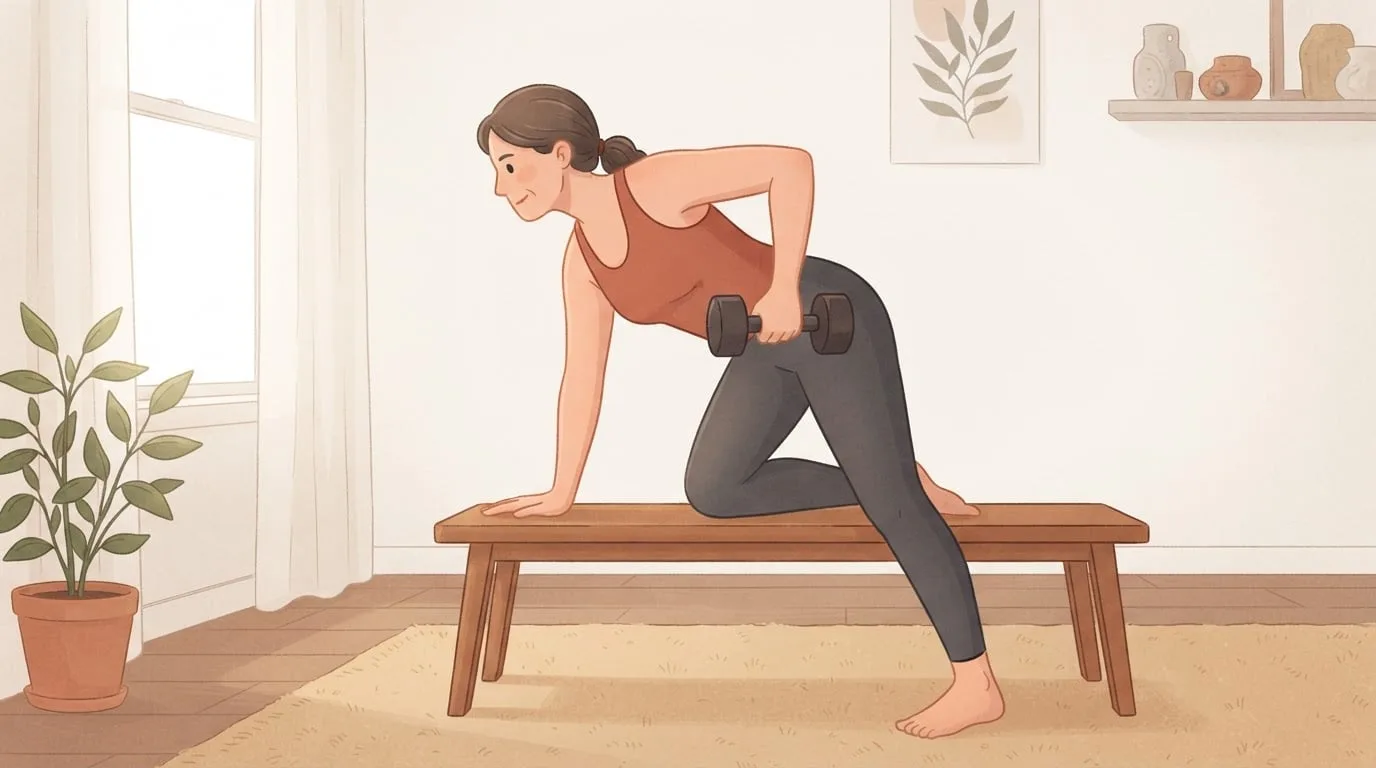
- Pull as often as you push. Match your push-up sets with rows: one-arm dumbbell rows, band pull-aparts, or bodyweight rows under a sturdy table. A few sets on most days is enough.
- Look after your wrists. Push-ups bend the wrist back under load. If yours ache, do the push-ups on your fists or on the handles of two dumbbells so the wrist stays straight.
- Keep your elbows at about 45 degrees. Elbows flared straight out to the sides load the front of the shoulder hardest. Tuck them partway and keep your body in one line from head to heels.
How to Do the 100 Pushup Challenge Without Burning Out
This push-up routine works for most beginners and intermediates. It keeps nearly every set short of failure, which is what lets you repeat it the next day.
- Test your max. Do as many clean push-ups as you can in one set, chest close to the floor and body straight. That's your starting number.
- Pick a set size of about half your max. Use the table below. Sets this size leave reps in the tank, so the hundredth rep looks like the first.
- Spread the sets out. Morning, lunch and evening blocks work, or a set each time you refill your water glass. Spacing them out is easier on your joints than one long session.
- Make two days a week harder. On those days, do fewer, bigger sets and take the last one to within a rep or two of failure. Keep the other days easy.
- Rest every fourth day, or do 50. A lighter day doesn't have to break your streak.
- Retest every two weeks. As your max rises, make your sets bigger and fewer. When 100 fits in three sets, switch to a harder push-up.
| Best set today | Set size | Sets to reach 100 | Where to do them |
|---|---|---|---|
| Under 10 | 8 to 10, on a counter or bench | 10 to 13 | On an incline until you can do 10 on the floor |
| 10 to 19 | 5 to 10 | 10 to 20 | The floor, spread through the day |
| 20 to 34 | 10 to 15 | 7 to 10 | The floor, in two or three blocks |
| 35 to 50 | 20 to 25 | 4 or 5 | The floor, in one session |
| Over 50 | 25 to 30 | 4 | A harder version, such as feet raised on a step |
How many push-ups should you do a day?
If your goal is general strength rather than a challenge, you don't need 100. Two to four sets that end one to three reps short of failure, on three or four days a week, trains the same muscles with far fewer reps. Weekly hard sets drive results more than the daily count, with more sets helping up to a point and then flattening out (Pelland and colleagues, 2026). A daily 100 is a good consistency tool, and it's far more than the minimum dose.
What This Means for You
The 100 pushup challenge works best as a habit with a number attached. For the first month it's real training for most beginners, bringing more reps, more endurance and some muscle. After that it keeps you strong and keeps you moving every day, and further progress comes from making the push-up harder.
The hard part is the same as with any plan: day 9, day 17, the morning you don't feel like it. If that's where past challenges ended, you're not lazy. Willpower is a weak engine for a daily habit, and structure works better: a fixed time, sets small enough to start without arguing with yourself, and a streak you don't want to break. As one FitCraft user, Mike, 23, put it: "The streak system got me hooked. I didn't want to break my chain."
If you'd rather not plan the progression yourself, FitCraft's no-equipment home workout app builds bodyweight programs with an AI coach who demonstrates every move in 3D and adjusts your workouts as you progress. Your streak, calendar rewards and leaderboard spot keep score along the way.
Frequently Asked Questions
Is it ok to do push ups every day?
Yes, for most healthy adults, as long as most days stay below your limit and your joints feel normal the next morning. In a 6-week trial, trained men who spread the same weekly workload over 6 sessions gained as much strength and muscle as men who used 3 sessions (Saric et al., 2019). Keep the hard sets to two days a week and take a lighter day when your elbows or shoulders ache.
Is 100 pushups a day too much?
It's too much if you can't yet do about 10 clean floor push-ups, if a joint still hurts from the day before, or if your best set keeps dropping. In those cases do the 100 on a counter or bench, cut the total to 50, or rest every fourth day. For people who can already do 25 or more in a row, 100 split into sets is a manageable daily dose.
How many calories do 100 push-ups burn?
About 30 to 50 calories for most adults. The 2024 Adult Compendium of Physical Activities rates vigorous calisthenics such as push-ups at 7.5 METs, so a 160-pound person burns about 37 calories in the roughly 4 minutes of work that 100 push-ups take. Heavier people burn more and lighter people burn less.
How many push-ups to burn 100 calories?
Roughly 200 to 350, depending on body weight. A 220-pound person needs about 200 push-ups to burn 100 calories and a 130-pound person about 340, based on the 2024 Compendium's 7.5 METs for vigorous calisthenics. A brisk walk of about 15 to 25 minutes burns a similar amount with no load on the shoulders.
Do push-ups increase testosterone?
Only briefly and by a small amount, and that rise doesn't decide how much muscle you build. In 56 young men followed through 12 weeks of training, the size of the hormone spike after a workout, free testosterone included, wasn't linked to gains in muscle mass or strength (West and Phillips, 2012). The training itself, enough protein and enough sleep are what build muscle.
Will doing 100 pushups a day help lose weight?
Not much on its own. A 160-pound person burns about 37 calories per 100 push-ups, roughly 1,100 calories over 30 days, which is about a third of a pound of fat on paper. Push-ups help body composition by keeping and building muscle while you eat a little less and walk more.