Chickpeas are everywhere now. They're in hummus tubs, crunchy snack bags, grain bowls and pasta made from chickpea flour. So it's fair to ask whether the reputation holds up once you look past the marketing.
Are chickpeas good for you? Yes, and unlike many health-halo foods, chickpeas have their own small set of human trials, not just borrowed evidence from beans in general. This page covers what a cup of chickpeas (or garbanzo beans, the same food) actually contains, what chickpea trials found for cholesterol, blood sugar and gut health, whether canned, roasted and hummus versions hold up, how chickpeas compare with other beans and with eggs, and who should go easy on them.
Chickpea Nutrition: What One Cup Gives You
A cup of chickpeas cooked from dry weighs about 164 grams. Here's what it carries, with the per-100-gram values alongside, from USDA FoodData Central:
| Cooked chickpeas, boiled without salt | Per cup (164 g) | Per 100 g | % Daily Value (per cup) |
|---|---|---|---|
| Calories | 269 | 164 | n/a |
| Protein | 14.5 g | 8.9 g | 29% |
| Carbohydrate | 44.9 g | 27.4 g | 16% |
| Fiber | 12.5 g | 7.6 g | 45% |
| Sugars (natural) | 7.9 g | 4.8 g | n/a |
| Fat | 4.2 g | 2.6 g | 5% |
| Folate | 282 mcg DFE | 172 mcg DFE | 71% |
| Manganese | 1.69 mg | 1.03 mg | 73% |
| Copper | 0.58 mg | 0.35 mg | 64% |
| Iron | 4.7 mg | 2.9 mg | 26% |
| Zinc | 2.5 mg | 1.5 mg | 23% |
| Phosphorus | 276 mg | 168 mg | 22% |
| Magnesium | 79 mg | 48 mg | 19% |
| Potassium | 477 mg | 291 mg | 10% |
| Sodium | 11 mg | 7 mg | under 1% |
Values from USDA FoodData Central entry 173757, rounded. Daily values are the FDA's adult figures.
Three numbers stand out. The fiber is the big one: 12.5 grams is close to half of the 28-gram daily value, and most adults fall well short of that. The folate comes next, at 71 percent of the daily value in one cup. And the protein is real but moderate. At about 5.4 grams per 100 calories, chickpeas are a protein-plus-carb food rather than a protein food like chicken or Greek yogurt.
Chickpeas also carry a little more fat than most beans, about 4 grams a cup, and USDA lists more of it as polyunsaturated than saturated. That small fat content is part of why chickpeas taste richer than black beans or lentils, and it turned out to matter in the cholesterol trials below.
Chickpeas Health Benefits: What the Chickpea Trials Found
Most bean research lumps chickpeas in with lentils, peas and every other pulse. A handful of trials fed people chickpeas specifically, and they're worth reading closely because they show both what chickpeas do and where the effect runs out.
Cholesterol: small, consistent drops
The main body of chickpea research comes from a group at the University of Tasmania. Pittaway and colleagues (2006) put 47 adults through two diets in random order, each lasting at least five weeks: one supplemented with chickpeas and one supplemented with wheat. After the chickpea phase, total cholesterol was 3.9 percent lower and LDL cholesterol 4.6 percent lower than after the wheat phase. The authors traced most of the gap to small differences in polyunsaturated fat and fiber between the two diets.
A tighter follow-up, Pittaway and colleagues (2007), matched the chickpea and wheat diets for fiber and calories in 27 adults. LDL still fell by 0.20 mmol/L (about 8 mg/dL) on chickpeas, though accidental changes in fat intake explained part of it. Then the group let 45 adults simply add at least 728 grams of canned chickpeas a week, about 104 grams a day, to their usual eating for 12 weeks. In that 2008 study, total cholesterol fell 7.7 mg/dL, LDL fell 7.3 mg/dL and fasting insulin dropped slightly. Fiber had the biggest single effect.
So chickpeas lower cholesterol modestly, partly through their own fiber and fat and partly by pushing other foods off the plate. Those are small effects next to a statin, but they come from a food you'd eat anyway.
Blood sugar: lower after a meal, not a long-term fix
Chickpeas have a glycemic index of 28 in the international GI tables compiled by Atkinson and colleagues (2008), against 75 for white bread on the same glucose scale. That's firmly low.
Human tests back it up after a single meal. Nestel and colleagues (2004) gave 19 healthy adults meals holding 50 grams of carbohydrate from chickpeas, wheat-based foods or white bread. Blood sugar was clearly lower 30 and 60 minutes after the chickpea meal, and insulin was lower at two hours. But the same team's six-week crossover in 20 adults found no change in fasting glucose, insulin or insulin sensitivity. In people with normal blood sugar, chickpeas soften the spike after a meal without rewiring metabolism.
A smaller trial adds a practical detail. Zafar and Kabir (2017) fed 12 young women either a cup of canned chickpeas (200 grams) or two slices of white toast with butter, both 218 calories. After the chickpeas, the blood sugar curve was 29 to 36 percent smaller, and the women ate less at the next meal, offsetting most of the chickpeas' calories.
Fullness: people snacked less
When the Tasmanian group tracked what their volunteers ate, chickpeas changed more than cholesterol. In Murty and colleagues (2010), 42 adults averaged 104 grams of chickpeas a day for 12 weeks. They reported feeling fuller, ate less from every food group, and tended to drift back to processed snacks once the chickpeas stopped. In focus groups they named inconvenience and stomach upset as the main reasons they'd struggle to keep eating chickpeas.
The legume evidence chickpeas share
Chickpeas are pulses, so the pooled pulse research applies to them too. A meta-analysis of 26 trials by Ha and colleagues (2014) found that about 130 grams of pulses a day lowered LDL by about 0.17 mmol/L. A meta-analysis of 9 feeding trials by Li and colleagues (2014) found pulse meals were 31 percent more filling than matched meals. Our page on why legumes are so healthy walks through that research, and our look at whether beans are good for you covers heart disease and diabetes outcomes. The rest of this page sticks to chickpeas.
Are Chickpeas Soluble or Insoluble Fiber?
Both, with insoluble fiber the larger share. A 2023 review of chickpea composition by Begum and colleagues reports that raw chickpea seeds are 18 to 22 percent dietary fiber by weight. Of that, 10 to 18 percentage points are insoluble and 4 to 8 points are soluble. The desi type, smaller and darker with a thicker hull, carries more total and insoluble fiber than the large kabuli chickpeas sold in most American cans.
The two kinds do different jobs:
- Insoluble fiber adds bulk and speeds things through your gut. That's the kind behind the improved bowel function volunteers reported in the chickpea trials.
- Soluble fiber thickens into a gel that slows digestion and binds some cholesterol-rich bile in the gut. That gel is the main way fiber lowers cholesterol, and fiber had the biggest single effect in the 2008 chickpea study.
Chickpeas also carry fermentable sugars called alpha-galacto-oligosaccharides, mostly stachyose and ciceritol. They aren't counted as fiber on a label, but your gut bacteria ferment them much like fiber, which brings us to your gut.
Are Chickpeas Good for Your Gut?
For most people, yes. The best direct test is a small Canadian trial. Fernando and colleagues (2010) had 12 healthy adults add 200 grams a day of canned chickpeas to soups and desserts for three weeks, compared with plain versions of the same foods. On chickpeas, Faecalibacterium prausnitzii, a bacterium that produces the gut-friendly fatty acid butyrate, became more abundant. Fewer people carried a group of putrefactive bacteria, and a high-ammonia strain turned up in 42 percent of people on chickpeas against 83 percent on the control diet. Short-chain fatty acid levels in stool didn't change, so treat this as a promising shift in bacteria rather than proof of better gut health.
The flip side is gas. The same oligosaccharides that feed those bacteria produce gas as they ferment. Two kitchen steps help:
- Soak dried chickpeas and drain the water. Njoumi and colleagues (2019) found that soaking cut the alpha-galacto-oligosaccharides in chickpeas by 40 percent, more than in any other legume they tested, and cooking lowered them further.
- Choose canned and rinse them. A Monash University analysis by Tuck and colleagues (2018) found canning was one of the processing methods that cut FODMAP content the most, likely because the water-soluble sugars leach into the liquid you pour away.
Start with a quarter to half a cup a few times a week and build up. For many people the gas settles after a few weeks of regular eating. People with irritable bowel syndrome are the exception, since chickpea oligosaccharides are a classic FODMAP trigger. If that's you, small portions of canned, rinsed chickpeas are the gentlest place to start, ideally with a dietitian.
Knowing what to do is the easy part.
FitCraft, our mobile fitness app, pairs you with an AI coach who builds you a personalized plan around your goals, schedule, and fitness level. Every FitCraft program is designed by Domenic Angelino, MPH (Brown University) and NSCA-CSCS, with research published in the Journal of Strength and Conditioning Research and Medicine & Science in Sports & Exercise.
Take the Free Assessment Free • 2 minutes • No credit cardCanned, Dried or Roasted: Which Chickpeas Are Healthiest?
Canned vs dried
Nutritionally they're close. Here's 100 grams of each from USDA, comparing chickpeas boiled from dry with canned chickpeas, drained and rinsed:
| Per 100 g | Boiled from dry, no salt | Canned, drained and rinsed |
|---|---|---|
| Calories | 164 | 138 |
| Protein | 8.9 g | 7.0 g |
| Fiber | 7.6 g | 6.3 g |
| Fat | 2.6 g | 2.5 g |
| Sodium | 7 mg | 212 mg |
USDA entries 173757 and 173801.
Canned chickpeas hold a bit more water, which is why every number is slightly lower per 100 grams. The real difference is sodium: about 320 mg in a cup of canned chickpeas even after rinsing, against almost none when you cook them from dry without salt. That's fine for most people, and it's worth knowing if you're watching your blood pressure. Buy no-salt-added cans when you can, and always drain and rinse. Rinsing also washes away some of the gas-producing sugars, as the Monash analysis found.
Are roasted chickpeas healthy?
Yes, with one catch: roasting concentrates the calories. Roasting drives off most of the water, so a handful of roasted chickpeas holds far more chickpea than the same handful boiled. Using USDA's values for dry chickpeas as a stand-in, a 1-ounce (28-gram) serving of plain roasted chickpeas comes to roughly 105 calories, 6 grams of protein and 3 to 4 grams of fiber before any oil.
Oil is where homemade and store-bought versions drift. A whole can, drained and rinsed (about 254 grams), is about 350 calories by USDA's count. Roast it with a tablespoon of olive oil and the tray comes to about 470 calories, and it shrinks so much it's easy to eat in one sitting. Bagged roasted chickpeas vary widely, so check the label for oil, sodium and sugary coatings like honey or chocolate. Compared with chips or pretzels, plain roasted chickpeas are still one of the better crunchy snacks, which is why they show up in our list of the best snacks for weight loss.
Is Hummus as Healthy as Chickpeas?
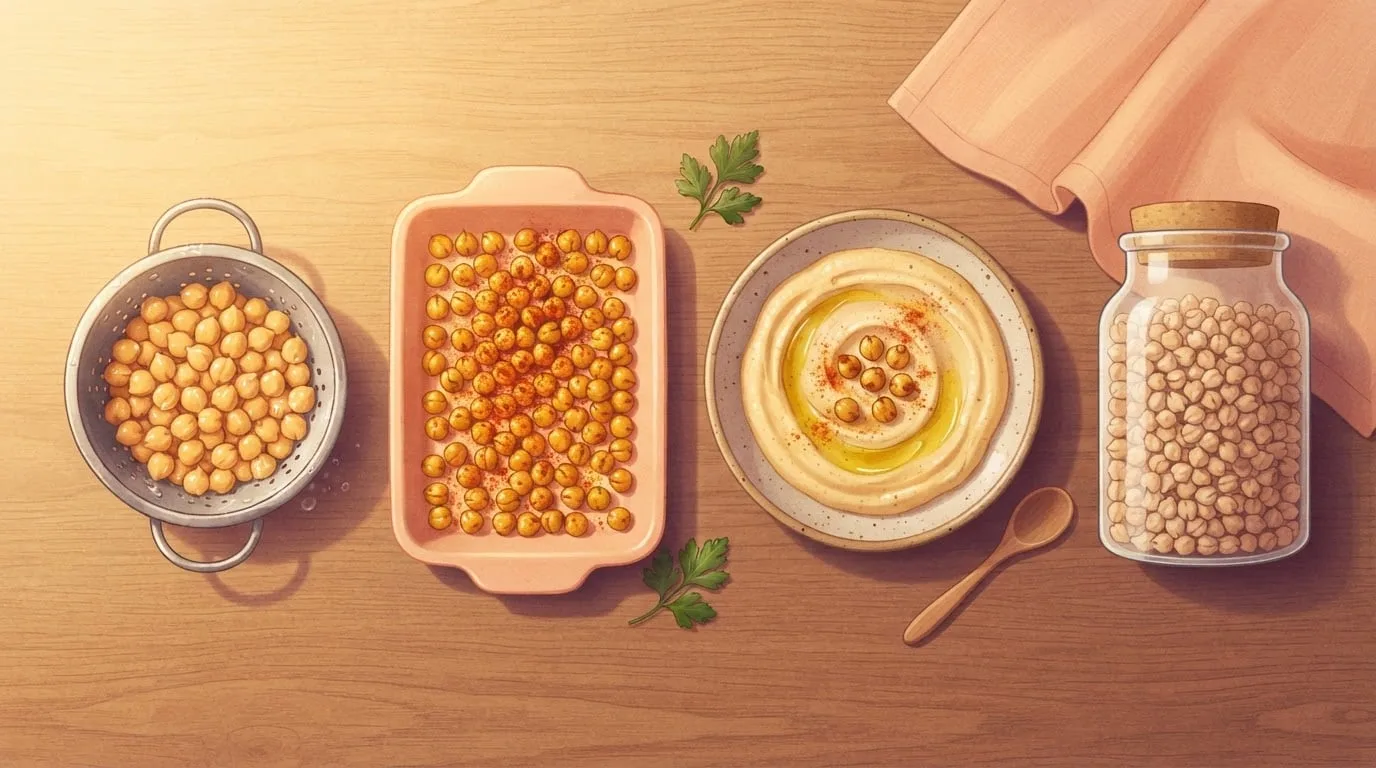
Hummus is chickpeas blended with tahini (sesame paste), olive oil, lemon and garlic, and the added fat changes the profile. Two tablespoons (30 grams) of commercial hummus have about 71 calories, 2.3 grams of protein, 1.7 grams of fiber, 5.3 grams of fat and 128 mg of sodium. The same 30 grams of plain boiled chickpeas have about 49 calories and under 1 gram of fat. About two-thirds of hummus calories come from fat, though it's mostly the unsaturated fat in sesame and olive oil.
Hummus still does well as a snack. In a crossover trial, Reister and Leidy (2020) gave 39 adults an afternoon snack of 4 tablespoons of hummus with pretzel crisps, granola bars with the same calories, or no snack, each for six days. Compared with no snack, the hummus pattern cut dessert snacking later that evening by about 20 percent and lowered hunger. It also led to slightly lower afternoon blood sugar than the granola bars. The study was funded by a hummus maker, and one author sits on its advisory board, so read it as supportive rather than settled.
The practical rule: hummus is a good dip, and the portion is what matters. Two to four tablespoons with vegetables is a sensible snack. Half a tub with a bag of pita chips is a meal's worth of calories.
Are Chickpeas Better for You Than Beans?
Not really. They're different, not better. Here's a cooked cup of chickpeas against two other common pulses, from USDA FoodData Central:
| Per cooked cup, boiled without salt | Chickpeas (164 g) | Black beans (172 g) | Lentils (198 g) |
|---|---|---|---|
| Calories | 269 | 227 | 230 |
| Protein | 14.5 g | 15.2 g | 17.9 g |
| Fiber | 12.5 g | 15.0 g | 15.6 g |
| Fat | 4.2 g | 0.9 g | 0.8 g |
| Folate | 282 mcg | 256 mcg | 358 mcg |
| Iron | 4.7 mg | 3.6 mg | 6.6 mg |
| Potassium | 477 mg | 611 mg | 731 mg |
USDA entries 173757 (chickpeas), 173735 (black beans) and 172421 (lentils), scaled to one cup.
Cup for cup, chickpeas are the highest in calories and fat and the lowest in protein and fiber of the three. Lentils win on protein, iron, folate and potassium. Black beans carry more fiber for fewer calories. What chickpeas offer is texture and versatility: they hold their shape in salads, roast crisp, blend smooth and stand up to curries, which makes them the legume many people actually eat. A legume you eat four times a week beats a slightly better one you eat once a month.
Chickpea Protein for Training: Is It Enough?
A cup of chickpeas gives 14.5 grams of protein and about 1 gram of leucine, the amino acid most tied to muscle building. The International Society of Sports Nutrition's protein position stand (Jäger and colleagues, 2017) suggests 20 to 40 grams of protein per meal with 700 to 3,000 mg of leucine. So a cup of chickpeas clears the leucine floor but not the protein target on its own.
You have two easy fixes:
- Eat a bigger portion. One and a half cups gets you about 22 grams of protein, at roughly 400 calories with the carbs to match. That suits a post-workout meal when you also want to refill glycogen.
- Pair them. Chickpeas with Greek yogurt, eggs, fish, chicken, tofu or a grain cover the protein target in a normal-sized meal. Grains also fill in methionine, the amino acid chickpeas run low on. Our review of whey vs plant protein explains why plant proteins need a slightly bigger dose to match animal ones.
Which is healthier, eggs or chickpeas? Neither wins outright. A large egg has about 6.3 grams of protein in 72 calories, which works out to roughly 8.8 grams per 100 calories against 5.4 for chickpeas. Eggs also bring vitamin B12 and much more choline, and chickpeas have none of the B12. Chickpeas bring fiber, which eggs lack entirely, and more folate. Eggs and a chickpea hash in one pan cover both.
Food only helps if the workouts happen, and that's usually the harder part. If your training is what keeps slipping, our comparison of FitCraft vs MyFitnessPal explains the difference between an app that logs your food and one that coaches your workouts. FitCraft's home workouts use your bodyweight and dumbbells, its programs are led by a 3D AI coach who demonstrates each exercise and says your name, and its streaks and leaderboards give you a reason to come back tomorrow.

Is There a Downside to Chickpeas?
A few, and most are easy to manage:
- Gas and bloating. The oligosaccharides ferment in your colon. Soaking, rinsing and a gradual ramp handle it for most people, while people with IBS may need to keep portions small.
- Sodium in canned chickpeas. Even rinsed, a cup of regular canned chickpeas has about 320 mg. No-salt-added cans fix it.
- Calorie creep. Hummus, falafel and oil-roasted chickpeas carry far more calories per bite than plain chickpeas.
- Iron that's harder to absorb. Chickpeas contain phytate, which binds iron. Hallberg and colleagues (1989) showed phytate cut iron absorption in a dose-dependent way, and that vitamin C counteracted it. Lemon juice, tomatoes or peppers in the same meal help.
- Legume allergy. Chickpea allergy is uncommon but real. A 2021 scoping review by Hildebrand and colleagues noted that chickpea, pea, lentil and lupine allergies are often involved in severe reactions. Chickpea isn't one of the major allergens US labels must declare, and chickpea flour (gram flour or besan) hides in many foods.
- Kidney disease. A cup has about 477 mg of potassium and 276 mg of phosphorus. If you have advanced kidney disease, ask your renal dietitian how chickpeas fit your limits.
Chickpeas Benefits for Women: Folate and Iron
Two nutrients make chickpeas especially useful for women. The first is folate. A cup holds 282 mcg, 71 percent of the 400 mcg daily value. Folate matters most around pregnancy, and the NIH Office of Dietary Supplements notes that women who could become pregnant are advised to get 400 mcg of folic acid a day from supplements or fortified foods on top of food folate. Chickpeas add to that, but they don't replace the supplement advice.
The second is iron. Women aged 19 to 50 need 18 mg a day, more than twice the 8 mg men need, according to the NIH iron fact sheet. A cup of chickpeas supplies 4.7 mg, about a quarter of a woman's daily need. It's the plant (non-heme) form, which is less readily absorbed, so the vitamin C pairing above matters most here. Men get the same protein, fiber and minerals from chickpeas, and the cholesterol trials included both men and women.
Are Chickpeas Healthy to Eat Every Day?
Yes, for most people. The Tasmanian volunteers ate about 104 grams a day, roughly two-thirds of a cup, for 12 weeks, and the gut study used 200 grams a day for three weeks. Neither study reported serious problems, and digestive discomfort was the main complaint the Tasmanian volunteers raised.
A sensible daily range is half a cup to a cup. Rotate chickpeas with lentils, beans and other protein foods so you get each one's strengths. Lentils bring more iron and folate, beans more fiber, and animal foods bring the vitamin B12 that no legume has.
What This Means for You
Chickpeas earn their place. A cup gives you a solid dose of fiber, folate, plant protein and minerals for about 270 calories. The chickpea-specific trials show modest cholesterol drops, gentler blood sugar after meals and a pull away from processed snacks. Buy canned and rinse them, soak dried ones, keep an eye on the oil in roasted chickpeas and hummus, and pair them with a protein food or a squeeze of lemon.
No single food will change your health on its own, though. What changes results is what you repeat: decent meals most days and workouts you actually show up for. Sarah, 27, lost 18 lb in three months and put it simply: "First app that made exercise feel like something I chose, not forced." A can of chickpeas in the pantry and a short workout on the calendar are both easy places to start.
Frequently Asked Questions
Are chickpeas good for you?
Yes. One cup of cooked chickpeas has about 269 calories, 14.5 grams of protein, 12.5 grams of fiber and 71 percent of the daily value for folate, according to USDA data. In trials that fed people chickpeas, LDL cholesterol fell by about 4 to 5 percent compared with a wheat-based diet.
Are chickpeas healthy for weight loss?
They can help. A cup of chickpeas brings 12.5 grams of fiber and 14.5 grams of protein, and in a small trial of 12 women a chickpea snack curbed appetite and led them to eat less at the next meal. Weight loss still depends on total calories, so watch the oil on roasted chickpeas and the portion of hummus.
Are chickpeas fattening?
Not in normal portions. Boiled chickpeas have about 164 calories per 100 grams, and only about 14 percent of those calories come from fat. They become calorie-dense when they're roasted in oil, fried as falafel or blended into hummus with tahini and oil.
Which is healthier, eggs or chickpeas?
Neither wins outright. Eggs carry more protein per calorie (about 8.8 grams per 100 calories against 5.4 for chickpeas) plus vitamin B12 and choline. Chickpeas bring fiber, which eggs lack entirely, plus more folate, so the two work well together in one meal.
Are garbanzo beans the same as chickpeas?
Yes. Garbanzo bean is the Spanish-derived name and chickpea is the English one for the same legume, Cicer arietinum. The large cream-colored kind in most cans is called kabuli, and the smaller, darker desi type is the one used for Indian chana dal and gram flour.
How much protein is in 100g of chickpeas?
About 8.9 grams in 100 grams of chickpeas boiled from dry, with 164 calories and 7.6 grams of fiber. Canned chickpeas, drained and rinsed, hold a little more water, so 100 grams has about 7 grams of protein and 138 calories. Dry, uncooked chickpeas have about 20.5 grams of protein per 100 grams.
Can you eat chickpeas raw?
Canned chickpeas are already cooked, so you can eat them straight from the can after a rinse. Dried chickpeas need soaking and thorough cooking first. Raw, they're rock hard and hard to digest.
Are chickpeas healthy for men?
Yes, for the same reasons they're healthy for anyone. A cup covers more than half the 8 mg of iron adult men need each day, adds 14.5 grams of protein and 12.5 grams of fiber, and the chickpea cholesterol trials included both men and women.