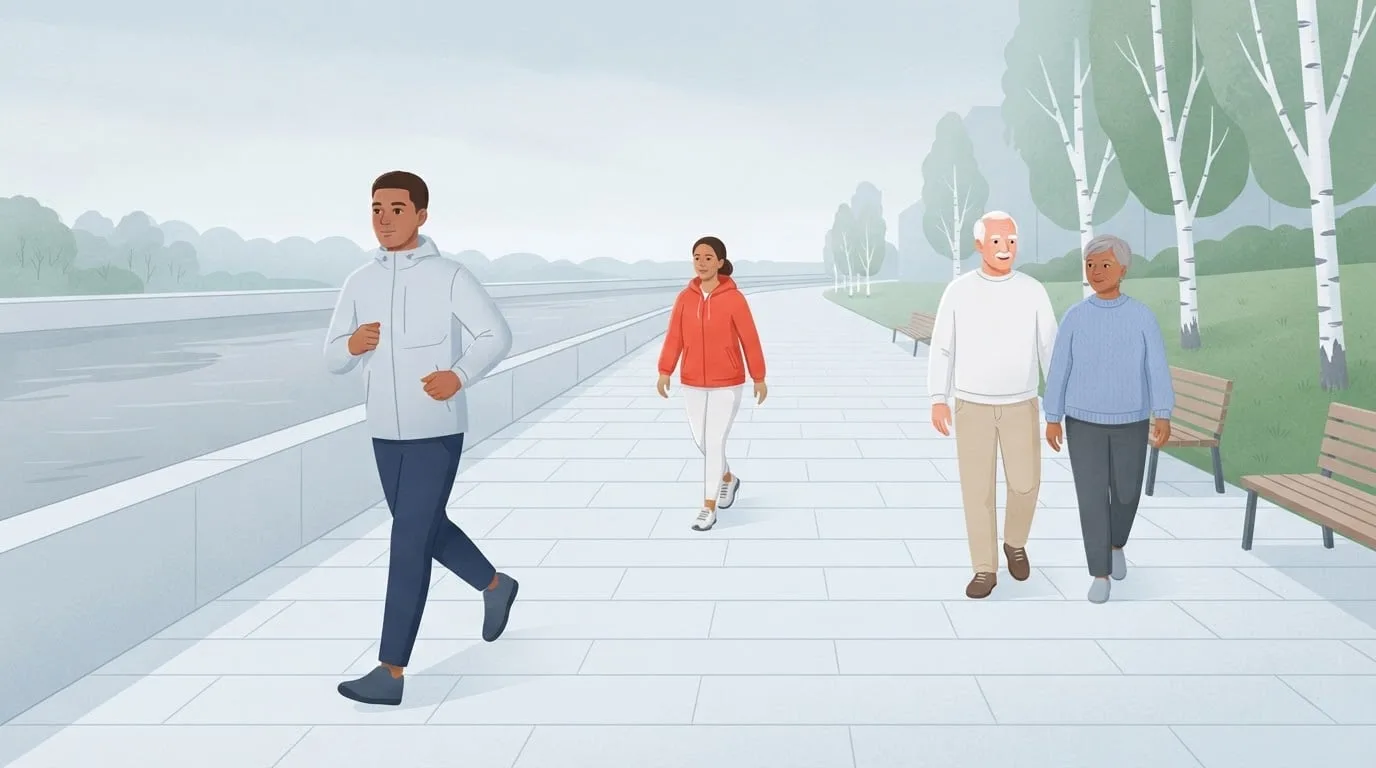
Watch any busy sidewalk and the spread looks huge. Some people glide past you and others you have to step around. Yet most of them are walking within about half a mile per hour of each other. The average walking speed is one of the most carefully measured numbers in exercise science, because clinicians use it as a quick read on how well the whole body is working.
That's also why your own pace can start to bother you. Maybe friends keep waiting at the corner, or a walk that used to feel easy now leaves you trailing. A slower pace usually points to fitness and leg strength more than to age, and both of those respond to training at any age.
This page gives the average walking speed in mph, km/h and meters per second, then breaks it down by age and sex using two large meta-analyses. It also covers brisk walking speed, how long 3 miles takes, what counts as a good walking speed for seniors, whether 2 mph is too slow and how to raise your own pace.
Average Walking Speed in mph, km/h and Meters per Second
Researchers report walking speed in meters per second, so most headlines are conversions. The most useful single figure for everyday walking comes from Murtagh and colleagues (2021), who pooled 35 studies of 14,015 apparently healthy adults walking outdoors. People asked to walk at their usual pace averaged 1.31 meters per second. Here's that number in every unit people search for.
| Unit | Average usual walking speed |
|---|---|
| Meters per second | 1.31 m/s |
| Kilometers per hour | 4.7 km/h |
| Miles per hour | 2.9 mph |
| Feet per second | 4.3 ft/s |
| Minutes per mile | about 20.5 |
| Minutes per kilometer | about 12.7 |
Walkway studies agree. Bohannon and Andrews (2011) pooled 41 studies covering 23,111 healthy adults who walked a straight course of 3 to 30 meters at a normal pace. Every age group from 20 to 69 averaged between 1.24 and 1.43 m/s, about 2.8 to 3.2 mph. So the rounded answer of about 3 mph holds whether you're timed in a clinic hallway or on a park path.
Slow, usual and fast: what each pace looks like
Murtagh's review also grouped the walks by the instruction people were given. These outdoor averages show how far apart the paces really are.
| Instruction | m/s | km/h | mph |
|---|---|---|---|
| Walk slowly | 0.82 | 3.0 | 1.8 |
| Walk at your usual pace | 1.31 | 4.7 | 2.9 |
| Walk at a medium pace | 1.47 | 5.3 | 3.3 |
| Walk fast | 1.72 | 6.2 | 3.8 |
Told to walk as fast as they possibly could, healthy adults went much faster than any of these. In Bohannon's 1997 study of 230 adults, average maximum speed ranged from 1.75 m/s (3.9 mph) in women in their 70s to 2.53 m/s (5.7 mph) in men in their 20s.
Average Walking Speed by Age and Sex
Age changes your pace less than you might expect until your 60s. The table below gives the decade-by-decade averages from Bohannon and Andrews' meta-analysis, converted from meters per second. Between 83 and 8,591 people stand behind each figure.
| Age | Men (m/s) | Men (km/h, mph) | Women (m/s) | Women (km/h, mph) |
|---|---|---|---|---|
| 20 to 29 | 1.36 m/s | 4.9 km/h, 3.0 mph | 1.34 m/s | 4.8 km/h, 3.0 mph |
| 30 to 39 | 1.43 m/s | 5.1 km/h, 3.2 mph | 1.34 m/s | 4.8 km/h, 3.0 mph |
| 40 to 49 | 1.43 m/s | 5.1 km/h, 3.2 mph | 1.39 m/s | 5.0 km/h, 3.1 mph |
| 50 to 59 | 1.43 m/s | 5.1 km/h, 3.2 mph | 1.31 m/s | 4.7 km/h, 2.9 mph |
| 60 to 69 | 1.34 m/s | 4.8 km/h, 3.0 mph | 1.24 m/s | 4.5 km/h, 2.8 mph |
| 70 to 79 | 1.26 m/s | 4.5 km/h, 2.8 mph | 1.13 m/s | 4.1 km/h, 2.5 mph |
| 80 to 99 | 0.97 m/s | 3.5 km/h, 2.2 mph | 0.94 m/s | 3.4 km/h, 2.1 mph |
Three patterns stand out. Men hold their speed from their 30s through their 50s, at about 1.43 m/s. Women peak in their 40s at 1.39 m/s and slow gradually after that. Both sexes slow more quickly after 70, and the steepest drop comes after 80, when both averages fall below 1.0 m/s.
Average walking speed for women vs men
Women walk a little slower than men on average, and the gap is small before 50. Outdoors, Murtagh's review found a usual pace of 1.26 m/s (2.8 mph) for women and 1.37 m/s (3.1 mph) for men. Women also took more steps to get there: about 122 a minute at their usual pace, against about 114 for men. That pattern fits a difference in step length. Shorter legs make shorter steps, so women cover part of the distance with a quicker rhythm. After 60, the gap in the walkway data widens to 0.1 m/s or a little more, roughly a quarter of a mile per hour.
Why walking speed drops with age
Bohannon's 1997 study looked at what predicts walking speed besides age. Speed went down with age, and it went up with height and with leg strength. Strength of the outer hip muscles, which keep your pelvis level on each step, tracked most closely with comfortable speed. Strength of the front of the thigh tracked most closely with maximum speed. You can't change your height, but you can change your strength. That's why a lower-body routine is the most reliable way to keep your pace as the decades pass.
Does Height Change Your Walking Speed?
A little. Taller people have longer legs and take longer steps, so at the same rhythm they cover more ground. In Bohannon's 1997 data, height was linked with both comfortable and maximum walking speed, but the correlations were modest, so height explains only a small part of the difference between two people. No large study gives a reliable average walking speed by height. Charts that list one are estimates built from step length.
If you're tall and always a step ahead of the group, the data backs you up: at the same number of steps a minute, a longer step simply carries you farther. Step length changes how long a step goal takes, too. Our breakdown of how long it takes to walk 10000 steps shows why taller walkers need more minutes to reach the same count.
Brisk Walking Speed: How Many Steps per Minute?
Brisk walking starts at about 2.5 mph, or roughly 100 steps a minute. The 2.5 mph figure is the CDC's example of moderate-intensity walking. The step count comes from the CADENCE-Adults studies, in which researchers measured oxygen use while adults walked on a treadmill at rising speeds. In 76 adults aged 21 to 40, Tudor-Locke and colleagues (2019) found that about 100 steps a minute marked moderate intensity (3 METs) and about 130 marked vigorous intensity (6 METs). The same thresholds held in 80 adults aged 41 to 60 (Tudor-Locke and colleagues, 2020).
Most adults already clear the moderate line at their normal pace. Outdoors, people walking at their usual pace averaged about 117 steps a minute in Murtagh's review. A medium pace of 1.47 m/s (3.3 mph) measured 4.2 METs, which is squarely moderate. A fast pace of 1.72 m/s (3.8 mph) came with about 127 steps a minute, close to the vigorous threshold. For most adults, brisk walking speed lands somewhere between 3 and 4 mph, or a 15- to 20-minute mile.
To find your own number, set a one-minute timer on your next walk and count every step. If you land under 100, shorter and quicker steps are the fastest way up. Our guide on how to walk faster has the technique cues and a six-week plan.

Knowing what to do is the easy part.
FitCraft, our mobile fitness app, pairs you with an AI coach who builds you a personalized plan around your goals, schedule, and fitness level. Every FitCraft program is designed by Domenic Angelino, MPH (Brown University) and NSCA-CSCS, with research published in the Journal of Strength and Conditioning Research and Medicine & Science in Sports & Exercise.
Take the Free Assessment Free • 2 minutes • No credit cardWhat Is a Good Walking Speed for Seniors?
For adults over 65, a usual walking speed of 1.0 m/s (about 2.2 mph) or faster is a good sign. Healthy adults in their 60s average about 1.24 to 1.34 m/s (2.8 to 3.0 mph), adults in their 70s about 1.13 to 1.26 m/s (2.5 to 2.8 mph), and adults over 80 just under 1.0 m/s (2.1 to 2.2 mph).
The 1.0 m/s line comes from Cesari and colleagues (2005). They timed 3,047 well-functioning adults with an average age of 74 over a 6-meter course and followed them for about five years. People who walked slower than 1 m/s had a 64 percent higher risk of death and a 48 percent higher risk of hospitalization. They also had more than twice the risk of a lasting limitation in lower-body function.
Every bit of speed counts. In the largest pooled analysis, Studenski and colleagues (2011) followed 34,485 adults aged 65 and over, whose average speed was 0.92 m/s, for 6 to 21 years. Each 0.1 m/s faster tracked with a 12 percent lower risk of death. Our review of walking speed and longevity goes through that evidence and the studies of self-rated pace in middle age.
There's a street-level benchmark too. In the UK, pedestrian crossings assume people walk at least 1.2 m/s (2.7 mph). Asher and colleagues (2012) tested 3,145 adults aged 65 and over in England. Average speed was 0.9 m/s for men and 0.8 m/s for women. In all, 84 percent of the men and 93 percent of the women either walked slower than 1.2 m/s or couldn't complete the short walk test safely. If a crossing feels rushed, you're far from alone, and it's useful information rather than a verdict.
Is walking 2 mph too slow?
It depends on your age and on whether 2 mph is your stroll or your best effort. Two miles per hour is 0.89 m/s. For adults over 80, that's close to average. For adults under 70, it's well below the averages in the table above and near the deliberately slow pace (0.82 m/s) in Murtagh's review. If 2 mph is your comfortable everyday pace before your 70s, check in with a doctor or physical therapist and start working on leg strength. As exercise, a 2 mph walk still beats sitting, but it's under the 2.5 mph mark for moderate intensity, so pick up the pace when you can.
How to Measure Your Own Walking Speed
Pick a flat, measured stretch, such as a quarter mile or one lap of a standard 400-meter track. Start walking well before the start so you're already at your everyday pace, then time the full distance without speeding up for the clock. Bohannon and Andrews warned that timing someone from a standing start over a short distance gives slower numbers than their averages, so give yourself a rolling start.
- Quarter mile: 900 divided by your seconds gives your speed in mph. A 5-minute quarter mile (300 seconds) is 3.0 mph.
- 400 meters: 400 divided by your seconds gives meters per second. A 300-second lap is 1.33 m/s.
- Phone or watch: most step-tracking apps show an average pace for an outdoor walk. Flat routes give cleaner readings than hilly ones.
Repeat the test every few months on the same route. A change of 0.1 m/s, about a quarter of a mile per hour, is the size of change the older-adult studies above treat as meaningful. If your pace has dropped along with a change in how you walk, our guide to a normal walking gait covers the signs worth showing a clinician.
How to Raise Your Average Walking Speed
Two things move walking speed: rhythm and leg strength. Rhythm is the quick win. Shorter, quicker steps and a bent-arm swing raise your speed within a few walks, and the walk-faster guide above lays out the drills.
Strength is the slower, longer-lasting fix, and it's the one that protects your pace after 60. Bohannon's data tie comfortable speed to the outer hip and maximum speed to the front of the thigh. Two short sessions a week of bodyweight or dumbbell moves cover both:
- Sit-to-stands from a chair, or goblet squats holding one dumbbell: 3 sets of 8 to 12.
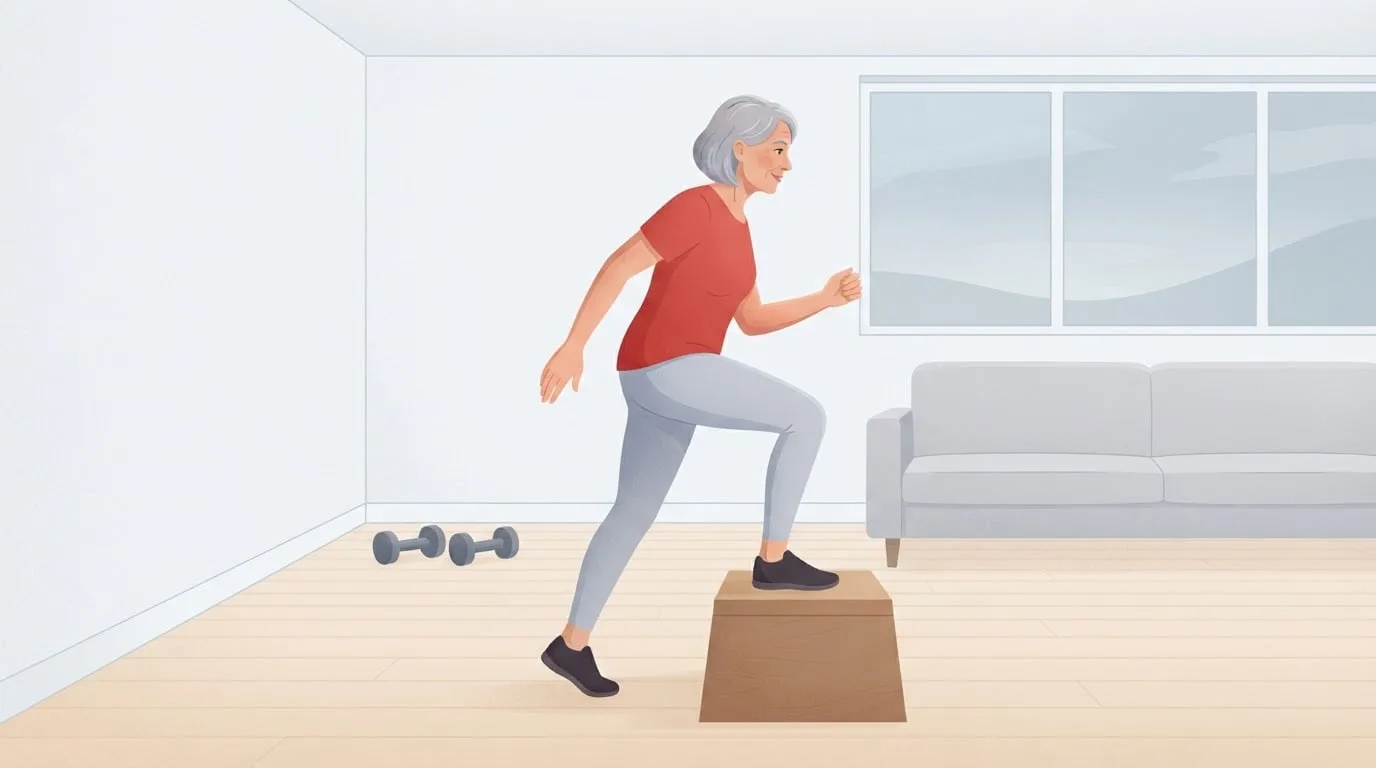
- Step-ups onto a sturdy step or low bench: 3 sets of 8 on each leg.
- Side-lying leg raises for the outer hip: 2 sets of 12 on each side.
- Calf raises on the edge of a step, for push-off: 2 sets of 15.
The hard part is the second month, when the novelty wears off and the sessions start slipping. FitCraft's 3D AI coaches demonstrate each bodyweight and dumbbell exercise, your workouts adapt as you progress, and streaks and calendar tracking make a missed week easy to spot. If sticking with it has been the problem before, see how a workout app that keeps you motivated handles the part willpower usually can't.
What This Means for You
If your everyday pace sits around 3 mph, you're average, and average is healthy. If it's closer to 2.5 mph and you're under 60, a few weeks of quicker steps and leg work will likely move it. If you're over 65, aim to keep your usual speed above 1.0 m/s, about 2.2 mph, and treat a drop as a reason to train rather than a sign of decline.
Picture the same walk a few months from now. You keep up with friends without thinking about it, the crossing signal feels generous, and the hill near home stops being the part you dread. Getting there doesn't take a new personality. It takes two short strength sessions and a few brisk walks a week, kept going long enough to count.
Frequently Asked Questions
What is the 6 6 6 walking rule?
The 6-6-6 walking rule is a challenge to walk briskly for 60 minutes at 6 a.m. or 6 p.m., with a 6-minute warm-up and a 6-minute cool-down, usually six days a week for six weeks. At an average pace of about 3 mph, the 60-minute walk covers roughly 3 miles. The 6 o'clock timing has no proven advantage, so the best slot is the one you can keep. Our look at the 6-6-6 walking challenge checks each part against the research.
Do slow walkers live longer?
No. Studies link a slower walking pace with a shorter life, not a longer one. In 34,485 adults over 65, each 0.1 m/s of extra walking speed tracked with a 12 percent lower risk of death, and in 50,225 British walkers, people who rated their pace as brisk or fast had a 24 percent lower risk of death than slow walkers. Walking speed mostly reflects fitness and leg strength, which is why it tracks health so closely.
How long does it take to walk 3 miles?
Walking 3 miles takes about an hour at an average pace of 3 mph, about 51 minutes at a brisk 3.5 mph and 45 minutes at a fast 4 mph. At a slow 2 mph stroll it takes an hour and a half. Our guide to how long it takes to walk a mile has the times for 2 and 5 miles too.
How much walking is 10,000 steps in hours?
10,000 steps takes most adults about 85 to 90 minutes of walking at their usual pace and about 75 to 80 minutes at a brisk pace, because people take roughly 115 to 130 steps a minute. In practice, a large share of those steps comes from ordinary moving around during the day, so a 10,000-step day rarely needs an hour and a half of dedicated walking.
What is average walking speed in km/h?
The average walking speed is about 4.7 km/h for healthy adults walking outdoors at their usual pace, according to a meta-analysis of 35 studies. By age and sex, averages run from about 5.1 km/h for men in their 30s to 50s down to about 3.4 km/h for women over 80. A brisk pace is roughly 5 to 6.5 km/h.
What is the average walking speed per second?
The average walking speed is about 1.3 meters per second, or about 4.3 feet per second, for healthy adults at their usual pace. Every age group between 20 and 69 averages between 1.24 and 1.43 meters per second, and adults over 80 average just under 1.0 meter per second.
How many miles can a person walk in a day?
A healthy adult walking at an average 3 mph covers about 24 miles in 8 hours of walking, though breaks, hills and sore feet usually keep an untrained walker's total lower. For health you need far less. The 150 minutes of brisk walking a week that guidelines recommend works out to about 22 minutes, or roughly a mile, a day.
What is a normal heart rate when walking?
There's no single normal number, because walking heart rate depends on your age, fitness and pace. In a meta-analysis of outdoor walking, adults at a medium pace of about 3.3 mph averaged about 56 percent of their maximum heart rate, with women at 61 percent and men at 53 percent. A cadence of about 100 steps a minute, or being able to talk but not sing, is an easier check that you're walking briskly.