
Can you build muscle on a calorie deficit, or do you have to pick one goal at a time? It's a fair thing to ask when you want to lose weight and look stronger once it's gone. One coach tells you to bulk first and cut later. A forum says you can do both. Neither tells you which answer applies to you.
That uncertainty costs people months. Some put off lifting until the weight is gone. Others cut calories so hard that their workouts fall apart, then blame themselves when the mirror doesn't change. Your starting point shapes the answer more than anything else, so that's what this page sorts out.
Below you'll find what the research found, why body fat matters so much, who can and can't expect new muscle, how much protein to eat and how to train with dumbbells and bodyweight. If you're setting a muscle-building calorie target instead, see our guide to how many calories to build muscle.
Can You Build Muscle on a Calorie Deficit? What the Research Shows
Yes, but more slowly than you would at maintenance or in a small surplus. The best single summary is a 2022 meta-analysis by Murphy and Koehler, which pooled randomized trials of resistance training in an energy deficit lasting at least three weeks. Compared with people lifting without a deficit, the dieters gained less lean mass (effect size -0.57, p = 0.02). Their strength gains didn't differ significantly (effect size -0.31, p = 0.28).
The authors then estimated that a deficit of about 500 calories a day was enough to stop lean mass gains. Their advice follows from that: if building lean mass is your goal, avoid long deficits, and if you only want to keep it, stay at or under about 500 calories a day.
Read that figure as an average across studies rather than a wall. A 2019 review by Slater and colleagues concluded that muscle growth in a deficit is more likely in people who are new to resistance training, overweight or obese, and less evident in highly trained people. So the same gap can mean slow growth for one person and none for another.
Where Does the Energy for New Muscle Come From in a Deficit?
Mostly from your body fat. The usual objection is that you can't build anything out of an energy shortage, but your body still carries a large reserve. A kilogram of body fat stores about 9,400 calories, based on the energy density in Hall's 2008 analysis. Slater's review puts the full cost of building a kilogram of muscle at roughly 1,450 to 1,780 calories. So one kilogram of fat holds enough energy to pay for more than five kilograms of muscle.
Fat can't supply the building blocks, though. It contains no nitrogen, so the amino acids in new muscle have to come from the protein you eat.
The real limit is the signal to grow
A deficit turns down the process that builds muscle, and lifting turns it back up. In a study by Areta and colleagues (2014), five days at 30 calories per kilogram of fat-free mass, against 45 in energy balance, cut resting muscle protein synthesis by 27 percent in 15 young adults. A session of resistance exercise brought it back to the energy-balance rate, and 15 or 30 grams of whey afterward lifted it about 16 or 34 percent higher.
Hector and colleagues (2018) found the same pattern in 24 men on a 40 percent deficit for 10 days. By our arithmetic, synthesis fell about 14 percent on 2.4 grams of protein per kilogram and about 26 percent on 1.2 grams, and lifting brought both groups back to at least their pre-diet rate. Those were short lab studies, but they explain why the plan is lifting plus protein.
Why your body fat level changes the answer
Stored fat can only release energy so fast. Alpert (2005) estimated the ceiling at about 290 kilojoules per kilogram of body fat per day, roughly 69 calories, from experiments on underfed people. Forbes's equation, as revisited by Hall (2007), adds that the leaner you are, the bigger the share of a small weight loss that comes from lean tissue.
| Body fat you carry | Most your fat can supply per day (Alpert) | Lean share of a small weight loss (Forbes) |
|---|---|---|
| 10 kg (22 lb) | About 690 calories | About 51% |
| 20 kg (44 lb) | About 1,390 calories | About 34% |
| 30 kg (66 lb) | About 2,080 calories | About 26% |
| 40 kg (88 lb) | About 2,770 calories | About 21% |
Both columns are our arithmetic from those formulas, not measurements of one person. Neither accounts for lifting, which shifts the loss toward fat, and Hall found that Forbes's equation understates lean loss in very large weight losses.
A 75 kg (165 lb) man at 13 percent body fat carries about 10 kg of fat, so a 500-calorie deficit uses more than 70 percent of his ceiling. Someone carrying 30 kg uses about a quarter of theirs, which leaves far more room for fat to cover the gap.
Who Can Build Muscle in a Calorie Deficit?
Three groups have good odds of adding muscle, and one mostly has to settle for keeping it.
| Starting point | What to expect in a modest deficit | Best approach |
|---|---|---|
| New to lifting | New muscle and fat loss together | Deficit up to about 500 calories |
| Returning after a break | Old muscle comes back quickly | Small deficit or maintenance |
| Higher body fat | Muscle kept, and added if lifting is new to you | Deficit up to about 500 calories, high protein |
| Lean and experienced | Muscle kept, little or none added | A short, slow cut, then a small surplus to build |
Can you build muscle in a calorie deficit as a beginner?
Yes, and beginners have the best odds. Slater's review singles out people new to resistance training, and it makes sense: the work is a fresh stimulus for muscle that hasn't adapted to it. Expect your reps to climb within weeks and visible change to take longer.
Can you build muscle in a calorie deficit if you're overweight?
Yes. More stored fat means more of the shortfall can come from fat. In a 16-week trial by Josse and colleagues (2011), 90 premenopausal women with overweight or obesity dieted and exercised daily. The group getting 30 percent of calories from protein, with plenty of dairy, gained lean tissue while losing fat. The group on 15 percent protein with little dairy lost lean tissue. Protein and dairy rose together, so the trial can't separate the two.
What about returning lifters?
Muscle you once had tends to come back faster than it was built, as our review of muscle memory explains. The deficit trials here didn't test returning lifters directly, so treat this as a reasonable inference. A small deficit or maintenance gives that muscle the best chance to regrow.
Who mostly can't build muscle in a deficit?
Lean, experienced lifters. Roth and colleagues (2023) put 38 resistance-trained men on about a third fewer calories than their maintenance week for six weeks, with 2.8 grams of protein per kilogram of fat-free mass and supervised leg training. They lost about 1.7 kg. Lean mass fell by 0.5 to 0.9 kg on average and thigh muscle thickness barely changed, whether they did 3 or 5 sets per exercise.
Helms and colleagues (2014) warn that the leaner you get, the greater the risk of losing lean mass, and suggest losing about 0.5 to 1 percent of body weight a week. Slower does help: in a 2011 trial by Garthe and colleagues, athletes on a smaller deficit gained 2.1 percent lean mass while a faster group gained none, as our guide on how to lose fat without losing muscle explains. If you're in this group, holding your muscle through a cut is a success, and a small calorie surplus is the faster way to add more.
Can You Build Muscle on a 500 Calorie Deficit?
Sometimes. That's right where the meta-analysis found gains stopped on average, so a beginner or someone with plenty of fat to lose may still add muscle, and a lean lifter probably won't. If muscle matters as much to you as the scale, a gap of 200 to 400 calories a day gives you more room.
Will a 1000 Calorie Deficit Cause Muscle Loss?
It raises the risk, and for a lean person it very likely will. Murphy and Koehler advise staying under 500 calories a day if you want to keep lean mass. The exceptions come from small trials with structured training. In a 12-week trial by Bryner and colleagues (1999), 20 adults lived on an 800-calorie liquid diet. Those who lifted three days a week lost no lean mass, while lean mass in those who did aerobic work four times a week fell from 51 to 47 kg. That doesn't make a deep deficit a good home plan, and an intake that low needs a doctor or dietitian involved.
Knowing what to do is the easy part.
FitCraft, our mobile fitness app, pairs you with an AI coach who builds you a personalized plan around your goals, schedule, and fitness level. Every FitCraft program is designed by Domenic Angelino, MPH (Brown University) and NSCA-CSCS, with research published in the Journal of Strength and Conditioning Research and Medicine & Science in Sports & Exercise.
Take the Free Assessment Free • 2 minutes • No credit cardHow Much Protein Do You Need to Build Muscle in a Deficit?
Aim for about 1.6 to 2.2 grams per kilogram of body weight a day, and sit higher in that range the bigger the deficit and the leaner you are. Three sources set those numbers:
- Longland and colleagues (2016). In a 40 percent deficit for four weeks, young men new to lifting gained 1.2 kg of lean mass on 2.4 grams per kilogram and 0.1 kg on 1.2 grams. Our body recomposition research review covers the caveats, starting with six training days a week.
- Pasiakos and colleagues (2013). In 39 adults on a 40 percent deficit for 21 days, 1.6 and 2.4 grams per kilogram both protected fat-free mass better than the 0.8-gram RDA.
- Morton and colleagues (2018). Across 49 trials and 1,863 people, extra protein stopped adding fat-free mass at about 1.62 grams per kilogram, with an upper confidence limit of 2.2. That analysis wasn't specific to dieting, so the top half of the range is safer in a deficit.
For a 70 kg (154 lb) person, that's about 110 to 155 grams a day. If you have a lot of weight to lose, I'd work from your goal weight, which is my coaching judgment rather than a trial result. Our protein calculator does the math.

How to Train in a Calorie Deficit With Dumbbells and Bodyweight
Train the way you'd train to build muscle. Five rules cover most of it:
- Lift two or three days a week. Bryner's lifters kept their lean mass on three sessions.
- Do about 3 hard sets per exercise. In Roth's trial, 5 sets kept no more muscle than 3.
- Take sets close to failure. Schoenfeld and colleagues (2017) pooled 21 studies and found that low and high loads built muscle about equally when sets went to failure, so light dumbbells work if the last reps are hard. In a small trial by Kikuchi and Nakazato (2017), push-ups matched a light bench press in untrained men.
- Try to beat your last session. Add a rep, slow the lowering or move up a dumbbell.
- Cut sets before you cut effort. In Bickel and colleagues (2011), young adults held their muscle size for 32 weeks on a third or even a ninth of their training dose.
Repeat this full-body session two or three times a week, stopping each set one or two reps short of failure.
| Movement | Exercise | Sets and reps |
|---|---|---|
| Squat | Goblet squat | 3 sets of 8 to 15 |
| Hip hinge | Dumbbell Romanian deadlift | 3 sets of 8 to 15 |
| Push | Push-up, hands raised if needed | 3 sets, close to failure |
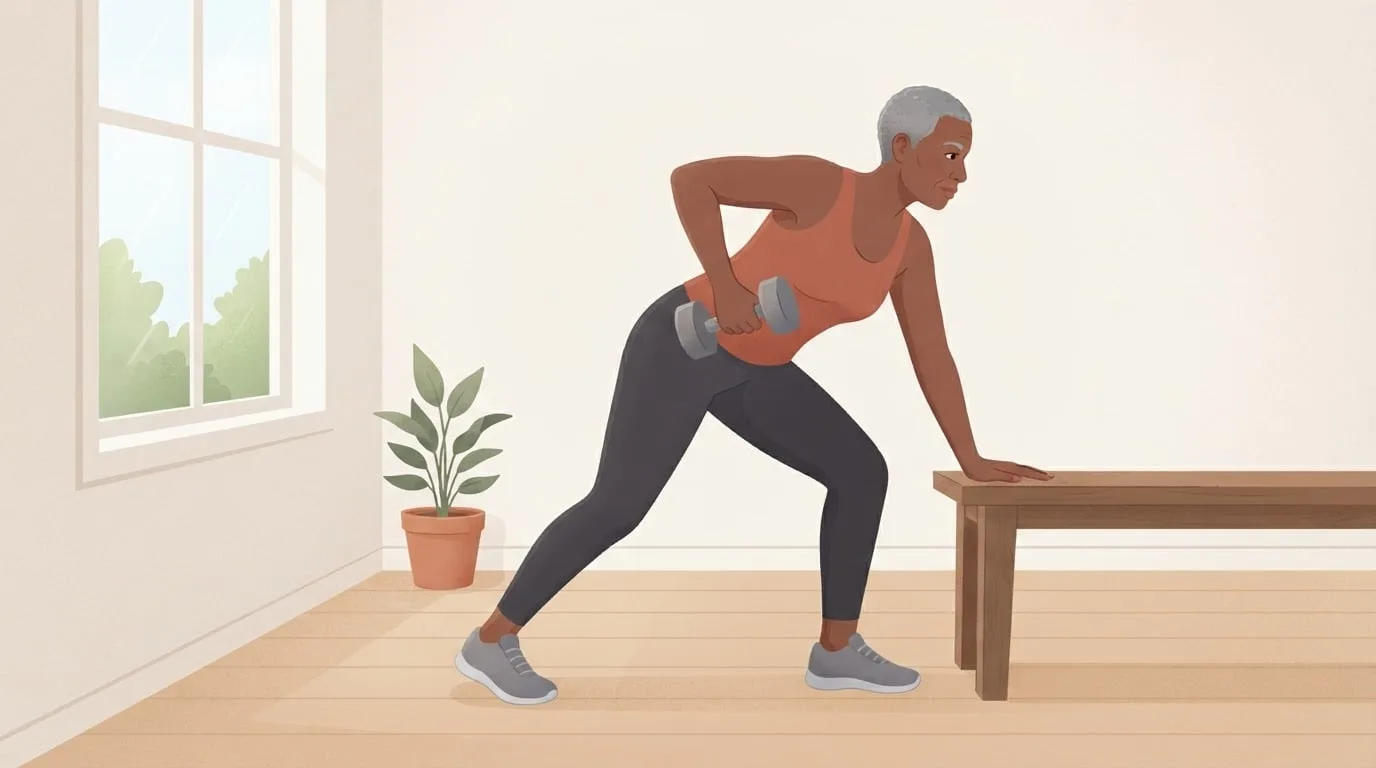
| Pull | One-arm dumbbell row | 3 sets of 8 to 15 per side |
| Single leg | Reverse lunge | 2 sets of 10 to 15 per side |
| Core | Plank | 2 sets of 30 to 60 seconds |
When a set gets easy, go heavier, slow the lowering to three seconds or add reps. Our full-body dumbbell workout guide has more options. If you'd rather not plan it yourself, a dumbbell workout app can do it for you. FitCraft's programs use dumbbells and bodyweight, a 3D AI coach demonstrates each exercise and your workouts adapt as you progress.
Building Muscle While Losing Weight: How to Tell It's Working
Can you gain muscle while losing weight? Yes, but the scale can't show it, because a slow gain in muscle hides inside a faster loss of fat. Judge it over 8 to 12 weeks: your weekly average weight should fall slowly, your waist should shrink, and your reps or dumbbell weights should hold or climb. If your lifts fall for several weeks, the deficit is probably too big.
What Kills Muscle Gains the Most?
Stopping does. Muscle built in a deficit comes slowly, so the plan only works if you're still lifting in month three. After that, the biggest threats are a deficit past about 500 calories a day, too little protein and short sleep.
What This Means for You
If you're new to lifting, coming back or carrying extra body fat, you don't have to choose between losing fat and gaining muscle. Eat 200 to 500 calories below maintenance, keep protein at 1.6 to 2.2 grams per kilogram and lift hard two or three times a week for at least 12 weeks. If you're lean and experienced, run one goal at a time.
The plan is simple but slow, and slow is where most people drift. You show up Monday, miss Wednesday and skip the next week. Mike, 23, got visibly stronger in four months with FitCraft: "The streak system got me hooked. I didn't want to break my chain." Picture three months from now: your waist is smaller, your first dumbbell feels light and training is part of your week.
Frequently Asked Questions
Can you build muscle on 1500 calories a day?
Only if 1,500 calories isn't far below your maintenance. A 35-year-old woman who's 5 ft 4 in and 150 lb and trains three days a week burns about 1,870 calories a day, so 1,500 is a deficit of about 370. A man of the same age who's 6 ft and 200 lb burns about 2,590, so 1,500 is a deficit of about 1,090, which is too big to expect growth.
Can you build muscle on 2000 calories a day?
It depends on your maintenance. For a 150 lb woman who burns about 1,870 calories a day, 2,000 is a small surplus of about 130. For a 200 lb man who burns about 2,590, it's a deficit of about 590, just past the point where lean mass gains stop on average. Estimate your own number with a TDEE calculator, then adjust it from your weekly average weight.
Can you build muscle on a calorie deficit with enough protein?
Protein helps, but you need lifting too, because lifting is what brings muscle protein synthesis back up in a deficit. Aim for about 1.6 to 2.2 g of protein per kg of body weight a day and train each muscle at least twice a week.
Can women build muscle in a calorie deficit?
Yes. In a 16-week trial of 90 premenopausal women with overweight or obesity, the group eating 30 percent of calories from protein, with plenty of dairy, gained lean tissue while losing fat. A lower-protein, low-dairy group lost lean tissue. The same rules apply as for men: a modest deficit, high protein and regular resistance training.
How many calories for a 350 lb man?
About 3,000 calories a day is a reasonable maintenance estimate for a sedentary 40-year-old man who's 5 ft 10 in and weighs 350 lb, and about 3,450 if he trains three days a week, using the Mifflin-St Jeor equation. Check that against your weight trend, and work with a doctor or dietitian at that weight.