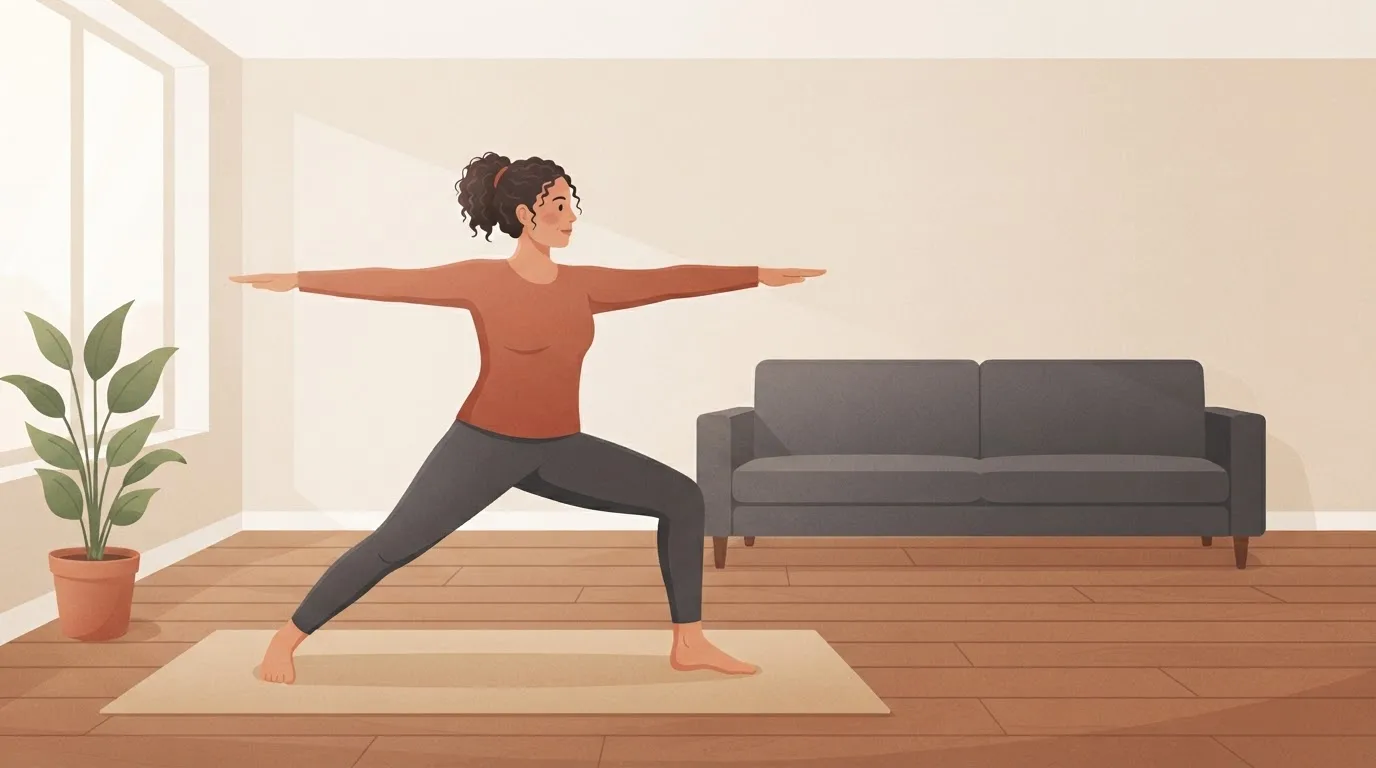
Maybe yoga is the one workout you actually enjoy. Or maybe it's the only kind that feels kind to a body that's out of practice. Either way, the question is fair. Can you lose weight doing yoga, or is it mostly stretching?
Yoga can help with weight loss, but the help looks different from a run or a spin class. Most styles burn modest calories, so yoga rarely moves the scale much by itself. It earns its place through the things around the calories, such as stress, sleep, overeating and sticking with exercise long enough for anything to work.
This page goes through the trials on yoga and body weight, how much of a calorie deficit a class can cover, which styles burn more, what yoga does for belly fat, and how to build a week where yoga does its share. For calorie numbers by style and body weight, see our answer to how many calories yoga burns.
Can You Lose Weight Doing Yoga? What the Trials Show
You can lose some weight doing yoga, especially if you have overweight and change how you eat at the same time. The research is smaller and weaker than the research on walking or strength training, so read the numbers below as a direction rather than a promise.
The broadest look is a review by Lauche and colleagues (2016), who pooled 30 randomized trials with 2,173 participants. Across all of them, yoga had no effect on body weight, BMI, body fat percentage or waist size. In the trials limited to people with overweight or obesity, BMI did fall compared with usual care. The authors called that result preliminary, because it wasn't robust to selection bias and publication bias couldn't be ruled out. No trial reported harm from the yoga itself.
Three more recent trials show what a yoga program for weight loss tends to look like.
| Study | Who took part | What they did | What happened to weight |
|---|---|---|---|
| Cramer 2016 | 60 women with a waist of 88 cm or more, average age 48 | Two 90-minute hatha classes a week for 12 weeks, plus advice to eat more plant foods and eat mindfully, with no calorie target | Lost 2.4 kg more than a waiting list, with a 3.8 cm smaller waist |
| Jakicic 2021 | 50 adults with obesity | A six-month weight-loss program with a reduced-calorie diet, plus restorative hatha or vinyasa yoga | Lost 3.4 kg with restorative yoga and 3.8 kg with vinyasa, with no difference by style |
| Unick 2022 | 60 women, average age 48, who had just finished a three-month weight-loss program | 12 weeks of yoga twice a week or cooking and nutrition classes | No overall difference at six months; among women who had already lost 5% or more, 9.0 kg lost with yoga against 6.7 kg |
The programs that worked had one thing in common. Each paired yoga with some change to eating, from plant-based guidance to a full reduced-calorie diet. None shows yoga alone producing big losses, and the Jakicic trial had no group without yoga, so most of its weight loss reflects the diet program around it. The Unick result comes from a subgroup, so treat it as a hint that yoga helps people hold on to early progress rather than as proof.
Will Yoga Help Weight Loss on Its Own?
Usually not by much, because a yoga class covers only a small slice of the calorie deficit that weight loss needs. The 2024 Adult Compendium of Physical Activities rates hatha yoga at 2.3 METs, vinyasa at 2.7 and power yoga at 4.0. Sitting still is 1 MET, so for a 170 lb (77 kg) adult, an hour of hatha burns about 100 calories more than resting, vinyasa about 130 and power yoga about 230.
Compare that with the deficit most weight-loss plans aim for. The main US obesity guideline recommends eating 500 to 750 fewer calories a day (Jensen and colleagues, 2014), which is 3,500 to 5,250 a week. Three hour-long vinyasa classes add about 400 extra calories a week, roughly a tenth of that. Even three power classes cover only about a fifth. Yoga can add to a deficit, but your eating has to supply most of it.
Which Styles of Yoga Burn More Calories?
Styles that keep you moving through standing poses burn the most. Power yoga (4.0 METs in the Compendium) and continuous sun salutations (3.5) lead, along with fast Ashtanga-style flows. Vinyasa and hot yoga come next, and hatha, yin and restorative classes burn the least. Measured in a lab, a 60-minute vinyasa class averaged 3.6 METs against 4.4 for brisk walking, and the gap nearly closed when the restorative last 15 minutes were left out (Sherman and colleagues, 2017). A heated room raises your temperature and heart rate, but a review of 43 hot yoga studies found it didn't raise the energy cost compared with unheated yoga (Willmott and colleagues, 2025).
For weight loss, though, the style may matter less than the habit. In the Jakicic trial, the restorative and vinyasa groups lost similar weight inside the same diet program. Session length was the bigger obstacle. As sessions grew from 20 to 40 to 60 minutes, the share of people who called the length a barrier rose from 0% to 7.5% to 48.8%, and 74.4% said they would keep doing yoga after the study. Pick a style you like at a length you'll repeat, and add intensity later if you want more burn.
Knowing what to do is the easy part.
FitCraft, our mobile fitness app, pairs you with an AI coach who builds you a personalized plan around your goals, schedule, and fitness level. Every FitCraft program is designed by Domenic Angelino, MPH (Brown University) and NSCA-CSCS, with research published in the Journal of Strength and Conditioning Research and Medicine & Science in Sports & Exercise.
Take the Free Assessment Free • 2 minutes • No credit cardCan Yoga Reduce Belly Fat?
Yoga can shrink your waist when it comes with changes to how you eat, but it can't burn fat from your belly in particular. In the Cramer trial, women with a large waist who did 12 weeks of hatha yoga ended up with waists 3.8 cm smaller than the waiting-list group. Their body fat fell 1.7 percentage points more and their BMI 0.8 points more. They attended about two-thirds of the classes, and the program included advice to eat mostly plant-based, less processed food and to eat mindfully, with no calorie target. The study stopped at 12 weeks, so nobody knows how long the change lasted.
Core-heavy poses don't target the fat over your abs, either. When Vispute and colleagues (2011) had sedentary adults do seven abdominal exercises five days a week for six weeks, their belly fat, waist size and body fat didn't change, even though their ab endurance improved.
So what kills belly fat naturally? The same things that shrink fat everywhere else: a steady calorie deficit, regular activity that includes strength training, and enough sleep. Yoga can support all three, and the Cramer program paired it with eating changes from the start.
How Yoga Helps You Lose Weight Indirectly
Yoga's biggest effects on your weight may come from what it does to the rest of your day.
Less stress eating
Stress pushes many people toward food, and yoga appears to blunt that. Unick and colleagues (2023) randomized 60 women who had just finished a 12-week weight-loss program to 12 weeks of yoga twice a week or to cooking and nutrition classes. When the women answered phone surveys five times a day, the yoga group reported fewer episodes of eating past full, overeating and losing control while eating, and they were less likely to eat to feel better or in response to stress. They also reported less stress and anxiety. A review of 42 trials found that yoga lowered evening and waking cortisol and resting heart rate compared with active control groups (Pascoe and colleagues, 2017).
More mindful eating
Yoga practice also goes with eating more mindfully. In a survey of 303 adults, Framson and colleagues (2009) found that people who did yoga scored higher on a mindful-eating questionnaire, while walkers and people who did other exercise didn't. Higher mindful-eating scores went with lower BMI. That's a snapshot of one group of people, so it can't show that yoga caused the difference, but it fits what the trials above found about overeating.
Better sleep and less hunger
Short sleep raises how much you eat, and yoga can improve sleep. Tasali and colleagues (2022) worked with adults aged 21 to 40 with overweight who usually slept less than 6.5 hours. When the sleep group added about 1.2 hours a night, they ate about 270 fewer calories a day than the control group, without being told to diet. On the yoga side, a review of 19 trials with 1,832 women with sleep problems found that yoga improved sleep quality compared with inactive controls (Wang and colleagues, 2020). A gentle evening practice won't burn much, but it may help you get the sleep that makes the next day's eating easier.
Sticking with it and keeping weight off
The exercise that works is the one you keep doing, and yoga holds people well. In the Unick trial, attendance, retention and satisfaction with the yoga classes were all high. Over the long run, Kristal and colleagues (2005) asked 15,550 adults aged 53 to 57 about their activity and weight since age 45. Among those with overweight, people who had practiced yoga for four years or more had lost about 5 pounds over that decade, while non-practitioners had gained 13.5. The weights were self-reported and recalled from years earlier, so this is an association rather than proof, but slow differences like that are what keeping weight off looks like.

Yoga vs Pilates, Walking and Strength Training for Weight Loss
If weight loss is your main goal, yoga works best as one part of your week, next to activities that burn more or build more muscle.
- Pilates sits in a similar low-intensity range, and its weight-loss trials are similarly modest. Our answer to whether Pilates is good for weight loss has those numbers.
- Walking burns a little more than vinyasa per hour, 4.4 METs against 3.6 in the Sherman study, and it's easy to add on the days you don't do yoga.
- Strength training does more to protect your muscle while you eat less. In a six-month diet trial of older adults, those who lifted lost 1.0 kg of lean mass against 2.7 kg for those who did aerobic exercise (Villareal and colleagues, 2017). Yoga builds some strength, and our answer to whether yoga counts as strength training covers what it misses.
Many people do best with a mix. When you choose an app, check whether one plan covers yoga, strength and cardio, because switching between three apps is how weeks fall apart. Our roundup of the best workout apps for weight loss looks at what each one includes.
A Week That Uses Yoga to Help You Lose Weight
This plan is built for a busy adult training at home. It keeps sessions short, because longer ones were the main barrier in the Jakicic trial, and it pairs yoga with walking and strength work.
| Day | Session | Why it's there |
|---|---|---|
| Monday | 30-minute vinyasa or power flow | The highest-burning yoga, done while you're fresh |
| Tuesday | 30-minute brisk walk, then 15 minutes of bodyweight or dumbbell strength | Extra calories and some muscle protection |
| Wednesday | 20 minutes of sun salutations | A short, steady flow that gets you breathing harder |
| Thursday | 30-minute strength session | Keeps your muscle while you eat less |
| Friday | 30-minute flow class | A second higher-effort yoga day |
| Saturday | Long walk or bike ride | The biggest calorie burn of the week |
| Sunday | 20 minutes of restorative yoga in the evening | Helps you wind down for sleep |
Pair the week with a modest calorie cut, protein at each meal and a regular bedtime. If you're new to yoga, start with our 20-minute yoga routine for beginners at home and build toward the flows. Our answer to how often you should do yoga covers the right number of sessions for other goals too.
What This Means for You
Yoga helps with weight loss mostly through habits rather than calories. It adds a little to your deficit, and it can make the rest of the plan easier through less stress eating, better sleep and a workout you look forward to. Treat it as one part of the week, next to walking, some strength work and a modest calorie cut, and give it three months before you judge the scale.
If yoga is the workout you'll actually show up for, that counts for a lot. Tim, a FitCraft user, went from zero flexibility to finishing a yoga program in 60 days. FitCraft's workouts include yoga, mobility, cardio and dumbbell or bodyweight strength, led by a 3D AI coach who demonstrates the moves on an interactive model and says your name as you go. Streaks and calendar rewards make it easier to keep the week going once the January buzz wears off.
Frequently Asked Questions
What happens to your body after 30 days of yoga?
After 30 days of regular yoga, most beginners move more easily and feel steadier in standing poses, but their weight has usually changed little. The trials that moved the scale ran for 12 weeks or longer and paired yoga with eating changes, so give yoga about three months before you judge its effect on your weight.
What is the 30-30-30 rule for weight loss?
The 30-30-30 rule is a social media routine: eat 30 grams of protein within 30 minutes of waking, then do 30 minutes of low-intensity exercise such as walking. We found no trial that tested it as a package. A protein-rich breakfast and a daily walk are reasonable habits, but your overall calorie balance still decides whether you lose weight.
At what age is it hardest to lose weight?
Metabolism isn't the main obstacle before about 60. A study of energy expenditure across the lifespan found that calorie burn, adjusted for body size, stays stable from age 20 to 60 and declines after that (Pontzer and colleagues, 2021). Weight gain in your 30s and 40s is more likely to come from moving less, losing muscle, sleeping less and eating more, which are all things you can change.
Is yoga or walking better for weight loss?
Brisk walking burns a little more. In a lab study, a 60-minute vinyasa class measured 3.6 METs against 4.4 for brisk treadmill walking, and the gap nearly closed when the restorative end of the class was left out (Sherman and colleagues, 2017). The two work well together, with walking adding calories and yoga helping with stress and sleep.
Can you lose weight doing yoga every day?
Yes, daily yoga can help if you also eat a little less than you burn. Thirty minutes a day of vinyasa or power yoga adds roughly 450 to 800 extra calories a week for a 170 lb adult, based on 2024 Compendium values. That's a useful boost, but it's smaller than a typical weekly calorie deficit, so eating changes still do most of the work.