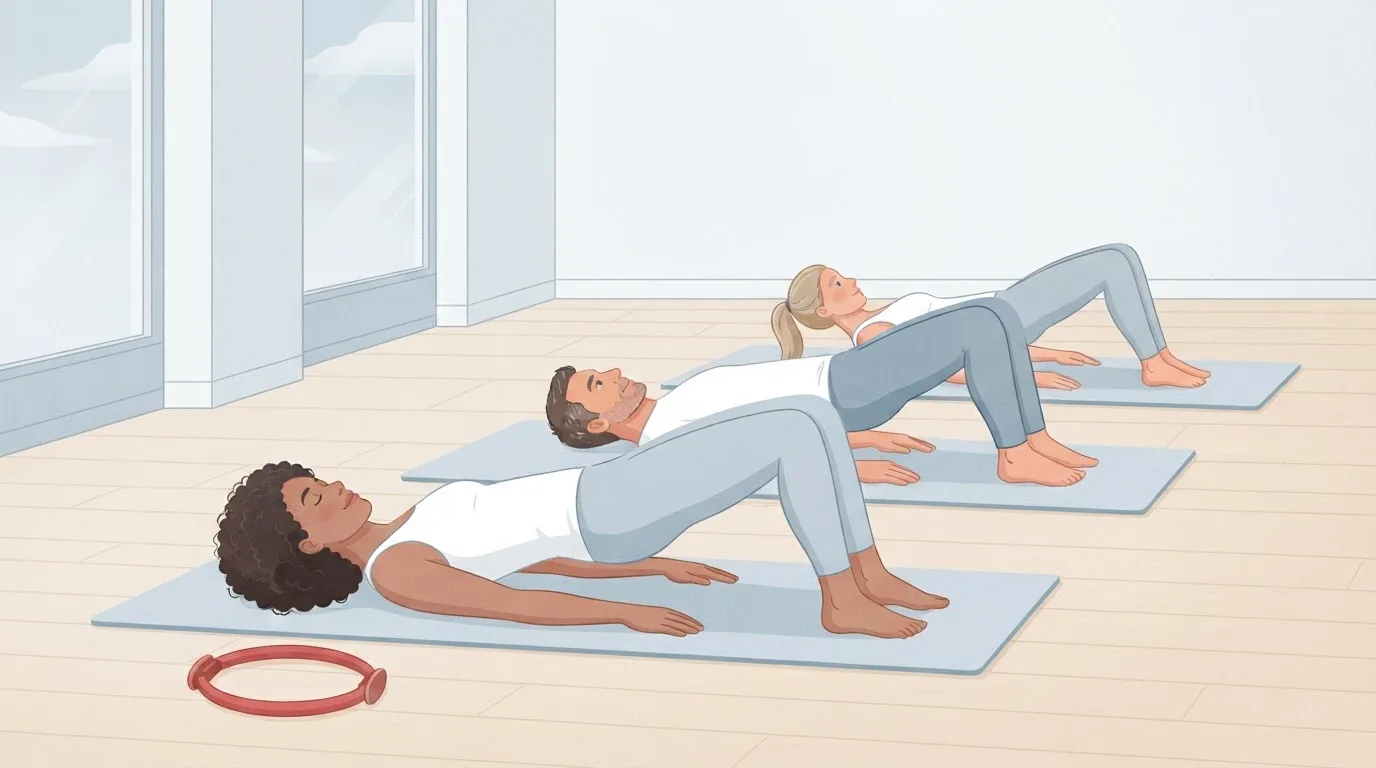
You've been to six Pilates classes. Your abs shake a little less during the hundred, but the mirror looks the same, and you're starting to wonder whether it's working. Pilates before and after results online make it look like the change happens in a month.
Many people quit right here, because the results seem slower than promised. The research gives a clearer timeline, and most of it is good news if you keep going two or three times a week. Some changes start in the first weeks. Others need a season.
This page lays out what changes at 2, 4, 8 and 12 weeks and at 6 months, based on how long each trial lasted. It also tests the famous 10, 20 and 30 sessions promise, shows how often you need to go and covers what happens if you take a break. If you're new to the method, our guide to what Pilates is explains how a class works.
How Long Does It Take for Pilates to Work?
Pilates starts working within the first few weeks, but different results arrive on different schedules. Flexibility and core control change first, often by 4 weeks. Muscular endurance and small changes in body fat follow by about 8 weeks. Cardio fitness and weight loss need around 12 weeks, and bigger muscles take months. This table lists the trials behind each step. All of them used two or three sessions a week unless noted.
| Time | What changes | Evidence |
|---|---|---|
| 2 weeks | Your deep core muscles switch on more, and the first soreness fades | Kim and Lee 2017 (2 weeks) |
| 4 weeks | Flexibility and control of your lower back and pelvis | Phrompaet 2011 (checked at 4 and 8 weeks) |
| 6 to 8 weeks | Ab endurance, flexibility, balance, a smaller waist and a little less body fat | Kibar 2016, Rogers 2009, Zaras 2023 |
| 12 weeks | Ab and upper-body endurance, cardio fitness and modest weight loss | Kloubec 2010, Pessôa 2023, Wang 2021 |
| 6 to 9 months | Bigger ab muscles, and steady flexibility gains even at one class a week | Dorado 2012 (36 weeks), Segal 2004 (6 months) |
Pilates Results Week by Week
After 2 weeks: your core learns the moves
The first two weeks are mostly about learning. You figure out how to breathe through each move and how to brace your trunk without holding your breath, and that learning shows up in your muscles quickly. In a small study by Kim and Lee (2017), 28 women did 60-minute Pilates breathing sessions three times a week for 2 weeks. Activity in their deep trunk muscles rose during curl-ups and lifting tasks. The study had no control group, so treat it as a sign of early change rather than proof.
Early strength comes mostly from your nervous system. In a classic 8-week training study, Moritani and deVries (1979) found that nerve-driven gains explained most of the first rise in strength, and muscle growth took over only after about 3 to 5 weeks. That study used weight training, but any new exercise follows the same order.
The soreness after your first class fades fast too. One bout of unfamiliar exercise protects your muscles from damage the next time you do it, which researchers call the repeated bout effect. By your third or fourth class, you'll likely leave tired rather than wrecked.
After 4 weeks: more flexibility and better control
By about a month, the changes are measurable. Phrompaet and colleagues (2011) randomized 40 healthy adults with an average age of 32 to 45-minute Pilates sessions twice a week or to no training. At 4 weeks the Pilates group's sit-and-reach flexibility had already improved more than the control group's.
Control improved too. On a test of how steadily you hold your lower back and pelvis, measured with a pressure sensor, 65 percent of the Pilates group passed at 4 weeks and 85 percent at 8 weeks. Nobody in the control group passed at either check. That's after just 8 classes, which lines up with the first part of the famous Pilates promise covered below.
After 8 weeks: stronger abs and small changes in shape
Around two months in, endurance and body shape start to move. Kibar and colleagues (2016) gave young women two 1-hour mat classes a week. By week 6 the 23 women doing Pilates beat 24 controls on hamstring flexibility and deep ab activity. Two weeks later they beat them on curl-up endurance and standing balance too. Their waists had shrunk as well.
Rogers and Gibson (2009) ran 8 weeks of three 1-hour mat classes a week for beginners. Compared with an active control group, the 9 people doing Pilates lost 1.2 percentage points of body fat and 2.7 cm from their waists. They also reached 7.5 cm further on the sit-and-reach test and did 14 more curl-ups. Those are real but modest changes, and the group was tiny.
A 2023 study found much the same in women around the age of most beginners. Zaras and colleagues followed 20 women with an average age of 45 who already did Pilates, with no separate control group. After 8 weeks of mat classes their body fat percentage, belly fat and resting heart rate had dropped, and their waists and thighs measured smaller. Their curl-ups, flexibility and aerobic fitness had improved.
After 12 weeks: the changes other people notice
Three months is the length most Pilates trials use. It's also where the broadest results show up. Kloubec (2010) randomized 50 active middle-aged adults to two 1-hour mat classes a week or no classes. After 12 weeks the Pilates group had better ab endurance, hamstring flexibility and upper-body endurance. Posture and balance didn't improve compared with the controls. That matters if those are your main goals. Our review of whether Pilates builds muscle covers this trial and the longer ones.
Cardio fitness needs about this long too. Pessôa and colleagues (2023) pooled 12 randomized trials and found that Pilates improved cardiorespiratory fitness only after at least 1,440 total minutes. The authors equate that to two sessions a week for three months or three a week for two months, and they rated the evidence very low to low in quality.
Weight loss follows a similar clock. In a 2021 meta-analysis of 11 trials by Wang and colleagues, Pilates cut body weight by an average of 2.4 kg in adults with overweight or obesity. The effect was clearer in longer programs. Our answer to is Pilates good for weight loss has the trial details.
After 6 months and beyond: bigger muscles and lasting flexibility
Muscle size takes the longest. In an MRI study, Dorado and colleagues (2012) had nine inactive women do Pilates twice a week for 36 weeks. Their main ab muscle, the rectus abdominis, grew 21 percent in volume, and the deeper side muscles grew 8 percent on the dominant side. There was no control group, but it's one of the few studies to measure muscle size directly.
Going once a week keeps some benefits and misses others. Segal and colleagues (2004) followed 32 adults who took one 1-hour mat class a week for 6 months. Their fingertip-to-floor reach improved by 3.4 cm at 2 months, 3.3 cm at 4 months and 4.3 cm at 6 months. Their weight, body composition and self-rated health didn't change.
Knowing what to do is the easy part.
FitCraft, our mobile fitness app, pairs you with an AI coach who builds you a personalized plan around your goals, schedule, and fitness level. Every FitCraft program is designed by Domenic Angelino, MPH (Brown University) and NSCA-CSCS, with research published in the Journal of Strength and Conditioning Research and Medicine & Science in Sports & Exercise.
Take the Free Assessment Free • 2 minutes • No credit cardHow Many Pilates Classes to See Results?
Plan on about 16 to 24 classes, or 8 to 12 weeks at two a week, before you judge your results. A line usually credited to Joseph Pilates promises that you'll feel a difference in 10 sessions, see one in 20 and have a new body in 30. The trials back the first part and soften the rest.
- 10 sessions: you'll feel it. Phrompaet's group had done 8 sessions at the 4-week check, when their flexibility beat the controls and most of them passed the core-control test.
- 20 sessions: you may see small changes. Rogers and Gibson's group measured a smaller waist and a little less body fat after 24 sessions.
- 30 sessions: not a new body. Kloubec's group did 24 sessions in 12 weeks without any change in posture. The muscle growth in Dorado's study took about 72 sessions, and weekly classes for 6 months didn't change body composition in Segal's.
So count on feeling better long before you look different. That's normal, and it's the point where sticking with it pays off.
How Often Should I Do Pilates to See Results?
Two or three sessions a week is the dose most trials used, and twice a week beat once a week in the best test of dose. Miyamoto and colleagues (2018) randomized 296 adults with chronic low back pain to an advice booklet or to Pilates once, twice or three times a week for 6 weeks. Twice a week cut pain and disability more than once a week, and three times a week did about as well as twice.
Once a week still helps, but slowly and narrowly. Segal's weekly class improved flexibility and nothing else they measured. Total time matters as well. Pessôa's threshold of 1,440 minutes works out to 24 hour-long sessions, so three classes a week gets you there in about 8 weeks and two a week in 12.
If you're a beginner, start with two sessions a week and add a third once the moves feel familiar. Short sessions at home on other days add minutes, although no trial has tested daily Pilates directly.
Can Pilates Change Your Body Shape?
Yes, a little, mostly through firmer muscles rather than big fat loss. In the 8-week trials above, waists shrank by about 2.7 cm and body fat fell by about 1 percentage point. Across 11 trials in adults with overweight or obesity, though, Wang's meta-analysis found no significant change in waist size, and lean mass didn't change either.
Posture can shift a little. In a 12-week study by Emery and colleagues (2010), 10 people who did two 1-hour sessions a week sat with less rounding in their upper backs and had stronger abs afterward. Kloubec's larger trial found no posture change, so don't count on it.
If you want visibly more muscle, Pilates alone is a slow route, because the loads stay light. Our answer to is Pilates strength training explains how to pair it with heavier work. For fat loss, food matters more than any number of classes.
What Happens to Your Pilates Results If You Take a Break?
A short break won't erase your progress. In the Zaras study, the women stopped Pilates for 3 weeks after their 8-week program. Their curl-ups, flexibility, aerobic fitness and smaller waist and thigh measurements held. Their body fat percentage, belly fat and resting heart rate went back to where they started.
So a holiday week or a busy month isn't a reset. Get back to two sessions a week as soon as you can, and expect the first class back to feel harder than your last one did.
How to See Pilates Results Faster
- Go two or three times a week. That's the dose behind almost every result on this page.
- Make it harder over time. Once a move feels easy, use a longer lever, a slower tempo, a single-leg version or a heavier spring.
- Add strength and cardio. Pilates leaves out heavy loading and hard cardio, so two short strength sessions and some brisk walking fill the gaps.
- Measure what changes first. Track how far you reach past your toes, how long you hold a plank or how many curl-ups you can do. Mirror changes come last.
- Mind your mood and energy too. In a 2018 meta-analysis of 8 controlled trials, Pilates reduced symptoms of depression, anxiety and fatigue and raised feelings of energy compared with no exercise. Those are results as well.
What This Means for You
Give Pilates 8 to 12 weeks at two or three sessions a week before you decide whether it's working. You'll likely feel it within the first month, as your core steadies and you reach further. The changes other people notice take a season, not a weekend.
The hard part is the middle stretch, when you feel better but don't look different yet. That's when a routine needs something that keeps you showing up. Pilates covers your core and flexibility, and FitCraft can cover the rest of your week. A 3D AI coach demonstrates each strength, cardio, yoga or mobility exercise and says your name during the workout. Your workouts adapt as you progress, and streaks and collectible cards give you a reason to come back. If you're comparing options, our ranking of the best fitness apps for women looks at which apps help people stay consistent. As one FitCraft user, Katie, put it: "I've tried everything. This is the first time I've stuck with something past two weeks."
Frequently Asked Questions
Can Pilates help with back pain?
Yes, Pilates can help chronic low back pain, often within about 6 weeks. In a trial of 296 adults by Miyamoto and colleagues (2018), two sessions a week for 6 weeks reduced pain and disability more than an advice booklet. In a 6-month trial by Natour and colleagues (2015), the Pilates group had less pain and better function and was already taking fewer pain pills at the 45-day check. See a clinician first if your pain is new or severe.
Is Pilates safe during pregnancy?
Pilates can be part of a healthy pregnancy, but check with your provider first. The American College of Obstetricians and Gynecologists says physical activity in pregnancy is safe and desirable when there are no obstetric or medical complications. A 2026 meta-analysis of 13 studies by Song and colleagues found that prenatal Pilates reduced musculoskeletal pain compared with standard care. Expect to modify some moves as your pregnancy progresses.
Does Pilates flatten your belly?
Pilates firms the muscles under your belly, but it doesn't burn belly fat on its own, because your body doesn't lose fat from the spot you train. In an 8-week trial, three classes a week took 2.7 cm off participants' waists, and an MRI study found the main ab muscle 21 percent larger after 36 weeks. A flatter stomach also depends on eating fewer calories than you burn.
Can you see results from Pilates at home?
Yes, most of the trials behind this timeline used mat Pilates, which you can do at home. In a 2025 trial by Zygouna and colleagues, adults with back pain followed Pilates videos at home three times a week for 3 weeks. Their pain fell by about 26 points on a 100-point scale. In a 12-week trial by Greco and colleagues (2024), women with obesity who did online Pilates at home on a Mediterranean diet lost fat and gained muscle compared with the diet alone.
How long does it take to lose weight with Pilates?
Weight loss from Pilates usually takes about 10 weeks or more to show, and it's modest. A 2021 meta-analysis of 11 trials by Wang and colleagues found an average loss of 2.4 kg in adults with overweight or obesity, with clearer effects in longer programs. Our answer to is Pilates good for weight loss covers those trials and the calories per class.
Will doing Pilates every day get results faster?
Doing Pilates every day adds minutes, which helps, but more isn't always better. In the Miyamoto trial, three sessions a week did about as well as two, and no trial has tested daily Pilates. If you practice daily, keep most sessions short and easy, rest when you're sore and count your total minutes rather than your days.