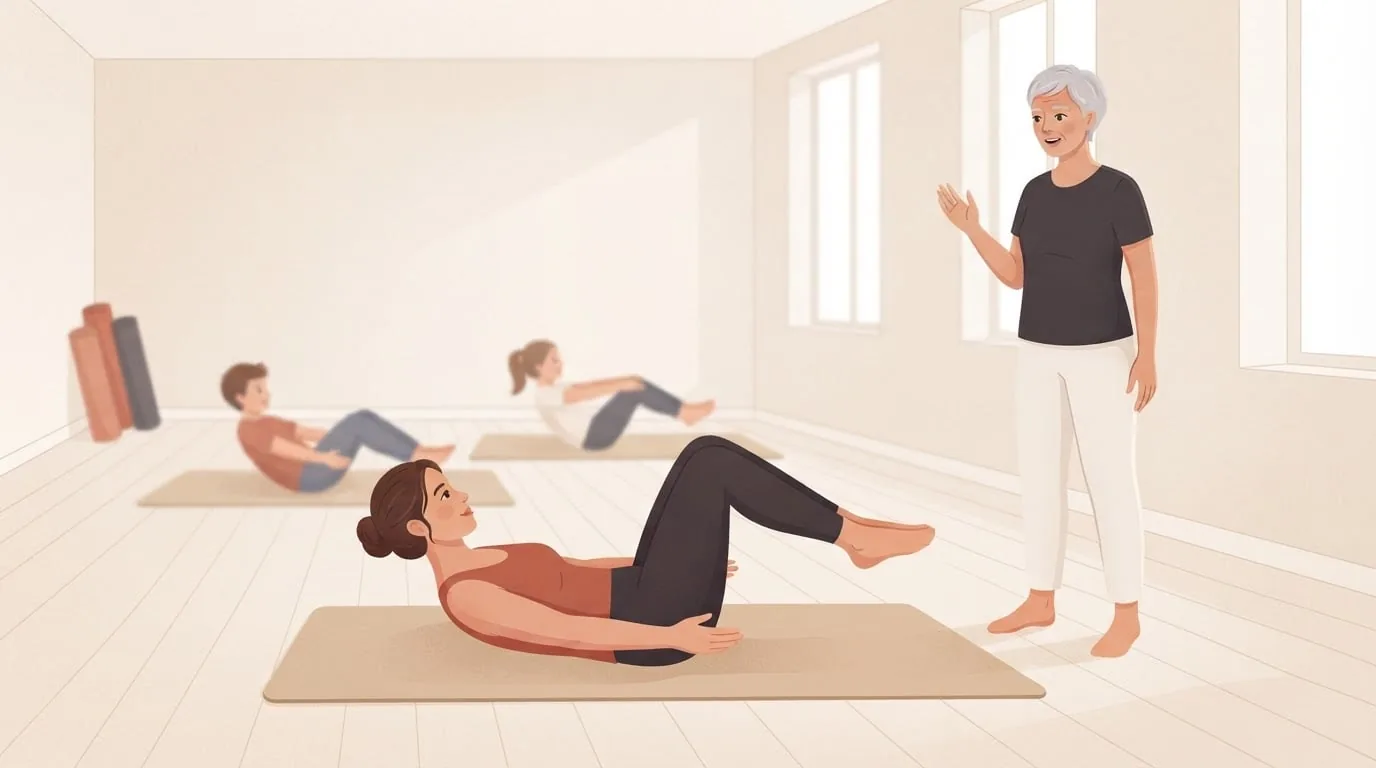
Everyone seems to be doing Pilates, and nobody quite explains what it is. One friend calls it core work. Another says it's the hardest class she's ever taken. The studio near you has machines that look like narrow beds with springs, and you aren't sure whether you'd be the only beginner in the room.
If you've walked out of workouts that felt built for someone fitter, it makes sense to want the facts first. Pilates is easier to judge once you know what happens in a class and what it can and can't do for you.
What Is Pilates Exercise?
Pilates is a system of controlled strength and mobility exercises. You work through a sequence of moves, many of them lying down, doing a few careful reps while you time your breathing to the movement. Much of the effort comes from the muscles around your trunk and hips, which teachers call the powerhouse: the band between the bottom of your rib cage and the line across your hips.
Researchers broadly agree on that description. Wells, Kolt and Bialocerkowski (2012) reviewed 119 papers and found Pilates described as a mind-body exercise focused on strength, core stability, flexibility, muscle control, posture and breathing, done on a mat or on specialized equipment.
It sits close to both strength training and yoga, and people often mix it up with barre. Our answer to whether Pilates is strength training covers where it fits in your week, and our guides to Pilates vs yoga and barre vs Pilates show how the classes differ.
Who Was Joseph Pilates, and What Did He Call It?
Joseph Pilates was a German-born physical trainer who called his method Contrology, a name built around the mind's control of the body. He was working in Britain as a boxing instructor and circus performer when World War I began, and he was arrested as an enemy alien in August 1914. According to research by the Knockaloe Centre, he reached the Knockaloe internment camp on the Isle of Man in September 1915 and stayed until March 1919. By his own account, he worked with invalids there.
You may have read that he built the first Reformer from hospital bed springs at the camp. Two of his biographers doubt that story, and the Knockaloe researchers found no confirmed evidence that he worked as a hospital orderly.
In the mid-1920s he moved to New York with his wife, Clara. A federal court's findings of fact place their home and adjoining studio at 939 Eighth Avenue, and he patented equipment between 1927 and 1951. He set out his ideas in two books, Your Health (1934) and Return to Life Through Contrology (1945). The 34 mat exercises in the second are still taught in classical classes. He died in 1967, and Clara ran the studio until 1970.
Why anyone can call a class Pilates
In October 2000 that same court ruled that Pilates is a generic word for a method of exercise rather than a brand. No single body controls who can teach it, and a 2011 review in Sports Health noted that instructor qualifications vary. The National Pilates Certification Program asks for at least 450 hours of training across the mat and machines, which is a fair benchmark to ask a teacher about.
What Are the Six Principles of Pilates?
The six principles of Pilates are centering, concentration, control, precision, breath and flow. The list is usually traced to a 1980 book by Philip Friedman and Gail Eisen, written after Joseph Pilates died.
| Principle | What it means in class |
|---|---|
| Centering | Movement starts from your trunk and hips, and your arms and legs follow |
| Concentration | You pay attention to every rep instead of counting down the set |
| Control | You move without momentum and lower as slowly as you lift |
| Precision | Positions are exact, and a few good reps beat many sloppy ones |
| Breath | Full inhales and exhales are timed to each movement |
| Flow | One move runs smoothly into the next |
Joseph Pilates put breathing first, writing, "Even if you follow no other instructions, learn to breathe correctly." Kim and Lee (2017) gave 28 women 2 weeks of Pilates breathing training, and activity in the deep side abdominals during curl-ups rose from 45 to 68 percent of maximum, although the study had no control group. Researchers mostly skip the other principles: Wells found the six discussed in about 23 percent of papers on average.
Mat vs Reformer: Which Pilates Should You Try?
Mat Pilates uses your body weight and leverage on the floor, while reformer Pilates uses a spring-loaded machine. The principles are the same, so start with whichever you can get to twice a week.
| Mat Pilates | Reformer Pilates | |
|---|---|---|
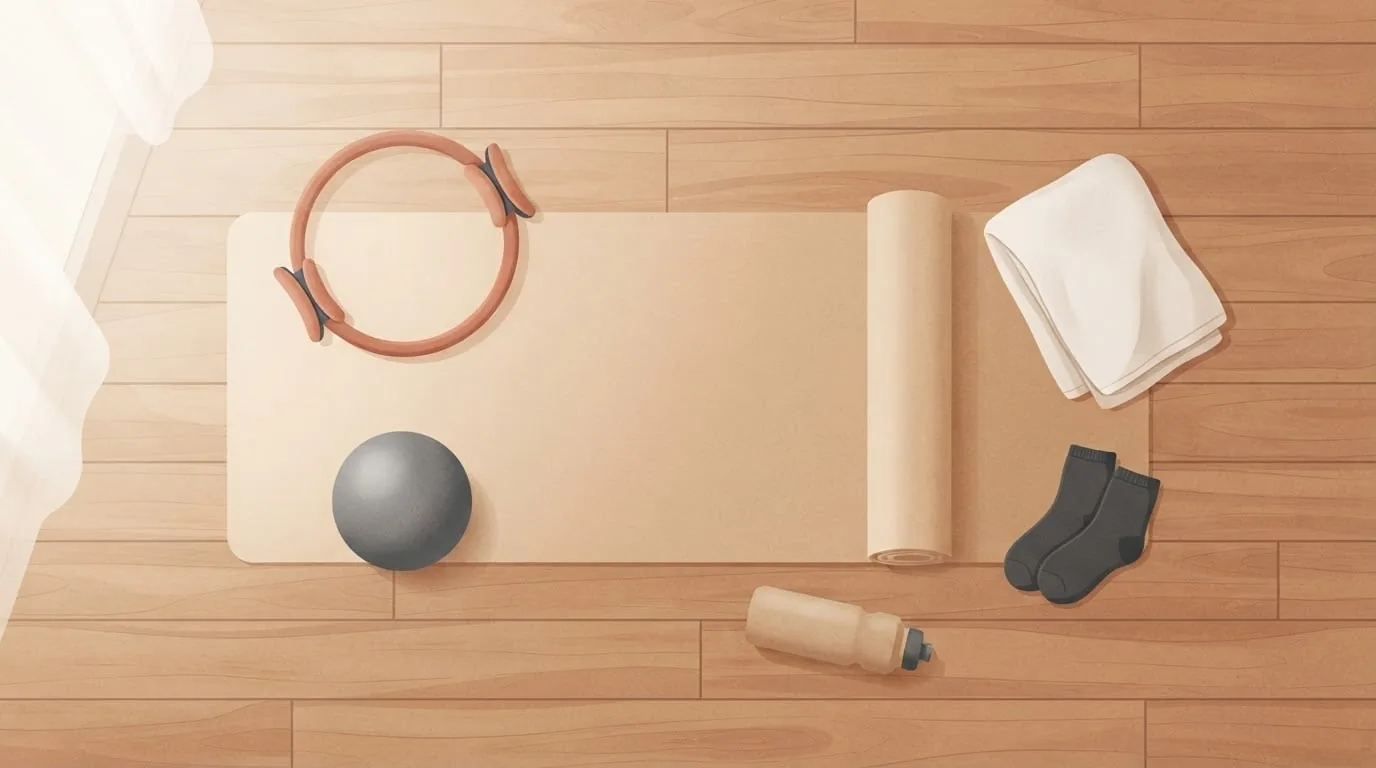
| Equipment | A thick mat, sometimes a ring, ball or band | A padded sliding carriage with springs, straps and a foot bar |
| Resistance | Your body weight and leverage | Springs you can change, plus your body weight |
| How it gets harder | Longer levers, slower tempo, one-leg versions | Spring changes, less support, smaller base |
| Best first choice if | You want the basics or want to practice at home | You want adjustable load and support from the machine |
What is a Pilates reformer?
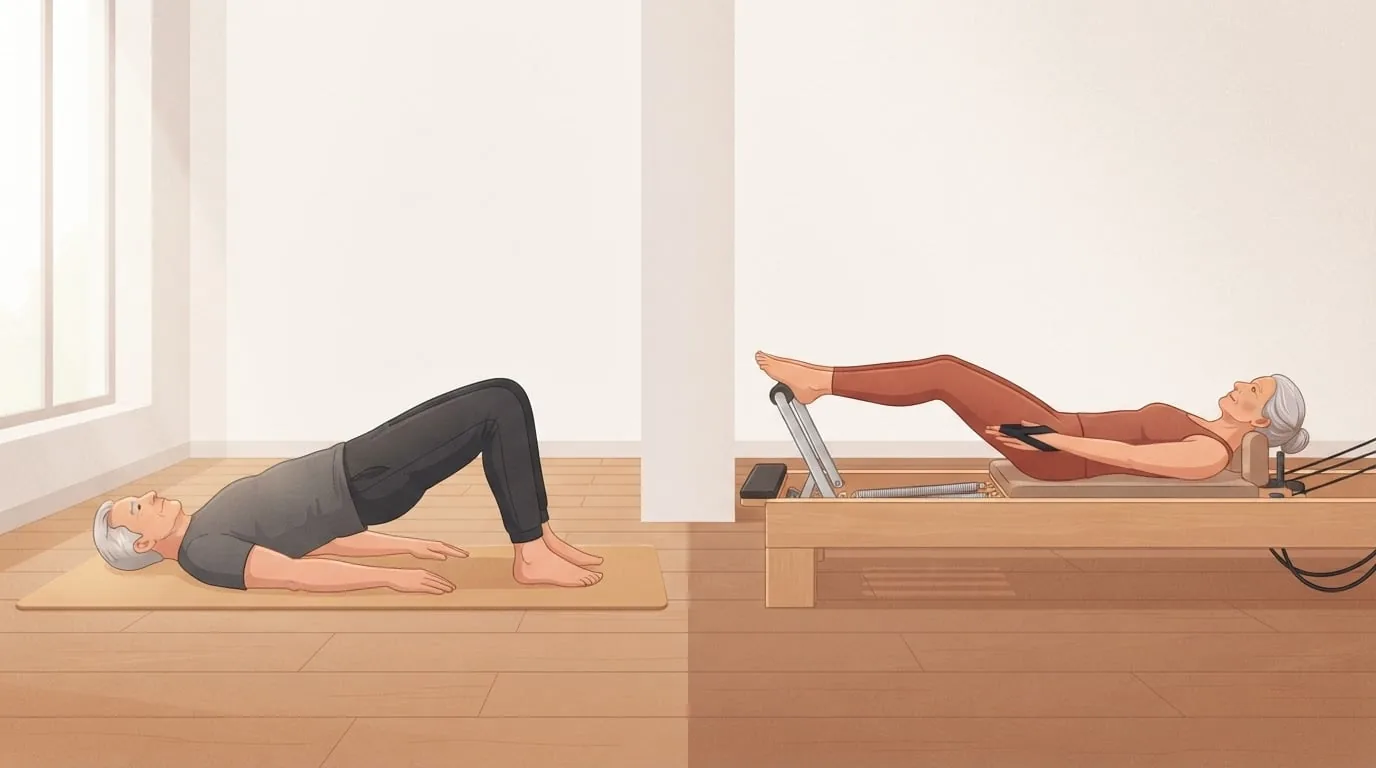
A Pilates reformer is a long, low frame with a padded carriage that rolls along rails. You push or pull the carriage against springs, with your legs on a foot bar or your arms in straps. The springs can add resistance or give support, so a beginner can often manage a reformer version of a move that's too hard on the floor. Other original machines include the trapeze table, or Cadillac, and the Wunda chair.
Head-to-head trials have mostly studied people with chronic low back pain. Da Luz and colleagues (2014) gave 86 patients 12 sessions over 6 weeks. Six months later the equipment group reported less disability and less fear of movement, with no difference in pain. In a 12-week trial of 98 patients, Cruz-Díaz and colleagues (2017) found that both formats improved pain, function and deep abdominal activation, and the equipment group improved faster. The machines may have a small edge, but the mat works and it's far easier to get to. At home, a wall can add some support, as our guide to wall Pilates at home shows.
What Is a Pilates Class Like?
A Pilates class is a guided session of about 45 to 60 minutes in which a teacher leads a small group through slow exercises. Classical classes keep Joseph Pilates's original exercises and order, and contemporary classes adapt them. Here's how a first beginner class usually runs:
- Check-in. Tell the teacher about any injury, back or neck pain, surgery or pregnancy, so they can swap exercises before you start.
- Setup and breathing. You learn to find a neutral spine and breathe into your ribs.
- Warm-up. Small pelvic tilts, bridges and curls get your trunk and hips working.
- Main sequence. You work through your abs, hips, legs, back and arms, with a few careful reps of each move.
- Cool-down. Slow spine stretches finish the class.
Wear fitted clothes so the teacher can see your alignment, and go barefoot or use grip socks. Expect your abs and hips to shake even though you're barely out of breath, and expect some soreness the next day.
Pilates for beginners: a 15-minute mat routine at home
You can try the basics at home with just a mat. Do these six moves slowly, then repeat the round. Stop any move that causes sharp pain.
| Move | How to do it | Reps |
|---|---|---|
| Pelvic curl | On your back with knees bent, roll your hips up and down one bone at a time. | 8 |
| The Hundred, beginner version | Lift your head and shoulders, knees over hips. Pump your arms, breathing in for 5 beats and out for 5. | 5 full breaths |
| Single-leg stretch | Keep your head up. Hug one knee in as the other leg reaches long, then switch. | 8 per side |
| Side-lying leg lift | With your hips stacked, lift the top leg and lower it slowly. | 10 per side |
| Swan prep | Face down with hands under your shoulders, lift your chest a few inches. | 6 |
| Spine stretch forward | Sit tall with legs apart, round forward from your head, then stack back up. | 5 |
Knowing what to do is the easy part.
FitCraft, our mobile fitness app, pairs you with an AI coach who builds you a personalized plan around your goals, schedule, and fitness level. Every FitCraft program is designed by Domenic Angelino, MPH (Brown University) and NSCA-CSCS, with research published in the Journal of Strength and Conditioning Research and Medicine & Science in Sports & Exercise.
Take the Free Assessment Free • 2 minutes • No credit cardWhat Is Pilates Good For? What the Research Shows
Pilates has its best support for chronic low back pain and trunk endurance, and weaker support for posture and balance. Quality is the catch. Xu and colleagues (2023) rated 27 meta-analyses of Pilates and judged 1 high quality, 1 moderate, 15 low and 10 critically low. This table shows where the studies point:
| Goal | Best evidence | What it found | Certainty |
|---|---|---|---|
| Chronic low back pain | Cochrane review, 10 trials, 510 people | Beat minimal care for pain and disability, with no clear edge over other exercise | Low to moderate |
| Core activation in back pain | Franks 2023, 8 trials, 437 people | Pilates wasn't worse than equal amounts of other exercise | Very low |
| Posture in children and teens | Roque 2024, 18 studies | Improved thoracic and lumbar angles compared with no training | Moderate |
| Posture in adults | Roque 2024 | Small gains in some angles | Very low to low |
| Balance in older adults | Barker 2015, 6 studies | Improved balance compared with no activity, with limited data on falls | Not graded; low-quality studies |
| Pelvic floor strength | Jacomo 2020, 7 trials | No gain unless combined with pelvic floor muscle training | Not graded |
Core endurance and abdominal muscle
Kibar and colleagues (2016) randomized healthy young women to two 1-hour classes a week or their usual routine, and after 8 weeks the 23 who did Pilates beat the 24 controls on a curl-up endurance test. In an MRI study by Dorado and colleagues (2012), nine inactive women trained twice a week for 36 weeks and their rectus abdominis grew 21 percent by volume, although there was no control group. Our review of whether Pilates builds muscle covers the wider trials.
Back pain
Pilates is a reasonable choice for chronic low back pain, and it isn't the only one. Network analyses have ranked it near the top for pain, as our wall Pilates page explains, and the reviews that weigh certainty are more cautious. Wong and colleagues (2023) pooled 11 trials against other exercise and found no strong evidence for choosing one type over another, so your goals and preferences should decide.
Posture and balance
Better posture is one of the most repeated Pilates promises and one of the least proven for adults. Roque's moderate-certainty findings came from young people. Emery and colleagues (2010) found less upper-back rounding after 12 weeks of two 1-hour sessions a week, but only 10 people trained.
Balance results look better, though Barker's team warned that weak studies may overstate them. Only 2 to 36 percent of the exercises in the programs they could rate offered a real balance challenge, so ask for more standing work if falls worry you.
Where the evidence is thin
- Which Pilates was tested. Only 3 of the 9 studies in the Sports Health review used classical Pilates, so results may not transfer to the class near you.
- Long-term results. Franks's review flagged a lack of long-term follow-up.
- Bone density and weight. Neither is a strong suit, and our page on Pilates for weight loss goes through those trials.
Who Is Pilates For?
Pilates suits most adults who want a controlled, low-impact way to get stronger. It's a good fit if you:
- are new to exercise or coming back after a long break;
- have chronic low back pain that a clinician has already checked;
- are older and want better balance and trunk strength;
- are pregnant and your provider agrees. A 2026 meta-analysis found less pain and disability with prenatal Pilates than with standard care, though it didn't assess adverse events;
- lift or run and want better control through your trunk.
It's a weaker fit as your only training if you want maximal strength or cardio fitness, because the loads and your heart rate stay low.
Are There Any Downsides to Pilates?
Yes. The main downsides of Pilates are that it leaves out heavy loading and cardio, teaching quality varies and some classic moves need adapting.
The moves to watch are deep forward bends, which run through much of the classic mat sequence. In a 1984 study of 59 women with spinal osteoporosis, Sinaki and Mikkelsen found new vertebral fractures or wedging in 89 percent of those doing flexion exercises and 16 percent of those doing extension exercises, although the flexion group had only nine women. McLaughlin and colleagues (2022) found just five Pilates studies in people at higher fracture risk, with no data on fractures or adverse events. If you have osteoporosis or a past fracture, talk to your doctor first and ask your teacher to swap those moves.
Injury data are sparse overall. Only two trials in the Cochrane review assessed adverse events: one reported none and the other reported minor ones.
How Often Should You Do Pilates?
Two sessions a week is the best-supported starting point. Miyamoto and colleagues (2018) randomized 296 adults with chronic low back pain to advice alone or advice plus 1, 2 or 3 Pilates sessions a week for 6 weeks. All three Pilates groups beat advice alone. Two sessions beat one, and three sessions scored about the same as two, although the trial's cost analysis favored three. The authors noted that attention and expectation may explain part of the benefit.
Results take a while to build. A 2023 meta-analysis of 12 trials found better cardiorespiratory fitness only after at least 1,440 total minutes of Pilates, which is two 1-hour classes a week for 12 weeks. For weight loss, most trials used three sessions a week.
What This Means for You
Pilates is a slow, precise, low-impact method that almost anyone can start. Book one beginner class or roll out a mat at home, then give it two sessions a week for two months before you judge it.
Picture eight weeks from now: you can hold the curl without your neck taking over, and you've got a habit in place of another plan you dropped. Pilates leaves room for strength and cardio in the rest of your week, and a personalized training program can cover that part. In FitCraft, a 3D AI coach demonstrates each strength, yoga, mobility or cardio exercise on an interactive model, says your name during the workout and adapts your workouts as you progress, while streaks keep you coming back. As one FitCraft user, Sarah, put it: "First app that made exercise feel like something I chose, not forced."
Frequently Asked Questions
Is Pilates challenging?
Yes, Pilates can be challenging even though it looks gentle. A beginner class moves slowly and won't leave you out of breath, but holding exact positions without momentum tires your abs and hips quickly. Advanced classical exercises such as the Teaser demand serious strength and control.
Is 20 minutes of Pilates a day enough exercise?
Twenty minutes of Pilates a day is a solid strength and mobility habit, but it isn't enough exercise on its own. It adds up to 140 minutes a week, a little more than the two 1-hour sessions used in many trials. Pilates sits below moderate cardio intensity, though, so you still need brisk walking, cycling or other aerobic work.
Is Pilates good for losing weight?
Pilates helps a little with weight loss, but it burns too few calories to do the job alone. It works best alongside changes to what you eat and more walking. Our answer to is Pilates good for weight loss has the trial numbers and the calories per class.
What is better, yoga or Pilates?
Neither is better for everyone. Pilates leans toward trunk strength and control, and yoga leans toward flexibility, breathing and stress relief. Pick the one you'll keep doing, and see our Pilates vs yoga guide for the details.
Which is better to lose belly fat, yoga or Pilates?
Neither yoga nor Pilates targets belly fat, because your body doesn't lose fat from the spot you train. Fat loss comes from your overall calorie balance, so choose the class you'll attend most often and pair it with walking and changes to your eating.