You peel a banana, open your food log and get three different answers. One entry says 105 calories, the poster in the produce aisle says 110, and a friend tells you bananas are basically sugar. It's a small thing, but small doubts like this are why keeping track of food starts to feel like homework.
The real answer is simple once you know what each number measures. Size does most of the work, so how many calories in a banana mostly comes down to its length. Below you'll find USDA's numbers for every size, why the counts differ, what ripening changes, how a banana compares with other snacks, and what the cycling trials found.
How Many Calories in a Banana by Size?
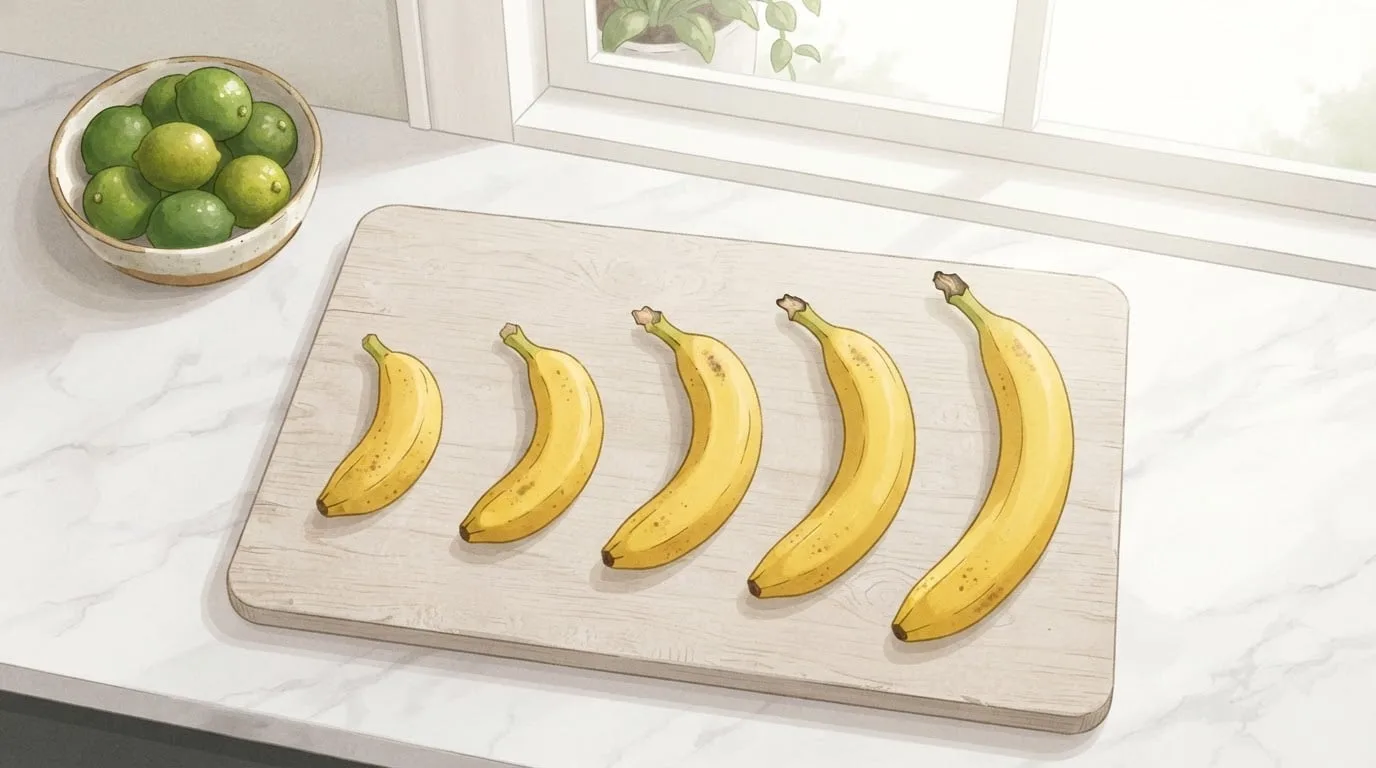
A banana has about 89 calories per 100 grams of peeled fruit, so its length decides almost everything. USDA lists five sizes by length, from under 6 inches to 9 inches or more. Here's what each one holds, along with two common kitchen amounts.
| Size | Peeled weight | Calories | Carbs | Sugar | Fiber | Protein | Potassium |
|---|---|---|---|---|---|---|---|
| Extra small (under 6 in) | 81 g | 72 | 18.5 g | 9.9 g | 2.1 g | 0.9 g | 290 mg |
| Small (6 to 6 7/8 in) | 101 g | 90 | 23.1 g | 12.4 g | 2.6 g | 1.1 g | 362 mg |
| Medium (7 to 7 7/8 in) | 118 g | 105 | 27.0 g | 14.4 g | 3.1 g | 1.3 g | 422 mg |
| Large (8 to 8 7/8 in) | 136 g | 121 | 31.1 g | 16.6 g | 3.5 g | 1.5 g | 487 mg |
| Extra large (9 in or longer) | 152 g | 135 | 34.7 g | 18.6 g | 4.0 g | 1.7 g | 544 mg |
| 100 grams, peeled | 100 g | 89 | 22.8 g | 12.2 g | 2.6 g | 1.1 g | 358 mg |
| 1 cup, sliced | 150 g | 134 | 34.3 g | 18.3 g | 3.9 g | 1.6 g | 537 mg |
| 1 cup, mashed | 225 g | 200 | 51.4 g | 27.5 g | 5.9 g | 2.5 g | 806 mg |
Values from USDA FoodData Central SR Legacy entry 173944 (Bananas, raw), scaled to USDA's gram weight for each size and rounded.
A medium banana has just 0.4 grams of fat and 1.3 grams of protein, so nearly every calorie comes from carbs.
If you log food by weight, peel the banana first, because USDA's numbers describe the fruit without the skin. Two medium bananas come to 210 calories and 54 grams of carbs.
Why Banana Calories Differ From One Source to Another
You'll see a few different calorie counts for what looks like the same banana. None is a mistake. Each one depends on the weight the source assumes and how it turns carbs into calories.
| Source | Banana weight | Calories | Where the number comes from |
|---|---|---|---|
| USDA older entry (SR Legacy) | 118 g, medium | 105 | 89 calories per 100 g, using a fruit-specific carb factor |
| FDA raw fruit poster | 126 g | 110 | A heavier banana, rounded to the nearest 10 |
| USDA newer entry (Foundation) | 118 g, medium | 114 | Our arithmetic from USDA's 97 calories per 100 g, which fits the general 4-9-4 factors |
FDA's raw fruit poster lists a heavier 126-gram banana, and USDA's 89 calories per 100 grams comes to 112 at that weight. FDA's rounding rules take anything above 50 calories to the nearest 10, which gives 110.
The gap between 105 and 114 comes from how calories are counted. The general system gives carbohydrate 4 calories per gram, while USDA's older banana entry uses 3.6, the Atwater specific factor for most fruit. USDA's newer entry, published in 2020, lists 97 calories per 100 grams, which matches the general factors. Put that entry's protein, fat and carbs through the fruit factors and you get about 88, almost the same as the older 89. So both entries describe nearly the same banana, counted two ways.
For logging, pick one number and use it every time. The gap is only about 9 calories a banana.
Carbs, Sugar and Fiber in a Banana
A medium banana has about 27 grams of carbohydrate, including about 14 grams of sugar, 6 grams of starch and 3 grams of fiber in USDA's older entry.
The sugar figure depends on how ripe the fruit is. USDA's newer samples of ripe bananas held 15.8 grams per 100 grams, about 19 grams in a medium banana. All of that sugar comes with the fruit, so a plain banana has no added sugar.
On the glycemic index, which ranks foods against pure glucose, the 2008 international tables by Atkinson and colleagues put raw banana at 51, between an apple at 36 and white wheat bread at 75.
What Micronutrients Are Found in Bananas?
Bananas are famous for potassium, but vitamin B6 is their strongest number. Here's what one medium banana gives you as a share of FDA's Daily Values:
- Vitamin B6: 0.43 mg, 25 percent of the Daily Value
- Manganese: 0.32 mg, 14 percent
- Vitamin C: 10 mg, 11 percent
- Potassium: 422 mg, 9 percent
- Magnesium: 32 mg, 8 percent
- Folate: 24 mcg, 6 percent
So a banana is a decent source of potassium, though it supplies only about a tenth of the 4,700-milligram Daily Value. USDA's newer lab samples came in lower on vitamin B6 and potassium and higher on vitamin C, which shows how much bananas vary.
Knowing what to do is the easy part.
FitCraft, our mobile fitness app, pairs you with an AI coach who builds you a personalized plan around your goals, schedule, and fitness level. Every FitCraft program is designed by Domenic Angelino, MPH (Brown University) and NSCA-CSCS, with research published in the Journal of Strength and Conditioning Research and Medicine & Science in Sports & Exercise.
Take the Free Assessment Free • 2 minutes • No credit cardGreen vs Ripe Bananas: Does Ripeness Change the Calories?
Ripeness barely changes the calories. As a banana ripens, its starch turns into sugar, so the carbohydrate changes form more than it changes amount. USDA's lab entries for ripe and overripe bananas show starch falling about 90 percent, from 3.66 to 0.41 grams per 100 grams, while total sugars stay at 15.8 grams. USDA has no entry for a green banana.
USDA does list fewer calories for the overripe samples, 85 against 97 per 100 grams. Those samples held more water and the batches were small, so don't read that as a rule.
The bigger change comes before a banana turns yellow. In a study by Englyst and Cummings (1986), starch made up about 37 percent of the dry weight of the least ripe bananas and about 3 percent of the ripest. When people with ileostomies ate these bananas, up to 90 percent of the starch passed through the small intestine undigested. That's resistant starch, and the amount reaching the colon could be up to eight times the fruit's fiber. So a green banana gives you somewhat less usable energy than its carbs suggest.
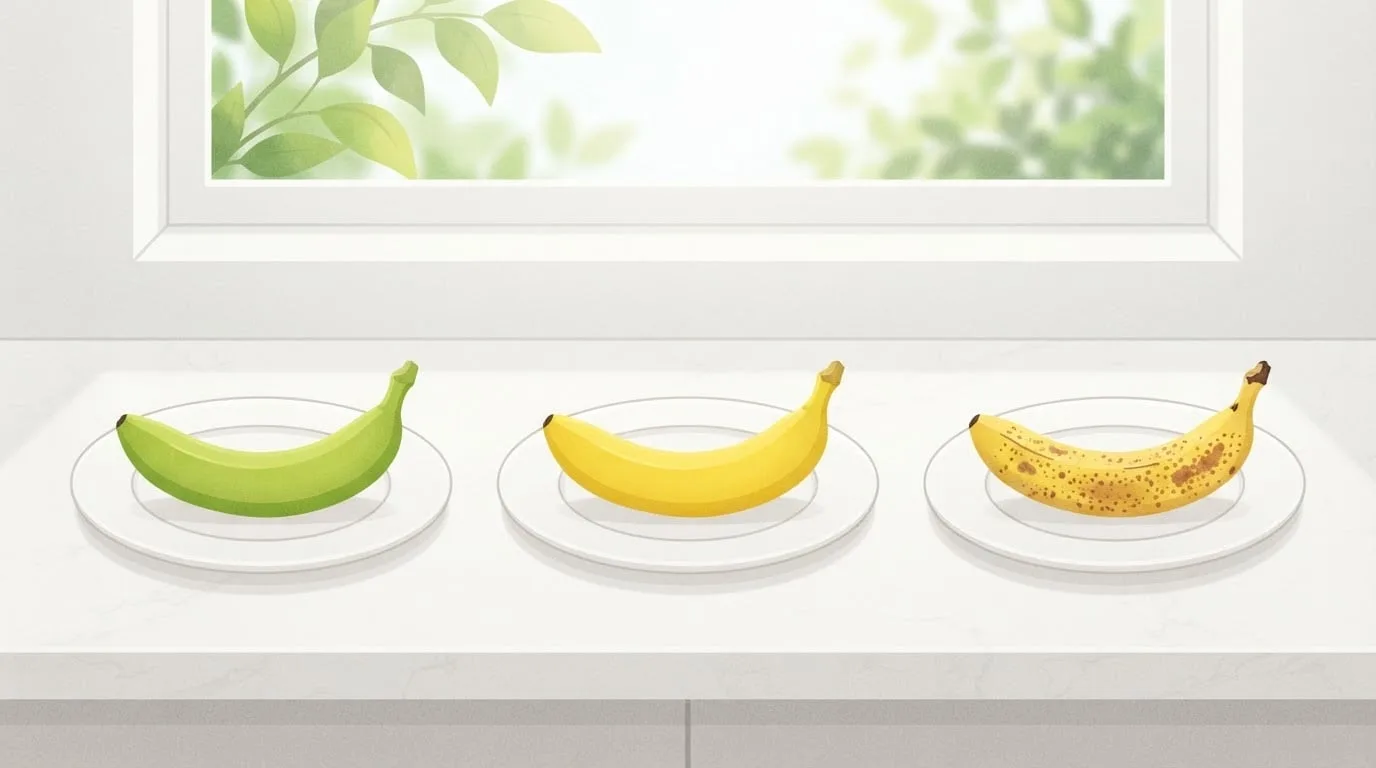
Ripeness matters more for blood sugar than for calories. In a small study by Hermansen and colleagues (1992), 10 adults with type 2 diabetes ate 120 grams of under-ripe or over-ripe banana on separate days. Blood sugar rose about 40 percent less after the under-ripe banana, and insulin responses were similar. If you're watching your blood sugar, a firmer banana is an easy swap, and you still count it like any other carb food.
Calories in a Banana vs Other Snacks
A banana is one of the lighter snacks you can grab, and one of the lowest in protein. Here's a medium banana next to other common snacks at USDA's portion sizes:
| Snack | Portion | Calories | Protein | Carbs | Fiber |
|---|---|---|---|---|---|
| Hard-boiled egg | 1 large (50 g) | 78 | 6.3 g | 0.6 g | 0 g |
| Apple | 1 medium (182 g) | 95 | 0.5 g | 25.1 g | 4.4 g |
| Greek yogurt, plain nonfat | 1 container (170 g) | 100 | 17.3 g | 6.1 g | 0 g |
| Banana | 1 medium (118 g) | 105 | 1.3 g | 27.0 g | 3.1 g |
| Potato chips | 1 oz (28 g) | 151 | 1.8 g | 15.3 g | 0.9 g |
| Almonds | 1 oz (23 nuts) | 164 | 6.0 g | 6.1 g | 3.5 g |
| Cereal or granola bar | 1 bar (43 g) | 203 | 4.3 g | 27.7 g | 2.3 g |
Values from USDA FoodData Central entries 173424, 171688, 170894, 173944, 169677, 170567 and 2708101, scaled to USDA's portion weights and rounded. Brands vary, especially for bars.
A banana and an apple are about 10 calories apart. Next to a granola bar, a banana saves about 100 calories and gives you nearly the same carbs. Its weak spot is protein. A container of plain Greek yogurt alongside a banana makes a 205-calorie snack with about 19 grams of protein.
For a sense of scale, a 150-pound person burns about 85 calories walking a mile and about 110 running one, so a medium banana is roughly one mile of running. Our guide to the best fruits for weight loss shows which fruits track with the most weight loss.
Are Dried Bananas Good for You?
Plain dried bananas are a good snack in small portions, and banana chips are closer to a treat. Drying takes out the water and leaves nearly everything else. Banana chips are usually fried as well, which is where their fat comes from. Here's how a serving of each compares with a fresh banana:
| Per serving | Fresh, medium (118 g) | Dehydrated, 1 oz (28 g) | Banana chips, 1 oz (28 g) |
|---|---|---|---|
| Calories | 105 | 98 | 147 |
| Sugar | 14.4 g | 13.4 g | 10.0 g |
| Fiber | 3.1 g | 2.8 g | 2.2 g |
| Potassium | 422 mg | 423 mg | 152 mg |
| Saturated fat | 0.1 g | 0.2 g | 8.2 g |
Values from USDA FoodData Central SR Legacy entries 173944, 173945 (Bananas, dehydrated, or banana powder) and 168849 (Snacks, banana chips), scaled and rounded.
An ounce of dehydrated banana is close to a whole fresh banana in calories, sugar, fiber and potassium, because a fresh banana is about 75 percent water and USDA's dehydrated entry is 3 percent. That makes a small handful easy to overeat. Check the ingredients for added sugar.
Banana chips lose most of the potassium and pick up a lot of fat. An ounce has 8.2 grams of saturated fat, about 41 percent of the Daily Value, so treat them as a snack food rather than a serving of fruit.
Bananas Before and After Workouts: What the Cycling Trials Found
Most of the sports research on bananas comes from one group led by David Nieman, testing trained cyclists over 75-kilometer time trials. Dole funded all three trials below, so read them with that in mind.
In the 2012 trial, 14 trained male cyclists took 0.2 grams of carbohydrate per kilogram of body weight every 15 minutes, from bananas on one ride and a 6 percent carbohydrate sports drink on the other. Finish times were 2.41 and 2.36 hours, a gap that wasn't statistically significant, and blood sugar rose about the same. Riders felt fuller and more bloated on bananas, after eating six to seven of them per ride.
A 2015 trial in 20 male athletes found riders 5.0 percent faster with bananas than with water. A 2018 trial in 14 men and 6 women found no difference in finish time between bananas, a sugar drink and water, though cortisol ran 19 to 39 percent lower with either carb source during the first 90 minutes of recovery.
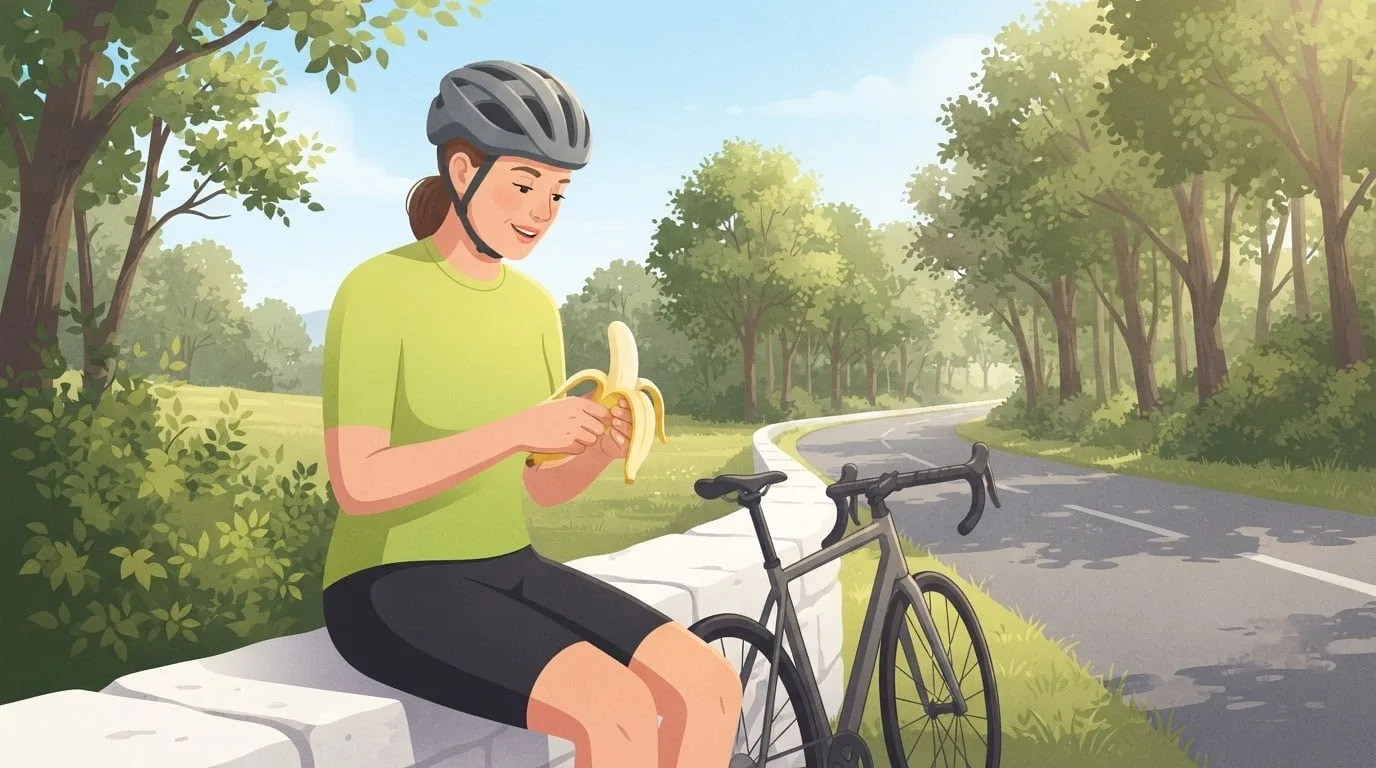
So a banana can stand in for a sports drink on a long ride, if your stomach tolerates the bulk. Jeukendrup (2014) recommends up to about 60 grams of carbohydrate an hour for efforts of 2 to 3 hours, and only small amounts for sessions of 30 to 75 minutes. For a 30-minute dumbbell session, a banana is optional, and it helps most if you haven't eaten in hours. Our page on how long to wait after eating before a workout covers the timing, and what to eat before a workout lists options for each time window.
Do bananas stop muscle cramps?
Bananas probably won't stop a cramp. Miller (2012) gave nine men 150 or 300 grams of banana after an hour of cycling in the heat. The larger dose raised blood potassium by just 0.16 mmol/L after 30 minutes and 0.3 mmol/L after 60 minutes, and every reading stayed in the normal range. The author concluded that bananas are unlikely to relieve cramps, because the rise is small and slow.
What This Means for You
Log a medium banana as 105 calories, and use the table when yours is clearly bigger or smaller. For more precision, weigh it peeled and use 89 per 100 grams.
A banana is an easy 27 grams of carbs before a hard session or on a ride of two hours or more. After training, it works best next to a protein food such as yogurt or eggs.
What decides your results is how often you train, and that's where most plans slip. Sarah, 27, lost 18 pounds in three months, and she put it this way: "First app that made exercise feel like something I chose, not forced." If sticking with it is your hard part, our roundup of the best workout apps for weight loss compares the apps built to keep you training. In FitCraft, a 3D AI coach demonstrates each bodyweight and dumbbell exercise and says your name while you train, your workouts adjust as you progress, and streaks, leaderboards and a new seasonal quest every month give you a reason to come back.
Frequently Asked Questions
How many bananas a day is good for you?
One or two bananas a day is a sensible amount for most healthy adults, and no official limit exists. Two medium bananas add about 845 milligrams of potassium, or 18 percent of the Daily Value, so ask your doctor first if you have kidney disease.
Are bananas good for digestion?
Yes, for most people. A medium banana has about 3 grams of fiber, about 11 percent of the Daily Value. Greener bananas also carry resistant starch, which passes through the small intestine undigested and reaches the colon.
Is there a downside to eating bananas?
For most people, no, but a few groups should take care. People with chronic kidney disease may need to limit bananas, because MedlinePlus lists them among the higher-potassium fruits. People with diabetes should count a banana's 27 grams of carbs, and some people with a latex allergy also react to bananas, a link known as latex-fruit syndrome.
Are bananas good for pregnancy?
Yes, for most people. MedlinePlus suggests 3 to 4 servings of fruit a day in pregnancy, and a banana is an easy one. It's a weak folate source at about 6 percent of the Daily Value, so keep taking your prenatal vitamin, and if you have gestational diabetes, count its carbs with your care team.
Do dehydrated bananas have potassium?
Yes. Dehydrated banana has about 1,491 milligrams of potassium per 100 grams, roughly four times as much as fresh, because the water is gone. An ounce has about 423 milligrams, the same as a medium fresh banana.
Do bananas have sodium in them?
Bananas have hardly any sodium. A medium banana has about 1 milligram, so it adds almost nothing to your daily total.
How many calories are in banana bread?
A 60-gram slice of homemade banana bread has about 196 calories, 33 grams of carbs and 6 grams of fat in USDA data, close to double a medium banana. Slices from a bakery can differ a lot by recipe and size.