Most pull-up numbers you'll find online are guesses. A forum thread says 10 is average, an app blog says 12 is strong, and a gym poster says real athletes do 20. None of them shows where the number came from, so you can't tell whether your own count is good or not.
That uncertainty is a real problem if you're trying to train. You don't know whether 3 reps means you're behind or right on track, and it's easy to decide you're just not built for the bar. You probably are. You just need a fair yardstick.
So this page uses the studies that actually counted pull-ups in real groups of people, the fitness tests that set pass marks, and the plain physics of lifting your own body weight. You'll find how many pull ups the average man can do, what percent of women can do a pull up, why a 200 lb man shouldn't compare himself with a 150 lb one, what changes with age, and how to add reps from wherever you start.
How Many Pull Ups Is Good?
Push-ups have a published adult norm table by age and sex, and our push-up benchmark page walks through it. Pull-ups don't. No national survey has counted strict pull-ups in a representative sample of adults. What exists is a handful of well-measured samples and a few test standards, and they line up well enough to build a benchmark ladder.
The table below is our coaching read of that data. It assumes strict, dead-hang pull-ups with an overhand grip. Each band is anchored to a group that was actually tested, which you'll find in the sections that follow.
| Level | Men | Women | What the data says about this level |
|---|---|---|---|
| Starting point | 0 | 0 | Normal for untrained adults. The average college woman in one lab study couldn't do a single rep. |
| Beginner | 1 to 4 | 1 | You can lift your own body weight. For a woman, one clean rep already beats the typical untrained result. |
| Intermediate | 5 to 9 | 2 to 4 | Around the 8.7-rep average of male firefighters who could do at least one pull-up. |
| Strong | 10 to 15 | 5 to 7 | At or above the Navy SEAL screening minimum for men, which is listed as 8 to 10. |
| Advanced | 16 to 22 | 8 to 10 | Strength-trained men in a lab study averaged 15.9. Ten reps earned a maximum score for women in the Marine Corps 2017 tables. |
| Elite | 23 or more | 11 or more | The top of the Marine Corps fitness test scale for men, reached by few people outside of training for it. |
What counts as a strict pull-up
Rep counts only compare fairly when the rep is the same. The firefighter study used a typical protocol: an overhand grip about shoulder width, a start from fully straight elbows with the feet off the floor, the chin at least to the top of the bar, and no swinging, kicking or twisting. Test yourself the same way. Warm up with a few easy hangs or assisted reps, then do one all-out set and stop counting the first time your chin doesn't clear the bar.
Chin-ups, with the palms facing you, usually give a higher number. If your chin-ups run well ahead of your pull-ups, that's normal, and our pullups vs chinups guide explains the grip strength gap behind it. Kipping reps and half reps don't belong in the count at all.
How Many Pull Ups Can the Average Man Do?
Nobody knows the true national average, because no one has tested a representative sample of men. The best numbers come from groups of men who were tested carefully, and they give a clear picture.
- Firefighters: about 9. Merrigan, Burke, Fyock-Martin and Martin (2020) tested professional firefighters in the International Journal of Exercise Science. The 30 men, average age 36 and average body fat about 24%, did 8.7 strict pull-ups on average. Only men who could do at least one rep were included, so the average for all men is lower.
- Strength-trained men: about 16. In Sanchez-Moreno, Cornejo-Daza, Gonzalez-Badillo and Pareja-Blanco (2020), 29 strength-trained men weighing about 74 kg averaged 15.9 pull-ups to failure before their training block started.
- College men: a small margin over body weight. Johnson and colleagues (2009) found the maximum load 35 college men could pull for one rep. It averaged 1.16 times body weight, so a typical man could do a single rep with about a sixth of his body weight added. That margin is small, which is why many men who don't train their back manage only a few bodyweight reps.
Age pulls the number down too. In Martin, Lockie, Fyock-Martin and Clark (2024), a study of 1,361 firefighters from one large urban department, older firefighters did fewer pull-ups (r = -0.39), and the lower-fitness group also carried more body fat and less lean mass.
Put together, 5 to 10 strict reps is a fair estimate for an active man under 40. An untrained man, especially a heavier one, often starts at 0 to 3. Ten or more puts you in the strong group of men who train.
What Percent of Women Can Do a Pull Up?
There's no measured national percentage for women either. Every study that has looked closely, though, points the same way: most untrained women can't do a strict pull-up yet, and the reason is physiology, not effort.
Start with upper-body strength. Miller, MacDougall, Tarnopolsky and Sale (1993) compared men and women in the European Journal of Applied Physiology and found the women were about 52% as strong as the men in the upper body but 66% as strong in the lower body. Women carry a smaller share of their lean tissue in the upper body, and the pull-up asks the arms and back to move the whole frame.
The Johnson study shows what that means on the bar. The 23 college women could pull a one-rep maximum of only 0.73 times their body weight on average. In other words, the average woman would have needed about a quarter of her weight taken off to finish one rep. The men in the same study averaged 1.16.
Training closes the gap, but it takes longer than most people expect. Flanagan, Vanderburgh, Borchers and Kohstall (2003) put college women who couldn't do a pull-up through a combined strength and aerobic program. Their upper-body strength and lean mass went up and their body fat went down. The women who succeeded had a higher strength-to-body-mass ratio and lower body fat. In 2012 news coverage of the study, co-author Paul Vanderburgh reported that only 4 of the 17 women managed a pull-up after three months.
So if you're a woman, one strict pull-up puts you ahead of the typical untrained result, 2 to 4 is solid, 5 or more is strong, and 8 or more is advanced. It's a slower skill to build than a push-up, and a 12-week block is often a starting phase rather than the finish line. Our first pull-up guide lays out a week-by-week plan from zero.
How Many Pullups Should a 200lb Man Be Able to Do?
No study sets a pull-up standard by body weight, but the research is clear about why weight matters so much. On every rep you lift almost your entire body. A heavier man needs more absolute strength just to match a lighter man's count.
Vanderburgh and Edmonds (1997) tested this directly in fit young men by adding known weights to them and counting their pull-ups. Their model predicted that a 10% increase in total mass from fat alone would cut pull-up performance by 53%. Ten percent more weight cost about half the reps. That's a far bigger penalty than most people would guess.
Extra muscle doesn't fully rescue you either. In Sanchez-Moreno, Pareja-Blanco, Diaz-Cueli and Gonzalez-Badillo (2016), a study of 25 trained male athletes, pull-ups fell as body mass rose (r = -0.55), and they fell as lean mass rose too (r = -0.51). Heavier men tended to be stronger on the lat pulldown machine, yet they did fewer pull-ups. Wood and Swain (2021) saw the same pattern in 333 Naval Special Warfare operators, where lighter operators did significantly better on the weighted pull-up.
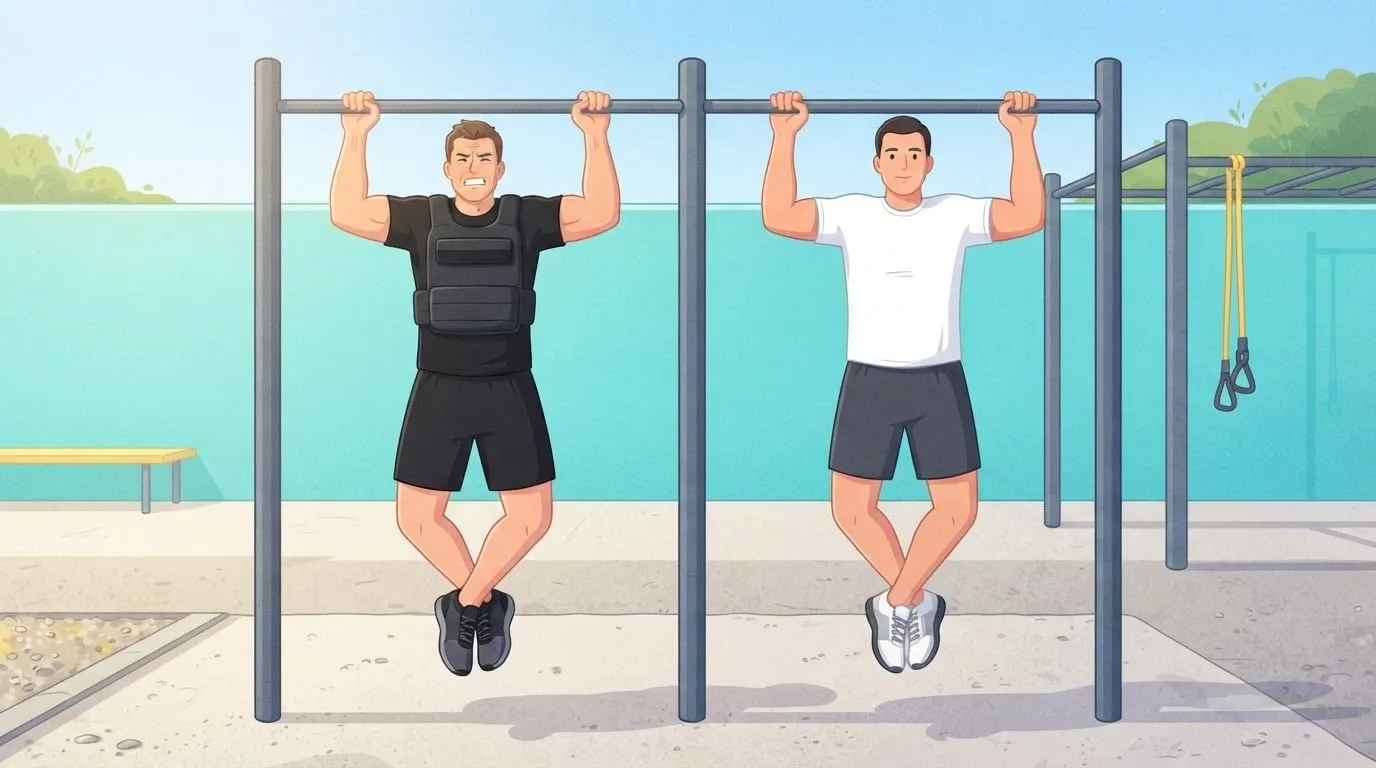
So what's a fair target at 200 lb? Five to 10 strict reps is a solid goal for a 200 lb man who trains, and 10 or more at that weight is genuinely strong. A fairer way to compare yourself with lighter people is to multiply your reps by your body weight. Halet, Mayhew, Murphy and Fanthorpe (2009) found that in 28 elite college swimmers, pull-ups times body mass predicted their one-rep max on the lat pulldown far better than the pull-up count alone (r = 0.86). The same swimmers did fewer pull-ups as their body mass rose (r = -0.48).
If you're carrying extra weight, both levers work. Building pulling strength raises your count, and losing fat raises it too, without any change in strength. Rows count toward that strength. A back workout at home with dumbbell rows trains the same lats and biceps on the days you're not on the bar.
Knowing what to do is the easy part.
FitCraft, our mobile fitness app, pairs you with an AI coach who builds you a personalized plan around your goals, schedule, and fitness level. Every FitCraft program is designed by Domenic Angelino, MPH (Brown University) and NSCA-CSCS, with research published in the Journal of Strength and Conditioning Research and Medicine & Science in Sports & Exercise.
Take the Free Assessment Free • 2 minutes • No credit cardWhat Do Military and Fitness Tests Ask For?
Military pull-up standards get quoted everywhere, so it helps to know what they are. Most are minimums for people about to train every day, not norms for the general public.
- Marine Corps Initial Strength Test. To start recruit training, candidates need as few as 2 or 3 pull-ups depending on the job they're headed for, according to military.com's summary of the test.
- Marine Corps Physical Fitness Test. Under the 2017 tables, men needed 18 to 23 dead-hang pull-ups for a maximum score and women 3 to 10, depending on age group, as military.com reported in 2017. Push-ups are allowed instead, but a perfect score needs pull-ups. The tables have been revised since, so check current Marine Corps orders before you train for a specific number.
- Navy SEAL Physical Screening Test. The published minimum is 8 to 10 pull-ups, depending on which version of the standard you read, and competitive candidates aim for 15 to 20.
- School fitness tests. The FitnessGram battery and the 2012 NHANES National Youth Fitness Survey use a modified pull-up instead of a full one: the student lies under a low bar with the heels on the floor and pulls the chest up to a band hung 8 inches below it.
Raising a standard fast has a cost. When the Marine Corps increased its pull-up requirements in 2017, McNeal and colleagues (2026) found in Military Medicine that upper-body musculoskeletal injury rates among male Marines, which had been falling, stopped falling, and rose steadily among Marines under 20. The study can't prove the pull-up change caused it, but the lesson for a home trainee is simple: add pull-up volume gradually.
How Many Pull Ups Should I Be Able to Do by Age?
There's no adult table by age, but the data does show how the number moves across a lifetime.
Teens (14, 15 and 16)
No national survey has counted full pull-ups in teenagers. The closest is Ervin, Fryar, Wang, Miller and Ogden (2014) in Pediatrics, which reported the modified pull-up results of 1,224 US children aged 6 to 15. Boys' scores climbed steeply with age, to a median of about 10 modified reps at 14 and 15. Girls' scores didn't rise with age, and the median at 13 to 15 was only 1 to 2. Weight status made a large difference: 64% of normal-weight boys did at least 5 modified pull-ups compared with 27% of boys with obesity, and 48% of normal-weight girls compared with 4% of girls with obesity.
For a full pull-up, that suggests a few strict reps is a good result for a teenage boy who doesn't train, and one strict rep puts a teenage girl well ahead of her peers. Teens who train can go much further, with supervision and sensible progression.
Adults from 20 to 60 and beyond
The Marine Corps tables lower the maximum-score number for older age groups, and the firefighter data shows the same slow decline. That decline isn't fixed. A 50 year old who trains pull-ups twice a week will beat most untrained 25 year olds. After 60, hanging and pulling your full body weight isn't the right test for everyone. Assisted pull-ups and rows build the same muscles with a load you can choose, and the medical note at the end of this page applies.

Why Does Your Pull-Up Number Matter?
Strength tests predict long-term health, and the large cohort studies behind that claim used push-ups, grip and leg strength. Our push-up norms page covers that evidence. No comparable cohort has followed pull-up counts. What the pull-up adds is a test of strength relative to body weight, which is exactly the quality that drops first when weight goes up and training stops. The Ervin survey made that point in children: heavier weight status hurt every test that involved lifting the body and helped the tests that didn't.
How Do I Train Pull-Ups?
If you can't do one yet, start with hangs, top holds, slow negatives and assisted reps. The 12-week first pull-up plan covers each step, and most people get their first rep sooner with chin-ups. Once you can do a few, the research on trained pullers gives you a clear rule.
Stop each set while the reps are still quick. In the 2020 Sanchez-Moreno study, 29 trained men did 16 pull-up sessions over 8 weeks, twice a week. One group ended every set once rep speed had dropped by 25%, and the other kept going until it dropped by 50%, much closer to failure. The 25% group gained more strength and more pull-up speed, while the 50% group didn't improve significantly. In practice, a 25% slowdown leaves several reps in the tank. An earlier study from the same lab, Sanchez-Moreno and colleagues (2017), saw max pull-up reps rise 15% after 12 weeks of training.
| Your current max | Each session | Sessions per week |
|---|---|---|
| 1 to 3 | 6 to 8 single reps with 1 to 2 minutes of rest, plus your assisted work | 2 to 3 |
| 4 to 6 | 5 sets of 2 to 3 reps | 2 to 3 |
| 7 to 10 | 4 to 5 sets of 4 to 5 reps | 2 to 3 |
| 11 to 15 | 4 sets of 6 to 7 reps | 2 |
| 16 or more | 4 sets of 8, or add a weighted vest or a slow 3-second lowering | 2 |
Add a rep to one set each week, retest your max every 4 weeks and move up a row when your max does. If you like practicing more often, greasing the groove spreads easy sets through the day. Keep them at about half your max and take a day or two off each week.
The plan only works if the sessions happen, and that's where most pull-up goals stall. If you want your strength days planned and kept on the calendar, FitCraft is a bodyweight workout app for home: its strength workouts use bodyweight and dumbbells, an AI coach demonstrates each exercise on an interactive 3D model, workouts adjust as you progress, and streaks and leaderboards keep you coming back.
What This Means for You
Your pull-up number isn't a verdict on you. It's a ratio of pulling strength to body weight, and both sides of that ratio move with training. If you're a man at 3 reps or a woman at zero, you're where most untrained adults start, not behind.
Pick the next band in the table, not the last one. One rep becomes three, three becomes five, and somewhere around there the bar stops feeling like a test and starts feeling like a tool. As one FitCraft user, Katie, put it: "I've tried everything. This is the first time I've stuck with something past two weeks." That's the part that decides your number in six months.
Frequently Asked Questions
How many pull-ups can an average person do?
No national survey has counted strict pull-ups in a representative sample of adults, so there's no true average. The samples that exist point to about 5 to 10 strict reps for active men: 30 male firefighters averaged 8.7, and strength-trained men in a lab study averaged 15.9. For untrained women the typical number is zero, because the average college woman in one study couldn't lift her own body weight once.
How many pull ups should I do a day?
Most people add reps fastest by training pull-ups on 2 or 3 days a week rather than every day. In an 8-week study, 2 sessions a week of sets that stopped while the reps were still quick improved strength and endurance, while sets pushed much closer to failure produced no significant gains. If you like daily practice, do a few easy sets of about half your max spread through the day, never near failure, and take 1 or 2 days off each week.
What happens if I do 100 pull-ups a day?
For most people, 100 strict pull-ups a day means 10 to 20 sets with no recovery days, which loads the elbows and shoulders far faster than the tendons adapt. Your reps may climb for a few weeks, but elbow pain is a common way these challenges end. Build up to a high daily total over several weeks, keep every set well short of failure, take days off, and stop at any joint pain.
How rare are 10 pull-ups?
For a man, 10 strict pull-ups is above the 8.7-rep average of the male firefighters in one study and meets the top of the published Navy SEAL screening minimum, so it's a strong number but not rare among men who train. For a woman, 10 strict pull-ups is rare: in the Marine Corps 2017 fitness tables, 10 earned a maximum score in the most demanding female age group.
Is it true that 70% of men can't do pull-ups?
No published study supports that exact figure. Nobody has tested strict pull-ups in a nationally representative sample of men, so the true share is unknown. Men who train usually can do several, while untrained and heavier men often can't do one, because every rep lifts nearly the whole body and extra mass cuts reps sharply.
How many pull-ups per day to gain muscle?
Muscle growth follows hard weekly sets, not a daily rep total. A 2017 meta-analysis (Schoenfeld, Ogborn and Krieger) found that 10 or more hard sets per muscle per week built more muscle than fewer than 5. For your back and biceps, that could be 3 or 4 sets of pull-ups or chin-ups on 2 or 3 days a week, with rows counted toward the total.
How many pull ups should I be able to do for a muscle up?
Coaches usually want to see about 8 to 10 strict pull-ups, a few chest-to-bar pull-ups and solid straight-bar dips before a first muscle-up. That's a coaching rule of thumb, not a tested threshold. No study has measured what percent of people can do a muscle-up either.