You stretch when something feels tight. Some weeks that means every day, and some weeks it means not at all. Or you started a morning routine, kept it going for ten days, and let it slide because nothing seemed to change.
That's frustrating, and it isn't a willpower problem. Most stretching advice tells you which stretches to do and almost never says how often, what happens if you skip a week, or whether a second session in the evening helps. Without those answers, a routine feels like guesswork, and guesswork is easy to quit.
Below are the answers the research supports: how often to stretch for each goal, how many times a day, how many minutes, whether stretching every day is good for you, how little you can do once you have the range you want, and a simple schedule for beginners at home.
How Often to Stretch for Each Goal
The right frequency depends on what you want stretching to do for you. The table gives the answer for each goal, and the evidence for each row follows.
| Your goal | How often | What a session looks like |
|---|---|---|
| Stay flexible for everyday health | At least 2 to 3 days a week | One stretch for each major muscle group, about 60 seconds in total per stretch |
| Gain flexibility in a tight area | 5 to 7 days a week | A few minutes on your two or three stiffest areas |
| Fit it into a busy week | 3 days a week, twice on each day | A short morning session and a short evening session |
| Keep range you've already built | 2 to 3 days a week | The same stretches on fewer days |
| Ease stiffness from desk work | Twice a day on workdays | Neck, chest, shoulder and hip stretches at your desk |
The baseline comes from the American College of Sports Medicine's 2011 position stand by Garber and colleagues. It recommends flexibility exercises for each major muscle-tendon group at least two or three days a week, adding up to about 60 seconds of stretching per exercise, and it notes that stretching works best when your muscles are warm. Treat that as the minimum. Trials that compared schedules generally found more range with more weekly sessions, as the next sections show. A second or third session on the same day added little once people were already stretching most days.
Two related questions have their own pages. How long to hold each stretch is covered with the trial data in our guide to post-workout stretches. And our science review of static vs dynamic stretching explains why moving stretches suit a warm-up while long holds belong after training.
How Many Times a Day Should You Stretch?
Once a day is enough for most people. A second short session helps if you only stretch on a few days a week, and a third adds little.
The clearest test is a hamstring trial from 1997. Bandy, Irion and Briggler put 93 adults aged 21 to 39 with tight hamstrings on a six-week program, five days a week. Some groups stretched once a day and others three times a day. At the end, the three-a-day groups had gained no more knee range than the once-a-day groups.
A second daily session matters more when you stretch on fewer days. In a 2012 trial by Cipriani and colleagues, 53 adults stretched their hamstrings for four weeks, either daily or three days a week, and either once or twice on each of those days. People who logged six or more sessions a week gained more hip range than people who did three, 24 percent against 16.8 percent. The authors concluded that three days a week worked about as well as daily stretching, as long as people stretched twice on each of those days.
So match the sessions to your week. If you stretch every day, once is plenty. If you can only manage three days, split each of them into two short sessions, such as one after you wake up and one in the evening. Stretching three times a day is safe at a gentle intensity, but the same minutes spread across more days are likely to do more for you.
How Long Should You Stretch Each Day?
For most people, 5 to 10 minutes a day covers the major muscle groups, and 1 to 2 minutes is enough for any single tight area.
Those numbers come from the weekly budget. A review of 23 long-term studies by Thomas and colleagues (2018) found clear gains once people stretched a muscle group for at least 5 minutes a week. A meta-regression of 189 studies by Ingram and colleagues (2025) found the returns flatten at around 10 minutes a week per muscle group. Our guide on how to become more flexible turns that budget into a full plan, joint by joint.
Divide 5 to 10 minutes by five stretching days and you get 1 to 2 minutes per muscle group per day. Pick five areas, such as your calves, hamstrings, hip flexors, chest and upper back, and a full routine at that dose takes 5 to 10 minutes.
Not every analysis finds that more frequent stretching wins. A 2024 meta-analysis by Konrad and colleagues, covering 77 studies and 3,870 participants, found that neither weekly frequency nor total stretching time changed how much range people gained. Every schedule in those trials worked to some degree. The practical reading is that extra sessions tend to help a little, but a routine you keep for months beats an ideal one you drop in week two.
If one area stays tight however often you stretch it, the dose may not be the problem. For the back of the thigh, our best stretches for hamstrings guide starts with a 15-second test that shows whether nerve tension, rather than muscle length, is holding you back.
Is It Good to Stretch Every Day?
Yes. For most healthy adults, stretching every day is safe and is usually the quickest way to gain range, as long as you ease into each position and stop at a comfortable pull. In the Cipriani trial above, the groups with more weekly sessions gained more.
Daily stretching may also help your blood vessels. In a trial by Bisconti and colleagues (2020), 39 healthy adults did 12 weeks of regular passive stretching of the thigh and calf muscles, on one leg or both, or no stretching at all. In the stretching groups, blood flow and artery function improved in both the legs and the arms, arterial stiffness fell, and blood pressure dropped slightly, by about 4 percent systolic and 8 percent diastolic. The control group didn't change. Some of the improvements faded within six weeks of stopping.
A second trial compared stretching with walking. Ko and colleagues (2021) randomly assigned 40 adults, average age 61, with high-normal blood pressure or stage 1 hypertension to 30 minutes of whole-body stretching or brisk walking, five days a week for eight weeks. Blood pressure fell more in the stretching group, while the walkers lost more fat around the waist. Both trials are small, so treat stretching as a useful addition to cardio, not a replacement for it.
There are times to skip the daily habit. Don't stretch a freshly strained muscle, and go easy if your joints are already very loose or a stretch brings on sharp pain, tingling or numbness. Our page on whether you can stretch too much covers the warning signs and who should hold back.
Knowing what to do is the easy part.
FitCraft, our mobile fitness app, pairs you with an AI coach who builds you a personalized plan around your goals, schedule, and fitness level. Every FitCraft program is designed by Domenic Angelino, MPH (Brown University) and NSCA-CSCS, with research published in the Journal of Strength and Conditioning Research and Medicine & Science in Sports & Exercise.
Take the Free Assessment Free • 2 minutes • No credit cardHow Often to Stretch to Keep Your Flexibility
Two or three days a week is usually enough to keep the range you've built. Stop completely, and most of it fades within about a month.
Willy and colleagues (2001) showed how quickly it goes. Eighteen inactive college students stretched their hamstrings twice a day, five days a week, for six weeks, and their knee range rose from 143 to 152 degrees. Four weeks after they stopped, it was back to 145. When they started again, they regained the range but went no further than the first time.
Cutting back works better than stopping. In a trial by Rancour, Holmes and Cipriani (2009), 32 adults stretched their hamstrings daily for four weeks. Then 18 of them dropped to two or three days a week and 14 stopped. Over the next four weeks the cut-back group held its range, while the group that stopped lost about 7 degrees.
An older trial suggests the maintenance dose can be smaller still. Wallin and colleagues (1985) trained 47 men, most of them with contract-relax stretching, where you briefly tense the muscle before easing deeper. After a month of sessions three times a week, one session a week was enough to keep the improved flexibility, while three to five sessions a week kept improving it. Results vary between studies, though. In the 2012 Cipriani trial, people still kept a significant part of their gains four weeks after they stopped.
Think of it in two phases. Build range with frequent sessions, then keep at least two or three a week to hold it.
How Often Should You Stretch If You Sit All Day?
If you sit for work, aim for a short stretching break twice a day on workdays. That's the schedule one trial in office workers tested, and it eased their neck and shoulder pain.
Tunwattanapong and colleagues (2016) recruited 96 office workers who'd had moderate to severe neck pain for at least three months. Everyone got an ergonomics leaflet, and half also did neck and shoulder stretches twice a day, five days a week. After four weeks, the stretching group had less neck and shoulder pain, better neck function and a better quality of life than the leaflet-only group.
Stiffness also follows the clock. Manire and colleagues (2010) measured 67 college students every two hours from the moment they woke up. Hamstring and lower back flexibility were lowest on waking and improved through the day, with the hamstrings loosest about 12 hours later. That's why the same stretch feels harder at 7 a.m. than after work. Ease into morning stretches more slowly, and don't judge your progress by how stiff you feel when you first get up.
A desk break routine that takes about three minutes:
- Neck side bend: sit tall and tip one ear toward your shoulder for a few slow breaths, then switch sides.
- Doorway chest stretch: rest your forearms on a door frame and step through until the front of your chest opens.
- Seated figure-four: cross one ankle over the other knee and lean forward with a long back to stretch the outer hip.
- Standing hip flexor stretch: take a long step back, tuck your tailbone and press the back hip forward.
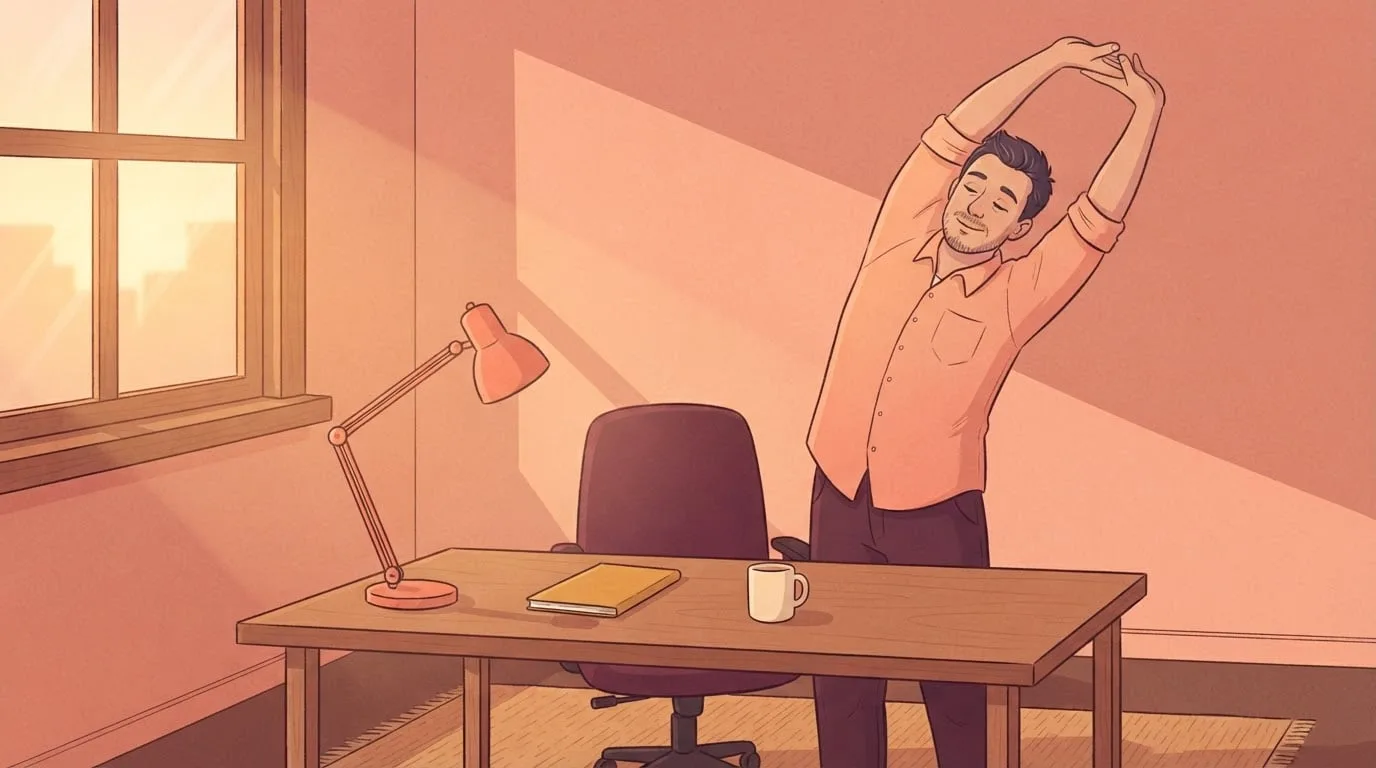
- Standing side reach: interlace your fingers overhead and lean slowly to each side.
A Simple Stretching Schedule for Beginners at Home
If you're starting from nothing, build the habit first and the dose second. This plan needs nothing more than a towel and a doorway, and it tops out at about 10 minutes a day.
| Weeks | How often | What to do |
|---|---|---|
| 1 and 2 | 3 days a week, twice a day | 3 or 4 stretches for your stiffest areas, about 3 minutes per session |
| 3 and 4 | 5 days a week, once a day | Add one or two areas, about 5 to 7 minutes per session |
| 5 to 8 | 5 to 7 days a week | A full routine of five or six areas, about 10 minutes |
| After week 8 | At least 2 to 3 days a week | The same routine to hold your range, or keep going daily to build more |
Attach the routine to something you already do every day, such as your morning coffee, a walk or an evening shower, so it doesn't depend on remembering. Your muscles will be warmer after a walk or a shower, which makes the stretches feel easier.
If you'd rather follow a plan than write one, a home workout app with no equipment will lay it out for you. FitCraft's workouts cover yoga and mobility as well as strength and cardio, a 3D AI coach demonstrates each move, and streaks and calendar tracking show how many days you've shown up.
What This Means for You
The answer to how often you should stretch is simpler than the advice you've probably heard. A few minutes on most days, at a comfortable pull, is what the trials that produced real gains asked people to do. Two short sessions on three days works if your week is crowded. And once you're happy with your range, two or three days a week keeps it.
The hardest part is building the habit. Picture a month from now: your first steps out of bed feel smoother, reaching into the back seat no longer needs a twist, and the stretch that used to feel like a fight is just part of your morning. Katie, a FitCraft user, described the change in her own words: "I've tried everything. This is the first time I've stuck with something past two weeks."
Frequently Asked Questions
Is it good to stretch every day?
Yes. For most healthy adults, stretching every day is safe and tends to build flexibility fastest, as long as you stop at a mild, comfortable pull. The American College of Sports Medicine sets a minimum of two or three days a week, and a review of 23 long-term studies recommended five or more days a week for more range. Skip a day if a muscle is freshly strained or a stretch causes sharp pain, tingling or numbness.
Can I stretch 3 times a day?
You can, but you probably don't need to. In a 1997 trial of 93 adults, stretching the hamstrings three times a day produced no more range after six weeks than stretching once a day. If you only stretch on a few days a week, two short sessions on each of those days is a better use of the time.
Why are my muscles always tight even though I stretch them?
The feeling of tightness comes partly from your nervous system, so it can linger even while your range improves. Long hours of sitting and nerve tension can both keep a muscle feeling tight, and stretching only when you feel stiff is rarely often enough to change much. Stretch on a schedule for at least four weeks, add strength work through a full range of motion, and see a physical therapist if the tightness comes with pain, tingling or weakness.
How does stretching work?
Regular stretching mainly raises your tolerance to the stretch, so your nervous system lets you move further before it calls a halt. Over several weeks the muscle and tendon also become slightly less stiff. Both changes fade within weeks if you stop, which is why how often you stretch matters as much as which stretches you do.
Is there a downside to stretching?
For most people the main downside comes from pushing too hard, because forcing a stretch into sharp pain can strain a muscle or irritate a nerve. People with very loose joints, osteoporosis or a fresh muscle strain need a more careful plan. Gentle stretching, even every day, carries little risk for healthy adults.
What is the hardest muscle to stretch?
There's no official ranking, but muscles that cross two joints are the hardest to stretch well, because you have to position both joints at once. The hamstrings, the calf's gastrocnemius and the rectus femoris at the front of the thigh are the usual examples. The hamstrings are also the most studied, and nerve tension there is often mistaken for a short muscle.