You walked 18 holes, your watch shows 15,000 steps and your feet are tired. Then a friend tells you golf isn't real exercise. So is golf exercise or not, and should that round count?
The research gives a clearer answer than the clubhouse does, and it turns mostly on one choice: whether you walk or ride. A walking round counts as exercise by public health standards. It also leaves gaps, because golf does little for your strength and rarely pushes your heart hard. If you golf partly because gyms aren't your thing, those gaps are easier to fill than you'd think.
Below you'll find walking and cart numbers from field studies, calories per hour and per round, what the health research shows, how far to trust the longevity data, golf's downsides and a short home routine.
Does Golfing Count as a Workout?
Yes, walking a round of golf counts as a workout by public health standards. The CDC's adult guidelines ask for 150 minutes a week of moderate activity, plus muscle-strengthening work on at least 2 days. In a rapid review of 19 studies, half of the reported values for golf fell in the moderate band of 3 to 5.9 METs, and the authors called golf primarily moderate intensity. A MET is a multiple of the energy you use at rest. Rounds run 3.5 to 5 hours in the field studies below, so one walking round goes a long way toward those 150 minutes.
On the 2024 Compendium of Physical Activities, walking golf rates 4.3 to 4.5 METs. That's a little below a brisk walk at 4.8 and well below a Zumba class at 6.5. Our pages on whether walking counts as exercise, whether Zumba is a good workout and whether barre is a good workout put those activities through the same test.
Effort per minute is the catch. In a crossover study of 25 regular golfers aged about 68, heart rate averaged 110 beats a minute during 18 holes and 121 on a 6 km walk, and the authors rated golf as low to moderate intensity. Golf was gentler per minute, but it lasted about 3.5 times longer.
Is Golf Good Exercise With a Cart?
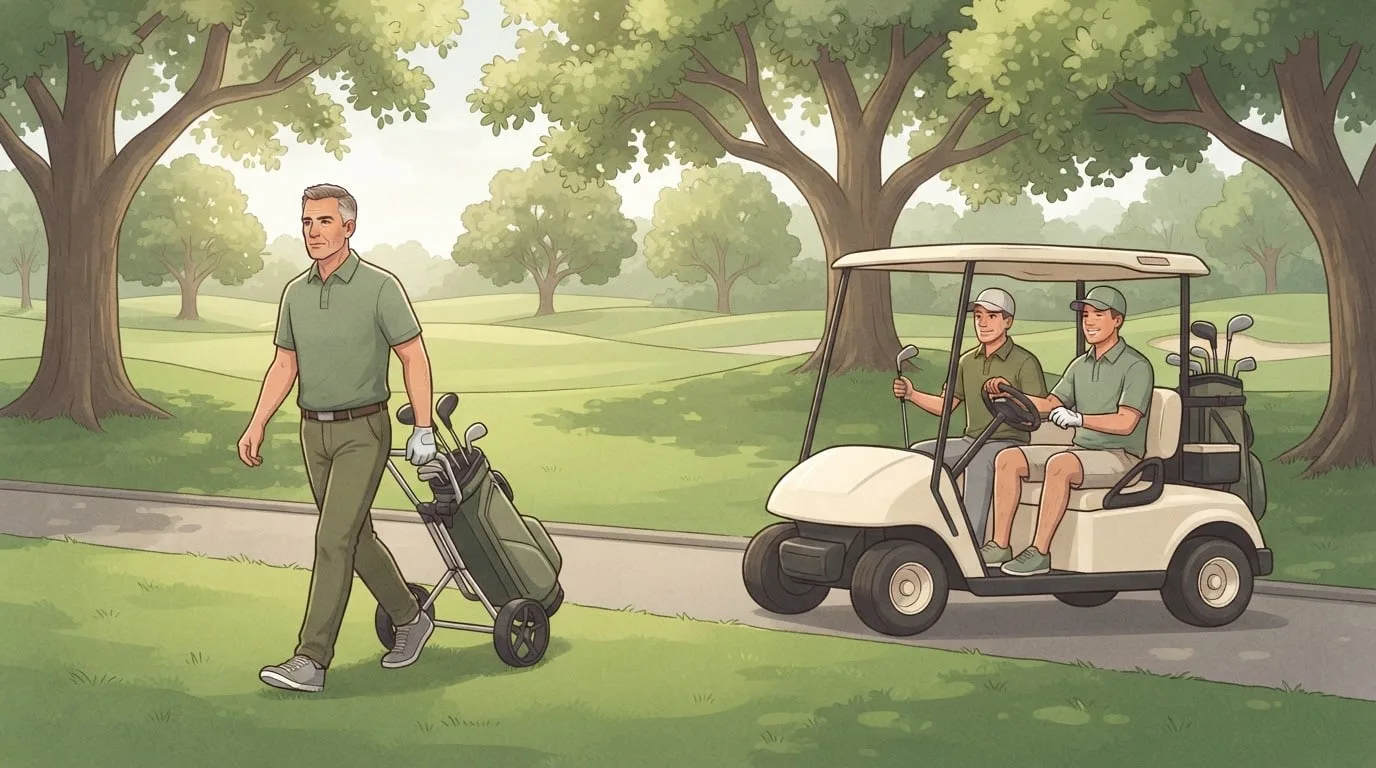
Golf with a cart still counts as activity, but riding removes much of the walking. In a 2025 randomized crossover study by O'Donnell and colleagues, 16 competitive male golfers played the same course twice, once walking with a caddie carrying the bag and once riding in a cart:
| Measure | Walking | Riding a cart |
|---|---|---|
| Steps | 17,007 | 6,274 |
| Active calories (above rest) | 880 | 456 |
| Average heart rate | 109 bpm | 94 bpm |
| Round time | 5 h 6 min | 5 h 5 min |
Riding cut steps by 63 percent and active calories by 48 percent. Clubhead speed and ball speed didn't differ between the two rounds. These were skilled players with an average age of 21 on a championship course, and golf organizations funded the study, so read it as one good test, not the final word.
Carrying your own bag adds more. An older study of male golfers, summarized in the 2017 review, found about 2 miles walked over 18 holes with a cart, 4 miles carrying clubs and 4.6 miles pulling them. Heart rates averaged 89, 113 and 103 beats a minute, and energy use was 5.2, 7.5 and 6.8 calories a minute. In the 2017 review, 18 holes on foot took 11,245 to 16,667 steps and 5.4 to 7 miles. Kobriger and colleagues (2006) counted 11,948 steps a round in 42 golfers, so most walkers clear 10,000 steps.
How Many Calories Does Golf Burn?
Walking golf burns about 300 to 440 calories an hour for most adults, and riding a cart or hitting balls at the range burns about 250 to 340. Those figures come from the 2024 Compendium:
| Body weight | Walking, carrying clubs (4.3 METs) | Walking, pulling clubs (4.5 METs) | Cart or driving range (3.5 METs) |
|---|---|---|---|
| 155 lb (70 kg) | 300 | 320 | 250 |
| 185 lb (84 kg) | 360 | 380 | 290 |
| 215 lb (98 kg) | 420 | 440 | 340 |
These are our calculations: METs times body weight in kilograms, rounded to the nearest 10. They include what your body would burn at rest.
Over a 4-hour walking round, that's about 1,440 calories at 185 pounds, or about 1,110 above resting. Measured rounds vary widely because methods differ. The 2025 cart study recorded 880 active calories over 5 hours with a chest monitor. The study of older golfers recorded 1,377 calories with a Fitbit, and its authors questioned the device's accuracy. The 2017 scoping review lists 531 to 2,467 calories for 18 holes. Claims of 2,000 calories or more sit near the top of that range, so don't plan around them.
Is Hitting 100 Golf Balls Good Exercise?
Hitting 100 golf balls is mild exercise, not a workout on its own. The Compendium rates the driving range at 3.5 METs, near the bottom of the moderate band and the same as riding a cart, which comes to about 5 calories a minute at 185 pounds. So calories burned at the driving range add up to about 220 in a 45-minute session. Each swing lasts a couple of seconds, and most of your time goes to standing and setting up. It's useful practice, but it won't replace walking a round.
Knowing what to do is the easy part.
FitCraft, our mobile fitness app, pairs you with an AI coach who builds you a personalized plan around your goals, schedule, and fitness level. Every FitCraft program is designed by Domenic Angelino, MPH (Brown University) and NSCA-CSCS, with research published in the Journal of Strength and Conditioning Research and Medicine & Science in Sports & Exercise.
Take the Free Assessment Free • 2 minutes • No credit cardWhat the Research Says About Golf and Health
The research points in a good direction, though much of it is weak. A 2017 scoping review by Murray and colleagues mapped 301 studies and linked golf with better cardiovascular, respiratory and metabolic profiles. Only 16 of those studies assessed health outcomes, and about two thirds of the primary studies were one-time snapshots, so the authors say they can't show cause and effect. The World Golf Foundation partly funded the review.
Two studies test golf more directly:
- A 20-week trial. Parkkari and colleagues (2000) compared 55 sedentary male golfers aged 48 to 64, encouraged to play 2 to 3 rounds a week, with 55 sedentary controls. The golfers lost 2.2 cm more from their waists and 1.4 kg more weight, raised their HDL cholesterol more and lasted 36 seconds longer on a treadmill walking test.
- A same-day comparison. In the crossover study of older golfers, systolic blood pressure fell after 18 holes, after a 6 km Nordic walk and after a 6 km walk, with no significant difference between them. Golf did better on HDL cholesterol, and better than the plain walk on blood glucose. Those markers were measured once, about 15 minutes after exercise.
A 2022 systematic review of 23 studies by Sorbie and colleagues reached a similar verdict. Golf may help musculoskeletal, cardiovascular and metabolic health, but the findings were mixed and most evidence showed no change in BMI.
Do Golfers Live Longer?
Golfers lived longer in the largest study, but golf may not be the whole reason. Farahmand and colleagues (2009) linked 300,818 Swedish Golf Federation members to national death records. Mortality was 40 percent lower than expected after adjusting for age, sex and socioeconomic status (standardized mortality ratio 0.60, 95% CI 0.57 to 0.64). The lowest handicaps had the lowest mortality, at 0.53 against 0.68 for the highest. The authors said a 40 percent reduction corresponds to about 5 extra years of life.
Treat that as encouraging, not as proof. Three things limit it:
- Who golfs. People choose to golf, and anyone too ill to play is unlikely to join a club. Researchers call this the healthy-user effect.
- What was adjusted. The abstract lists age, sex and socioeconomic status. It lists no adjustment for smoking, diet or other exercise.
- What the authors say. They couldn't conclude that physical activity from golf explains the whole drop, and the 2017 scoping review calls the link an association.
What Golf Doesn't Give You
Golf leaves two gaps: strength and hard cardio. The 2022 systematic review found similar grip strength in golfers and non-golfers, and a randomized trial saw no change in grip strength or walking speed after a golf program. So a round doesn't cover the CDC's 2 days of muscle-strengthening work.
On cardio, VO2 max, the standard measure of aerobic fitness, didn't change in the 20-week trial, though submaximal performance improved. The scoping review also notes that higher-intensity exercise produces bigger cardiovascular gains than golf.
Balance may be a bright spot. Most studies in the 2022 review favored golf, and older male golfers held a single-leg stance for 28.1 seconds against 17.1 seconds in controls. That was a small comparison, though, and the 20-week trial found no change in balance.
What Are the Downsides of Playing Golf?
The main downsides of playing golf are back and arm injuries, sun exposure and the time a round takes.
- Injuries. The scoping review puts injuries at 15.8 to 40.9 percent of amateurs a year. The lower back accounts for 18.3 to 36.4 percent of them, followed by the elbow, wrist and hand. If your back already bothers you, our guide to the best exercises for lower back pain is a good place to start.
- Sun. Five UV studies in the same review found exposure that puts golfers at higher skin cancer risk than non-golfers. Wear sunscreen and protective clothing, and use shade when you can.
- Time. A round took 3.5 hours for the older golfers and more than 5 hours in the tournament study, which makes two or three a week hard to fit in.
Is Golf Good Exercise for Seniors?
Yes, golf is good exercise for seniors, and the same round may work an older heart harder. The older golfers in the crossover study took 13,446 steps and walked 5.5 miles in about 3.5 hours. In one study summarized in the 2017 review, elderly men spent 70 percent of their round above 70 percent of maximum heart rate, though the review calls the evidence on age unclear. Golf also offers a reason to keep walking long distances every week. Older golfers still need strength work, since golf can't be counted on to supply it.
A Home Routine for Golfers
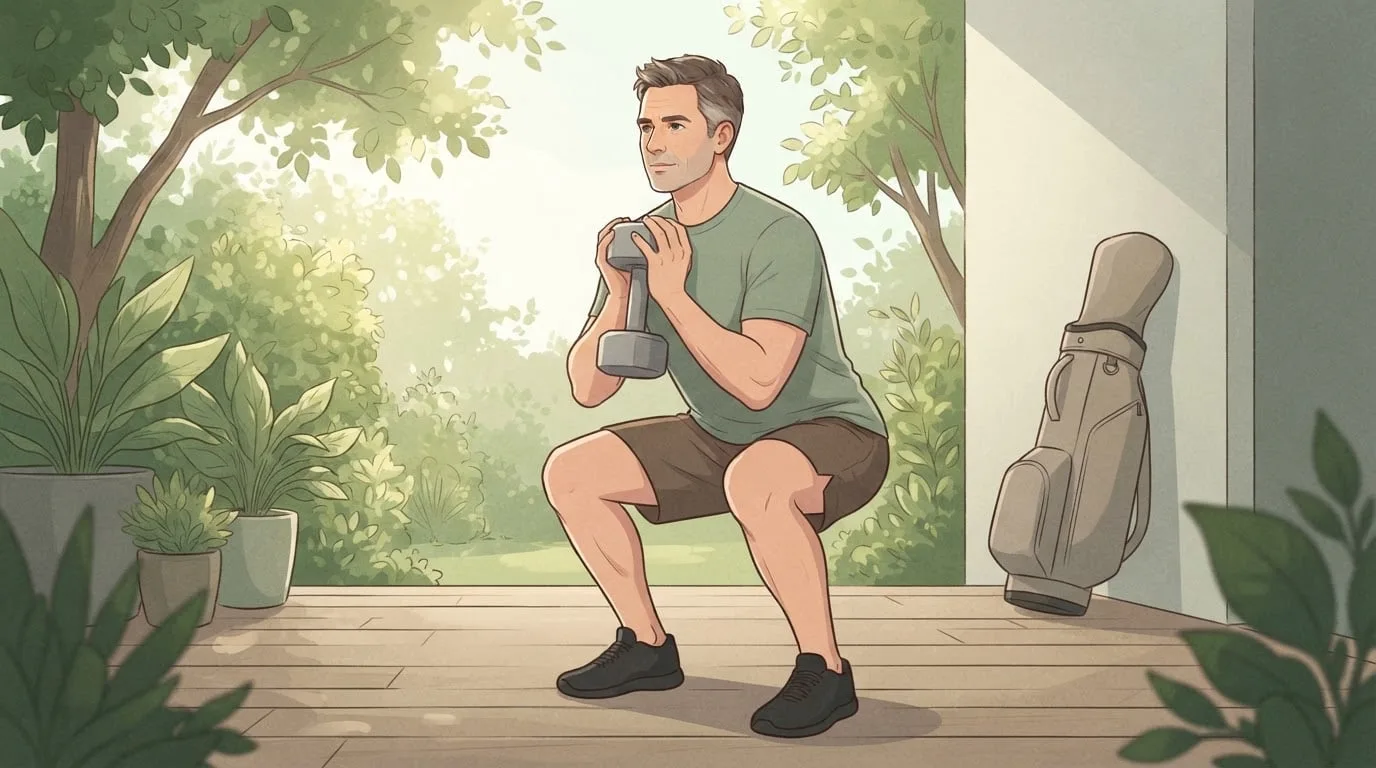
Two short strength sessions a week fill golf's biggest gap, and they may help your game too. In a 2026 meta-analysis of 33 studies and 798 golfers, physical training added about 1.05 m/s (2.3 mph) of clubhead speed and 9.3 meters (10 yards) of carry distance in controlled studies. The authors rated the certainty of that evidence as low.
This session uses a pair of dumbbells and your body weight and takes about 30 minutes. It covers your legs, hips, back, chest and the trunk muscles that resist bending. Treat it as a starting template, since it isn't a tested golf protocol.
| Exercise | Sets and reps | What it trains |
|---|---|---|
| Goblet squat | 3 x 8 to 12 | Legs and hips |
| Dumbbell Romanian deadlift | 3 x 8 to 12 | Hamstrings, glutes and lower back |
| One-arm dumbbell row | 3 x 8 to 12 per side | Upper back and arms |
| Push-up | 3 sets, stopping 2 reps short of failure | Chest, shoulders and triceps |
| Side lunge | 2 x 8 per side | Hips and side-to-side leg strength |
| Side plank | 2 x 20 to 30 seconds per side | Trunk and hips |
Warm up for 5 minutes first and leave at least a day between sessions. When you can hit the top of the rep range on every set, pick up a heavier dumbbell or add a rep. Stop any exercise that causes sharp pain, and start lighter if you have a history of back trouble.
What This Means for You
Keep playing, and walk whenever you can. Pulling or carrying your bag keeps most of the steps, and even a cart round moves you more than a day on the couch. Count a walking round toward your weekly minutes and stop worrying about whether it's real exercise.
Then close the gap with two short strength sessions. That's the part that tends to slide, especially if you've never liked gyms. It usually isn't a discipline problem. You just need something that keeps you going between rounds.
That's where a workout app for people who hate working out can help. In FitCraft, a 3D AI coach demonstrates each bodyweight and dumbbell exercise, says your name during the workout and adjusts your workouts as you progress. Streaks, collectible cards and a new seasonal quest every month give you a reason to open the app between rounds. As one FitCraft user, Matt, put it: "The real win is I actually want to work out now. That's never happened before."
Frequently Asked Questions
Is golf good exercise to lose weight?
Golf helps a little, mostly if you walk. In a 20-week trial, sedentary men encouraged to play 2 to 3 rounds a week lost 1.4 kg more than controls and 2.2 cm more from their waists. A 2022 systematic review found that most studies showed no change in BMI, so pair golf with strength work and changes to what you eat.
Is golf good for your back?
Golf can be hard on your back, because the lower back is its most common injury site in amateurs. In a review of 19 studies, older age and higher body mass went with more back pain, and novice golfers with past back pain had 9.8 times the relative risk of new pain. Swing mechanics showed no consistent link, so see a clinician about persistent pain before changing your swing.
Is swinging a golf club good exercise?
Swinging a club on its own is mild exercise. The 2024 Compendium rates the driving range at 3.5 METs, which is about 5 calories a minute for a 185-pound adult. Most of the exercise in a round comes from walking between shots, not from the swing.
Is 9 holes of golf good exercise?
Yes, if you walk it. Nine holes covers about 2.7 to 3.3 miles, and one study measured 512 total calories, about 310 above resting. That's a solid session, and it's easier to fit into a weekday than a full round.
How many steps is 18 holes of golf?
Walking 18 holes takes about 11,000 to 17,000 steps, depending on the course and the golfer. One study of 42 golfers on three courses averaged 11,948 steps, and young competitive golfers on a championship course averaged 17,007. Riding a cart dropped that second group to 6,274.